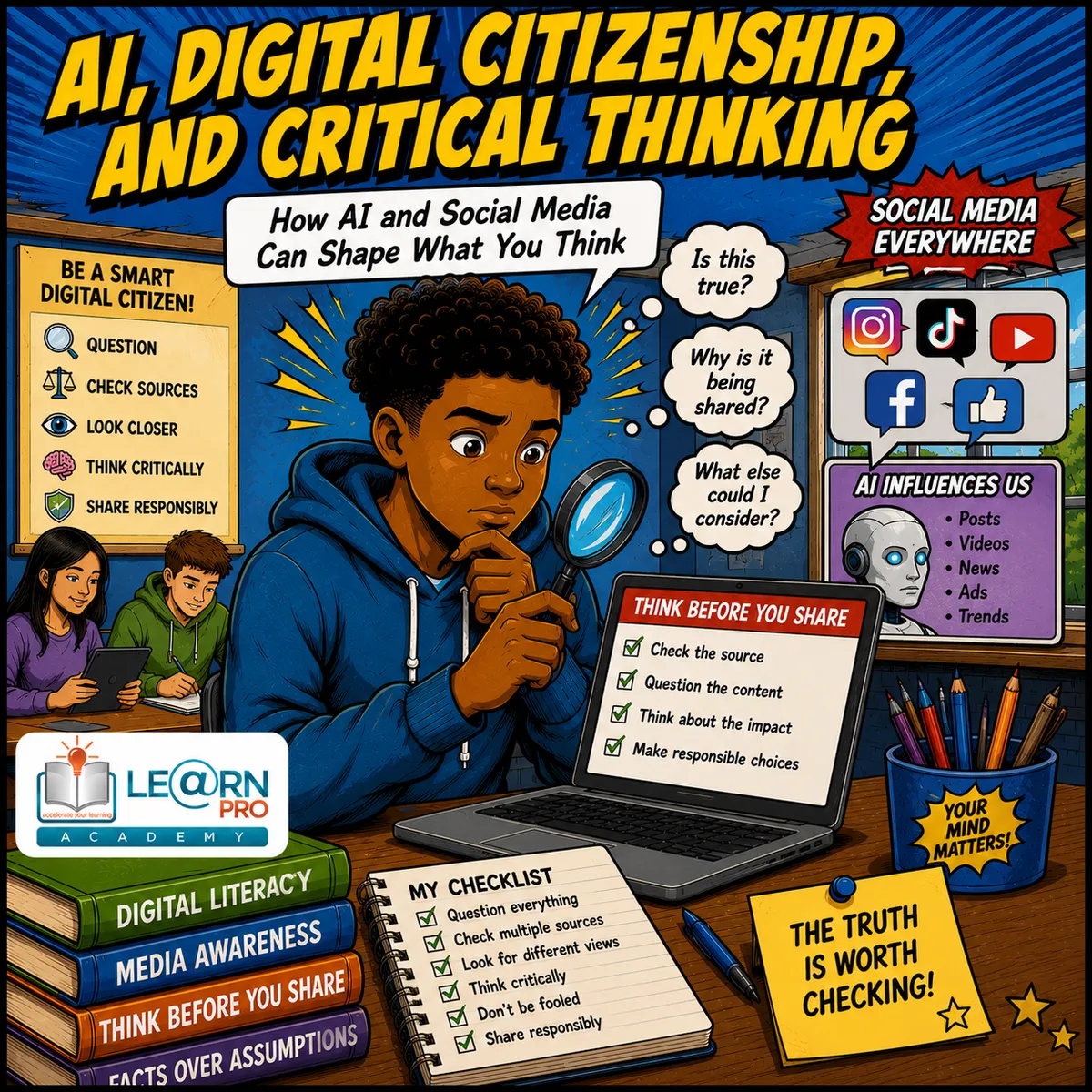
How AI and Social Media Can Shape What You Think
This is article #4 of 5 in the AI, Digital Citizenship, and Critical Thinking Series
Introduction
For many Grade 10–12 learners, social media is part of everyday life. You might use platforms to chat with friends, watch funny videos, follow your favourite sports teams, learn new skills, keep up with current events, or simply relax after school. Social media has become one of the main ways people discover information and connect with others.
But have you ever wondered why your social media feed looks different from someone else's?
Why do you keep seeing videos about football while your friend mostly sees fashion content? Why does one learner's feed focus on gaming while another sees study tips or cooking videos?
The answer is artificial intelligence (AI).
Social media platforms do not usually show everyone the same content. Instead, AI-powered algorithms study your online behaviour and decide what they think you are most likely to enjoy, click on, watch, comment on, or share.
Most of the time, this helps create a more personalised experience. However, it can also influence what you believe, how you spend your time, what opinions you hear, and even how you feel about yourself and others.
As a learner growing up in the digital age, understanding how AI shapes your online experience is an important part of digital literacy. It helps you stay in control of your own thinking instead of allowing technology to make too many decisions for you.
In this article, you will learn how AI-powered social media works, why algorithms show you certain content, how online recommendations can influence your opinions and behaviour, and how to use social media wisely while protecting your independent thinking.
What Is An Algorithm?
Before understanding how AI influences social media, you first need to understand the word algorithm.
An algorithm is simply a set of instructions that tells a computer how to solve a problem or make a decision. Think of it like a recipe. A recipe tells someone exactly how to bake a cake. An algorithm tells a computer exactly how to complete a task.
On social media, algorithms help decide:
which posts appear first,
which videos you see,
which advertisements you receive,
who is suggested as a friend,
which accounts are recommended,
which topics become popular.
Modern algorithms often use AI to become smarter over time.
How AI Learns About You
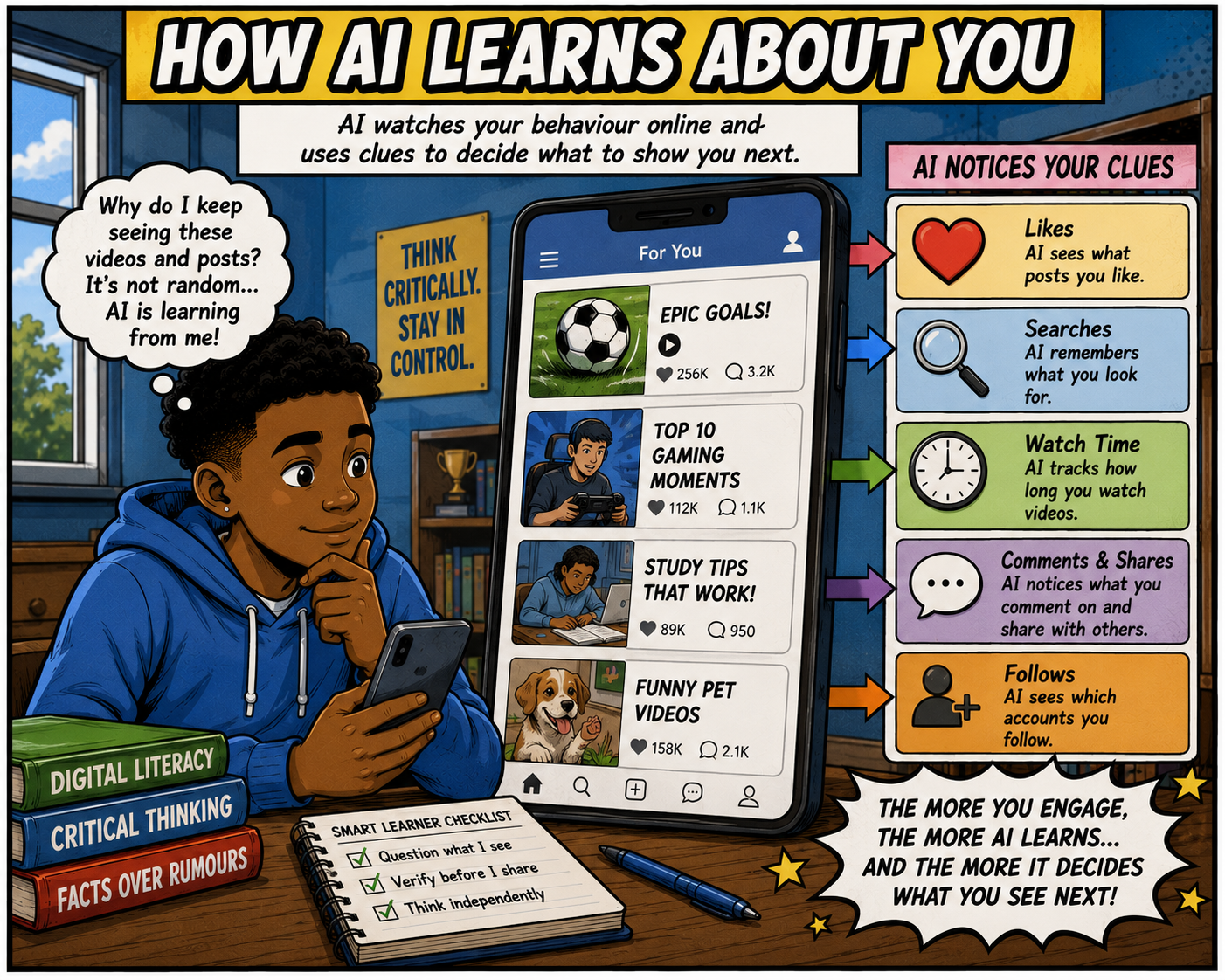
AI does not know you personally. Instead, it learns from your digital behaviour. Every time you use social media, you leave behind small clues about your interests.
The AI may notice:
which videos you watch until the end,
which posts you like,
which accounts you follow,
what you search for,
what you comment on,
what you share,
how long you spend reading a post,
which advertisements you click,
which topics you ignore.
Over time, AI builds a picture of what it believes interests you.
It then shows you more of the same.
Why Every Feed Looks Different
Have you ever compared your social media feed with a friend's? Even if you use the same platform, your feeds may look completely different. That is because AI creates a personalised experience for each user.
For example: Sipho watches rugby highlights.
Soon his feed is full of:
rugby news,
sports interviews,
training tips,
match analysis,
fitness videos.
Meanwhile, Aisha enjoys cooking videos.
Her feed becomes filled with:
recipes,
baking tutorials,
kitchen gadgets,
healthy meals,
restaurant reviews.
Neither feed is wrong.
They simply reflect different interests.
AI Wants To Keep Your Attention
Social media companies make money when people spend more time using their platforms. The longer users stay online, the more advertisements they see. Because of this, AI is designed to recommend content that keeps people watching.
It often chooses content that is:
entertaining,
emotional,
surprising,
funny,
exciting,
dramatic,
controversial,
highly engaging.
This does not necessarily mean the content is educational or balanced.
It simply means AI predicts that you are likely to continue watching.
Why Some Videos Keep Appearing
Have you ever watched one video about a topic and suddenly your entire feed seems filled with similar videos?
This happens because AI assumes:
"You watched one of these."
"So you will probably enjoy more."
Sometimes this is helpful. If you are revising Mathematics, AI may recommend more educational videos.
But sometimes it creates a very narrow online experience.
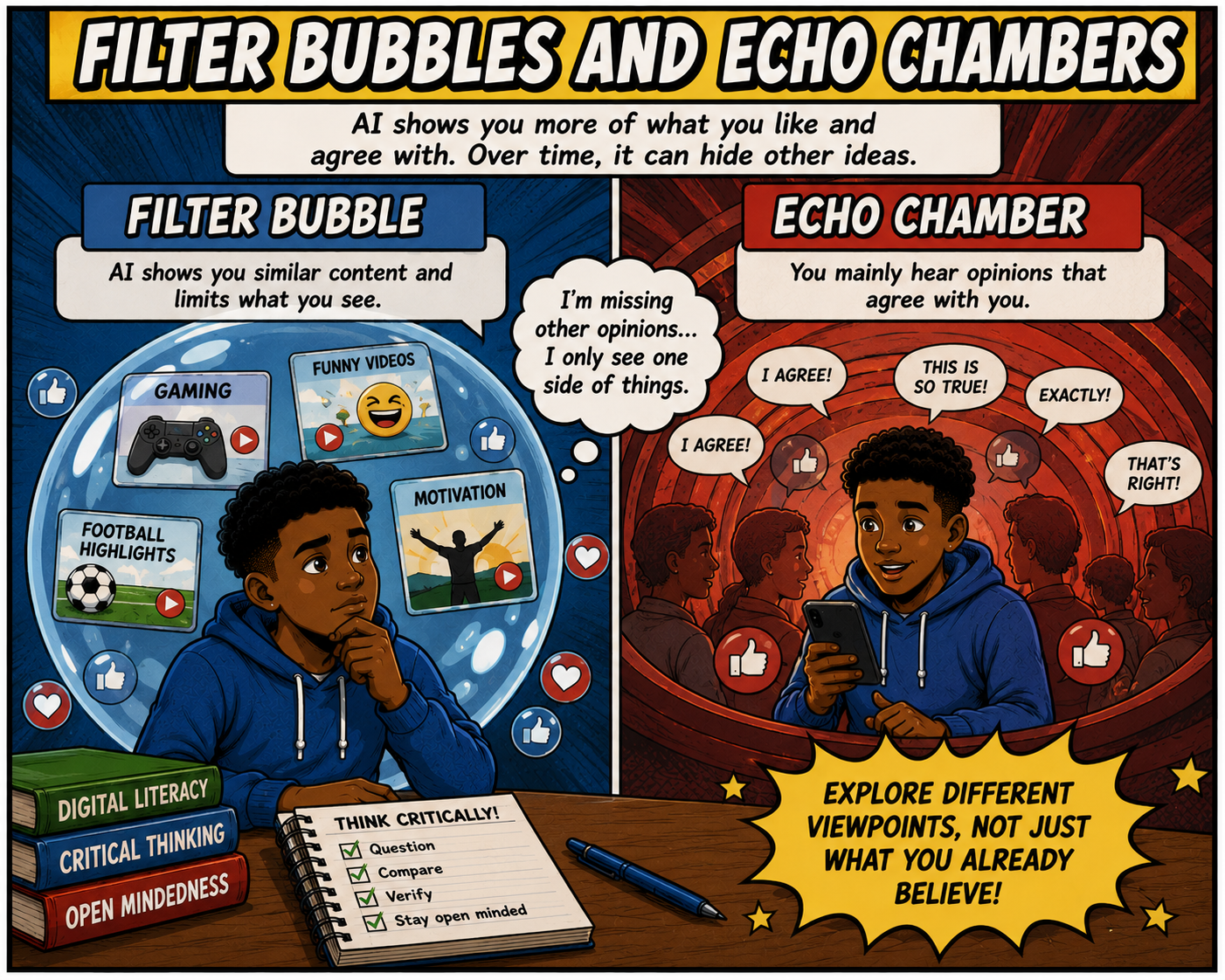
Filter Bubbles and Echo Chamber
What Is A Filter Bubble?
A filter bubble happens when AI repeatedly shows you information that matches your existing interests while hiding other viewpoints.
Imagine wearing glasses that only allow you to see one colour. Eventually, you may forget that other colours exist. Filter bubbles work in a similar way.
Instead of showing many different ideas, AI keeps recommending similar content. This limits your exposure to new perspectives.
What Is An Echo Chamber?
An echo chamber is an online environment where people mostly hear opinions that are similar to their own.
Imagine standing inside a cave. Every time you speak, your own voice echoes back. Online, something similar can happen.
You may:
follow people who agree with you,
receive AI recommendations that match your interests,
see comments supporting similar opinions,
rarely encounter different viewpoints.
Over time, it becomes easier to believe that everyone thinks the same way you do.
Why This Matters For Students
Learning is about exploring ideas.
Good education encourages learners to:
ask questions,
compare viewpoints,
evaluate evidence,
solve problems,
think independently.
If AI only shows you one side of every issue, your learning becomes less balanced.
Critical thinking requires exposure to different perspectives.
AI Can Influence Opinions
Most people believe they make decisions completely independently. However, repeated exposure to the same ideas can gradually influence opinions.
Suppose a learner watches many videos claiming: "This is the only correct way to study."
Even if other effective methods exist, repeatedly seeing the same message may make it feel unquestionably true.
This is why it is important to compare information instead of relying on one platform.
Emotional Content Gets More Attention
AI often notices which posts receive the most engagement. Unfortunately, emotional content usually performs well.
People are more likely to react to content that makes them feel:
excited,
angry,
shocked,
afraid,
surprised,
amused.
Because emotional posts generate more interaction, AI may recommend them more often.
This does not always mean they are the most accurate or helpful.
Viral Does Not Mean True
Many learners assume that if millions of people share something, it must be correct. That is not always true.
Posts become viral because people interact with them. AI measures popularity. It does not automatically measure truth.
False information can spread just as quickly as accurate information.
Sometimes it spreads even faster.
How Advertising Uses AI
Social media platforms also use AI to personalise advertisements. Instead of showing the same advert to everyone, AI predicts what each person might be interested in.
It considers factors like:
age,
interests,
previous searches,
shopping behaviour,
online activity.
This is why two people may receive completely different advertisements.
Understanding this helps learners recognise that advertising is carefully targeted.
Influencers And AI
Influencers create content that reaches large audiences. AI often recommends popular creators because many people interact with their posts. However, popularity does not automatically mean expertise.
Before accepting advice from influencers, ask:
Is this information accurate?
Do experts agree?
Is this sponsored content?
What evidence supports these claims?
Always separate popularity from credibility.
The Danger Of Endless Scrolling
AI is designed to keep suggesting new content. As soon as one video ends, another begins. This makes it easy to spend far more time online than planned.
Many learners have experienced saying: "I'll only watch one video." An hour later, they are still scrolling.
This is not simply a lack of self-control. The platform is specifically designed to encourage continued engagement.
Recognising this helps you make better decisions about your screen time.
Comparing Yourself To Others
AI often recommends content that receives many likes, shares, and comments. Unfortunately, this can sometimes create unrealistic expectations.
You may repeatedly see:
perfect holidays,
expensive clothes,
luxury cars,
flawless appearances,
constant success,
exciting lifestyles.
Remember that people usually share their highlights, not their everyday lives.
Comparing yourself to carefully selected online moments can damage self-confidence.
How AI Can Also Be Helpful
Not everything about AI-driven social media is negative. AI can recommend valuable content too.
For example, it can help you discover:
educational channels,
study techniques,
career advice,
university information,
coding tutorials,
science videos,
language lessons,
exam preparation tips.
The goal is not to avoid AI completely.
The goal is to use it wisely.
Training Your Algorithm
One interesting fact is that you also influence the AI. Every action you take teaches the algorithm something.
If you begin following educational content instead of only entertainment, your recommendations gradually change.
You can improve your feed by:
following educational creators,
watching study videos,
searching for useful topics,
hiding harmful content,
unfollowing negative accounts,
engaging with positive learning material.
In other words, you help train the algorithm.
Think Before You Click
Every click sends information to the AI.
Before opening sensational headlines, ask yourself:
Am I genuinely interested?
Is this reliable?
Am I simply curious because it is shocking?
Will clicking encourage more similar content?
Being intentional about your online behaviour helps you stay in control.
Ask Yourself Important Questions
Whenever you see content online, ask:
Why am I seeing this?
Who benefits if I believe this?
What evidence supports it?
Could there be another viewpoint?
Is this fact or opinion?
Is this trying to sell me something?
Am I seeing the whole picture?
These questions strengthen your critical thinking.
A Classroom Example
Imagine your Life Orientation teacher asks learners to research healthy eating.
One learner relies only on social media videos.
Another learner uses:
school textbooks,
scientific websites,
government health information,
AI summaries,
teacher guidance.
Which learner is more likely to produce balanced research? The second learner.
Using multiple reliable sources produces stronger understanding.
Digital Wellbeing Matters
Healthy technology use is not only about avoiding misinformation. It is also about protecting your wellbeing.
Good digital habits include:
limiting unnecessary scrolling,
taking regular breaks,
spending time offline,
exercising,
reading books,
talking to friends face-to-face,
getting enough sleep,
balancing entertainment with learning.
Technology should improve your life, not control it.
Building Independent Thinking
Perhaps the most important lesson is this: AI should help you think — not think for you.
Your education is about developing:
judgement,
reasoning,
curiosity,
creativity,
problem-solving,
independent decision-making.
Technology is a powerful assistant.
Your brain remains your greatest learning tool.
Becoming A Responsible Digital Citizen
Responsible learners understand that social media is carefully designed.
Instead of passively accepting every recommendation, they:
question what they see,
verify information,
explore different viewpoints,
control their screen time,
follow trustworthy sources,
avoid sharing misinformation,
use AI responsibly,
remain curious,
think independently.
These habits will serve you throughout school, university, your career, and everyday life.
Conclusion
Artificial intelligence has transformed social media into a highly personalised experience. Every like, search, comment, and video you watch helps AI decide what to show you next. While this can make social media more enjoyable and useful, it also means that technology can influence your attention, opinions, and behaviour in ways you may not always notice.
As a Grade 10–12 learner, understanding how AI-powered algorithms work gives you greater control over your online experience. Instead of allowing recommendations to shape your thinking automatically, you can choose to question information, explore different viewpoints, and use social media intentionally.
Remember that your feed is only one small part of the digital world. The most successful learners do not rely on one platform or one source of information. They compare ideas, verify facts, think critically, and remain open to learning from many different perspectives.
In the end, the smartest way to use AI and social media is to make sure they support your learning rather than control your thinking. Your curiosity, judgement, and ability to think independently will always be more powerful than any algorithm.
Additional Articles in the AI, Digital Citizenship, and Critical Thinking Series
How to Spot AI-Generated Misinformation Online
What Is AI Bias and Why Should Students Care?
Deepfakes, Fake Images, and Digital Truth: What Learners Need to Know
How AI and Social Media Can Shape What You Think
Thinking for Yourself in an AI World
Disclaimer
AI Tools were used to assist with research. Remember to always cross-check everything that you read.