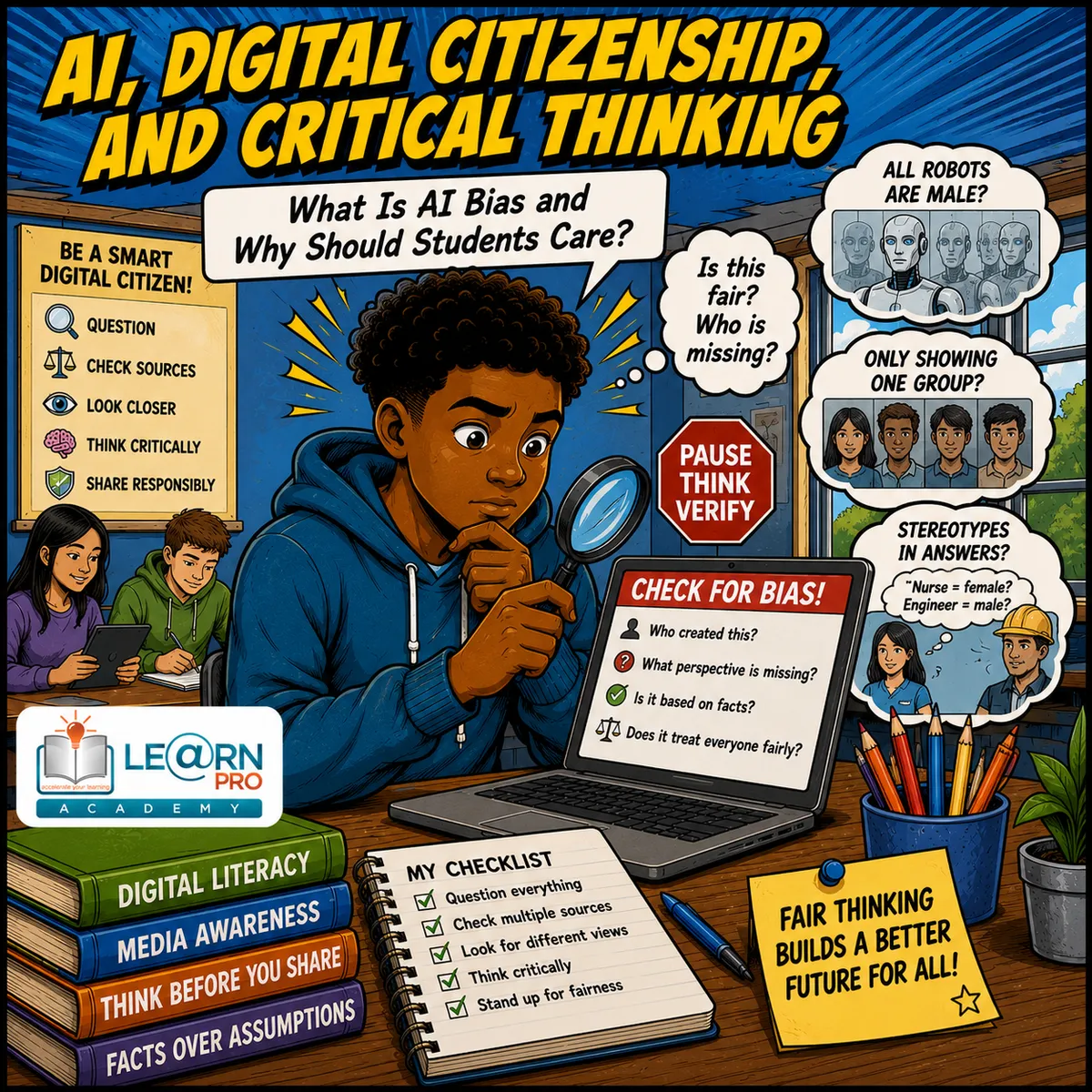
What Is AI Bias and Why Should Students Care?
This is article #2 of 5 in the AI, Digital Citizenship, and Critical Thinking Series
Introduction
Artificial intelligence (AI) has become a powerful learning tool for students around the world. It can explain difficult concepts, answer questions, help with homework, generate study notes, create quizzes, and even assist with writing assignments. Many learners now use AI almost every day, both at school and at home.
Although AI is incredibly useful, it is important to understand that it is not perfect. Many people assume that because AI is based on computers and technology, it is always fair, objective, and correct. However, this is not always true.
AI learns from information that already exists. Much of this information comes from books, websites, articles, research papers, news reports, and other material created by people. Since people sometimes make mistakes, have personal opinions, or see the world differently, AI can also reflect these differences. This is known as AI bias.
Bias does not always mean that AI is deliberately unfair. Often, it simply means that the information AI provides may be incomplete, one-sided, or influenced by the data it learned from.
As a learner, understanding AI bias is just as important as understanding how to use AI itself. When you know that AI can sometimes favour one viewpoint, leave out important information, or repeat common stereotypes, you become a smarter and more responsible user of technology.
In this article, you will learn what AI bias is, why it happens, how it can affect your learning, and how you can use AI wisely while still thinking critically.
What Does Bias Mean?
Before we talk about AI bias, let's first understand the meaning of the word bias. Bias is when something unfairly favours one idea, opinion, group, or point of view over another.
Sometimes bias is obvious. Sometimes it is very subtle.
For example, imagine two sports journalists writing about the same soccer match.
One supports Team A.
The other supports Team B.
Even though they watched the same game, their reports may sound different because each person notices different things and has different opinions.
Neither report tells the complete story on its own.
The same idea can happen with information that AI learns from.
What Is AI Bias?
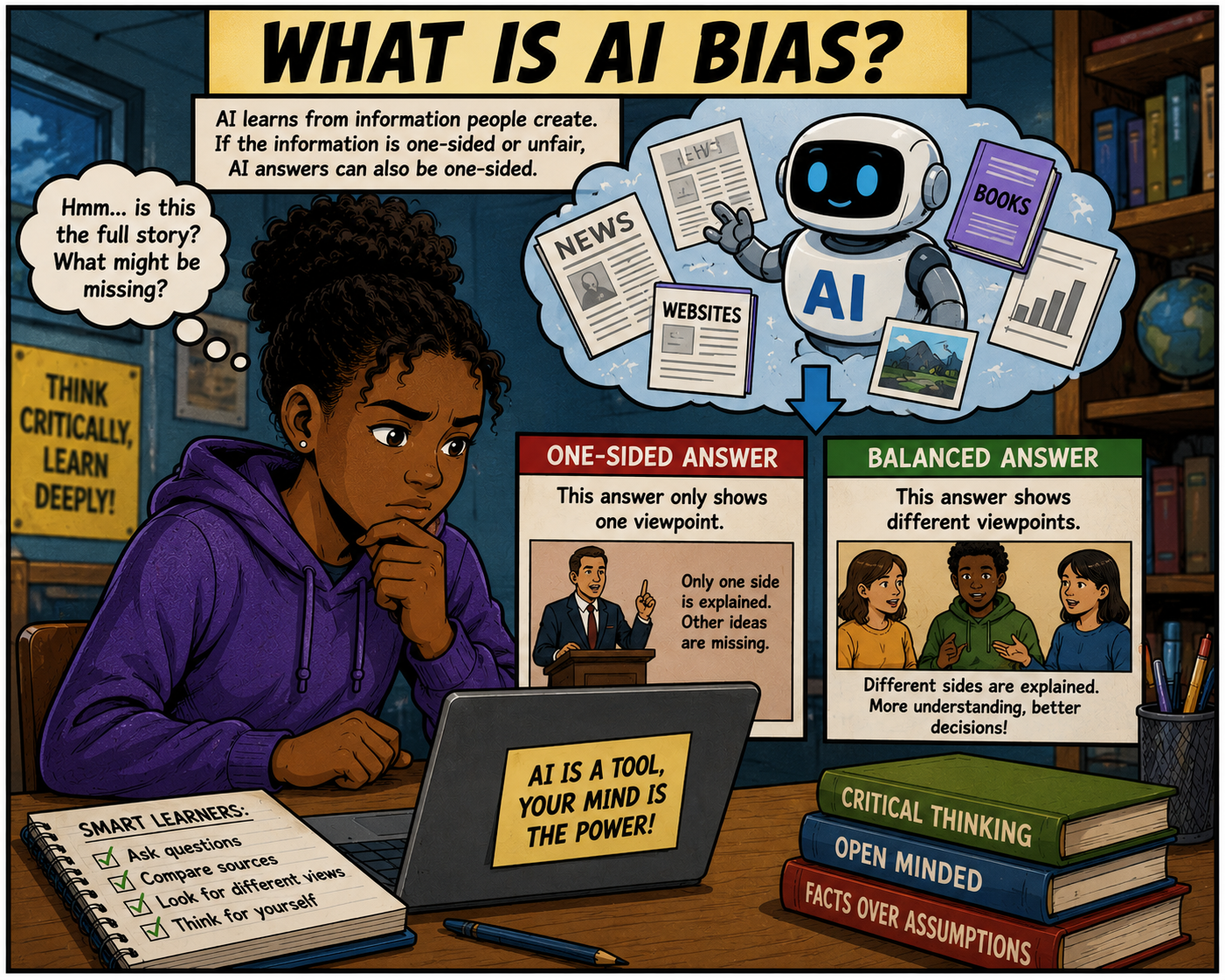
AI bias happens when an AI system produces answers that are unfair, incomplete, inaccurate, or favour one perspective more than another. This usually happens because of the information used to train the AI.
AI does not develop opinions like humans do. Instead, it learns patterns from enormous collections of information.
If those collections contain:
missing information,
outdated information,
inaccurate information,
stereotypes,
or one-sided viewpoints,
the AI may repeat those patterns in its answers.
This is why AI is not automatically neutral. It reflects the information it has learned from.
Why Does AI Bias Happen?
Many learners imagine AI as a machine that simply knows everything. In reality, AI learns from data. Think of data as the books in a giant digital library. If the library contains mostly books written from one viewpoint, the AI will naturally learn more about that viewpoint than others.
Bias can happen for many reasons.
The Training Data Is Incomplete
No collection of information includes everything.
Some countries, cultures, languages, and communities have much more information available online than others.
This means AI may know far more about certain places while having less information about others.
Human Bias Exists
People create books.
People write websites.
People publish articles.
People collect data.
Since humans sometimes have opinions or make mistakes, AI may learn from those same sources.
Information Changes Over Time
Knowledge is always changing.
Scientific discoveries improve.
New laws are introduced.
Historical understanding develops.
Medical advice changes.
If AI has learned from older information, some answers may no longer be completely accurate.
Some Topics Have Different Opinions
Not every question has one perfect answer.
Questions involving history, politics, ethics, economics, or culture often include different viewpoints.
AI may summarise the most common opinions but leave out minority perspectives.
AI Does Not Think Like A Human
One of the biggest misunderstandings about AI is believing it actually thinks. It does not.
AI does not have:
personal experiences,
emotions,
beliefs,
values,
common sense,
or personal judgement.
Instead, it predicts the most likely answer based on patterns it has learned. Sometimes those predictions are excellent. Sometimes they are incomplete. Sometimes they are wrong.
Understanding this helps learners avoid placing too much trust in every AI response.
A Simple Classroom Example
Imagine your Geography teacher asks: "Describe the world's best city."
You ask AI the question. One AI answer might recommend London. Another might recommend Singapore. A different AI might suggest Cape Town or Tokyo.
Who is correct?
There is no single correct answer because "best" depends on what people value:
Some care about safety.
Others care about jobs.
Others care about climate.
Others care about education.
The AI's answer depends on the information it has learned and how it interprets your question.
This is an example of how bias and subjectivity can influence answers.
Bias Does Not Always Mean Wrong
This is an important idea. Many people hear the word "bias" and assume everything is false.
That is not true. A biased answer may still contain many correct facts.
The problem is that it may not tell the whole story. Imagine reading only one chapter of a textbook.
You would learn something useful. But you would not understand the complete subject.
Bias often works the same way.
Different Types Of AI Bias
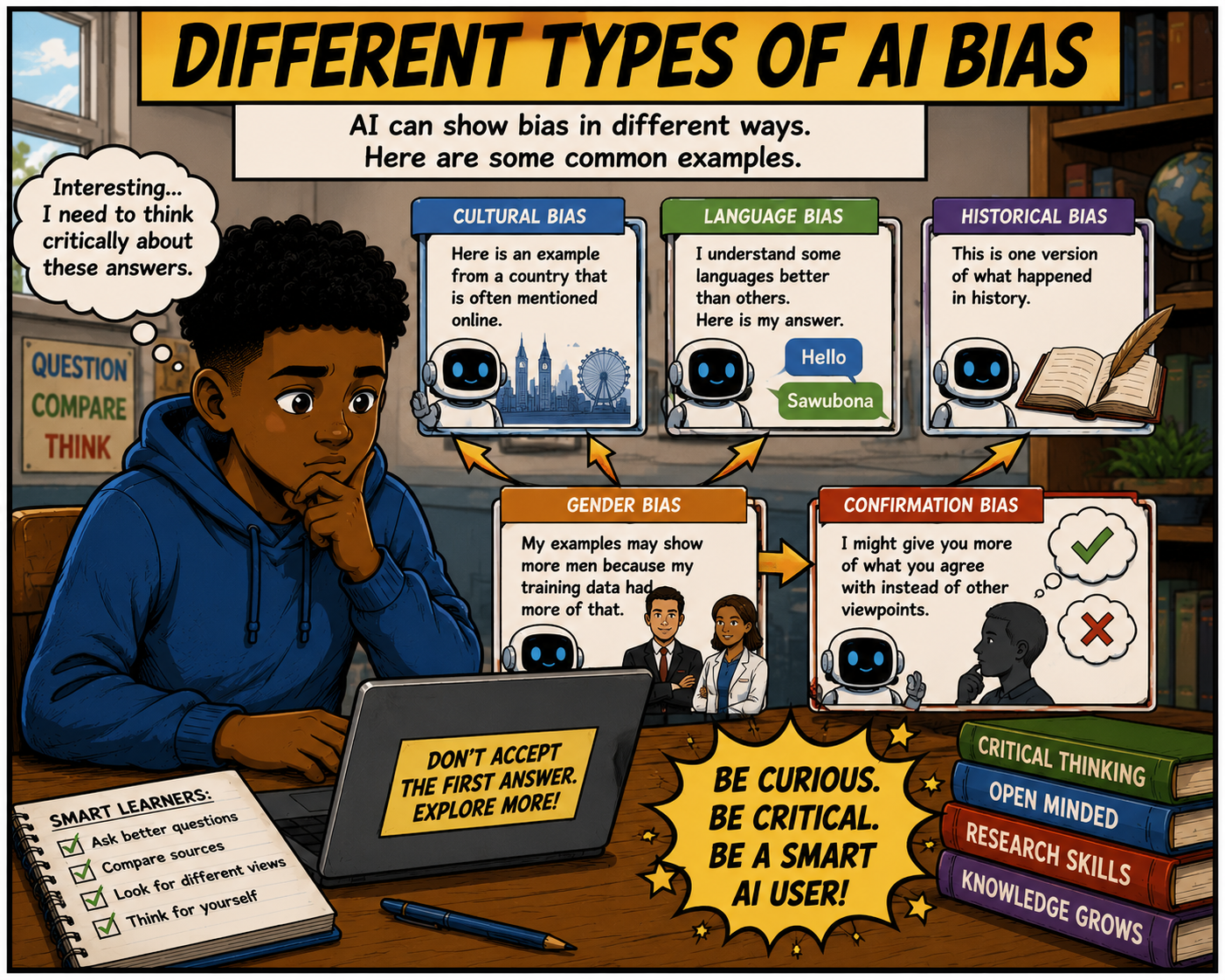
AI bias can appear in different ways. Understanding these examples helps learners recognise it more easily.
Cultural Bias
Most AI systems learn from information created around the world. However, some countries produce much more online content than others.
As a result, AI may sometimes explain ideas using examples from countries that are more heavily represented online.
For South African learners, this means some examples may not match your own experiences.
For instance, an AI may explain school systems using American or European examples instead of South African schools.
That does not necessarily make the explanation wrong, but it may not be the most relevant.
Language Bias
Some languages have far more digital content available than others. English has an enormous amount of online information. Many African languages have much less publicly available digital content. As a result, AI often performs better in English than in less represented languages.
This is improving, but learners should remember that language differences can affect AI responses.
Historical Bias
History is often viewed from different perspectives. Different countries may describe the same historical event differently. AI may summarise the version it has encountered most often.
Good learners understand that history often benefits from reading multiple sources.
Gender Bias
Historically, some careers were associated more with men than women. If AI learns from older information, it may unintentionally reflect outdated stereotypes. For example, it might provide examples that mention male engineers more often than female engineers.
Modern AI developers work hard to reduce these patterns, but they can still appear.
Confirmation Bias
Although confirmation bias is mainly a human behaviour, AI can sometimes reinforce it. Confirmation bias happens when people only look for information that supports what they already believe. Imagine someone asks AI questions in a way that only seeks one answer.
Instead of exploring different viewpoints, they keep asking until they find an answer they like.
This can strengthen existing opinions instead of encouraging balanced thinking.
Why Students Should Care About AI Bias
You may wonder: "Why does this matter to me?" The answer is simple. Many learners now use AI every day.
You might use it to:
revise schoolwork,
research projects,
prepare speeches,
understand difficult concepts,
improve essays,
practise exam questions.
If you assume every answer is perfectly balanced, you could accidentally learn incomplete information.
Understanding AI bias helps you become a stronger learner.
AI Is A Starting Point, Not The Final Answer
One of the best ways to think about AI is to compare it to a helpful tutor. A good tutor explains ideas. Answers questions. Suggests improvements. Encourages learning.
But you would still check your textbook, listen to your teacher, and complete your own research.
AI should play the same role.
It should support your learning — not replace it.
How To Spot Possible AI Bias
There is no simple test that instantly identifies bias.
Instead, ask yourself questions like these:
Does this answer only present one viewpoint?
Could another perspective exist?
Is the information current?
Does my textbook agree?
What does my teacher say?
Can another reliable source confirm this?
Does this explanation seem balanced?
Are important facts missing?
These questions help you think more carefully.
Compare More Than One Source
Excellent learners rarely depend on a single source. Imagine you are writing a Life Sciences assignment.
Instead of only asking AI, you could also use:
your textbook,
class notes,
educational websites,
scientific organisations,
teacher guidance,
library resources.
When several trusted sources agree, your confidence increases.
Ask Better Questions
Sometimes the quality of the AI answer depends on the question you ask.
Instead of asking: "Which opinion is correct?"
You could ask:
"What are the different viewpoints?"
"What arguments support each side?"
"Can you explain both perspectives fairly?"
"What do experts disagree about?"
Better questions often produce more balanced answers.
Learn To Recognise Missing Information
Sometimes bias appears because important information is missing. Suppose AI explains climate change using only scientific facts but ignores social or economic impacts.
The explanation may still be correct. It is simply incomplete.
As learners, you should always ask: "What information might be missing?"
Don't Be Afraid To Challenge AI
Many learners feel uncomfortable questioning AI because it sounds confident.
Remember this: AI is a tool. It is acceptable to disagree with it.
You can ask:
"Can you explain that differently?"
"Do experts disagree?"
"Can you provide another perspective?"
"What evidence supports this?"
"Are there exceptions?"
Critical thinking makes AI more useful.
A South African Example
Imagine your class is discussing water shortages.
An AI system may provide examples from California, Australia, or Europe because there is a large amount of online information about those regions.
However, your teacher may want you to understand drought conditions in South Africa.
You could improve your learning by asking: "Can you explain this using South African examples?"
This helps AI provide information that is more relevant to your curriculum.
Bias In School Research
When using AI for school projects, avoid copying the first answer you receive.
Instead:
ask follow-up questions,
compare different explanations,
verify important facts,
check official sources,
include multiple viewpoints where appropriate.
This produces stronger assignments and demonstrates better research skills.
Responsible AI Users Think Critically
Responsible learners do not simply collect information.
They evaluate it.
They ask questions.
They compare ideas.
They recognise that knowledge is often more complex than a single answer.
These habits are valuable not only for AI but for all forms of learning.
AI Developers Are Working To Reduce Bias
The companies that build AI systems know bias is an important challenge.
Researchers continually work to:
improve training data,
include more diverse information,
reduce stereotypes,
test AI carefully,
update models,
improve fairness.
Although AI continues improving, no system is completely free from bias.
That is why human judgement remains essential.
Building Healthy AI Habits
As AI becomes more common in education, develop habits that will help you throughout your life.
Good habits include:
asking thoughtful questions,
checking more than one source,
reading your textbook,
listening to your teacher,
recognising different viewpoints,
avoiding assumptions,
verifying important facts,
remaining curious,
keeping an open mind,
thinking independently.
These habits will help you succeed in school, university, and your future career.
Conclusion
Artificial intelligence is one of the most exciting technologies available to learners today. It can explain complex ideas, support revision, improve writing, and make learning more interactive. However, AI is not perfect, and one of its biggest challenges is bias.
AI bias happens because AI learns from information created by people and collected from the real world. If that information is incomplete, outdated, or one-sided, the AI may reflect those same patterns in its answers. This does not mean AI is useless —it simply means learners should use it wisely.
The best students combine AI with critical thinking. They compare information, ask questions, verify facts, and consider different viewpoints before reaching conclusions. They understand that AI is a valuable learning assistant, but not the final authority.
As you continue using AI throughout your education, remember this simple principle: Don't stop thinking just because the answer came from a computer. Your curiosity, judgement, and ability to think critically will always be your greatest strengths.
Additional Articles in the AI, Digital Citizenship, and Critical Thinking Series
How to Spot AI-Generated Misinformation Online
What Is AI Bias and Why Should Students Care?
Deepfakes, Fake Images, and Digital Truth: What Learners Need to Know
How AI and Social Media Can Shape What You Think
Thinking for Yourself in an AI World
Disclaimer
AI Tools were used to assist with research. Remember to always cross-check everything that you read.