
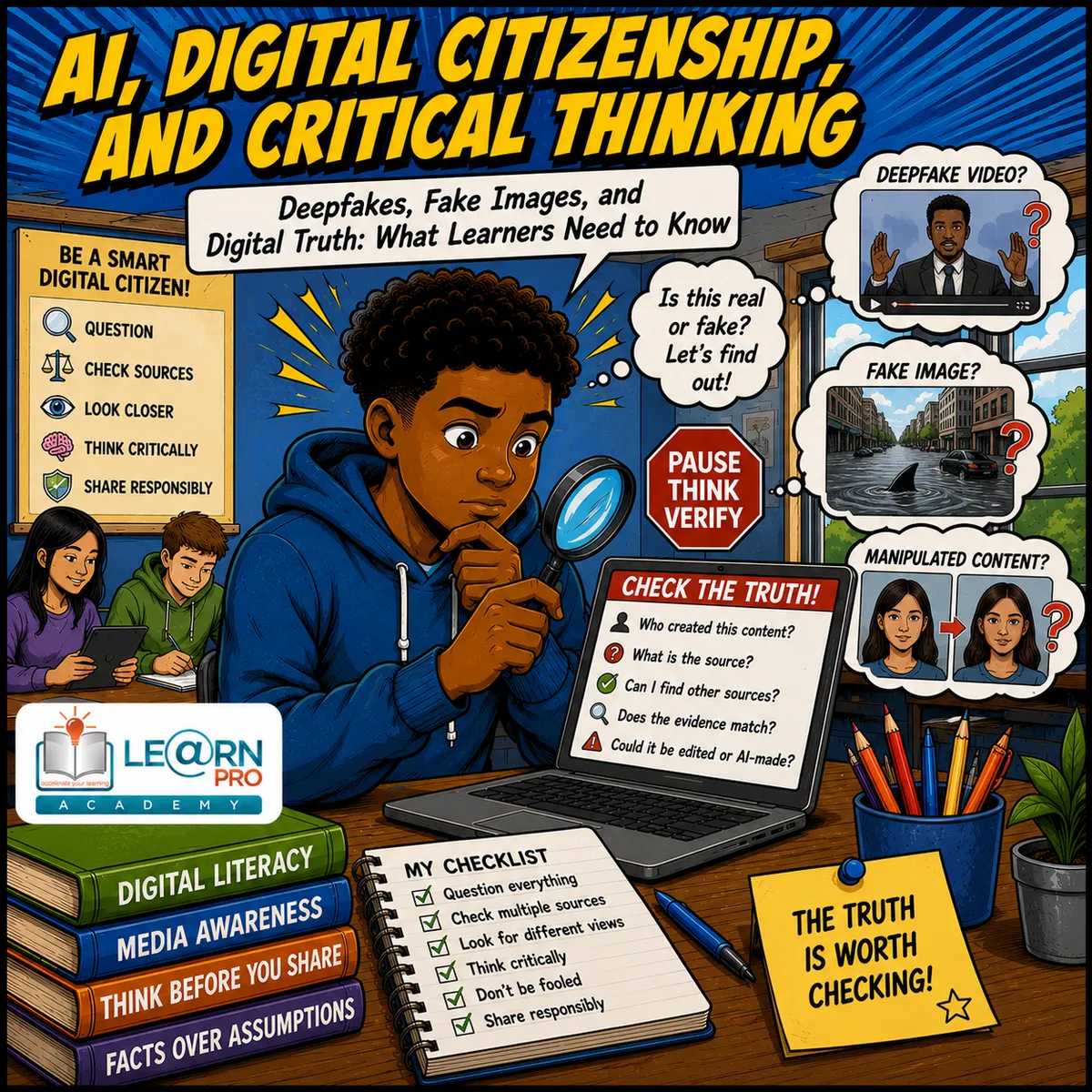
Deepfakes, Fake Images, and Digital Truth: What Learners Need to Know
This is article #3 of 5 in the AI, Digital Citizenship, and Critical Thinking Series
Introduction
Imagine scrolling through social media and seeing a video of a famous sports star announcing their retirement. A few minutes later, you watch another video showing a politician making a shocking statement. Then you come across an image of a natural disaster that appears completely real.
Would you believe what you just saw?
Many people would.
For most of history, photographs and videos were considered strong evidence that something had happened. While photographs could be edited and videos could be manipulated, doing so often required expensive software and highly skilled editors.
Today, artificial intelligence (AI) has changed that completely.
AI can now create incredibly realistic images, voices, and videos that never actually existed. These creations are often so convincing that even experienced internet users can struggle to tell the difference between what is real and what is fake.
These AI-generated creations are called deepfakes and synthetic media.
Although this technology can be used for creative and educational purposes, it can also spread misinformation, damage reputations, encourage scams, and confuse millions of people online.
As a learner, you are growing up in a world where "seeing is believing" is no longer always true. Digital literacy now includes learning how to question what you watch, hear, and share online.
In this article, you will learn what deepfakes are, how AI creates fake content, why it matters, how to recognise warning signs, and how you can protect yourself from being misled.
What Is A Deepfake?
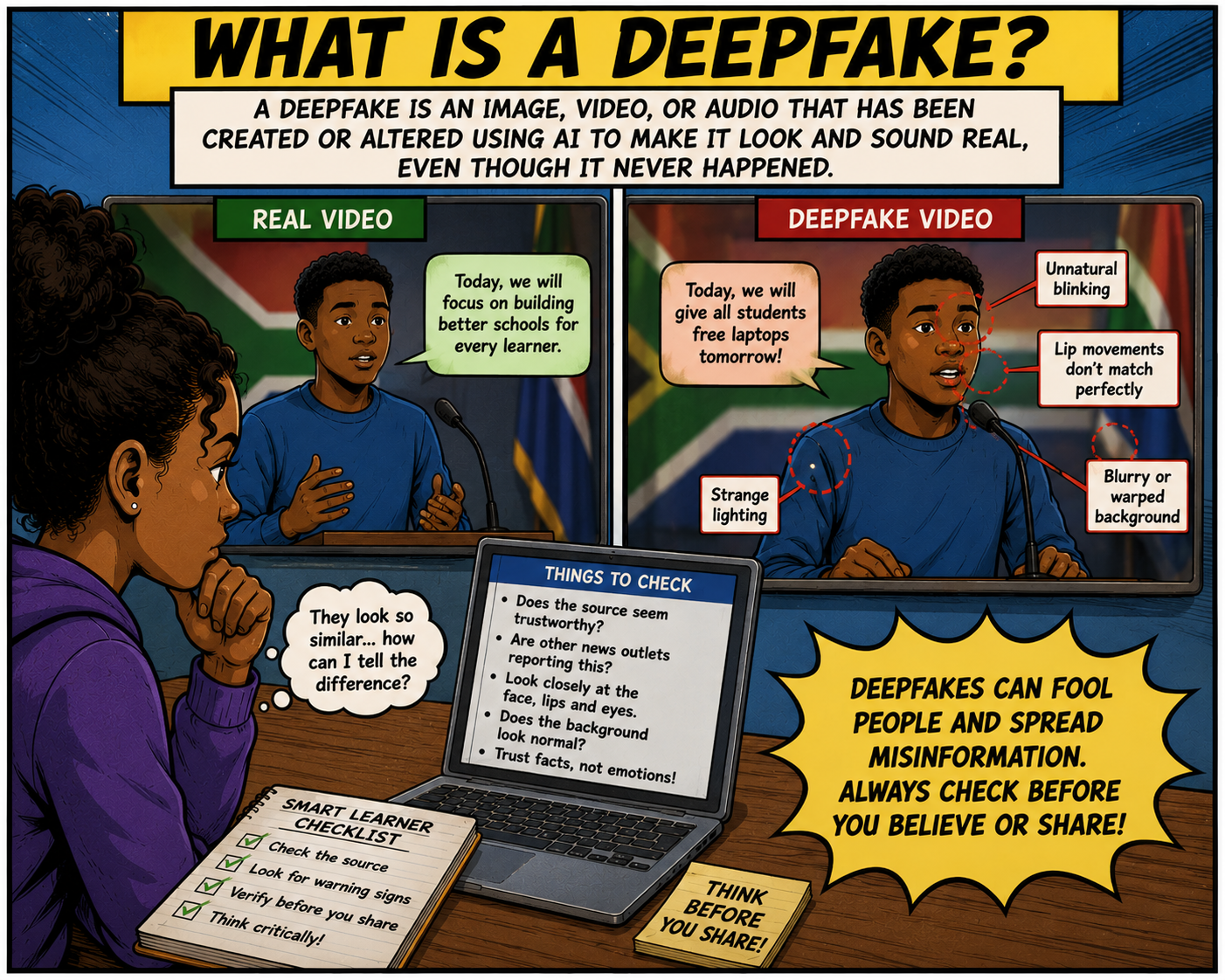
A deepfake is an image, video, or audio recording that has been created or altered using artificial intelligence to make it appear as though someone said or did something they never actually said or did.
The word deepfake combines two ideas:
Deep learning – a type of artificial intelligence that learns patterns from enormous amounts of data.
Fake – something that is not genuine.
AI studies thousands of photographs, videos, and voice recordings of a person. It learns their:
facial expressions,
smile,
eye movements,
voice,
pronunciation,
body language,
and speaking style.
It can then generate entirely new content that appears authentic.
To someone watching for the first time, it may look completely real.
What Are Fake Images?
Not every AI-generated picture is a deepfake.
Some images are created entirely from text instructions.
For example, someone could ask AI to generate:
a lion walking through a shopping centre,
snow falling on Table Mountain,
dinosaurs walking through Johannesburg,
a celebrity standing on the Moon,
a giant shark swimming through city streets.
The resulting image may look like a real photograph, even though the event never happened. These are called AI-generated images or synthetic images.
Some are created simply for entertainment or art. Others are designed to fool people.
What Are Fake Voices?
AI can also copy voices.
If enough recordings of someone's voice are available online, AI may be able to create new speech that sounds almost identical.
This technology can imitate:
celebrities,
politicians,
teachers,
family members,
radio presenters,
business leaders,
or even ordinary people.
This creates new opportunities for fraud and scams. Imagine receiving a phone call that sounds exactly like someone you know.
The voice alone is no longer enough to prove identity.
What Are Fake Videos?
Deepfake videos combine several AI technologies.
The AI may generate:
a person's face,
their voice,
their lip movements,
facial expressions,
body movement,
background,
and lighting.
Everything works together to create the illusion that the person really appeared in the video.
Some deepfakes are easy to recognise. Others are becoming almost impossible to detect without specialised software.
Why Are Deepfakes Becoming More Common?
Several reasons explain why deepfakes are increasing.
AI Technology Is Improving
Every year, AI becomes more powerful.
Images become sharper.
Voices become more natural.
Videos become smoother.
This makes fake content harder to recognise.
AI Tools Are Becoming Easier To Use
In the past, creating realistic fake videos required professional editing skills.
Today, many AI tools allow users to generate realistic content with only a few instructions.
As the technology becomes easier to use, more people gain access to it.
Social Media Spreads Content Quickly
One fake video can reach millions of people before anyone checks whether it is real.
Exciting stories spread especially fast because people enjoy sharing surprising content.
Unfortunately, corrections often spread much more slowly than the original misinformation.
Why Should Students Care?
Some learners believe deepfakes only affect celebrities. In reality, anyone can be affected.
Students use:
social media,
messaging apps,
video platforms,
online learning,
digital photographs,
and AI tools almost every day.
Understanding deepfakes helps protect you from becoming a victim or accidentally spreading false information.
Digital literacy is now an essential life skill.
How Deepfakes Can Cause Harm
Although deepfake technology has positive uses, it can also cause serious problems.
Spreading Misinformation
One fake video can convince thousands or even millions of people that something happened when it never did.
False information can influence:
opinions,
school discussions,
communities,
elections,
public trust,
and emergency responses.
Damaging Someone's Reputation
Imagine someone creates a fake video showing a person behaving badly. Even after the truth is discovered, the person's reputation may already be damaged.
False content can spread much faster than corrections.
Online Bullying
Sadly, some people misuse AI to create embarrassing fake images or videos of classmates. This is a form of cyberbullying.
It can cause:
embarrassment,
anxiety,
stress,
damaged friendships,
and emotional harm.
Creating or sharing fake images of others without permission is irresponsible and can have serious consequences.
Financial Scams
Criminals increasingly use AI voices and fake videos in scams.
For example, someone might receive a phone call that sounds exactly like a family member asking for urgent money.
Without careful checking, people can easily be tricked.
Loss Of Trust
As deepfakes become more realistic, people may begin doubting genuine photographs and videos too.
This creates a difficult situation where people no longer know what to believe.
Trust becomes harder to build.
Positive Uses Of AI-Generated Media
Not all AI-generated media is harmful. Many positive uses exist.
For example:
creating educational animations,
restoring old photographs,
making films,
creating video game characters,
producing special effects,
helping people communicate,
language translation,
historical recreations,
accessibility tools for people with disabilities.
The technology itself is not good or bad. Its impact depends on how people choose to use it.
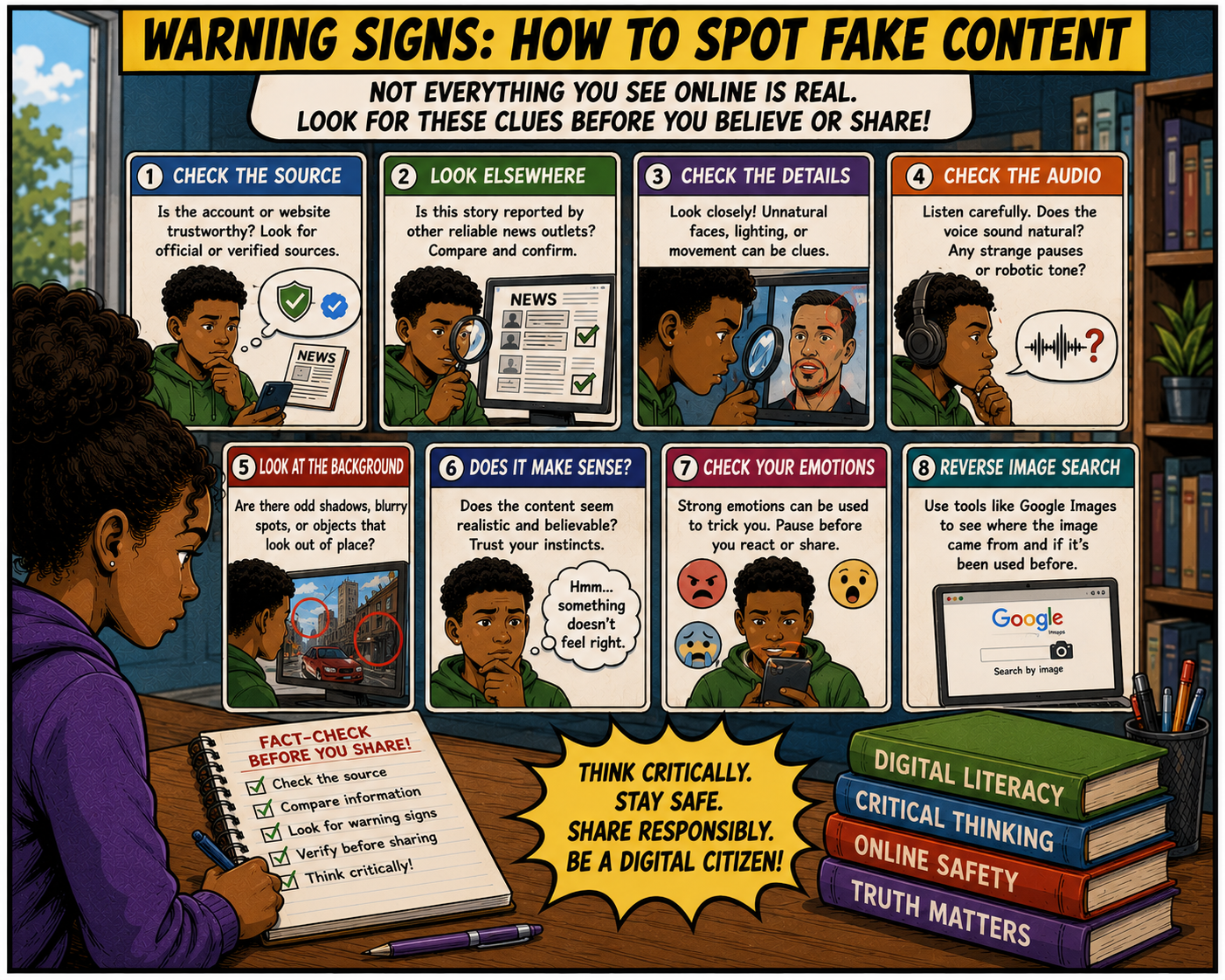
Warning Signs: How to Spot Fake Content
Warning Sign 1: Does The Source Seem Trustworthy?
Before believing any image or video, ask:
Who posted this?
Is the account genuine?
Is it an official organisation?
Is it a trusted news source?
Can I verify the original upload?
Unknown accounts deserve extra caution.
Warning Sign 2: Does The Story Appear Anywhere Else?
If a shocking event really happened, multiple trusted news organisations would normally report it. If only one unknown social media account shares the story, investigate further.
Always compare information.
Warning Sign 3: Look Carefully At Faces
Although AI continues improving, some fake videos still show unusual facial details.
Look for:
unnatural blinking,
blurry edges,
distorted ears,
strange teeth,
inconsistent skin,
unusual facial movements.
Small details often reveal editing.
Warning Sign 4: Watch The Lips Carefully
Sometimes the lips do not perfectly match the words being spoken.
Although this mismatch may only last a fraction of a second, it can indicate manipulation.
Warning Sign 5: Listen Carefully To The Voice
AI-generated voices are becoming more realistic.
However, some warning signs include:
unusual pauses,
robotic tone,
inconsistent emotion,
strange pronunciation,
unnatural rhythm.
These clues are becoming less obvious as technology improves.
Warning Sign 6: Look At The Background
Sometimes the background contains clues.
You may notice:
objects changing shape,
impossible reflections,
disappearing people,
inconsistent lighting,
distorted buildings,
unusual shadows.
AI often struggles with fine details.
Warning Sign 7: Does The Image Make Sense?
Ask yourself: "Is this realistic?" Sometimes fake images show impossible situations.
Examples include:
impossible weather,
unusual animal behaviour,
incorrect landmarks,
impossible physics,
inconsistent clothing,
unrealistic proportions.
Critical thinking remains your best defence.
Warning Sign 8: Strong Emotional Reactions
Many fake posts are designed to trigger emotions before you start thinking.
You might feel:
shock,
anger,
fear,
excitement,
curiosity,
sadness.
Pause before reacting.
Emotional content spreads quickly because people share it immediately.
The Importance Of Reverse Image Searching
One useful digital skill is reverse image searching. Instead of searching with words, you search using the image itself.
This can help you discover:
where the image first appeared,
whether it has been edited,
whether it has been used before,
whether it has been taken from another event.
This is a useful fact-checking technique used by journalists.
Verify Before You Share
One simple habit can prevent many problems.
Before sharing any dramatic image or video, ask yourself:
Do I know where this came from?
Can another trusted source confirm it?
Could AI have created this?
Am I reacting emotionally?
Could sharing this harm someone?
Waiting just a few minutes to verify information can stop misinformation from spreading.
A School Example
Imagine someone shares a video in your class WhatsApp group. The video appears to show your principal announcing that school exams have been cancelled. Many learners become excited.
Some immediately share the video with friends.
Instead of forwarding it, you decide to:
check the school's official communication,
visit the school website,
ask a teacher,
wait for confirmation.
Later you discover the video was completely fake.
Your careful thinking prevented you from spreading misinformation.
Respect Other People's Digital Identity
Every person has a digital identity.
This includes:
photographs,
videos,
online profiles,
voice recordings,
social media accounts.
Never use AI to create fake content about someone else without permission. Even if it is meant as a joke, it can damage trust and hurt relationships.
Responsible digital citizens respect other people's privacy and reputation.
AI Will Continue To Improve
The warning signs we recognise today may become harder to spot in the future. AI-generated media improves every year.
That means learners must rely less on visual clues alone and more on:
trusted sources,
fact-checking,
evidence,
critical thinking,
patience,
responsible sharing.
Technology changes. Good judgement remains valuable forever.
Digital Truth Matters
Living in a digital world means learning to separate facts from fiction.
Truth matters because it helps us:
make good decisions,
protect ourselves,
support others,
build trust,
solve problems,
learn accurately,
participate responsibly in society.
Without reliable information, people can easily become confused or manipulated.
Becoming A Responsible Digital Citizen
Responsible learners develop habits that protect themselves and others.
Good habits include:
questioning surprising content,
checking trusted sources,
thinking before sharing,
respecting other people's privacy,
avoiding online rumours,
reporting harmful fake content,
using AI ethically,
asking teachers when unsure,
verifying important information,
keeping an open and curious mind.
These habits will benefit you long after you leave school.
Conclusion
Artificial intelligence has made it possible to create realistic fake images, voices, and videos that can easily fool people. While these technologies have exciting educational and creative uses, they also create new challenges for learners, teachers, families, and society.
As a Grade 10–12 learner, you do not need to become an expert in artificial intelligence to stay safe online. What you do need is a habit of questioning what you see, hear, and read. Instead of believing every dramatic image or video, take a moment to investigate. Check the source, compare reliable information, and ask whether the content makes sense.
Remember that technology will continue to change, but the skills of critical thinking, curiosity, honesty, and responsible decision-making will always remain important. By combining these skills with careful use of AI, you can enjoy the benefits of technology while helping to build a safer, more trustworthy digital world for everyone.
Additional Articles in the AI, Digital Citizenship, and Critical Thinking Series
How to Spot AI-Generated Misinformation Online
What Is AI Bias and Why Should Students Care?
Deepfakes, Fake Images, and Digital Truth: What Learners Need to Know
How AI and Social Media Can Shape What You Think
Thinking for Yourself in an AI World
Disclaimer
AI Tools were used to assist with research. Remember to always cross-check everything that you read.