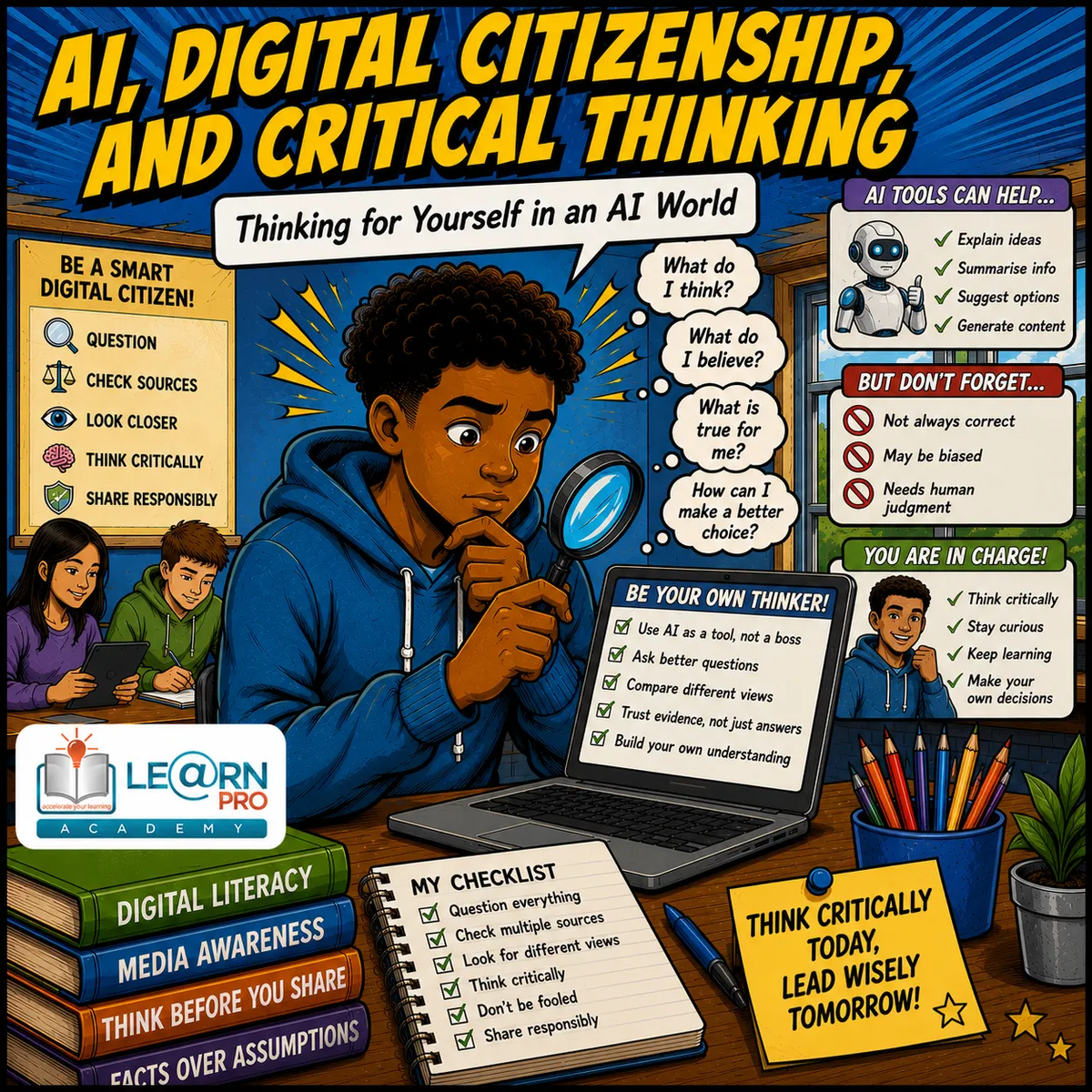
Thinking for Yourself in an AI World
This is article #5 of 5 in the AI, Digital Citizenship, and Critical Thinking Series
Introduction
Artificial intelligence (AI) is becoming part of everyday life. It can answer questions, explain difficult school topics, create study notes, help with writing, generate images, solve problems, and even hold conversations. For many Grade 10–12 learners, AI has become another tool for learning alongside textbooks, teachers, and the internet.
There is no doubt that AI is changing education in exciting ways. It can save time, personalise learning, and make difficult concepts easier to understand. It gives learners access to information faster than ever before.
However, there is one thing AI should never replace.
Your ability to think for yourself.
Education is about much more than memorising facts or finding quick answers. School is designed to help you develop skills that will benefit you throughout your life. These include asking questions, solving problems, analysing information, making decisions, forming opinions, and learning from mistakes.
If learners begin accepting every AI answer without thinking, they risk weakening these important skills. Technology should support your mind — not replace it.
As AI becomes more powerful, independent thinking becomes even more valuable. Employers, universities, and communities will continue to need people who can think critically, solve new problems, communicate clearly, and make responsible decisions.
In this article, you will learn why independent thinking matters, how AI can sometimes influence your decisions, and practical ways to use AI while keeping your own curiosity, judgement, and creativity at the centre of your learning.
What Does It Mean To Think For Yourself?
Thinking for yourself does not mean ignoring advice from teachers, parents, or experts.
It means using your own mind to:
ask questions,
examine evidence,
compare ideas,
solve problems,
make informed decisions,
form your own opinions,
and learn from experience.
Independent thinkers are curious.
They do not simply accept information because someone else says it is true.
Instead, they ask:
Is this correct?
What evidence supports it?
Could there be another explanation?
Does this make sense?
These questions are at the heart of lifelong learning.
Why Thinking Matters More Than Memorising
Many learners believe success comes from remembering lots of information. While knowledge is important, understanding is even more valuable.
Imagine two students preparing for an examination. The first memorises every answer without understanding the concepts. The second learns the ideas, understands why they work, and practises applying them to different situations.
If the examination asks unfamiliar questions, which learner is more likely to succeed?
Usually, the second learner.
Thinking skills help you solve new problems — not just repeat old answers.
AI Can Answer Questions Quickly
One of AI's greatest strengths is speed.
Within seconds it can:
explain a concept,
summarise a chapter,
create practice questions,
suggest essay ideas,
generate revision notes,
provide examples,
answer follow-up questions.
This saves learners valuable time. But speed is not the same as understanding.
Reading an answer is very different from truly learning it.
The Difference Between Knowing And Understanding
Imagine someone gives you the answer to a Mathematics problem. You copy it. Your homework is complete.
But what happens when the examination contains a different question? If you never understood the method, you may struggle.
AI can provide answers. Only you can develop understanding through practice and thinking.
Why Your Brain Needs Practice
Your brain becomes stronger when you use it. Just like muscles grow stronger through exercise, thinking skills improve through practice.
Every time you:
solve a difficult problem,
write an essay,
compare information,
analyse a source,
make a decision,
explain an idea,
your brain develops valuable skills.
If AI does all the thinking for you, your own thinking skills may improve more slowly.
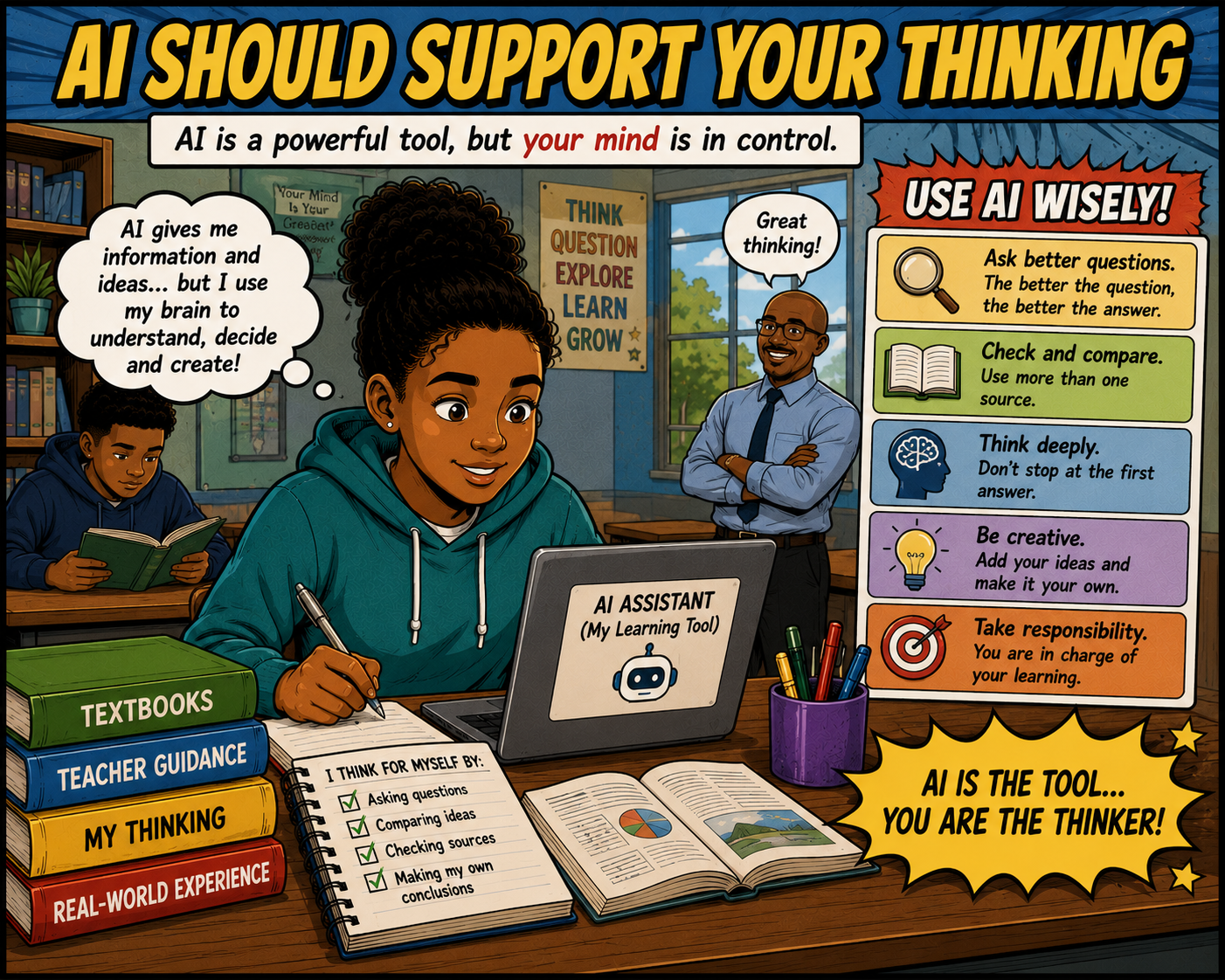
AI Should Support Your Thinking
Think of AI as a calculator. A calculator helps you perform calculations faster. It does not replace your understanding of Mathematics.
Similarly, AI helps organise information and explain concepts. It should not replace your reasoning.
The goal is to use AI as a learning partner — not as a substitute for your own mind.
Asking Better Questions
Independent thinkers ask thoughtful questions. Instead of accepting the first answer, they explore further.
For example, rather than asking: "What is climate change?"
You could ask:
Why does climate change happen?
What evidence supports this?
How does it affect South Africa?
What different solutions are being discussed?
What do scientists still disagree about?
Better questions lead to deeper understanding.
Learning To Question Information
Not every answer — whether from AI, the internet, or another person — is completely correct. Responsible learners develop the habit of questioning information respectfully.
Ask yourself:
Is this accurate?
Can I verify it?
Does another reliable source agree?
Is important information missing?
Could there be another perspective?
Questioning is not disrespectful. It is an important part of education.
Making Your Own Decisions
AI can offer suggestions. However, important decisions should still be yours.
For example, AI may suggest:
study schedules,
career ideas,
essay structures,
project topics,
revision methods.
These suggestions can be useful.
But only you understand:
your goals,
your interests,
your strengths,
your challenges,
your learning style.
Use AI to gather ideas — not to make your decisions for you.
Creativity Still Belongs To You
AI can generate poems, stories, artwork, presentations, and essays. This is impressive. But creativity is more than producing content.
Real creativity involves:
imagination,
personal experiences,
emotions,
curiosity,
originality,
experimentation.
Your unique ideas cannot be replaced by technology.
AI can inspire creativity. Your imagination gives it meaning.
Learning From Mistakes
Many learners dislike making mistakes. However, mistakes are one of the best ways to learn.
Imagine writing an essay. Your teacher provides feedback showing areas for improvement. At first, you may feel disappointed.
But by correcting those mistakes, you become a stronger writer.
If AI always provides perfect answers immediately, you may lose valuable opportunities to learn through problem-solving.
Mistakes are not failures. They are stepping stones to understanding.
Comparing Different Viewpoints
Independent thinkers rarely rely on a single source. Suppose you are researching renewable energy.
Instead of reading only one AI answer, you could compare:
your textbook,
class notes,
educational websites,
government publications,
scientific organisations,
AI explanations.
Comparing different sources gives you a broader understanding.
Avoid Becoming Too Dependent On AI
AI is incredibly helpful. However, relying on it for everything can create problems.
Imagine using AI to:
solve every Maths question,
write every essay,
summarise every chapter,
answer every homework question,
generate every idea.
Eventually, you may become less confident solving problems independently.
Healthy learning means balancing AI assistance with your own effort.
Building Confidence In Your Own Thinking
Confidence grows through experience. Every time you solve a difficult problem yourself, your confidence increases.
Every essay you write.
Every speech you deliver.
Every project you complete.
Every challenge you overcome.
These experiences teach you: "I can think through difficult situations."
AI should build your confidence — not replace it.
A Classroom Example
Imagine your History teacher asks: "Why did a particular historical event happen?" You ask AI for an explanation.
Instead of copying it immediately, you:
read the explanation,
compare it with your textbook,
check historical sources,
discuss it in class,
form your own conclusion.
You have used AI responsibly.
The final understanding belongs to you.
Independent Thinkers Stay Curious
Curiosity is one of the most valuable learning skills.
Curious learners ask:
Why?
How?
What if?
Could there be another answer?
What happens next?
AI can answer many questions. Curiosity helps you discover new ones.
Digital Literacy Includes Independent Thinking
Digital literacy is not only about using technology. It is also about understanding how technology influences us.
Good digital citizens:
verify information,
question online content,
recognise misinformation,
understand AI limitations,
think critically,
make responsible choices.
Technology changes. Critical thinking remains essential.
Your Values Matter
AI can provide facts and suggestions. It cannot decide your personal values.
Only you can decide:
what is fair,
what is kind,
what is honest,
what is responsible,
what matters most to you.
Character is built through your own choices. Technology cannot replace personal integrity.
Preparing For Your Future Career
Many future careers will include AI. Doctors, engineers, teachers, accountants, scientists, designers, lawyers, business owners, and many others will use AI tools.
However, employers will still value people who can:
solve unfamiliar problems,
communicate clearly,
lead teams,
think creatively,
make ethical decisions,
adapt to change,
learn continuously.
These are human skills. They become more valuable — not less — in an AI-powered world.
Practical Habits For Independent Thinkers
Here are some habits you can practise every day:
Ask follow-up questions instead of accepting the first answer.
Compare information from multiple reliable sources.
Complete some work without AI to strengthen your own skills.
Explain concepts in your own words.
Practise solving difficult problems independently before asking for help.
Read books as well as online information.
Reflect on what you have learned.
Learn from mistakes instead of avoiding them.
Stay curious about the world.
Keep asking "Why?"
These habits will strengthen your thinking throughout your education.
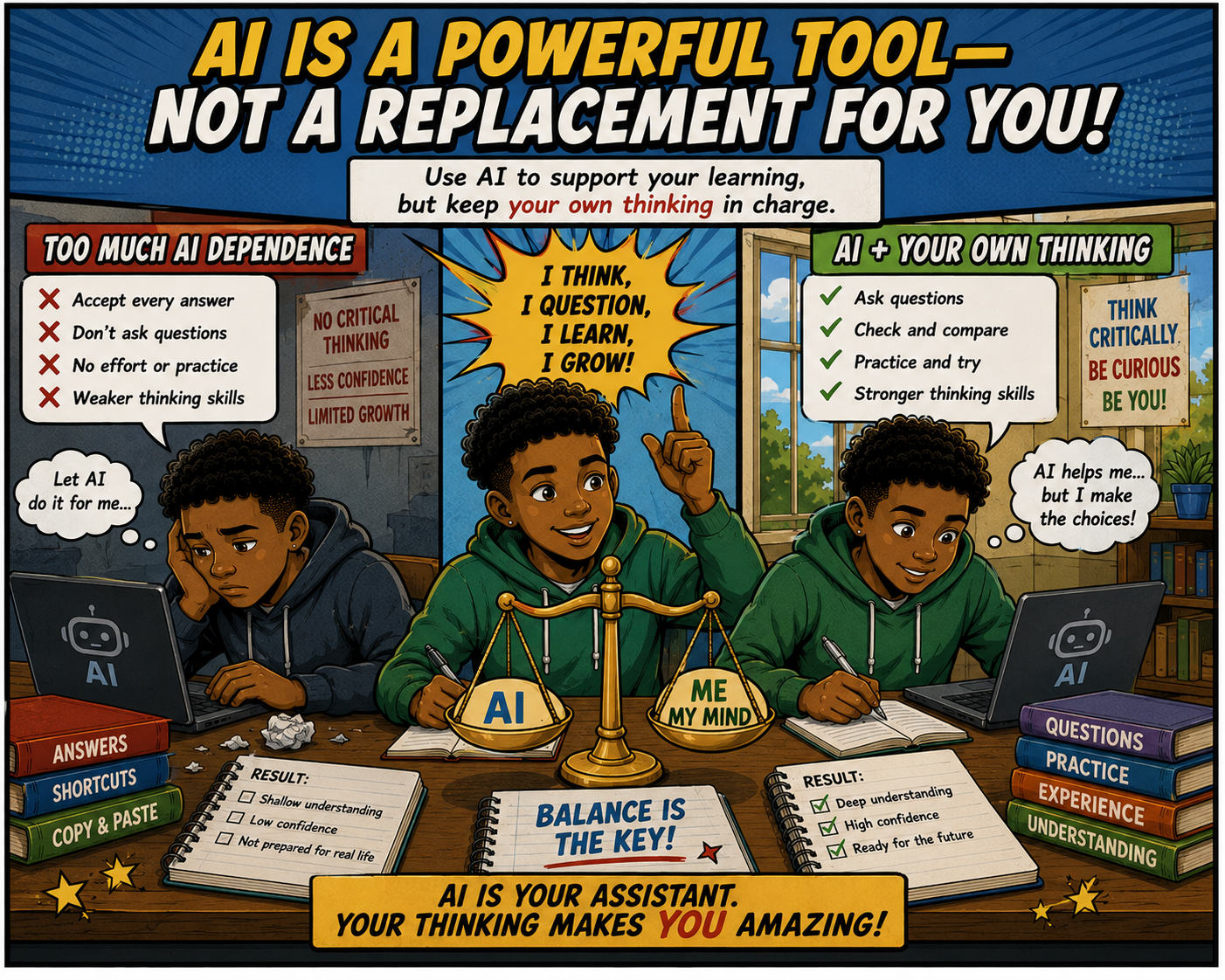
AI Is A Powerful Tool — Not A Replacement For You
Throughout history, humans have invented tools to make work easier.
Books helped preserve knowledge.
Calculators sped up calculations.
Computers improved productivity.
The internet connected the world.
AI is another powerful tool.
Like every tool, its value depends on how wisely it is used.
Your intelligence, curiosity, creativity, empathy, and judgement remain uniquely human strengths.
Becoming A Lifelong Learner
The world will continue changing:
New technologies will appear.
Jobs will evolve.
Knowledge will grow.
The learners who succeed will not necessarily be those who memorise the most information. They will be those who know how to learn, adapt, question, and think independently.
Lifelong learning begins with curiosity. AI can support that journey. It cannot replace it.
Conclusion
Artificial intelligence is one of the most exciting educational tools available today. It can explain concepts, generate ideas, organise information, and help learners become more efficient. Used responsibly, AI can make studying easier and learning more enjoyable.
However, the greatest skill you can develop is not learning how to use AI — it is learning how to think for yourself while using AI. Your ability to question information, solve problems, make decisions, evaluate evidence, and form your own opinions will always be more valuable than simply finding quick answers.
As you continue your education, remember that AI is your assistant, not your replacement. Use it to support your learning, challenge your thinking, and inspire your curiosity, but never stop asking questions or trusting your own ability to reason.
In an AI-powered world, technology will continue to evolve. The learners who will thrive are those who combine the power of AI with the even greater power of an independent, curious, and thoughtful mind.
Additional Articles in the AI, Digital Citizenship, and Critical Thinking Series
How to Spot AI-Generated Misinformation Online
What Is AI Bias and Why Should Students Care?
Deepfakes, Fake Images, and Digital Truth: What Learners Need to Know
How AI and Social Media Can Shape What You Think
Thinking for Yourself in an AI World
Disclaimer
AI Tools were used to assist with research. Remember to always cross-check everything that you read.