
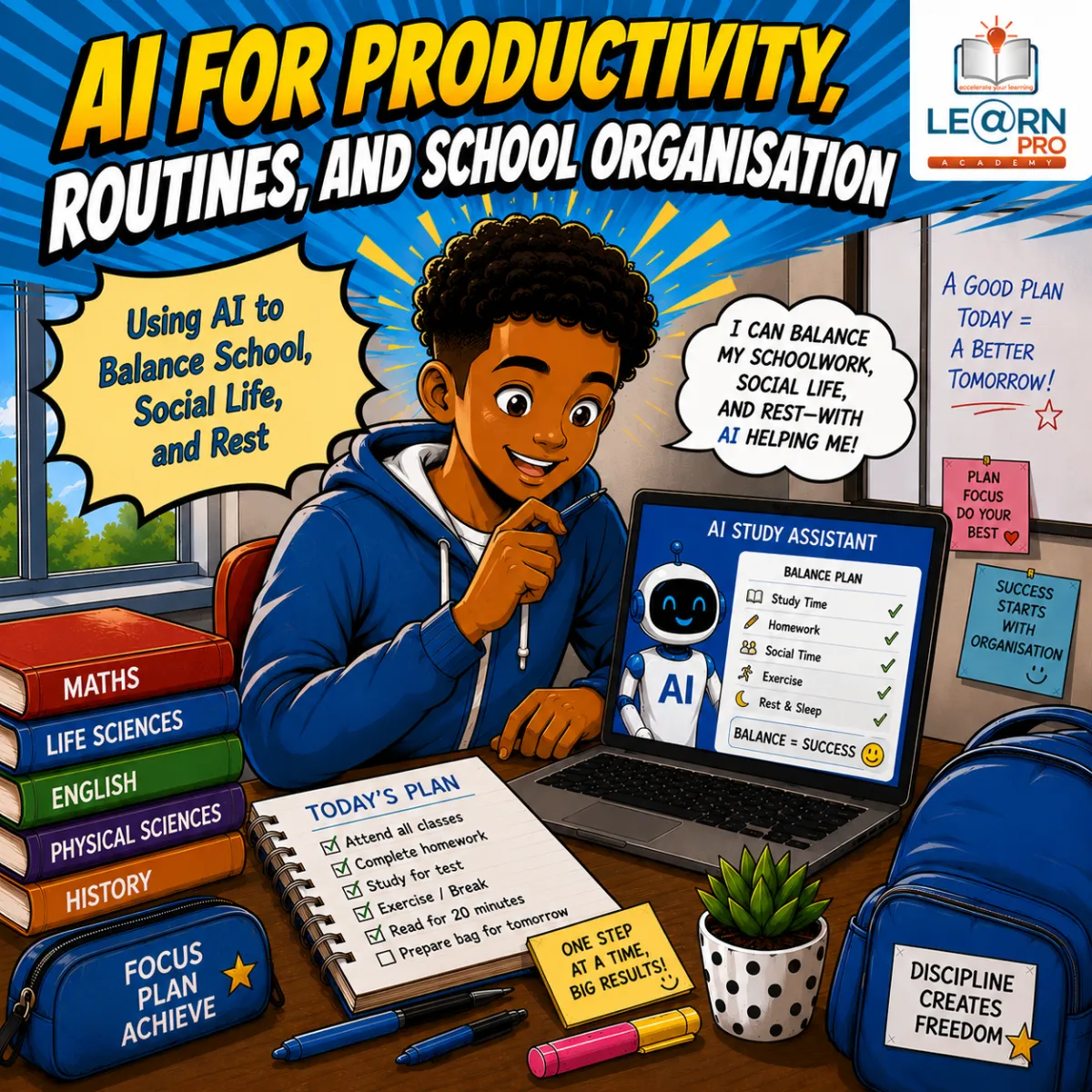
Using AI to Balance School, Social Life, and Rest
This is article #4 of 5 in the AI for Productivity, Routines, and School Organization Series
Introduction
Life as a high school learner can feel like a constant race against the clock. Between attending classes, completing homework, studying for tests, participating in sport, spending time with family, seeing friends, and trying to get enough sleep, it may seem impossible to fit everything into one day.
Many learners believe they have only two choices: either work all the time or relax all the time. Neither option is healthy. Spending every spare minute studying can lead to stress and burnout, while avoiding schoolwork can cause poor marks and even more pressure later.
The truth is that a balanced life is not about doing everything perfectly. It is about managing your time wisely, setting realistic priorities, and making room for both responsibility and rest.
Artificial Intelligence (AI) can help learners build this balance. AI cannot create more hours in the day, but it can help you use your time more effectively. It can organise your schedule, identify your priorities, suggest realistic routines, and help you avoid becoming overwhelmed.
This article explains how AI can support learners in balancing school, social life, hobbies, family responsibilities, and personal wellbeing while still achieving their academic goals.
Why Balance Matters
Some learners believe that studying all day will automatically lead to better marks. In reality, your brain needs time to rest and recover.
A balanced lifestyle helps you:
Concentrate better.
Remember information more easily.
Feel less stressed.
Stay healthier.
Enjoy learning more.
Build stronger relationships.
Avoid burnout.
Develop better long-term habits.
Success is not only measured by school marks. It also includes your physical health, emotional wellbeing, friendships, and family relationships.
What Happens When Life Becomes Unbalanced?
When one part of your life takes over everything else, problems often appear.
For example:
If school becomes your entire life:
You may become exhausted.
Your motivation may decrease.
You may lose interest in hobbies.
Stress levels may increase.
If entertainment becomes your entire focus:
Homework gets delayed.
Deadlines are missed.
Marks begin to fall.
Last-minute panic increases.
Healthy learners understand that different parts of life support one another.
How AI Can Help You Find Balance
AI works best when it understands your weekly schedule.
Instead of asking: "Make me a timetable."
Try asking: "I am a Grade 10 learner. I have school from Monday to Friday, netball practice twice a week, church on Sunday, and I help at home every evening. Help me create a balanced weekly schedule."
AI can suggest ways to organise:
Homework.
Revision.
Assignments.
Family time.
Sport.
Social activities.
Sleep.
Breaks.
The more accurate your information, the more useful the plan becomes.
Start By Identifying Your Priorities
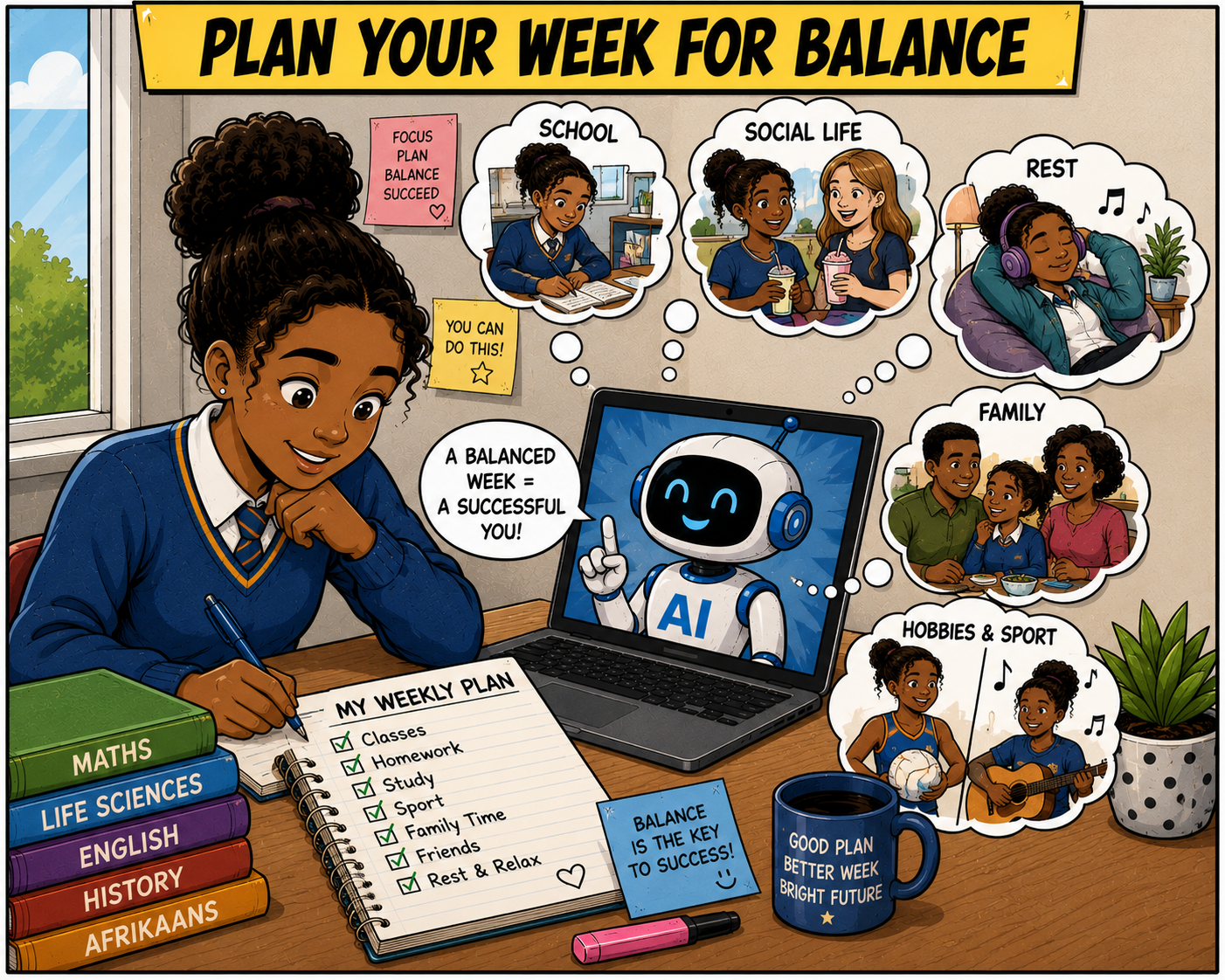
Every learner has responsibilities that are most important.
These usually include:
School attendance.
Homework.
Assignment deadlines.
Studying for tests.
Sleep.
Family commitments.
After these priorities are planned, you can organise everything else around them. AI can help you decide what should always come first.
Understand That Rest Is Productive
Many learners feel guilty when they are resting.
They think: "I should be studying."
However, rest is part of learning. Your brain processes information while you sleep and recover.
Without enough rest, you may experience:
Poor concentration.
Forgetfulness.
Irritability.
Lower energy.
Reduced motivation.
AI can help remind you to include breaks instead of filling every minute with work.
Plan Your Week Instead Of Only Your Day
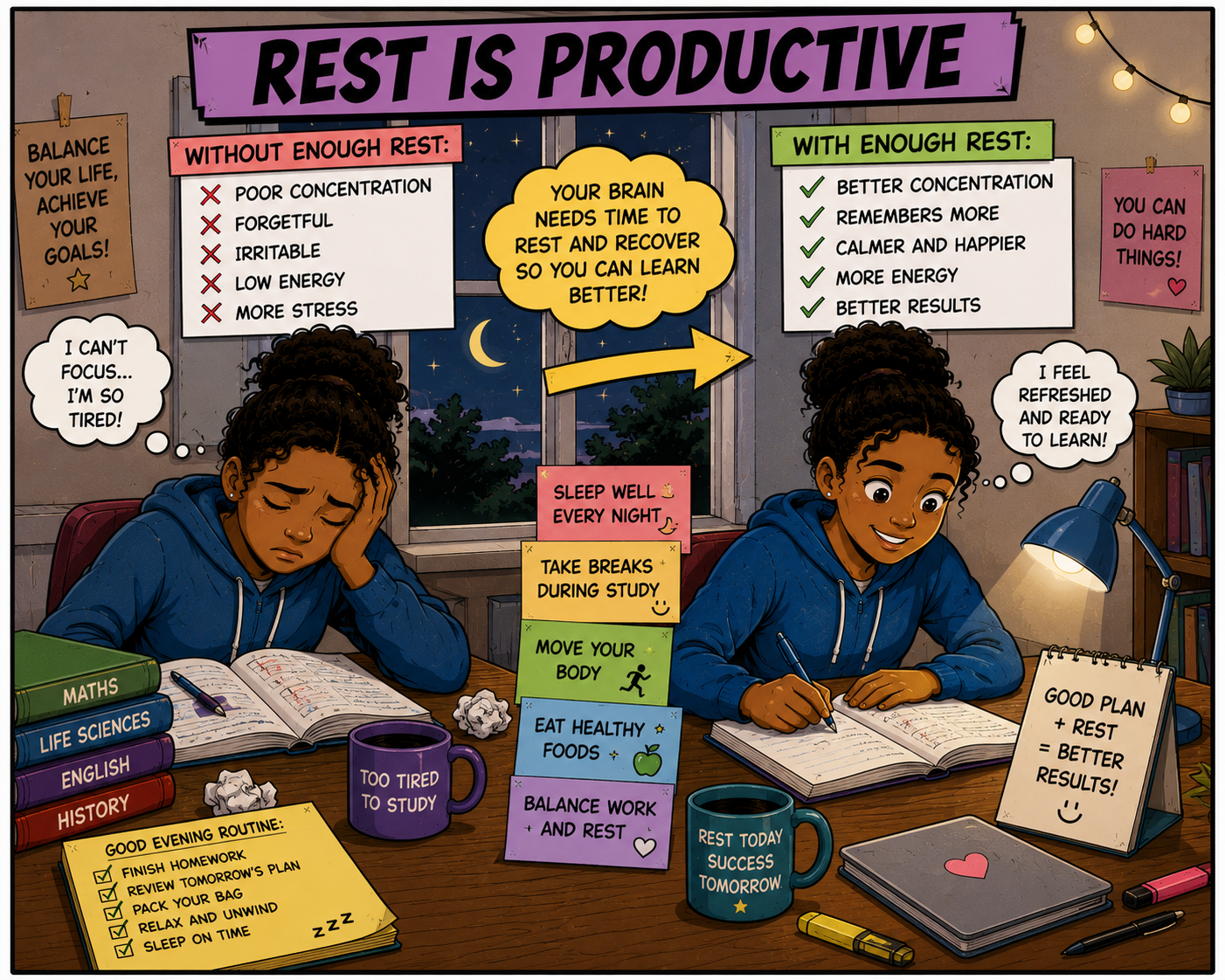
Daily planning is helpful, but weekly planning gives you a bigger picture.
For example:
Monday:
Homework and Mathematics revision.
Tuesday:
Netball practice and English homework.
Wednesday:
Life Sciences assignment.
Thursday:
Study for Friday's test.
Friday:
Complete remaining homework.
Saturday:
Revision and free time.
Sunday:
Family time and prepare for school.
AI can organise your week so that no single day becomes overwhelming.
Make Time For Family
School is important, but family relationships also matter.
Many learners help with:
Cooking.
Cleaning.
Looking after younger siblings.
Family businesses.
Household responsibilities.
These activities are part of life and should be included in your schedule. AI can help create routines that respect both school and home responsibilities.
Balance School With Sport And Hobbies
Sport, music, art, drama, and other hobbies are not distractions.
They help learners:
Stay active.
Build confidence.
Reduce stress.
Develop teamwork.
Improve discipline.
AI can help you organise your homework around practice sessions instead of forcing you to choose one over the other.
For example:
School until 2:30 p.m.
Homework from 4:00–5:00 p.m.
Soccer practice from 5:30–7:00 p.m.
Revision for 30 minutes after dinner.
Small adjustments make busy schedules more manageable.
Spend Time With Friends Wisely
Friendships are an important part of high school.
Friends provide:
Support.
Encouragement.
Fun.
Motivation.
However, spending every afternoon socialising can reduce study time. AI can help you find a healthy balance.
For example:
Complete homework first.
Then enjoy time with friends without feeling guilty.
This approach helps you relax while still meeting your responsibilities.
Avoid Overscheduling Yourself
Some learners try to fill every hour with activities. This often leads to exhaustion.
Your timetable should include:
School.
Homework.
Rest.
Meals.
Exercise.
Free time.
Sleep.
Leaving small gaps in your schedule allows you to handle unexpected events. AI can help create routines with realistic flexibility.
Learn To Say No
Sometimes learners agree to too many activities.
For example:
Extra clubs.
Social events.
Gaming sessions.
Online chats.
Weekend outings.
While these activities are enjoyable, they should not interfere with important school responsibilities. AI can help you decide whether your schedule is becoming too busy.
Build Healthy Evening Routines
The evening often determines how successful the next day will be.
A balanced evening routine could include:
Completing homework.
Reviewing tomorrow's timetable.
Packing your school bag.
Spending time with family.
Relaxing before bed.
Going to sleep at a consistent time.
Avoid using phones or other devices late into the night, as they may affect your sleep. AI can suggest routines that improve both productivity and wellbeing.
Prepare For Busy Weeks
Some weeks are naturally more demanding than others.
Examples include:
Examination periods.
School camps.
Sports tournaments.
Cultural festivals.
Multiple assignments.
During these weeks, balance becomes even more important.
You could ask AI: "I have two assignments, three tests, and rugby practice this week. Help me organise my schedule."
AI can spread your workload across several days instead of leaving everything until the last minute.
Recognise The Signs Of Burnout
Burnout happens when stress continues for too long without enough recovery.
Warning signs include:
Constant tiredness.
Feeling unmotivated.
Losing interest in school.
Difficulty concentrating.
Feeling overwhelmed.
Becoming easily frustrated.
If you notice these signs, your routine may need adjustment. AI can help you reduce your workload where possible and create more realistic schedules.
Remember that serious or ongoing stress should also be discussed with a trusted adult, parent, teacher, or school counsellor.
Use AI To Reflect On Your Week
Every weekend, spend a few minutes reviewing your progress.
Ask yourself:
Did I complete my homework?
Did I sleep enough?
Did I spend time with family?
Did I have time to relax?
Which day felt most stressful?
You can also ask AI: "Help me review my week and suggest ways to improve my balance."
Reflection helps you improve one week at a time.
Keep Your Schedule Flexible
Life rarely follows a perfect timetable. Unexpected events happen.
For example:
A teacher gives surprise homework.
A family member becomes ill.
A sports match is cancelled.
You get invited to a birthday celebration.
Rather than becoming frustrated, adjust your plan. AI makes it easy to reorganise your schedule whenever necessary.
Flexibility is one of the strengths of good planning.
Avoid Comparing Your Life With Others
Every learner has different circumstances.
Some learners:
Walk to school.
Others travel long distances.
Some have quiet study spaces.
Others study in busy homes.
Some care for younger siblings after school.
Others have fewer responsibilities.
Your schedule should fit your own life —not someone else's.
AI helps create personalised plans instead of copying unrealistic routines.
Use AI To Protect Your Wellbeing
AI can remind you to include healthy habits such as:
Drinking enough water.
Taking short movement breaks.
Sleeping consistently.
Managing screen time.
Exercising regularly.
Taking breaks between study sessions.
These small habits improve both learning and wellbeing.
Common Mistakes To Avoid
When trying to balance school and life, avoid these common mistakes:
Trying To Do Everything Perfectly
Perfection is impossible.
Focus on steady progress.
Ignoring Sleep
Sleep supports memory, learning, and concentration.
Leaving Homework Until Late
Completing work early creates more free time later.
Planning Every Minute
Leave space for unexpected events.
Comparing Yourself With Others
Build a schedule that matches your own responsibilities.
Using AI To Replace Your Own Judgement
AI offers suggestions.
You still make the final decisions.
Practical AI Prompts You Can Use
Here are some useful prompts to help balance different parts of your life:
"Help me build a balanced weekly schedule."
"Organise my homework around sports practice."
"Help me balance school, family, and free time."
"Review my timetable and suggest improvements."
"Create a realistic after-school routine."
"Help me reduce stress during a busy week."
"Suggest ways to improve my work-life balance as a learner."
"How can I fit revision into my weekly schedule?"
"Help me plan enough time for sleep."
"Adjust my timetable because I have extra assignments this week."
Remember to provide AI with accurate information about your real schedule so that its suggestions are practical.
A Balanced Life Supports Better Learning
High school is about much more than completing homework and writing examinations. It is also a time to build friendships, strengthen family relationships, discover your interests, develop healthy habits, and prepare for adulthood.
Finding balance does not mean giving equal time to every activity every day. Some weeks will require more studying, while others will include more sport, family events, or relaxation. The important thing is to adjust your schedule thoughtfully instead of allowing one area of your life to take over everything else.
AI can be a valuable planning partner by helping you organise your responsibilities, identify your priorities, and build routines that fit your real life. It can remind you to include rest, avoid burnout, and make time for the people and activities that matter most.
Remember that balance is not something you achieve once and then forget. It is something you continue to improve throughout high school and beyond. By using AI wisely and making thoughtful decisions about your time, you can become a learner who works hard, enjoys life, and stays healthy—both inside and outside the classroom.
Additional Articles in the AI for Productivity, Routines, and School Organization Series
How to Use AI to Organise Homework and Assignment Deadlines
Using AI to Build a Daily School Routine That Actually Works
How AI Can Help You Stop Procrastinating on Schoolwork
Using AI to Balance School, Social Life, and Rest
How to Use AI to Build Better Study Habits Over Time
Disclaimer
AI Tools were used to assist with research. Remember to always cross-check everything that you read.