
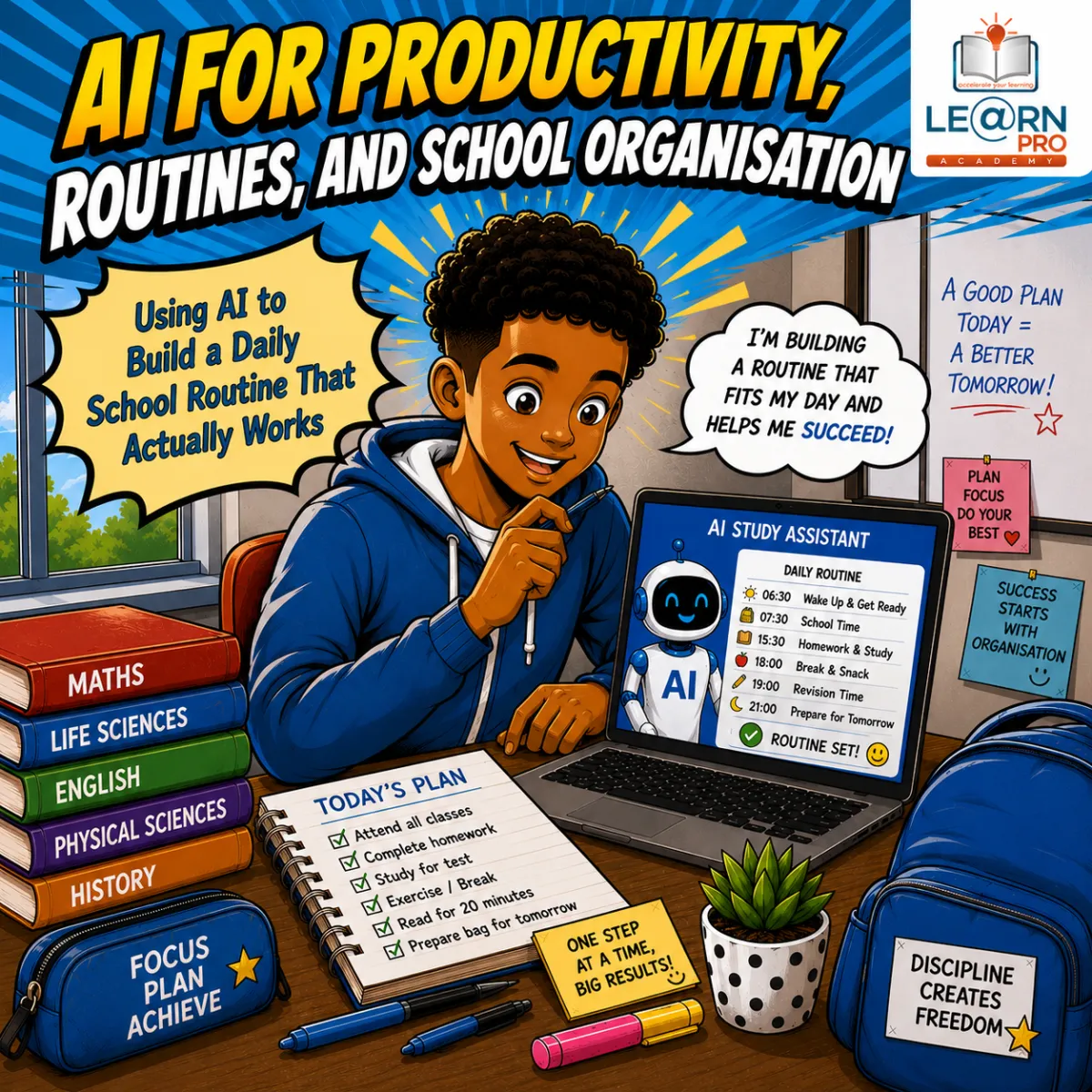
Using AI to Build a Daily School Routine That Actually Works
This is article #2 of 5 in the AI for Productivity, Routines, and School Organization Series
Introduction
Every learner has heard the advice: "You need a good routine." Teachers, parents, and successful students often talk about the importance of following a daily schedule. Yet many learners still find it difficult to build a routine that actually works.
The problem is not that routines are a bad idea. The problem is that many routines look perfect on paper but are impossible to follow in real life. Some learners travel long distances to school. Others have sport practice, family responsibilities, part-time jobs, or younger siblings to help care for. Every learner's life is different.
This is where Artificial Intelligence (AI) can become a helpful planning partner. AI cannot force you to follow a routine, but it can help you create one that fits your real life instead of an ideal situation. It can organise your schoolwork, suggest realistic study times, help balance homework with rest, and adjust your schedule when unexpected events happen.
The goal is not to let AI control your day. The goal is to use AI as a planning tool that helps you build healthy habits, reduce stress, and make better use of your time.
Why Daily Routines Matter
Many learners think routines are boring because they imagine every minute of the day being planned. A good routine is not about removing freedom. It is about reducing confusion.
When you know what comes next, you spend less time wondering what to do and more time actually doing it.
A daily routine helps you:
Arrive at school prepared.
Complete homework on time.
Study regularly instead of cramming.
Sleep enough every night.
Reduce stress.
Build confidence.
Create healthy habits.
Balance school with your personal life.
Successful learners often have different personalities and abilities, but most of them have one thing in common — they follow consistent routines.
Why Many School Routines Fail
Many learners copy routines from social media or YouTube without thinking about whether they fit their own lives.
For example, you may see a video showing a learner waking up at 4:30 a.m., exercising for an hour, studying before school, attending extra lessons, and still having time to relax.
That routine may work for someone else, but it may not work for you.
A routine usually fails because it is:
Too strict.
Too busy.
Unrealistic.
Based on someone else's lifestyle.
Missing time for rest.
Ignoring transport time.
Ignoring family responsibilities.
Difficult to maintain every day.
The best routine is one that you can follow consistently—not one that looks impressive.
How AI Can Help You Build A Personal Routine
AI works best when you give it information about your own life.
Instead of asking: "Make me a study routine."
Try asking: "I am a Grade 11 learner. I leave home at 6:00 a.m., get home at 4:00 p.m., have soccer practice on Tuesdays and Thursdays, and usually spend one hour on homework. Help me build a realistic weekday routine."
The more accurate your information, the more useful AI's suggestions become.
AI can consider:
School hours.
Transport time.
Homework.
Assignments.
Test preparation.
Sports.
Family responsibilities.
Religious activities.
Hobbies.
Bedtime.
Free time.
This creates a routine that fits your life instead of someone else's.
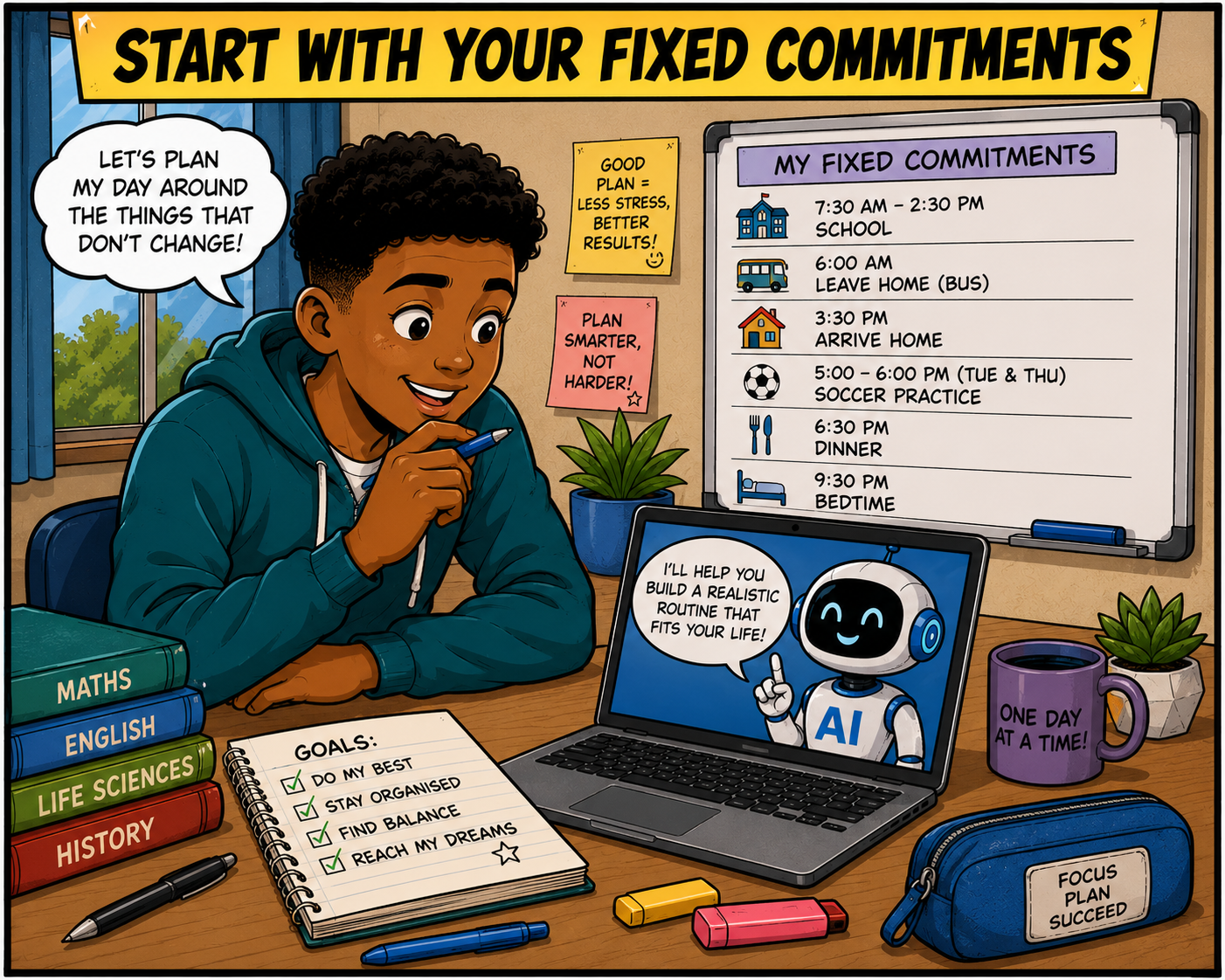
Start With Your Fixed Commitments
The easiest way to build a routine is to begin with the activities that cannot change.
These include:
School hours.
Bus or taxi times.
Sports practice.
Family responsibilities.
Religious commitments.
Meals.
Bedtime.
These are called fixed commitments because they happen at specific times.
Once they are in your timetable, AI can help organise everything else around them.
For example:
6:00 a.m.
Wake up.
7:30 a.m.–2:30 p.m.
School.
3:30 p.m.
Arrive home.
5:00–6:00 p.m.
Soccer practice.
The remaining time becomes easier to plan.
Build Around Your Energy Levels
Not everyone works best at the same time. Some learners concentrate better after school. Others need a short break first. Some learners enjoy studying early in the morning before school.
AI can help you identify your most productive times.
You might ask: "I feel tired after school but work well after dinner. Help me organise my homework around this."
Or: "I concentrate best in the morning. How can I use that before school?"
Understanding your own energy levels helps create routines that feel natural.
Include Time To Rest
One of the biggest mistakes learners make is filling every free minute with work. Rest is not wasted time. Rest helps your brain recover so that you can learn more effectively.
A healthy routine includes:
Time to eat.
Time with family.
Exercise.
Hobbies.
Relaxation.
Enough sleep.
AI can remind you to include breaks instead of creating unrealistic schedules.
Remember that studying for four focused hours is often more effective than studying for eight exhausted hours.
Create A Simple After-School Routine
The hours after school are often the most important part of the day.
Without a plan, learners may spend hours watching videos or scrolling through social media before realising it is already late.
A simple routine might look like this:
4:00 p.m.
Arrive home.
4:00–4:30
Rest and eat.
4:30–5:30
Homework.
5:30–5:45
Short break.
5:45–6:30
Study for upcoming tests.
6:30
Dinner.
7:00–8:00
Complete assignments or revision.
8:00
Relax.
9:30
Prepare for bed.
AI can adjust this schedule depending on your daily responsibilities.
Use AI To Balance Different Subjects
Some learners spend all their time on their favourite subject and avoid the subjects they find difficult. AI can help create balance.
Instead of studying Mathematics every day, AI may suggest rotating subjects.
For example:
Monday: Mathematics and English.
Tuesday: Life Sciences and Geography.
Wednesday: Accounting and Afrikaans.
Thursday: History and Mathematics.
Friday: Revision and catch-up work.
This prevents one subject from being neglected.
Plan For Busy Weeks
Not every week is the same.
Sometimes you have:
Three tests.
Two assignments.
Sports tournaments.
Family events.
School camps.
Your routine should be flexible. AI can help reorganise your week.
You might ask: "I have three tests this week and rugby practice. Help me adjust my routine."
Instead of giving up, you simply change the plan.
Build Small Habits Instead Of Big Changes
Many learners try to change everything at once.
For example:
Wake up two hours earlier.
Study four hours every night.
Stop using social media completely.
Exercise every day.
Read for an hour.
This usually lasts only a few days. Instead, AI can help you build one habit at a time.
For example:
Week 1: Complete homework before watching television.
Week 2: Add twenty minutes of revision.
Week 3: Pack your school bag every evening.
Week 4: Sleep thirty minutes earlier.
Small improvements become lasting habits.
Use AI To Prepare For Tests
Good routines change when tests are approaching. Instead of studying everything the night before, AI can spread revision over several days.
Example:
Monday: Mathematics revision.
Tuesday: History notes.
Wednesday: Life Sciences diagrams.
Thursday: Practice questions.
Friday: Quick review.
This reduces stress and improves memory.
Organise Your Morning Routine
Many learners begin the day in a rush. They cannot find their books, forget homework, or leave without eating breakfast. A simple morning routine helps prevent this.
For example:
Wake up.
Make your bed.
Get dressed.
Eat breakfast.
Check your timetable.
Pack your school bag.
Leave on time.
AI can suggest ways to improve your morning routine based on your own schedule.
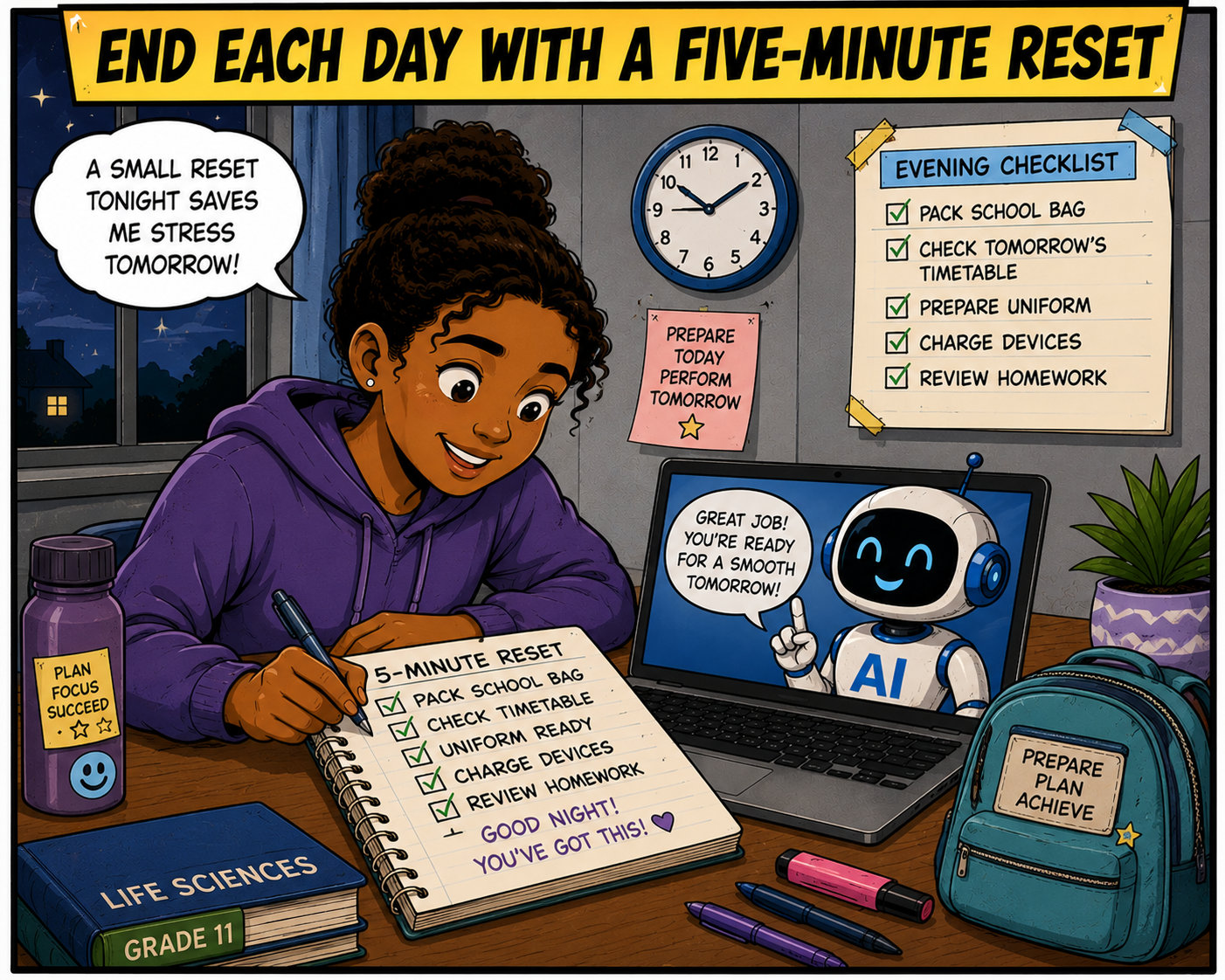
End Each Day With A Five-Minute Reset
One of the easiest habits to build is a daily reset.
Before going to bed:
Pack your school bag.
Charge your devices if needed.
Check tomorrow's timetable.
Prepare your uniform.
Review tomorrow's homework.
This small habit saves time every morning.
AI can even generate a personalised evening checklist.
Learn To Adjust Your Routine
No routine is perfect.
Sometimes:
A teacher gives unexpected homework.
A family event changes your plans.
You become sick.
A sports practice runs late.
Instead of feeling like you have failed, simply adjust the routine. AI is useful because it can quickly reorganise your schedule.
For example: "I missed yesterday's homework because I was sick. Help me rearrange the rest of my week."
Good routines are flexible.
Avoid Comparing Yourself With Others
One learner may study two hours every evening.
Another learner may need only one hour.
One learner may travel fifteen minutes to school.
Another may travel two hours.
Your routine should reflect your own life.
AI can personalise your routine instead of copying someone else's.
Success comes from consistency, not comparison.
Use AI To Review Your Routine Every Week
A routine should improve over time.
Once a week, ask yourself questions like:
What worked well?
Which parts were difficult?
Did I have enough sleep?
Did I finish my homework?
Which subject needed more attention?
Did I leave enough time to relax?
You can also ask AI: "Review my weekly routine and suggest realistic improvements."
Reflection helps you make small adjustments instead of starting over.
Common Mistakes To Avoid
When building a routine with AI, avoid these mistakes:
Trying To Follow Someone Else's Schedule
Your life is different from theirs.
Ignoring Sleep
Sleep is essential for learning, memory, and concentration.
Planning Every Minute
Leave space for unexpected events.
Skipping Breaks
Regular breaks improve focus.
Being Too Strict
Missing one day does not mean your routine has failed.
Depending On AI For Every Decision
Use AI as a guide, but learn to manage your own time as well.
Practical AI Prompts You Can Use
Here are some useful prompts to help you build and improve your routine:
"Help me build a daily school routine based on my timetable."
"Create a weekday routine for a Grade 12 learner."
"Help me balance homework, sport, and family responsibilities."
"How can I fit revision into my daily schedule?"
"Adjust my routine because I have tests next week."
"Review my current routine and suggest improvements."
"Help me create a better morning routine."
"Create a five-minute evening checklist before bed."
"Help me manage my time after school."
"Suggest a realistic study routine for weekends."
Remember that AI gives suggestions. You should always adapt them to fit your own responsibilities and priorities.
Good Routines Lead To Better Habits
A successful school routine is not about filling every minute with work. It is about creating a balanced day that gives you enough time to learn, rest, spend time with family and friends, and enjoy your hobbies.
AI can make this process much easier by helping you organise your time, identify your priorities, and adjust your schedule when life changes. Instead of guessing how to fit everything into one day, you can use AI to create a routine that matches your real responsibilities and energy levels.
The most important part of any routine is not how detailed it is —it is how consistently you follow it. Even a simple routine that you follow every day is more valuable than a perfect timetable that you abandon after one week.
As you continue through high school, your routine will change. Your subjects, workload, and responsibilities will grow, but the habit of planning your day will remain one of the most valuable skills you can develop. By using AI wisely as a planning partner rather than a decision-maker, you can build routines that reduce stress, improve your learning, and help you become a more confident, organised, and independent learner.
Additional Articles in the AI for Productivity, Routines, and School Organization Series
How to Use AI to Organise Homework and Assignment Deadlines
Using AI to Build a Daily School Routine That Actually Works
How AI Can Help You Stop Procrastinating on Schoolwork
Using AI to Balance School, Social Life, and Rest
How to Use AI to Build Better Study Habits Over Time
Disclaimer
AI Tools were used to assist with research. Remember to always cross-check everything that you read.