
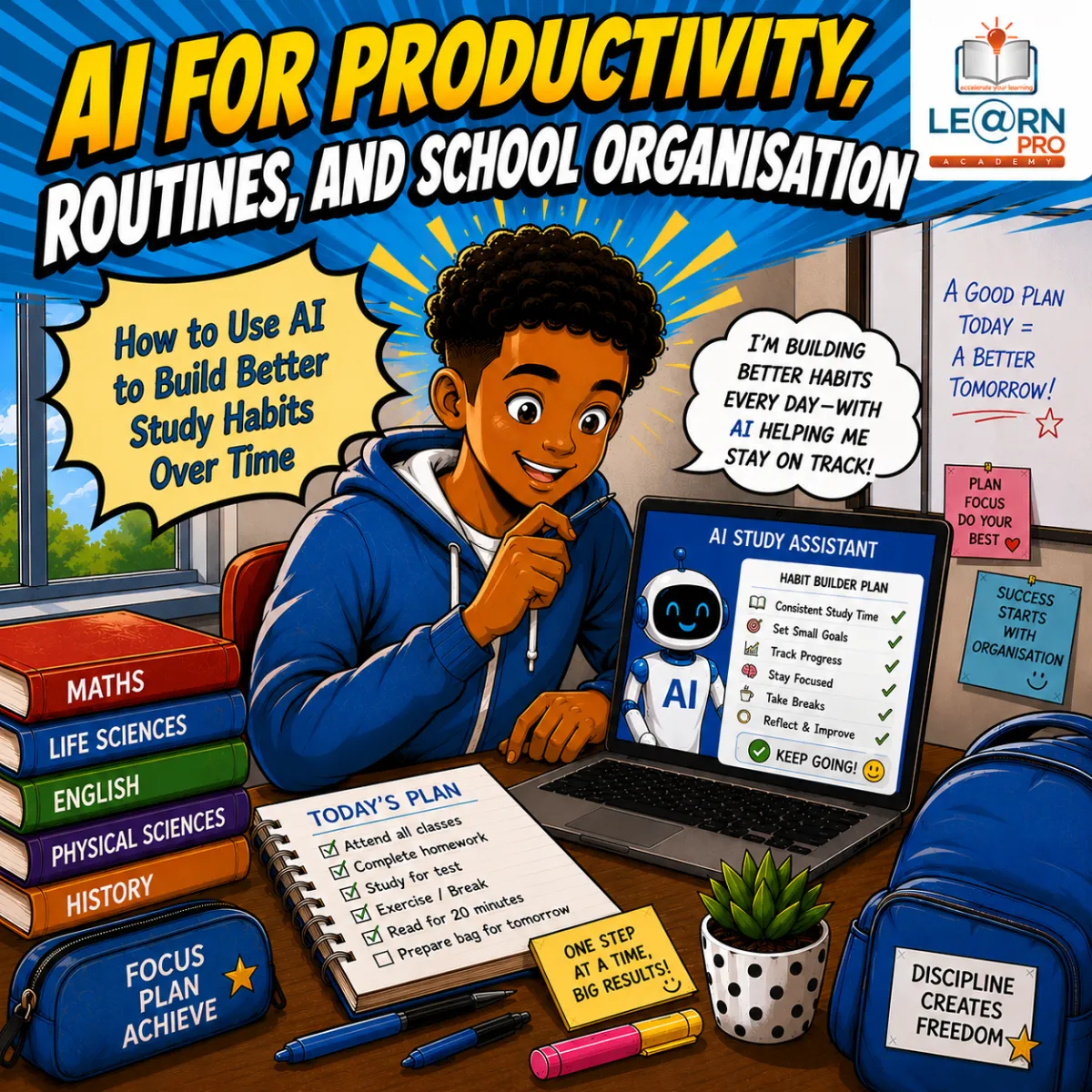
How to Use AI to Build Better Study Habits Over Time
This is article #5 of 5 in the AI for Productivity, Routines, and School Organization Series
Introduction
Every learner has heard someone say, "Good habits lead to success." Whether it comes from a teacher, parent, coach, or older sibling, the message is usually the same: success is not built on one great day of studying — it is built on many small, consistent actions repeated over time.
Unfortunately, many learners expect study habits to develop overnight. They decide to completely change their routine on a Monday, study for hours every evening, wake up early every day, and never become distracted again. A few days later, the routine feels impossible, and they give up.
The truth is that good study habits grow slowly. Just like learning a new sport, playing a musical instrument, or improving your fitness, building better habits takes patience and consistency.
Artificial Intelligence (AI) can make this process much easier. AI cannot create discipline for you, but it can help you build it. It can help you set realistic goals, create routines, track progress, identify weak areas, and encourage small improvements every week.
This article explains how learners can use AI to build study habits that last throughout high school and prepare them for future success.
What Are Study Habits?
Study habits are the regular behaviours that support effective learning.
They are not one-time actions.
They are things you do consistently.
Examples include:
Completing homework every day.
Revising class notes regularly.
Starting assignments early.
Studying before tests instead of cramming.
Packing your school bag every evening.
Asking questions when you do not understand.
Managing your time well.
Getting enough sleep before exams.
Good habits make studying feel easier because they become part of your daily routine.
Why Good Habits Matter More Than Occasional Effort
Many learners work extremely hard just before examinations. While this may help in the short term, it is difficult to maintain.
Compare these two learners:
Learner A studies for four hours the night before every test.
Learner B studies for thirty minutes every day.
Over an entire school year, Learner B is likely to remember more information, experience less stress, and feel more confident because learning happens gradually.
Consistency usually beats occasional bursts of effort.
Why Building Habits Can Feel Difficult
Building habits is challenging because your brain prefers familiar routines. When you try something new, it often feels uncomfortable.
Learners may struggle because they:
Forget their plans.
Lose motivation.
Become distracted.
Expect quick results.
Try to change too much at once.
Become discouraged after missing one day.
This is completely normal. Good habits are built through repetition, not perfection.
How AI Can Help You Build Better Habits
AI is useful because it can support your progress every day.
It can help you:
Set realistic goals.
Create daily reminders.
Suggest routines.
Break goals into smaller actions.
Track progress.
Review your habits.
Identify areas for improvement.
Encourage consistency.
Instead of trying to remember everything yourself, AI becomes a planning partner.
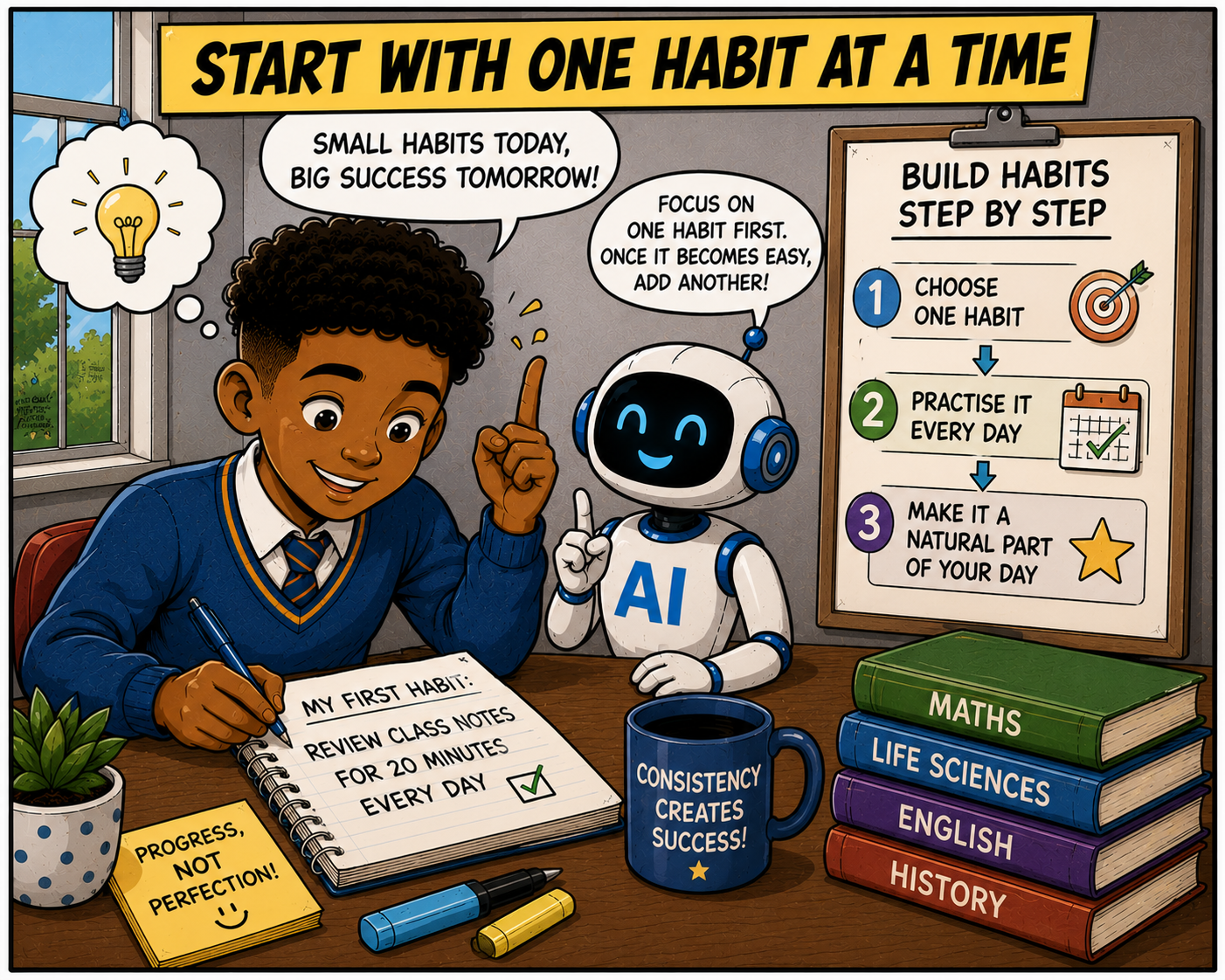
Start With One Habit At A Time
One of the biggest mistakes learners make is trying to improve everything at once.
For example:
Study longer.
Wake up earlier.
Read more.
Exercise every day.
Stop procrastinating.
Never use social media.
This usually becomes overwhelming. Instead, choose one habit.
For example: "I will spend twenty minutes reviewing today's lessons every afternoon."
Once that habit feels natural, add another one. AI can help you decide which habit to build first.
Set Realistic Goals
Good goals are clear and achievable.
Instead of saying: "I want better marks."
Say: "I will complete all my Mathematics homework this week."
Or: "I will revise Biology for twenty minutes every weekday."
AI can help turn big goals into smaller, measurable actions.
Build Habits Around Your Existing Routine
It is easier to build a new habit when you connect it to something you already do.
For example:
After arriving home from school:
→ Eat a snack.
Then:
→ Review class notes for twenty minutes.
Or:
After dinner:
→ Pack your school bag.
Or:
Before going to bed:
→ Check tomorrow's homework.
AI can help you identify the best places to add new habits into your existing routine.
Keep Study Sessions Short At First
Many learners believe studying for several hours every day is necessary. In reality, shorter, focused sessions often work better.
For example:
20 minutes of revision.
5-minute break.
20 minutes of homework.
This feels manageable and encourages consistency. AI can create study sessions that match your available time.
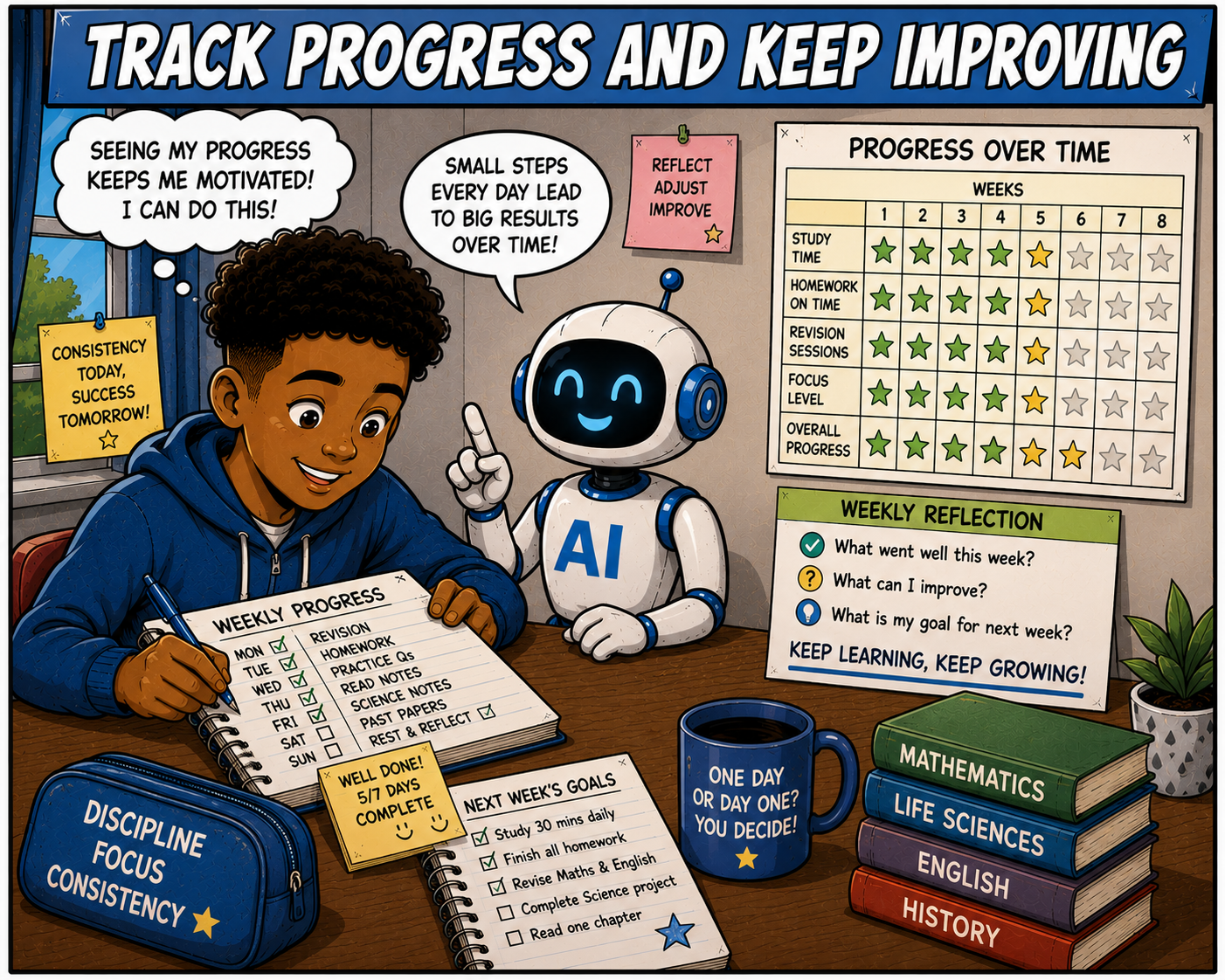
Track Your Progress
Seeing progress helps maintain motivation.
AI can help you record:
Homework completed.
Chapters revised.
Practice questions answered.
Assignments submitted.
Study hours.
Weekly goals achieved.
Watching your progress grow encourages you to continue.
Celebrate Small Wins
Many learners only celebrate final exam results. Instead, celebrate smaller achievements.
Examples include:
Completing your homework every day for one week.
Studying consistently for five days.
Improving your test mark.
Starting an assignment early.
Following your study routine.
AI can even suggest healthy rewards after reaching milestones.
Learn From Missed Days
Everyone misses a study session sometimes. Do not let one missed day become one missed week.
Instead, ask yourself:
Why did I miss today?
Was I tired?
Was my schedule unrealistic?
Did something unexpected happen?
Then simply continue tomorrow. AI can help adjust your plan instead of making you feel like you have failed.
Use AI To Build Better Revision Habits
Revision should happen regularly—not only before examinations.
AI can create revision schedules like:
Monday:
Mathematics.
Tuesday:
History.
Wednesday:
Life Sciences.
Thursday:
English.
Friday:
Accounting.
This spreads learning across the week and improves long-term memory.
Reduce Distractions
Good habits become easier when distractions are reduced.
Common distractions include:
Phones.
Social media.
Gaming.
Television.
Constant notifications.
AI can suggest focused study sessions.
For example:
Study for forty minutes.
Take a ten-minute break.
Return for another session.
Small periods of focused work are often more effective than trying to study for hours without concentration.
Build Confidence Through Consistency
Confidence grows through repeated success.
Every completed homework task...
Every revision session...
Every assignment submitted on time...
These small actions build confidence.
AI can help remind you how much progress you have already made.
Reflect Every Week
Reflection is one of the fastest ways to improve.
Every weekend, ask yourself:
Which habit improved this week?
Which habit needs more work?
What distracted me?
What should I change next week?
You can also ask AI: "Review my study habits and suggest one improvement for next week."
Small weekly improvements become major changes over time.
Create Positive Reminders
Many learners only notice their mistakes. Instead, use encouraging reminders.
Examples include:
Progress is better than perfection.
One study session at a time.
Small improvements matter.
Today's effort builds tomorrow's success.
Consistency beats cramming.
AI can even create personalised motivational reminders based on your goals.
Build Habits During The Whole School Year
Do not wait until examinations begin. The best habits are built throughout the year.
Good habits include:
Reading notes after every lesson.
Asking questions in class.
Completing homework on time.
Organising school files.
Preparing for tests early.
When examinations arrive, learners with strong habits often feel calmer because they have already done most of the work.
Avoid Becoming Dependent On AI
AI should support your habits—not replace them.
You should still:
Decide your own priorities.
Think independently.
Complete your own schoolwork.
Solve problems yourself.
Reflect honestly on your progress.
Over time, many good habits should continue even when AI is not available.
Common Mistakes To Avoid
When using AI to build study habits, avoid these mistakes:
Trying To Change Everything At Once
Choose one habit first.
Expecting Immediate Results
Habits take time.
Giving Up After One Bad Day
Simply begin again tomorrow.
Ignoring Rest
Healthy habits include sleep and relaxation.
Comparing Yourself With Other Learners
Focus on improving your own routine.
Using AI To Replace Your Own Discipline
AI provides guidance.
You provide the effort.
Practical AI Prompts You Can Use
Here are some useful prompts for building better study habits:
"Help me build one new study habit this week."
"Create a daily revision routine."
"Review my study habits and suggest improvements."
"Help me stay consistent with homework."
"Track my weekly study goals."
"Suggest healthy rewards for reaching study milestones."
"Help me improve my revision habits."
"Build a study routine around my school timetable."
"Help me avoid distractions while studying."
"Create a realistic long-term study plan."
The more honestly you describe your routine, the more personalised AI's suggestions will be.
Small Habits Create Big Success
Every successful learner has one thing in common: they build habits that support learning over time. They do not rely on last-minute effort or hope that motivation will suddenly appear. Instead, they develop routines that make studying a normal part of everyday life.
AI can make this journey easier by helping you plan realistic goals, organise your schedule, monitor your progress, and reflect on your improvements. It can remind you to stay consistent, celebrate your successes, and adjust your routine when life changes.
However, the real work still belongs to you. AI cannot attend your classes, complete your homework honestly, or practise your subjects on your behalf. Those are responsibilities that only you can fulfil.
Remember that every small habit matters. Reading your notes for twenty minutes, finishing your homework on time, asking one question in class, or preparing for tomorrow before going to bed may seem like small actions, but together they build a strong foundation for long-term success.
As you continue through high school, these habits will become part of who you are. They will not only help you earn better marks but also prepare you for college, university, the workplace, and lifelong learning. By using AI as a supportive coach rather than a shortcut, you can build study habits that will benefit you for many years to come.
Additional Articles in the AI for Productivity, Routines, and School Organization Series
How to Use AI to Organise Homework and Assignment Deadlines
Using AI to Build a Daily School Routine That Actually Works
How AI Can Help You Stop Procrastinating on Schoolwork
Using AI to Balance School, Social Life, and Rest
How to Use AI to Build Better Study Habits Over Time
Disclaimer
AI Tools were used to assist with research. Remember to always cross-check everything that you read.