
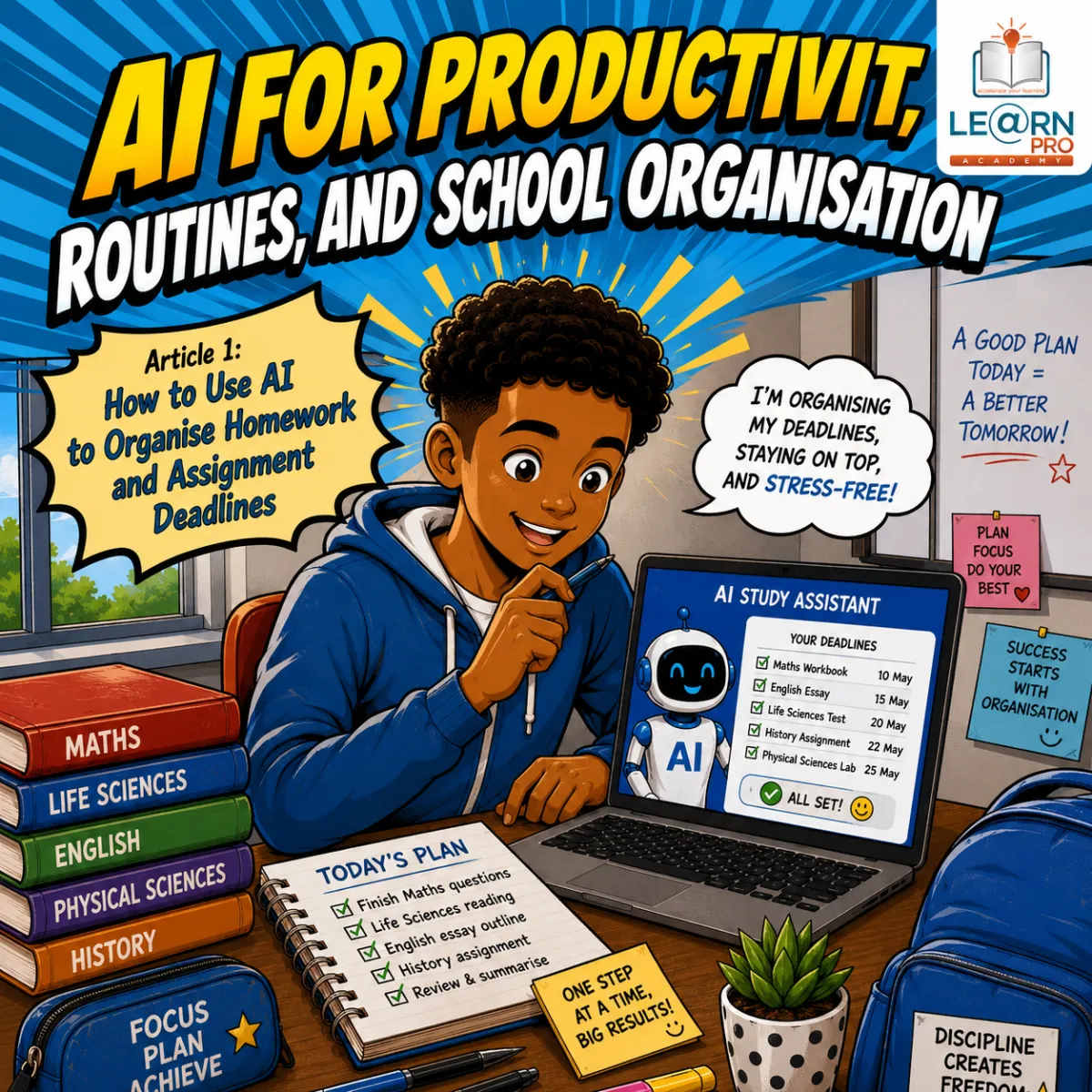
How to Use AI to Organise Homework and Assignment Deadlines
This is article #1 of 5 in the AI for Productivity, Routines, and School Organization Series
Introduction
School can become very busy, especially during the middle and end of a term. You may have homework from different subjects, assignments with different due dates, tests to study for, and projects that take several weeks to complete. It is easy to feel overwhelmed when everything seems to happen at once.
Many learners do not struggle because they are lazy or incapable. They struggle because they lose track of what needs to be done. A forgotten assignment, a missed deadline, or leaving work until the last minute can create unnecessary stress and lower marks.
Artificial Intelligence (AI) can help learners become more organised. It cannot do your schoolwork for you, but it can act like a personal planning assistant. AI can help you list your tasks, organise your priorities, create study schedules, break large assignments into smaller steps, and remind you what to focus on each day.
The goal is not to become dependent on AI. The goal is to use AI as a tool that helps you develop good organisational habits that will benefit you throughout high school and beyond.
Why Organisation Matters More Than Intelligence
Many learners believe that successful students are simply smarter than everyone else. While ability plays a role, good organisation is often the real difference between learners who succeed consistently and those who struggle.
Imagine two Grade 11 learners preparing for the same History assignment.
The first learner starts working two weeks before the deadline. They research one section each day, write a draft, check their work, and submit it on time.
The second learner remembers the assignment only the night before it is due. They rush through the work, miss important information, and submit something incomplete.
Both learners may have the same level of intelligence, but their organisation leads to very different results.
Being organised helps you:
Remember important deadlines.
Reduce stress.
Avoid last-minute panic.
Produce better-quality work.
Have more free time.
Build confidence.
Develop responsibility.
Organisation is a skill that anyone can learn.
What AI Can Do As A Planning Assistant
Think of AI as a digital organiser rather than a homework machine.
AI is especially useful because it can quickly organise information and suggest practical ways to manage your workload.
For example, AI can help you:
Create homework checklists.
Sort assignments by priority.
Build weekly study plans.
Estimate how long tasks may take.
Break large projects into smaller steps.
Suggest revision schedules.
Create reminders.
Help balance different subjects.
Instead of wondering where to begin, AI helps you create a clear plan.
Why Learners Miss Deadlines
Missing deadlines rarely happens because learners simply forget.
Usually, it happens because of one or more of these reasons:
Too many assignments at once.
No written homework list.
Underestimating how long work will take.
Waiting until the last minute.
Feeling overwhelmed.
Poor time management.
Spending too much time on phones or social media.
Forgetting instructions given in class.
AI cannot solve every problem, but it can help you identify these challenges before they become serious.
Start By Collecting Everything In One Place
The first step towards better organisation is simple. Stop trying to remember everything. Instead, keep all your school tasks together.
This could include:
Homework.
Assignments.
Projects.
Practical tasks.
Oral presentations.
Test dates.
Exam dates.
Sports commitments.
Club activities.
Once everything is listed, AI can help organise it.
For example, you could ask: "Help me organise these school tasks by due date."
Or: "Which assignments should I complete first?"
AI can turn a confusing list into a clear action plan.
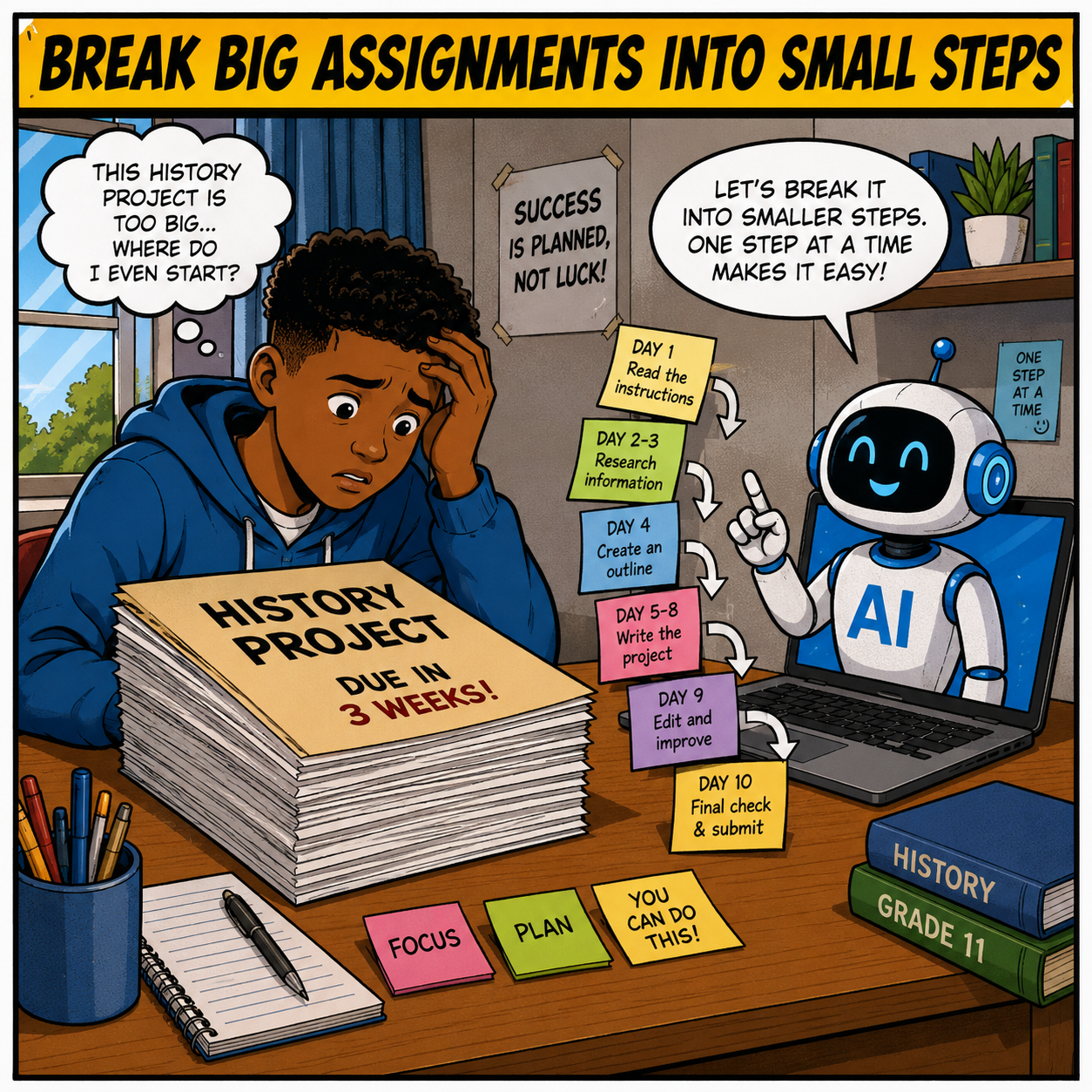
Break Big Assignments Into Small Steps
Large assignments often feel difficult because learners only see one huge task. AI helps by breaking large pieces of work into smaller jobs. Imagine your teacher gives you a Life Sciences research project due in three weeks.
Instead of thinking: "I have a huge project."
AI might suggest:
Day 1:
Read the instructions.
Understand the topic.
Day 2:
Research information.
Day 3:
Collect pictures or diagrams.
Day 4:
Create an outline.
Day 5:
Write the introduction.
Day 6:
Write the first section.
Day 7:
Continue writing.
Day 8:
Finish the report.
Day 9:
Edit and improve.
Day 10:
Print or submit.
Now the project feels much easier because every day has one small goal.
Learn To Prioritise Your Work
Not every task has the same importance. AI can help learners decide what should be completed first.
One simple method is to organise work into four groups:
Urgent and Important
Complete these immediately.
Examples:
Homework due tomorrow.
Test tomorrow.
Assignment due today.
Important But Not Urgent
Plan these early.
Examples:
Project due next week.
Exam revision.
Oral presentation preparation.
Less Important
Complete these after important schoolwork.
Examples:
Optional reading.
Extra practice.
Not Important Right Now
Activities like endless scrolling on social media should wait until important work is finished.
AI can help sort your task list into these categories.
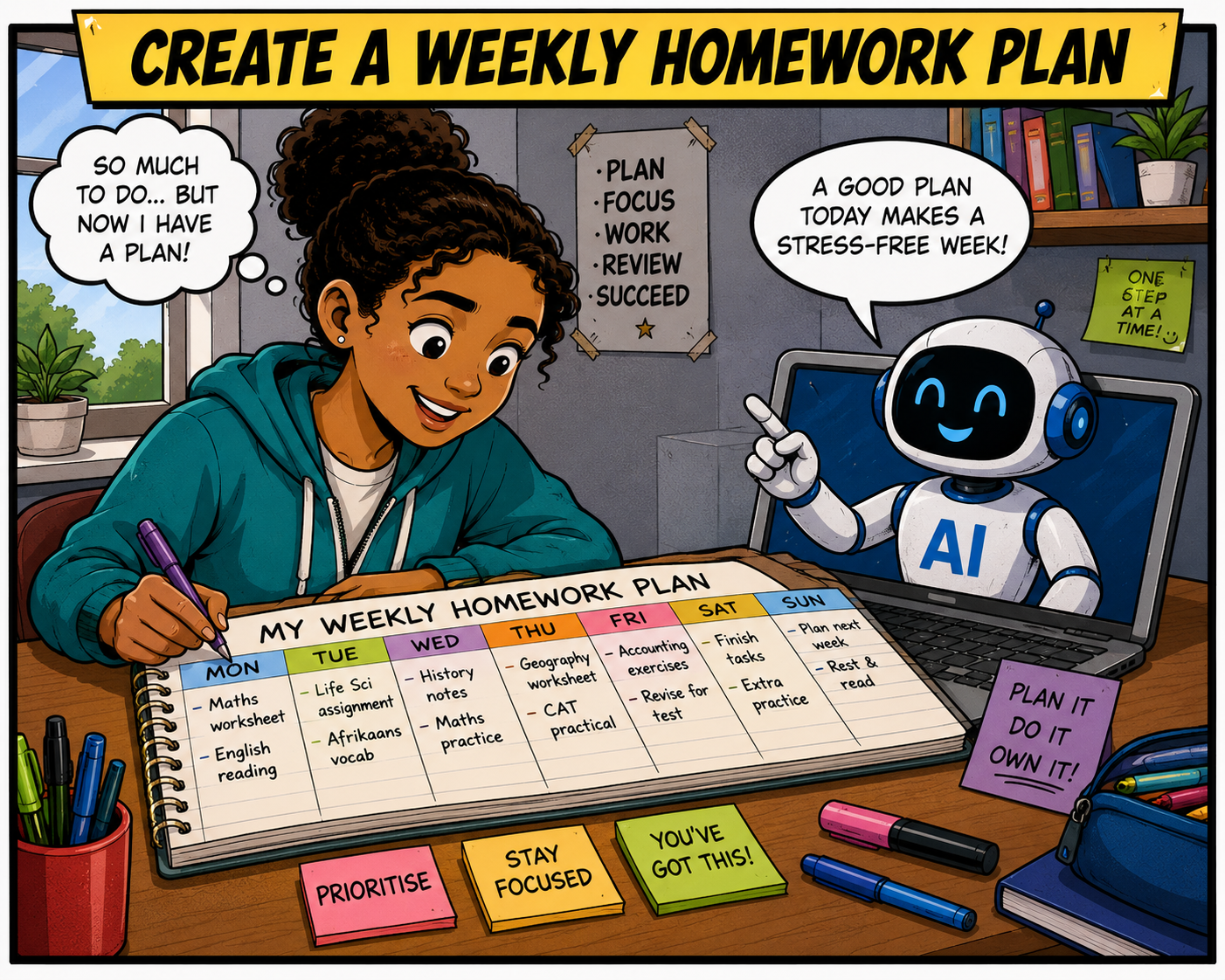
Create A Weekly Homework Plan
Looking at an entire month's workload can feel stressful. Instead, focus on one week at a time. AI can help build a realistic weekly timetable.
For example:
Monday:
Maths homework
English reading
Geography revision
Tuesday:
Life Sciences assignment
Afrikaans homework
Wednesday:
Study for Friday's test
Complete CAT practical
Thursday:
Finish assignment
Revise Mathematics
Friday:
Check next week's homework
Organise files
Saturday:
Catch up on unfinished work
Sunday:
Prepare for Monday
A weekly plan helps you stay in control without feeling overwhelmed.
Plan Your Day Instead Of Guessing
Many learners start homework without deciding what they want to achieve. This often leads to wasting time. Instead, ask AI to help create a daily plan.
For example:
4:00–4:20
Snack and rest after school.
4:20–5:00
Mathematics homework.
5:00–5:15
Short break.
5:15–6:00
History assignment.
6:00–6:30
Dinner.
6:30–7:15
Study for Friday's test.
7:15–7:30
Pack school bag.
Having a plan makes it easier to stay focused.
Use AI To Estimate Time
Many learners underestimate how long homework will take. A task that seems like thirty minutes may actually require two hours. AI can help estimate realistic times.
For example: "I have ten Maths questions, a two-page English essay, and a Geography worksheet. Help me estimate how long each task may take."
Although the estimates may not always be perfect, they help learners plan more realistically.
Create Simple Checklists
Checklists are one of the easiest ways to stay organised. Instead of remembering everything, simply tick off completed tasks.
AI can create daily checklists like:
□ Finish Maths worksheet
□ Read Chapter 5 in Geography
□ Revise Chemical Reactions
□ Print History assignment
□ Pack calculator
Each completed task gives you a sense of progress.
Keep Track Of Long-Term Projects
Some assignments take several weeks. These are often forgotten because the deadline seems far away. AI can help create progress milestones.
For example:
Week 1: Research
Week 2: Writing
Week 3: Editing
Week 4: Final submission
This approach prevents last-minute panic.
Organise Different Subjects Separately
Different subjects require different types of work. AI can help organise each subject individually.
For example:
Mathematics:
Homework
Practice questions
Formula revision
English:
Reading
Essay planning
Vocabulary
Accounting:
Exercises
Financial statements
Revision
Life Sciences:
Practical preparation
Diagrams
Definitions
Keeping subjects organised makes schoolwork much easier to manage.
Use AI To Prepare For Busy Weeks
Some weeks include:
Tests
Assignments
Sports
Cultural activities
Family responsibilities
These weeks require extra planning.
You could ask AI: "Next week I have two tests, one assignment, rugby practice, and a family event. Help me create a realistic study plan."
AI can spread your workload across several days instead of leaving everything until the end.
Build A Homework Routine
Good organisation becomes easier when you follow the same routine every day.
For example:
After school:
Rest.
Eat a snack.
Then:
Check homework list.
Next:
Complete the hardest subject first.
Take a short break.
Continue with the remaining work.
Finally:
Pack your school bag.
Check tomorrow's timetable.
Repeating this routine every day helps build good habits.
Use AI To Reflect At The End Of Each Week
Organisation is not only about planning. It is also about improving. Every Friday or Sunday, spend a few minutes reviewing your week.
Ask AI questions like:
Which tasks did I finish?
What caused delays?
Which subjects took longer than expected?
What should I improve next week?
Reflection helps you become more organised over time.
Avoid Becoming Too Dependent On AI
AI is a helpful assistant, but it should never replace your own responsibility.
You should still:
Read school notices yourself.
Write down homework in class.
Listen carefully to teachers.
Check assignment instructions.
Keep your own calendar.
Learn to manage your time.
If AI is unavailable, you should still be able to organise your work independently.
Think of AI as training wheels that help you develop good habits — not as something that does everything for you.
Common Mistakes Learners Should Avoid
When using AI for organisation, avoid these common mistakes:
Trying To Organise Too Much At Once
Start with today's homework before planning the next month.
Ignoring The Plan
A timetable only works if you follow it.
Making Unrealistic Schedules
Do not plan six straight hours of homework after school. Include breaks, meals, and time to relax.
Forgetting About Rest
Good organisation includes enough sleep, exercise, and family time.
Using AI To Do The Homework Instead
AI should help you plan your work, not complete it for you. You learn best by thinking through the questions yourself.
Practical AI Prompts You Can Use
Here are some simple prompts that learners can try:
"Help me organise my homework by due date."
"Create a homework checklist for this week."
"Break this assignment into small daily tasks."
"Help me build a study timetable for my tests."
"Which task should I complete first?"
"Estimate how long these homework tasks may take."
"Help me balance homework, sport, and family time."
"What should I finish today if I only have two hours?"
"Help me prepare for next week's deadlines."
"Review my weekly study plan and suggest improvements."
Remember to personalise the information you give AI. The more accurate your list of tasks and deadlines, the more useful its suggestions will be.
Organisation Is A Skill You Build Every Day
No learner becomes perfectly organised overnight.
Good organisation grows through small daily habits. Writing down homework, checking deadlines, breaking work into smaller steps, and following a simple routine may not seem exciting, but these habits make a huge difference over time.
AI can support this process by helping you think ahead, manage your workload, and reduce the stress of trying to remember everything at once. It gives you a clearer picture of what needs to be done and helps you create realistic plans that fit your school life.
As you become more organised, you will often find that school feels less overwhelming. You are more likely to complete assignments on time, prepare properly for tests, and enjoy more free time because you are no longer rushing to meet deadlines.
The most successful learners are not always the ones with the highest natural ability. They are often the ones who consistently plan ahead, stay organised, and take responsibility for their learning. By using AI wisely—as a planning assistant rather than a shortcut — you can build habits that will help you succeed throughout high school, in further education, and in your future career.
Additional Articles in the AI for Productivity, Routines, and School Organization Series
How to Use AI to Organise Homework and Assignment Deadlines
Using AI to Build a Daily School Routine That Actually Works
How AI Can Help You Stop Procrastinating on Schoolwork
Using AI to Balance School, Social Life, and Rest
How to Use AI to Build Better Study Habits Over Time
Disclaimer
AI Tools were used to assist with research. Remember to always cross-check everything that you read.