
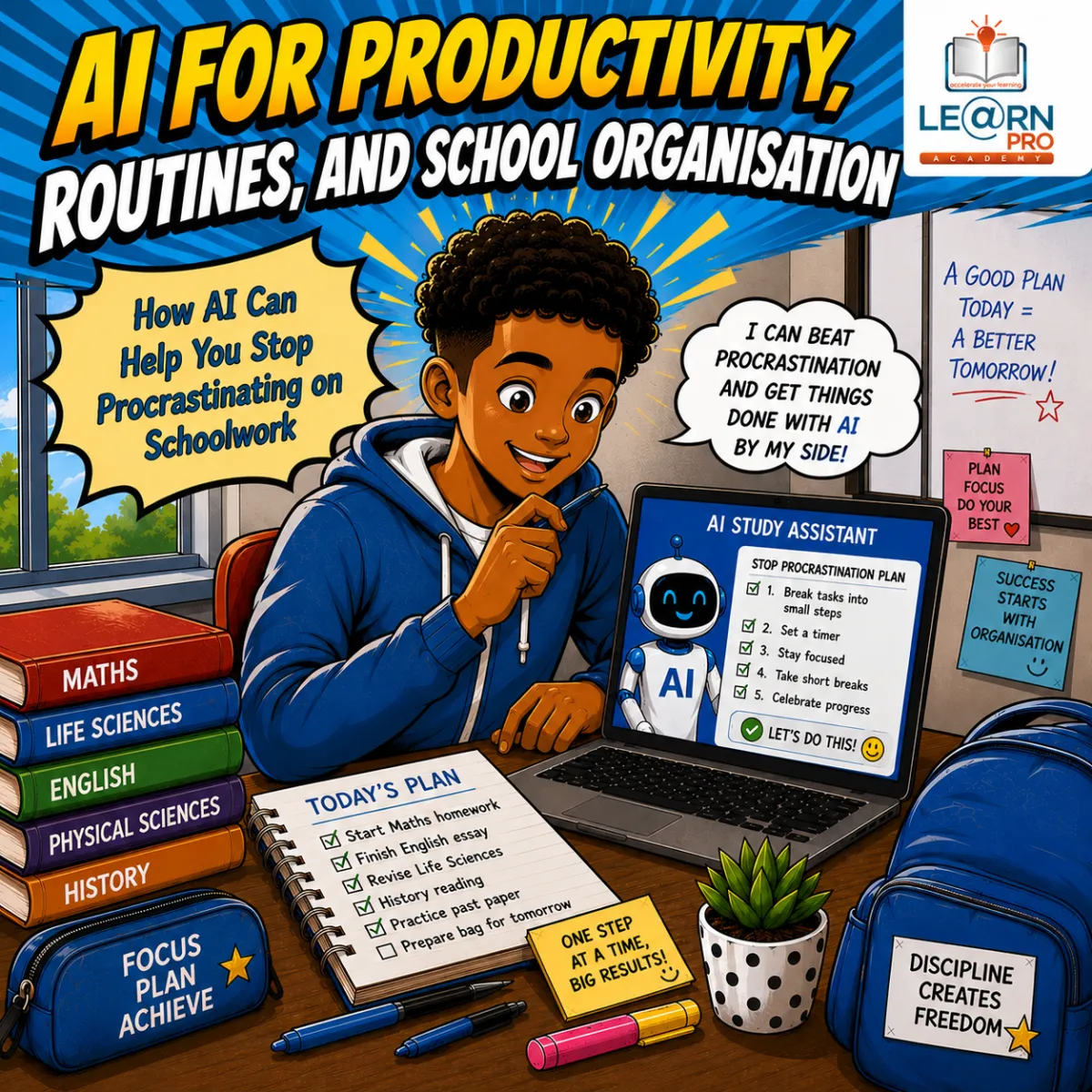
How AI Can Help You Stop Procrastinating on Schoolwork
This is article #3 of 5 in the AI for Productivity, Routines, and School Organization Series
Introduction
Almost every learner has experienced procrastination. You know you have homework to complete, a test to study for, or an assignment due next week, but instead of getting started, you decide to do something else. You tell yourself, "I'll start later." Before you know it, later becomes tomorrow, and tomorrow becomes the night before the deadline.
Procrastination is one of the biggest challenges many high school learners face. It affects learners who achieve high marks as well as those who struggle at school. It is not always caused by laziness. Often, learners procrastinate because they feel overwhelmed, unsure where to begin, worried about making mistakes, or simply distracted by other activities.
Artificial Intelligence (AI) cannot magically make procrastination disappear. However, it can become a useful coach that helps you take the first step. AI can break large tasks into smaller ones, create simple action plans, encourage healthy routines, and help you build confidence instead of feeling overwhelmed.
The goal is not to let AI do your work. The goal is to use AI to make getting started easier so that you can develop self-discipline and better study habits over time.
What Is Procrastination?
Procrastination means delaying work that you know you should be doing, even though you understand that waiting may cause problems later.
It often sounds like this:
"I'll start after dinner."
"I'll do it tomorrow."
"I still have plenty of time."
"I'm not in the mood right now."
"I'll wait until I feel motivated."
Unfortunately, waiting for motivation often means waiting far too long.
The important thing to remember is that procrastination is a behaviour — not a personality. It is something you can change.
Why Learners Procrastinate
Many people believe procrastination is caused by laziness. In reality, there are many reasons why learners put work off.
Some common reasons include:
Feeling overwhelmed by a large assignment.
Fear of getting the answers wrong.
Not understanding the work.
Poor organisation.
Too many distractions.
Low confidence.
Lack of motivation.
Perfectionism.
Feeling tired after school.
Not knowing where to begin.
Understanding why you procrastinate is the first step towards overcoming it.
How AI Can Help Without Doing The Work For You
AI should never complete your homework or write your assignments for you. Instead, it should help you think more clearly and organise your approach.
AI can help you:
Understand assignment instructions.
Break work into smaller tasks.
Suggest realistic timelines.
Create daily checklists.
Build study routines.
Explain difficult concepts.
Encourage regular progress.
Review your study plan.
Think of AI as a coach standing beside you, not someone taking the test on your behalf.
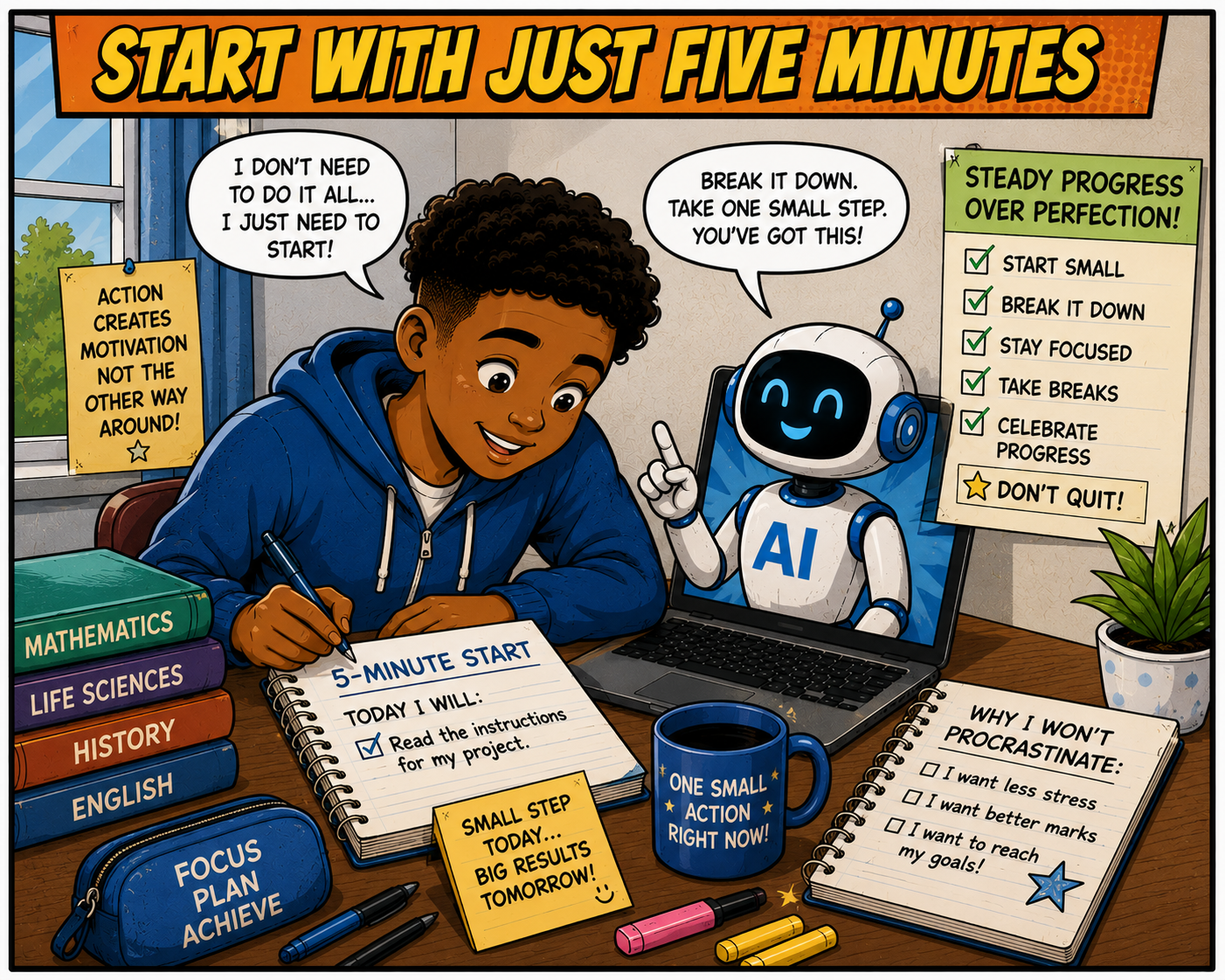
Start With Just Five Minutes
One of the biggest challenges is simply getting started. Many learners think they need two or three free hours before beginning an assignment. That is not true.
Often, five focused minutes are enough to overcome the hardest part. Ask AI: "Give me one small task that I can complete in five minutes."
For example:
Instead of: Complete my Geography project
AI might suggest:
Read the instructions.
Create a title page.
Write down three research questions.
Find one reliable source.
Create a document to save your work.
After completing one small task, continuing often becomes much easier.
Break Large Tasks Into Smaller Pieces
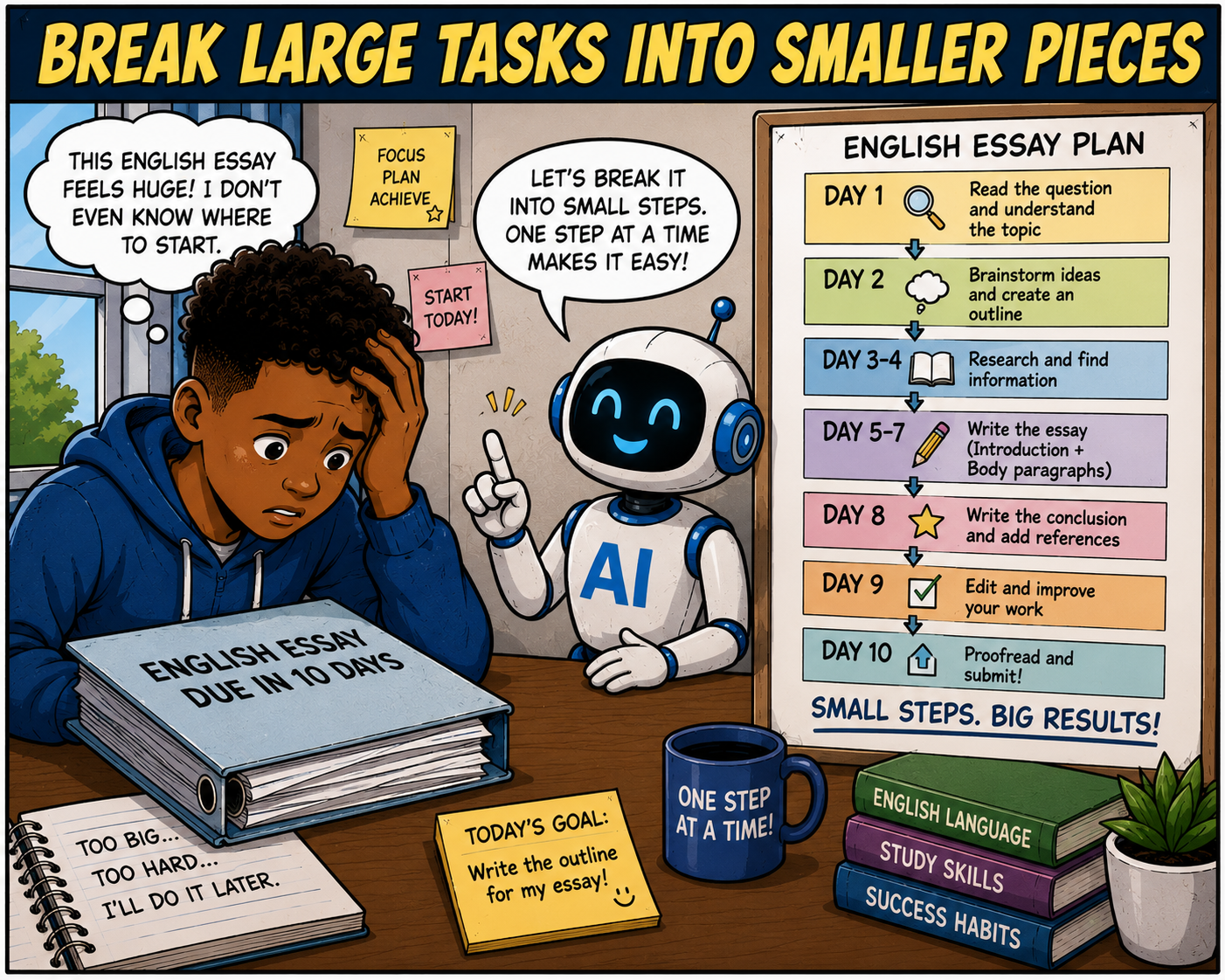
Large assignments feel frightening because they appear to be one enormous job. AI can divide them into manageable steps. Imagine you have an English essay due in ten days.
Instead of seeing one large task, AI might suggest:
Day 1: Read the topic.
Day 2: Brainstorm ideas.
Day 3: Research information.
Day 4: Write the introduction.
Day 5: Write the first paragraph.
Day 6: Write the second paragraph.
Day 7: Complete the conclusion.
Day 8: Edit.
Day 9: Proofread.
Day 10: Submit.
Each day feels achievable.
Stop Waiting For Motivation
Many learners believe they should only study when they feel motivated. The truth is that motivation often comes after you begin working. Action creates motivation — not the other way around.
AI can remind you of this by helping you create simple action plans instead of waiting for the perfect moment.
Instead of asking: "How can I become motivated?"
Try asking: "What is the smallest action I can take right now?"
That question is far more useful.
Use AI To Remove Decision Fatigue
Sometimes learners procrastinate because they keep asking themselves:
What should I do first?
Which subject is most important?
Should I study or complete homework?
Which assignment is due next?
Making too many decisions becomes exhausting. AI can reduce this mental load.
Ask: "Help me decide what I should focus on today."
A clear answer removes uncertainty and makes starting easier.
Create A Daily Action List
Long to-do lists often feel discouraging. Instead, ask AI to create a short daily action list.
For example:
Today's Tasks
✔ Complete Mathematics homework.
✔ Study Life Sciences for 30 minutes.
✔ Read one chapter of English.
✔ Pack school bag.
Completing a few realistic tasks every day is more effective than creating impossible lists.
Understand Why You Avoid Certain Subjects
Most learners procrastinate more in some subjects than others.
You may delay:
Mathematics because it feels difficult.
English essays because writing takes time.
History because there is lots of reading.
AI can help you understand why. For example: "I always avoid Accounting homework. Help me understand why."
Sometimes the answer is not laziness. You may simply need more practice or a different learning approach.
Build Better Study Habits
Procrastination becomes weaker when good habits become stronger.
AI can help you build habits like:
Starting homework at the same time every day.
Studying before using social media.
Taking regular breaks.
Reviewing class notes daily.
Preparing for tests early.
Small daily habits reduce the temptation to delay work.
Remove Distractions
Modern learners face more distractions than ever before.
These include:
Social media.
Video streaming.
Gaming.
Constant phone notifications.
Messaging apps.
AI can help you create distraction-free study sessions. For example: "Help me create a 45-minute focused study session."
The plan may include:
Phone on silent.
One subject only.
Ten-minute break afterwards.
No social media until the session is complete.
Focus becomes much easier.
Reward Progress Instead Of Waiting For Perfection
Some learners refuse to feel proud until everything is finished. This makes studying feel endless.
Instead, celebrate progress.
Examples include:
Completing one chapter.
Finishing ten Maths questions.
Writing the introduction.
Revising one topic.
AI can even suggest small rewards after completing study sessions.
These rewards could include:
Watching one episode of a favourite programme.
Playing a game for thirty minutes.
Going for a walk.
Spending time with friends.
Progress deserves recognition.
Use AI To Reduce Stress Before Deadlines
The closer a deadline gets, the more anxious many learners become. Ironically, stress often causes even more procrastination. AI can help reduce this pressure by creating a recovery plan.
For example: "My assignment is due in three days and I haven't started. Help me create the best possible plan."
Although it is always better to start early, having a structured plan is better than panicking.
Learn From Your Previous Mistakes
Every learner has delayed work at some point. Instead of feeling guilty, use the experience to improve.
Ask AI questions like:
Why did I leave this assignment so late?
What distracted me?
What should I change next time?
How can I avoid repeating this mistake?
Reflection turns mistakes into learning opportunities.
Use AI As An Accountability Partner
Sometimes simply telling someone your goal makes you more likely to complete it. AI can become an accountability partner.
For example:
You tell AI: "Today I want to finish my Geography homework before 6:00 p.m."
Later you ask: "Help me review what I completed today."
This creates a sense of responsibility without replacing your own self-discipline.
Build Confidence One Small Success At A Time
Confidence grows through action. Every completed task proves that you are capable of making progress. AI can help you notice your achievements.
Instead of focusing on everything still left to do, it can help you recognise:
Assignments completed.
Revision sessions finished.
Homework submitted.
New habits developed.
Better time management.
Small victories become long-term confidence.
Avoid Depending On AI
AI should support your progress—not become your excuse.
Do not ask AI to:
Complete assignments.
Write essays you submit as your own.
Answer tests dishonestly.
Replace your own thinking.
Instead, use AI to:
Plan.
Organise.
Explain.
Encourage.
Review.
The learning must always remain yours.
Common Mistakes To Avoid
When using AI to overcome procrastination, avoid these mistakes:
Waiting For The Perfect Plan
A simple plan followed today is better than a perfect plan that never begins.
Trying To Finish Everything At Once
Focus on one task.
Ignoring Breaks
Rest improves concentration.
Comparing Yourself To Other Learners
Everyone learns differently.
Believing Motivation Comes First
Action usually creates motivation.
Giving Up After One Bad Day
Missing one study session does not mean you have failed.
Simply begin again tomorrow.
Practical AI Prompts You Can Use
Here are some prompts that can help you stop procrastinating:
"Help me break this assignment into daily tasks."
"Give me one five-minute task to get started."
"Help me prioritise today's homework."
"Create a 45-minute focused study session."
"Help me organise my work for this week."
"Review my study habits and suggest improvements."
"Help me stay focused while studying."
"Explain why I keep avoiding this subject."
"Help me prepare for next week's deadlines."
"Suggest a realistic study routine that reduces procrastination."
The better the information you give AI, the more useful its suggestions will be.
Progress Begins With The First Step
Procrastination is something almost every learner experiences, but it does not have to control your school life. Delaying homework, revision, or assignments may feel easier in the moment, yet it often creates more stress, less confidence, and rushed work later.
AI can help by making the first step feel smaller. Instead of looking at one overwhelming task, you can break it into simple actions, organise your priorities, and build routines that encourage steady progress. Over time, these small actions become habits, and those habits become self-discipline.
Remember that AI is a support tool, not a replacement for your own effort. Real learning still comes from reading, thinking, practising, making mistakes, and improving through experience. AI simply helps remove some of the confusion that makes getting started difficult.
Every assignment you begin on time, every study session you complete, and every deadline you meet is another step towards becoming a more confident and independent learner. You do not need to wait until you feel perfectly motivated. Start with one small action today, and let that action lead to the next. Consistent progress, not perfection, is what leads to long-term success in school and beyond.
Additional Articles in the AI for Productivity, Routines, and School Organization Series
How to Use AI to Organise Homework and Assignment Deadlines
Using AI to Build a Daily School Routine That Actually Works
How AI Can Help You Stop Procrastinating on Schoolwork
Using AI to Balance School, Social Life, and Rest
How to Use AI to Build Better Study Habits Over Time
Disclaimer
AI Tools were used to assist with research. Remember to always cross-check everything that you read.