
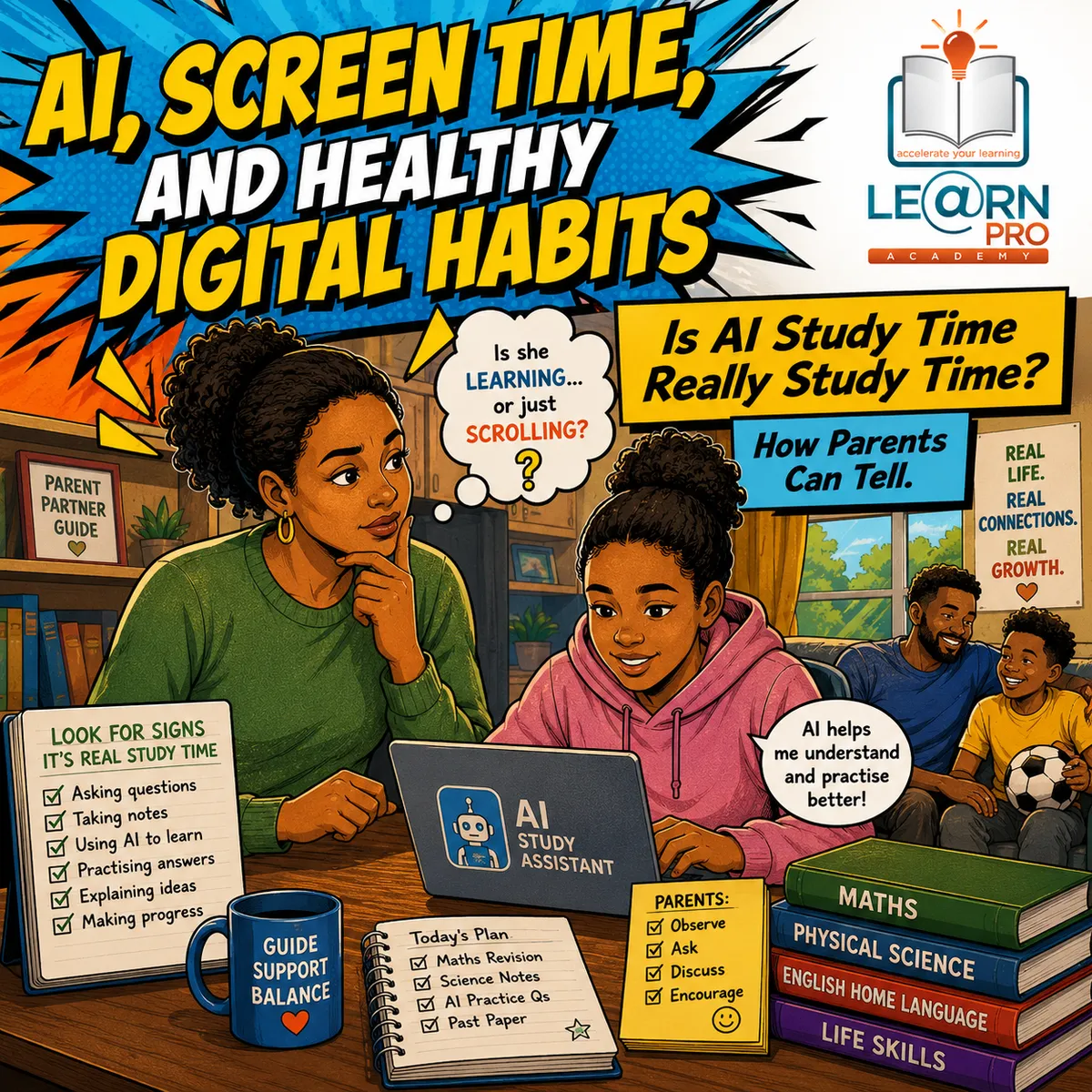
Is AI Study Time Really Study Time? How Parents Can Tell
This is article #1 of 5 in the AI, Screen Time, and Healthy Digital Habits Series
Introduction
Artificial intelligence (AI) has changed the way many high school learners study. Instead of opening only a textbook or notebook, learners may now spend hours looking at a laptop, tablet, or smartphone while asking AI to explain concepts, create quizzes, or help with assignments.
For many parents, this creates a new challenge.
A teenager may say, "I'm studying," but from across the room it can look exactly the same as watching videos, scrolling through social media, chatting with friends, or playing games. Since almost everything happens on the same device, it becomes difficult to know whether screen time is productive or simply another distraction.
This uncertainty can easily lead to conflict. Parents may feel their child is wasting time, while the learner feels they are not being trusted.
The good news is that parents do not need to become AI experts or constantly monitor every click. Instead, they can learn to recognise the signs of meaningful learning and encourage healthy study habits.
This article will help parents understand the difference between genuine AI-supported studying and screen time that only looks productive.
Why This Question Matters
Today's learners use digital devices for almost every part of school life.
They may:
Access online textbooks.
Watch educational videos.
Complete assignments.
Communicate with teachers.
Use school learning platforms.
Revise with AI.
Create flashcards.
Practise exam questions.
Because all these activities happen on one screen, it is impossible to judge learning simply by looking at the device.
A learner typing into ChatGPT for twenty minutes may be working extremely hard.
Another learner may spend the same twenty minutes switching between AI, WhatsApp, TikTok, Instagram, YouTube, and gaming without making real academic progress.
The screen looks identical.
The learning does not.
Productive Screen Time Looks Different From Passive Screen Time
Not all screen time is equal. Some screen time builds knowledge, thinking, and confidence. Other screen time simply fills time.
Parents benefit from asking a different question.
Instead of asking: "How many hours was my child on the computer?"
Ask: "What happened during those hours?"
Quality matters more than quantity.
Two focused hours of revision are usually more valuable than six distracted hours with constant interruptions.
What Genuine AI Study Time Looks Like
When AI is used well, the learner remains mentally active.
The learner is:
Reading carefully.
Thinking about answers.
Asking follow-up questions.
Comparing information.
Solving problems.
Making notes.
Correcting mistakes.
Testing understanding.
The AI is supporting learning — not replacing it.
For example, a Grade 11 Mathematics learner may ask AI: "Explain quadratic equations using a simpler example."
After reading the explanation, the learner then solves several problems independently.
This is productive learning. The learner is doing the thinking.
What Fake Study Time Often Looks Like
Sometimes learners appear busy but are not actually learning.
Examples include:
Constantly switching between apps.
Watching unrelated videos.
Checking notifications every few minutes.
Copying AI answers without reading them.
Asking AI to complete homework without understanding it.
Spending more time decorating notes than learning content.
Reading without remembering anything.
The learner may genuinely believe they have studied. However, very little information has been processed or remembered.
Busy does not always mean productive.
AI Should Encourage Thinking, Not Replace It
One of the biggest misunderstandings about AI is that faster always means better. Learning has never been about producing answers as quickly as possible.
Real learning happens when learners:
Think deeply.
Make mistakes.
Correct misunderstandings.
Connect new ideas with previous knowledge.
Practise repeatedly.
AI should make these processes easier—not remove them.
Parents should encourage their children to use AI to improve understanding rather than avoid thinking.
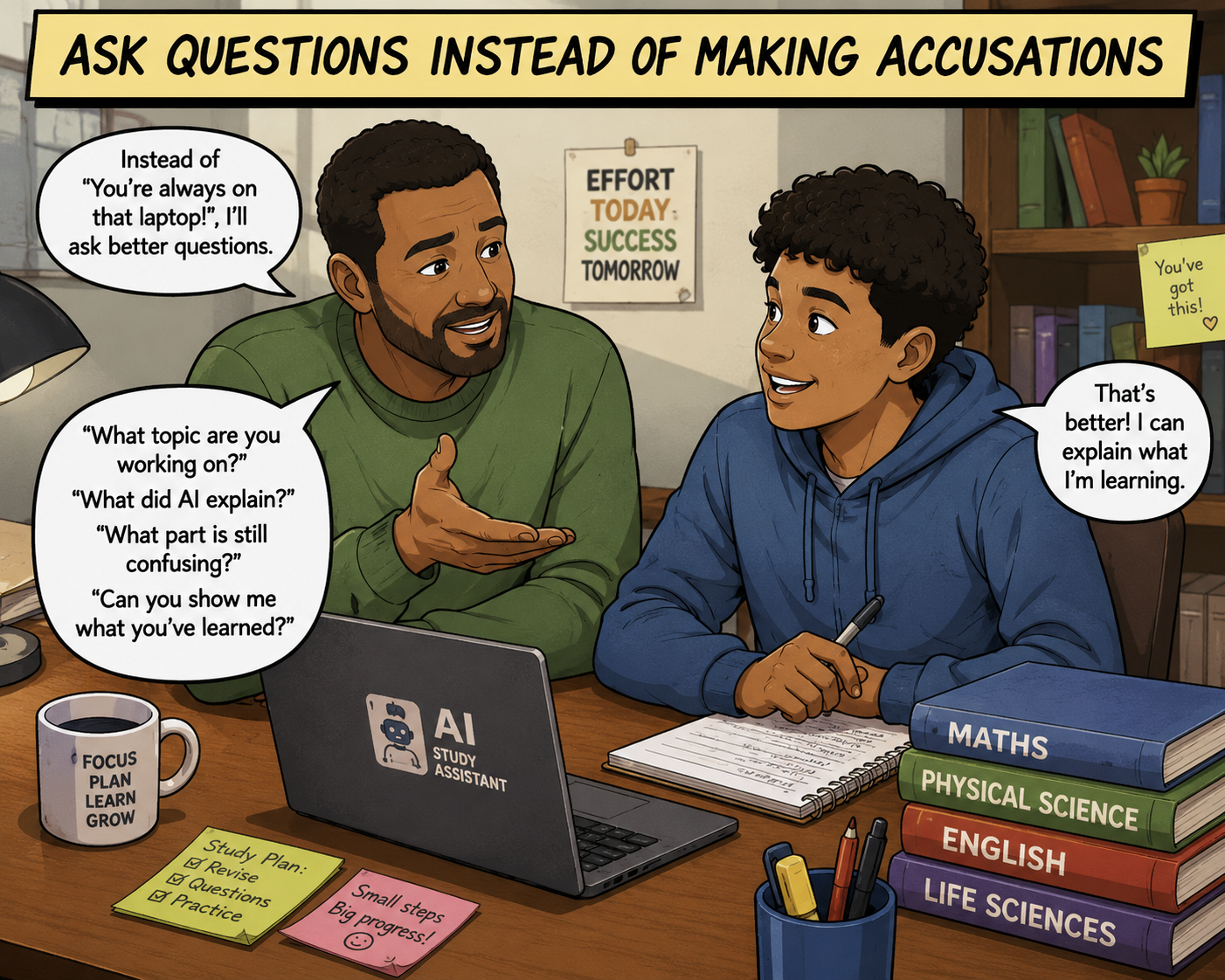
Ask Questions Instead Of Making Accusations
If parents immediately assume their child is wasting time, conversations often become arguments.
Instead of saying: "You've been on that phone all afternoon!"
Try asking:
"What topic are you working on?"
"What did AI explain today?"
"Can you show me what you've learned?"
"What part was difficult?"
"What questions did you ask?"
These questions encourage conversation rather than conflict.
They also help parents understand what is really happening.
A Learner Who Understands Can Usually Explain
One of the easiest ways to check genuine learning is to ask the learner to explain something.
Parents do not need to know the subject.
Simply ask: "Can you teach me what you learned today?"
If the learner can explain:
the main idea,
why it works,
how they solved a problem,
or how AI helped,
they probably understand the topic reasonably well. If they cannot explain anything beyond reading AI's answer aloud, more learning is needed.
Teaching someone else is one of the strongest signs of understanding.
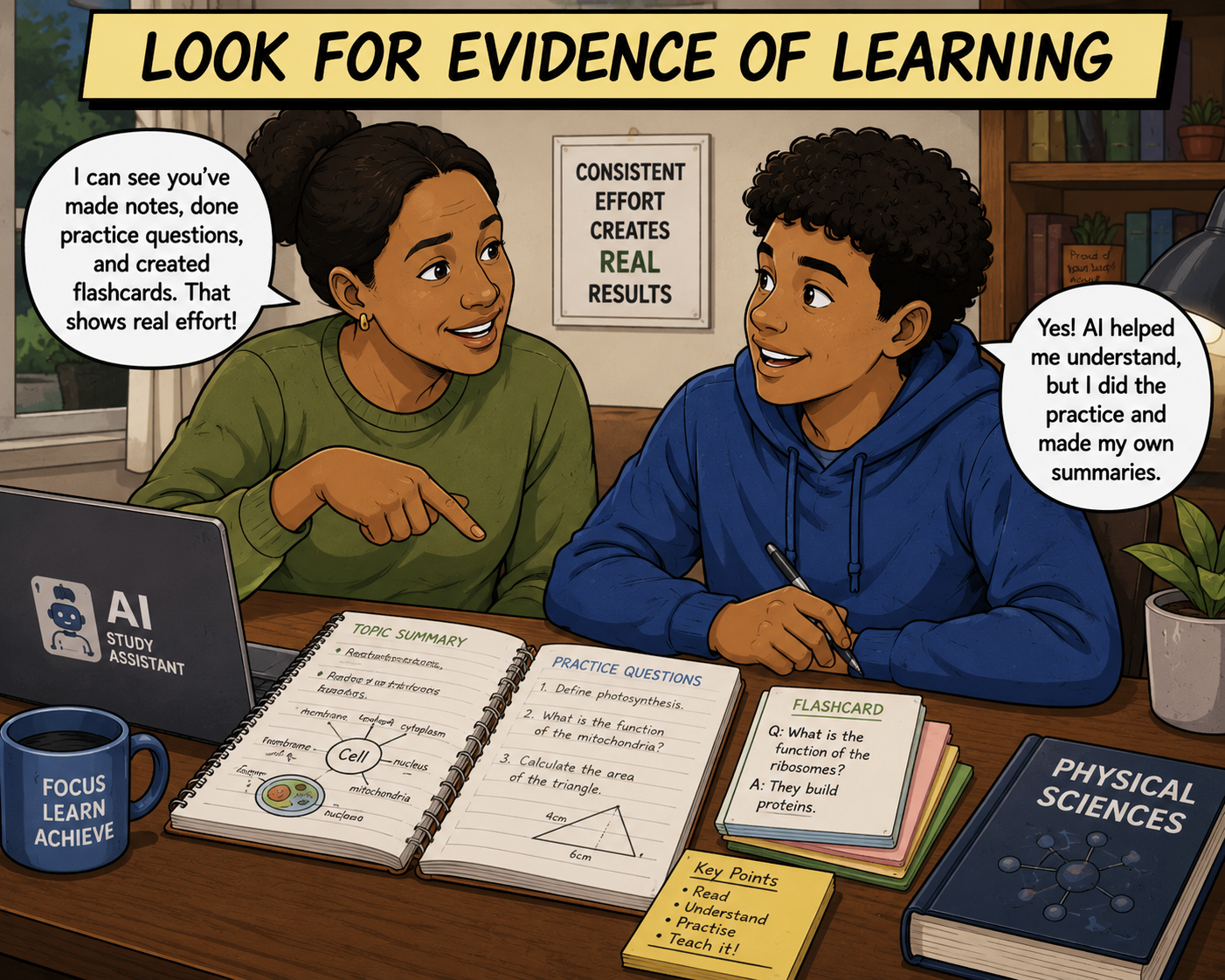
Look For Evidence Of Learning
Parents should not judge study sessions only by screen time. Look for signs that learning happened.
Examples include:
New handwritten notes.
Practice questions completed.
Flashcards created.
Summary pages.
Improved homework.
Corrected mistakes.
Better confidence.
Clear explanations.
These outcomes matter far more than simply sitting in front of a device.
Watch How AI Is Being Used
The type of AI conversation often tells parents far more than the amount of time spent online.
Helpful prompts include:
"Explain photosynthesis more simply."
"Give me five practice questions."
"Test me without showing the answers."
"Help me understand this graph."
"What mistake did I make?"
Less helpful prompts include:
"Write my assignment."
"Give me the answers."
"Finish my homework."
"Write my essay."
The first group encourages learning.
The second group encourages dependence.
Signs That AI Is Supporting Real Learning
Parents may notice that their child:
Talks more confidently about school.
Asks better questions.
Revises more consistently.
Uses fewer last-minute cramming sessions.
Becomes less anxious about difficult topics.
Completes work independently after using AI.
Makes fewer repeated mistakes.
These are positive signs that AI is functioning as a study assistant.
Signs That AI May Be Becoming A Distraction
Parents should also notice warning signs.
Examples include:
Long hours online with little completed work.
Constant switching between apps.
Homework taking much longer than expected.
Difficulty explaining what was studied.
Becoming defensive when asked about schoolwork.
Depending on AI for every question.
Losing confidence when AI is unavailable.
These signs do not automatically mean something is wrong.
However, they suggest that study habits may need adjustment.
Multitasking Reduces Learning
Many learners believe they can study while:
watching videos,
replying to messages,
listening to social media clips,
checking notifications,
and chatting with friends.
Research consistently shows that constant task-switching reduces concentration and memory.
Each interruption forces the brain to refocus.
This wastes valuable study time.
Parents can encourage learners to study with:
notifications switched off,
unnecessary apps closed,
short, focused study sessions,
planned breaks.
Studying well usually means doing fewer things at once.
Encourage Active Learning Instead Of Passive Reading
Reading AI explanations is only the beginning.
Parents can encourage learners to:
solve problems themselves,
answer quiz questions,
explain concepts aloud,
create summaries,
draw diagrams,
make flashcards,
test themselves without notes.
The more actively the learner participates, the more likely the information will be remembered.
Learning is something we do, not something we watch.
AI Should Be One Study Tool Among Many
Healthy studying still includes:
Textbooks.
Exercise books.
Class notes.
Past examination papers.
Teacher feedback.
Group discussions.
Practical activities.
Independent thinking.
AI should complement these resources. It should not replace every other way of learning.
The strongest learners combine multiple study methods.
Build Trust Instead Of Surveillance
Parents sometimes feel they need to constantly check devices. While occasional supervision is appropriate, constant surveillance may damage trust.
Instead, build routines.
For example:
Agree on study times.
Agree on break times.
Discuss daily goals.
Review completed work together.
Celebrate progress.
When learners understand expectations, they often become more responsible.
South African Families Face Different Circumstances
Families across South Africa have different access to technology.
Some learners have:
personal laptops,
reliable fibre internet,
quiet study spaces.
Others may rely on:
shared smartphones,
prepaid mobile data,
public Wi-Fi,
crowded homes,
electricity interruptions.
Parents should avoid comparing their child with others. Effective learning is possible in many different environments.
The important question is whether available technology is being used purposefully.
Even a learner using AI for twenty focused minutes on a shared phone can make meaningful academic progress.
Helping Teenagers Develop Self-Management
The ultimate goal is not for parents to supervise every study session forever. High school learners are preparing for university, college, apprenticeships, and employment.
They need to develop skills such as:
managing distractions,
planning study time,
using AI responsibly,
recognising procrastination,
evaluating information,
solving problems independently.
Parents can gradually move from controlling study habits to coaching them.
This builds confidence and independence.
Practical Questions Parents Can Ask After AI Study Sessions
Simple conversations often reveal much more than checking screen time.
Consider asking:
What subject did you work on today?
What did AI help you understand?
What was still confusing?
Did you solve any questions on your own?
What surprised you today?
What will you revise tomorrow?
How do you know you understand the topic now?
These questions encourage reflection.
Reflection strengthens learning.
A Healthy Home Environment Makes A Difference
Parents do not need perfect knowledge of school subjects. What matters most is creating an environment where learning is valued.
This includes:
encouraging curiosity,
praising effort,
supporting routines,
reducing unnecessary distractions,
discussing school regularly,
recognising improvement,
encouraging honesty about difficulties.
When learners know they can ask for help without fear of criticism, they are more likely to develop healthy study habits.
Conclusion
As AI becomes a normal part of education, parents will increasingly see their children spending study time on digital devices. The challenge is that productive learning and unproductive screen time can look almost identical from the outside.
Fortunately, parents do not need to monitor every minute or become experts in artificial intelligence. Instead, they can focus on what truly matters: whether learning is taking place. A learner who can explain ideas, answer questions, solve problems independently, and show evidence of progress is using technology well. A learner who simply spends long hours on a screen without understanding or improvement may need guidance to develop better study habits.
The goal is not to eliminate AI from learning, nor to assume that every minute spent online is educational. The goal is to help young people use AI intentionally, thoughtfully, and responsibly. When parents ask good questions, encourage active learning, and build trust instead of relying only on supervision, AI becomes a valuable study partner rather than another source of distraction.
Ultimately, meaningful study is measured not by the amount of time spent looking at a screen, but by the knowledge, confidence, and independence that learners gain from the experience.
Additional Articles in the AI, Screen Time, and Healthy Digital Habits Series
Is AI Study Time Really Study Time? How Parents Can Tell
Helping Your Teen Balance AI Use, Schoolwork, and Rest
AI, Phones, and Procrastination: What Parents Should Watch For
Setting Healthy Rules for AI and Device Use During Exam Time
Teaching Your Child That Technology Should Support Life — Not Control It
Disclaimer
AI Tools were used to assist with research. Remember to always cross-check everything that you read.