
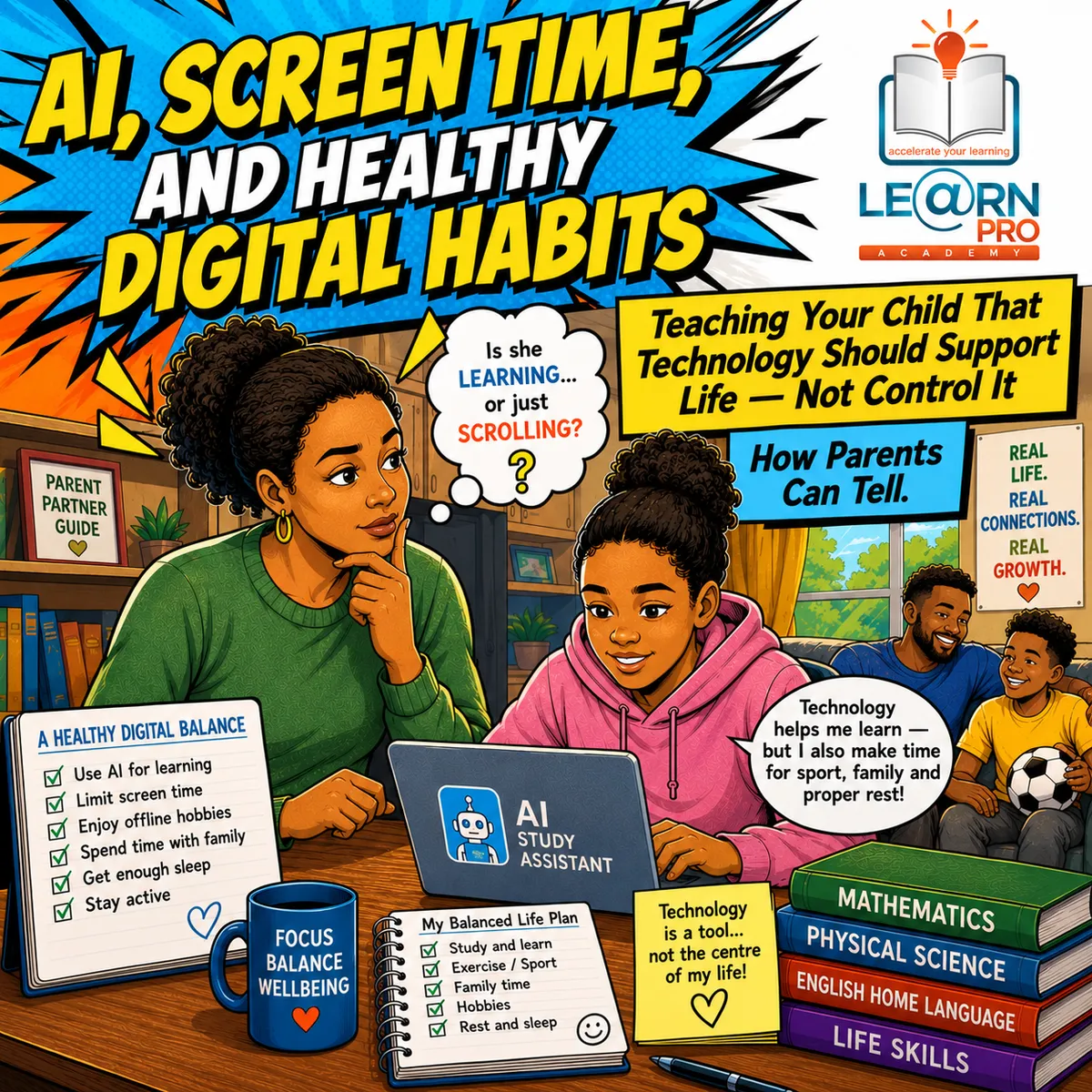
Teaching Your Child That Technology Should Support Life — Not Control It
This is article #5 of 5 in the AI, Screen Time, and Healthy Digital Habits Series
Introduction
Artificial intelligence (AI) is becoming part of everyday life. Today's teenagers are growing up in a world where AI can answer questions, explain school subjects, help with revision, create study plans, improve writing, and even assist with career exploration. As technology continues to develop, AI will almost certainly become a normal part of higher education, the workplace, and daily life.
For parents, this creates an important responsibility.
The goal is not to keep children away from technology altogether. That is neither realistic nor helpful. Instead, parents need to teach their teenagers how to build a healthy relationship with technology — one where digital tools support learning and personal growth without becoming the centre of everything.
Technology should improve life, not replace it.
Teenagers still need meaningful conversations, family relationships, physical activity, hobbies, creativity, sleep, and opportunities to think independently. These experiences help young people become confident, balanced adults who can use technology wisely without becoming dependent on it.
This article explores practical ways parents can teach their children that AI and digital technology are valuable tools — but that real life always comes first.
Technology Is Here To Stay
Parents sometimes wonder whether AI is simply another trend.
The reality is that AI is likely to become an increasingly important part of education and many careers.
Future professionals in fields such as:
Healthcare
Engineering
Accounting
Law
Education
Agriculture
Business
Information Technology
Design
Manufacturing
are all expected to use digital tools and AI in different ways.
Preparing teenagers for this future means teaching responsible use rather than avoidance.
AI Is A Tool, Not An Identity
Technology works best when it serves a clear purpose:
A calculator helps solve mathematical problems.
A dictionary helps explain words.
AI helps learners understand information, practise skills, and organise learning.
None of these tools define who a person is.
Parents can remind teenagers that their identity is built through:
Character.
Relationships.
Values.
Kindness.
Curiosity.
Integrity.
Effort.
Responsibility.
Technology supports these qualities.
It cannot replace them.
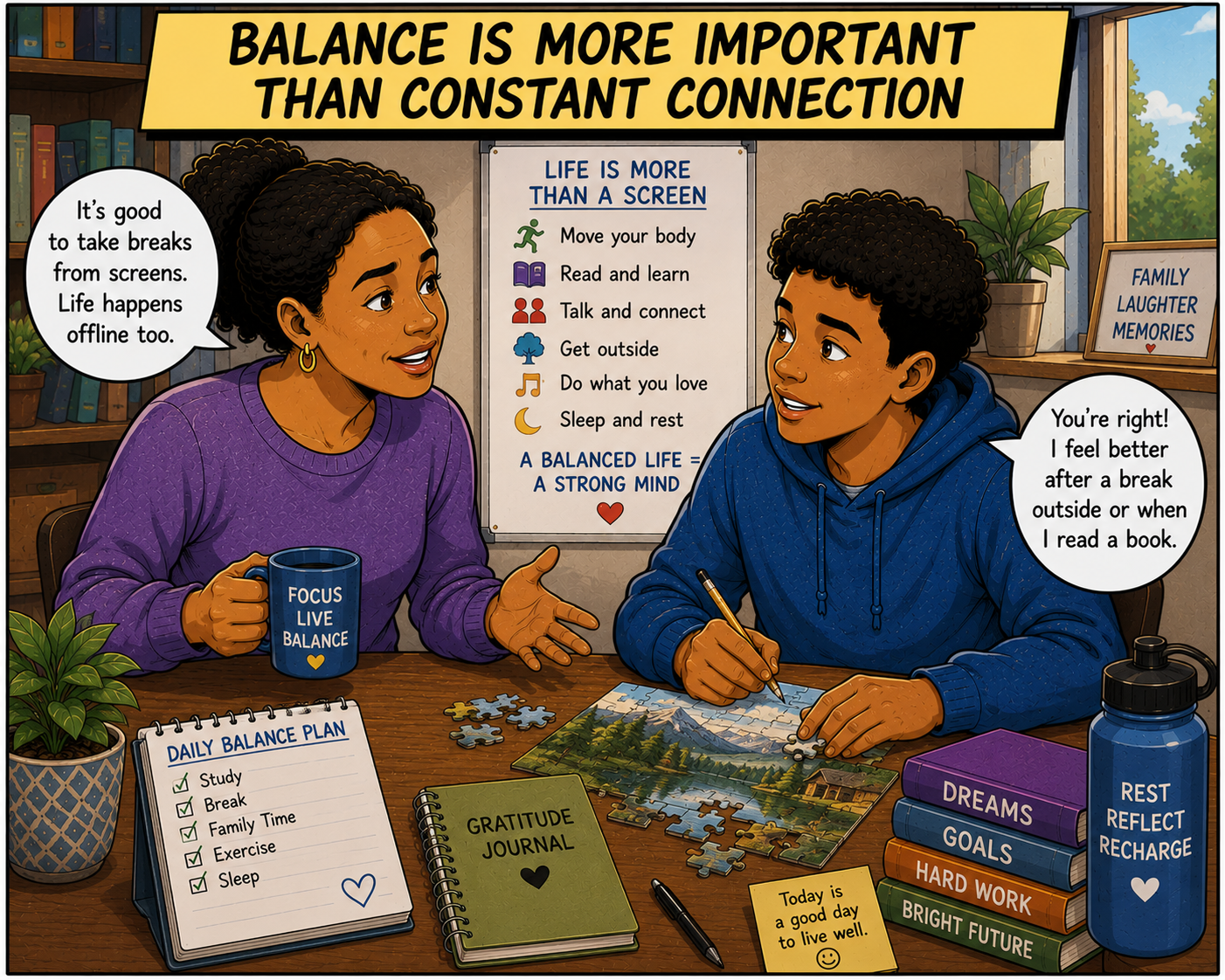
Balance Is More Important Than Constant Connection
Modern technology makes it possible to stay connected almost all the time. Messages, notifications, videos, games, and AI are available every hour of the day.
Constant connection, however, is not always healthy. Teenagers need regular opportunities to disconnect.
Balance includes:
Quiet thinking.
Family conversations.
Outdoor activities.
Reading.
Creative hobbies.
Exercise.
Rest.
Parents should help children understand that taking a break from technology is healthy — not something to feel guilty about.
Learning Still Requires Independent Thinking
AI can explain difficult topics and answer questions quickly.
However, teenagers still need opportunities to:
Solve problems independently.
Form opinions.
Analyse information.
Ask their own questions.
Learn from mistakes.
Parents should encourage learners to think before asking AI.
For example:
What do I already know?
What have I already tried?
What is confusing me?
Using AI after thinking encourages stronger learning.
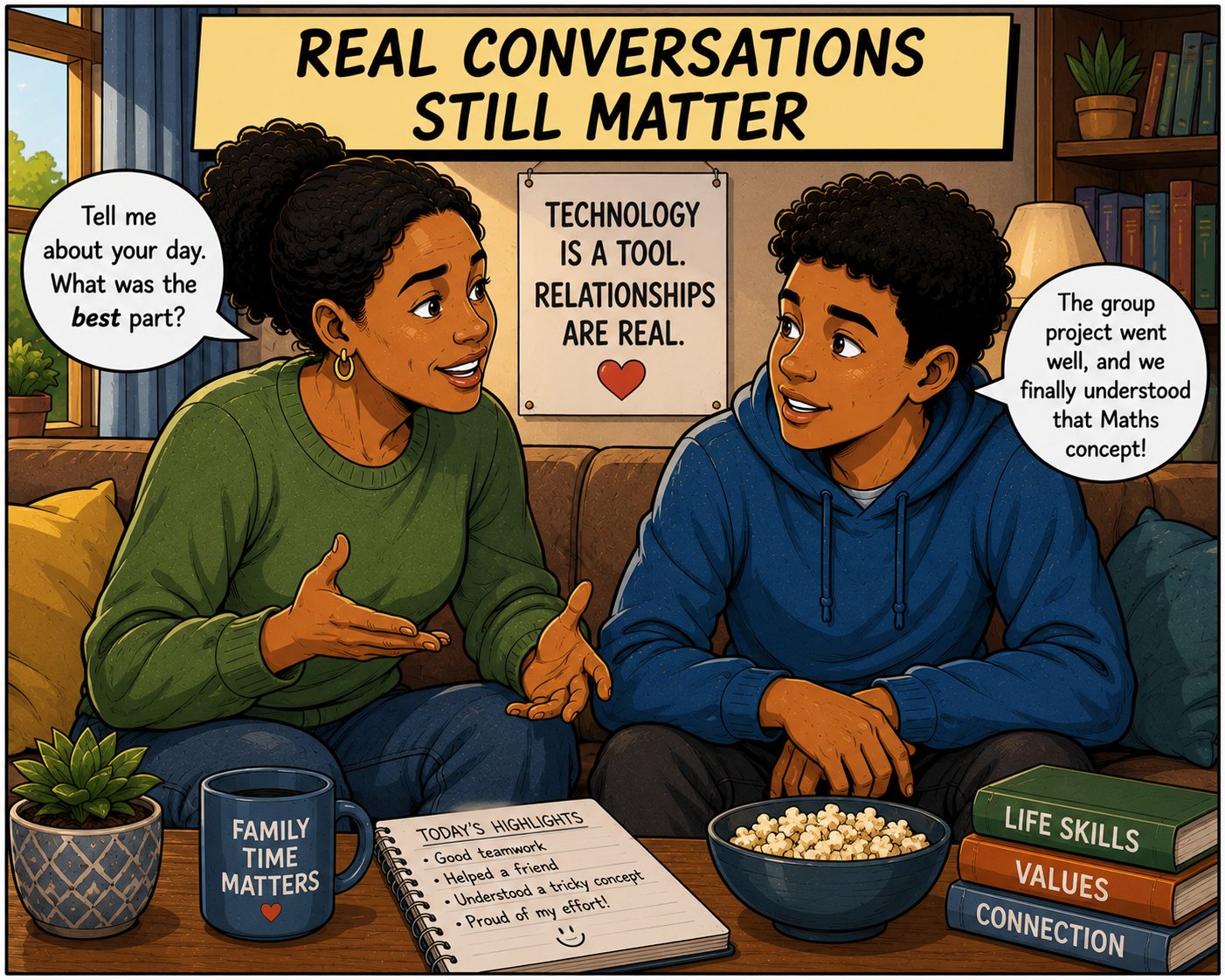
Real Conversations Still Matter
Technology makes communication easier. However, texting and AI conversations should never replace real human relationships.
Parents can strengthen family connections by:
Eating meals together.
Talking about the school day.
Discussing current events.
Listening without judgement.
Encouraging face-to-face conversations.
Teenagers often need trusted adults more than they realise.
Family conversations remain one of the strongest influences on healthy development.
Teach The Difference Between Convenience And Dependence
AI makes many tasks faster. That convenience is valuable. Dependence is different. A learner who uses AI to understand difficult Biology concepts is using technology well.
A learner who feels unable to complete any homework without AI may be becoming too dependent.
Parents should encourage teenagers to ask:
Could I solve this myself?
Have I tried first?
Am I learning or simply copying?
These questions promote confidence and independence.
Technology Should Save Time — Not Consume It
One promise of technology is efficiency.
If AI helps complete revision in less time, that extra time can be used for:
Exercise.
Reading.
Family activities.
Rest.
Personal interests.
Community involvement.
Technology should create more opportunities for life — not reduce them.
Parents can help teenagers think about how they use the time technology saves.
Encourage Hobbies Beyond Screens
Teenagers benefit from interests that do not depend on devices.
Examples include:
Sport.
Music.
Drawing.
Photography.
Cooking.
Gardening.
Reading.
Drama.
Volunteering.
Woodwork.
Craft projects.
Offline hobbies build creativity, confidence, and resilience.
They also remind teenagers that enjoyment does not always require a screen.
Rest Is Part Of Success
Some learners feel they must always be productive. Parents can teach an important lesson: Rest is not laziness.
Healthy rest improves:
Memory.
Concentration.
Mood.
Creativity.
Emotional wellbeing.
Balanced learners usually perform better over time than exhausted learners.
Teach Responsible Digital Choices
Eventually teenagers will make technology decisions without parents nearby.
Parents can prepare them by asking questions such as:
Why are you using this app?
Is it helping your learning?
Are you becoming distracted?
Is this a good use of your time?
Could you take a short break?
These conversations build judgement rather than simple obedience.
Help Teenagers Recognise When Technology Is Taking Over
Sometimes technology slowly becomes the centre of daily life.
Warning signs may include:
Constant phone checking.
Difficulty concentrating without devices.
Poor sleep.
Reduced interest in hobbies.
Less family interaction.
Anxiety when disconnected.
Avoiding responsibilities.
Parents should respond calmly.
The goal is to restore balance — not create shame.
Family Rules Should Support Healthy Living
Technology rules work best when they reflect family values.
Examples include:
No phones during family meals.
Respect quiet study time.
Put devices away before bedtime.
Use AI for learning, not shortcuts.
Spend time outdoors regularly.
Make time for family activities.
Simple routines become lifelong habits.
South African Families Have Different Circumstances
Every South African family experiences technology differently.
Some homes have:
Fibre internet.
Multiple devices.
Dedicated study areas.
Others manage with:
Shared smartphones.
Limited mobile data.
Load shedding.
Busy households.
Healthy technology habits do not depend on expensive equipment.
Families can still prioritise:
Respect.
Communication.
Balance.
Responsibility.
Purposeful technology use.
Good habits matter more than perfect circumstances.
Parents Should Model Healthy Technology Habits
Teenagers observe adult behaviour closely.
Parents who:
Put phones away during conversations,
Listen attentively,
Read books,
Spend time outdoors,
Balance work and family,
demonstrate healthy digital habits every day.
Children often imitate what they consistently see.
Leading by example is one of the most powerful teaching tools available.
Celebrate Effort, Not Constant Online Activity
Busy does not always mean productive.
Parents should praise:
Consistent study.
Honest effort.
Good decisions.
Responsible AI use.
Perseverance.
Improvement.
Recognition encourages healthy motivation.
Teenagers learn that success comes through effort rather than constant screen time.
Encourage Reflection
Reflection helps teenagers become thoughtful technology users.
Parents can ask:
What did AI help you do today?
What did you learn without AI?
When were you most focused?
What distracted you?
What would you do differently tomorrow?
Reflection strengthens self-awareness.
Self-aware learners make better choices.
Teach That Mistakes Are Part Of Learning
Teenagers will sometimes misuse technology:
They may procrastinate.
They may become distracted.
They may rely on AI too much.
Rather than responding only with punishment, parents can help learners reflect:
What happened?
Why did it happen?
What can you change next time?
Mistakes become valuable learning opportunities.
Preparing Teenagers For Adult Life
The workplace of the future will expect employees to use AI effectively.
It will also expect people who can:
Think critically.
Communicate well.
Work independently.
Solve problems.
Build relationships.
Adapt to change.
Manage themselves.
Technology skills alone are not enough. Human skills remain equally important.
Parents play a key role in developing both.
A Healthy Relationship With Technology Is Built Over Time
Healthy technology habits do not appear overnight.
They develop through:
Daily conversations.
Positive examples.
Consistent routines.
Gradual responsibility.
Mutual trust.
Parents should expect gradual progress rather than perfection.
Each responsible decision strengthens lifelong habits.
Technology Should Always Remain A Servant — Never The Master
Perhaps the most important lesson parents can teach is this: Technology is an excellent servant. It is a poor master.
AI should help teenagers:
Learn.
Create.
Explore.
Organise.
Solve problems.
It should never decide their values, replace their relationships, control their emotions, or dominate their daily lives.
The person should always remain in control of the technology — not the other way around.
Conclusion
Artificial intelligence will continue to shape education, work, and everyday life, making it an important skill for today's teenagers to understand. Parents do not need to fear this future or prevent their children from using technology. Instead, they can focus on teaching the habits, values, and decision-making skills that allow technology to be used wisely and responsibly.
The most successful young people will not necessarily be those who spend the most time using AI. They will be those who know when technology is helpful, when independent thinking is needed, when relationships deserve their full attention, and when it is time to put the device away. A healthy balance between digital tools and real-life experiences creates stronger learners, healthier families, and more confident young adults.
Ultimately, technology should always support life — not control it. When parents consistently model balanced digital habits, encourage meaningful conversations, promote independent thinking, and remind their teenagers that character matters more than technology, they prepare them for a future where AI is a powerful tool, but never the centre of who they are.
Additional Articles in the AI, Screen Time, and Healthy Digital Habits Series
Is AI Study Time Really Study Time? How Parents Can Tell
Helping Your Teen Balance AI Use, Schoolwork, and Rest
AI, Phones, and Procrastination: What Parents Should Watch For
Setting Healthy Rules for AI and Device Use During Exam Time
Teaching Your Child That Technology Should Support Life — Not Control It
Disclaimer
AI Tools were used to assist with research. Remember to always cross-check everything that you read.