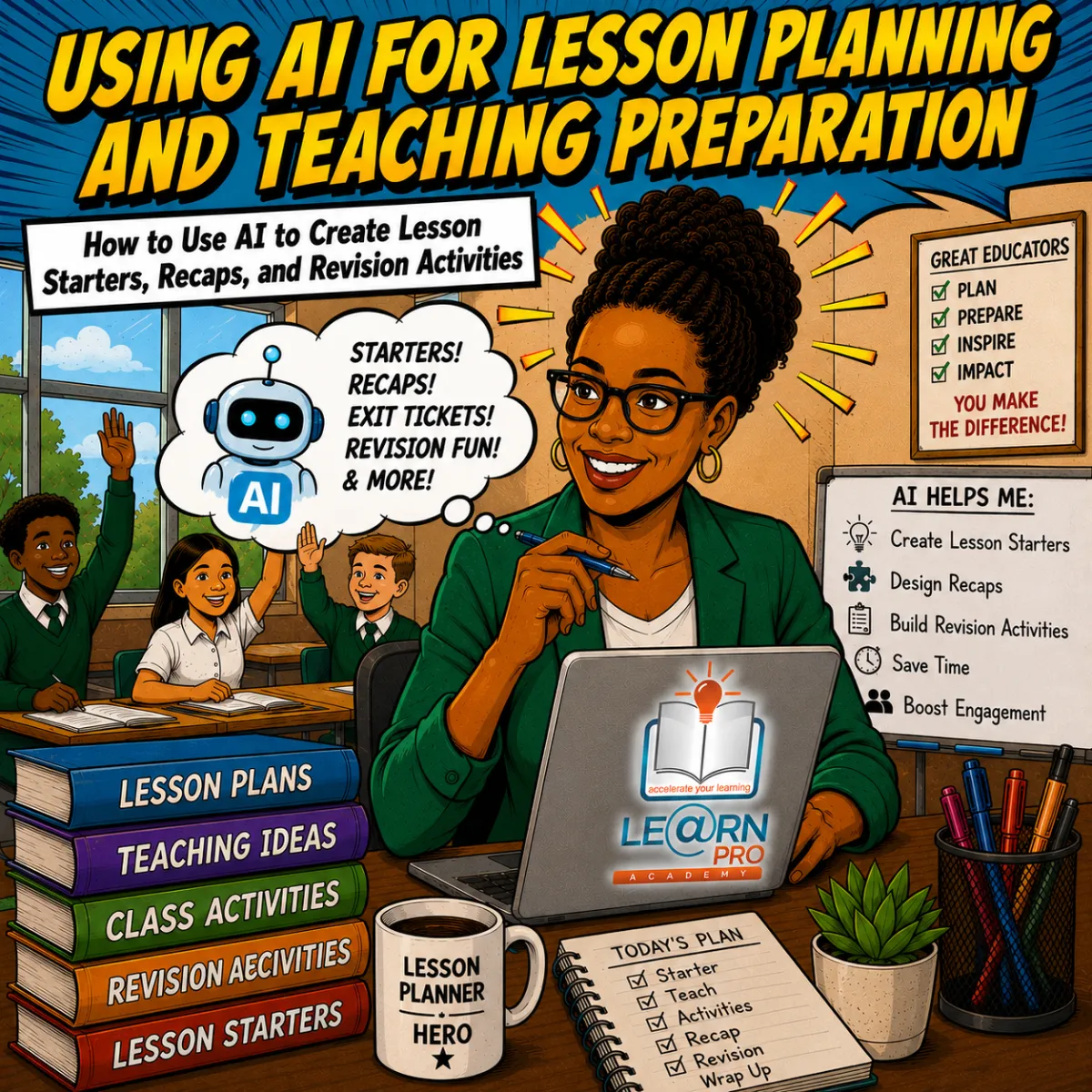
How to Use AI to Create Lesson Starters, Recaps, and Revision Activities
This is article #5 of 5 in the Using AI for Lesson Planning and Teaching Preparation Series
Introduction
Excellent teaching involves much more than simply explaining new content. While the main teaching section of a lesson is important, experienced educators know that the moments before and after the lesson are often just as valuable. A strong lesson introduction captures learners' attention, activates prior knowledge, and prepares them for new learning. A well-planned ending helps learners organise what they have learned, reflect on key ideas, and identify any remaining questions.
These small teaching moments have a significant impact on learner engagement and long-term memory.
Unfortunately, they are also some of the easiest parts of lesson planning to overlook.
When educators are busy preparing lesson content, marking assessments, completing administrative work, and managing large classes, there is often little time left to create interesting warm-up activities, meaningful recaps, or creative revision exercises.
Artificial Intelligence (AI) can help.
AI can quickly generate lesson starters, discussion prompts, quick quizzes, exit tickets, revision games, reflection questions, and recap activities that support learning without requiring hours of preparation. Rather than replacing an educator's creativity or professional judgement, AI provides a collection of ideas that teachers can adapt to suit their learners, their subject, and the CAPS curriculum.
For South African educators teaching diverse classrooms with varying learner needs, AI can become a valuable planning assistant that improves lesson flow while saving valuable preparation time.
This article explores practical ways educators can use AI to strengthen the beginning, middle, and end of every lesson.
Why Lesson Structure Matters
Every lesson has three important stages.
The beginning prepares learners to learn.
The middle develops new understanding.
The ending reinforces learning.
When any of these stages is weak, learners may struggle to connect ideas or remember important concepts.
A balanced lesson usually includes:
A lesson starter.
Clear teaching.
Learner participation.
Guided practice.
Independent practice.
Reflection.
Revision or recap.
AI can support each of these stages.
AI Is A Teaching Assistant
Before using AI, it is important to remember its role.
AI generates suggestions.
Educators make professional decisions.
Teachers still decide:
Lesson objectives.
Curriculum alignment.
Classroom pace.
Learner support.
Assessment requirements.
Teaching methods.
AI simply reduces the time needed to prepare supporting activities.
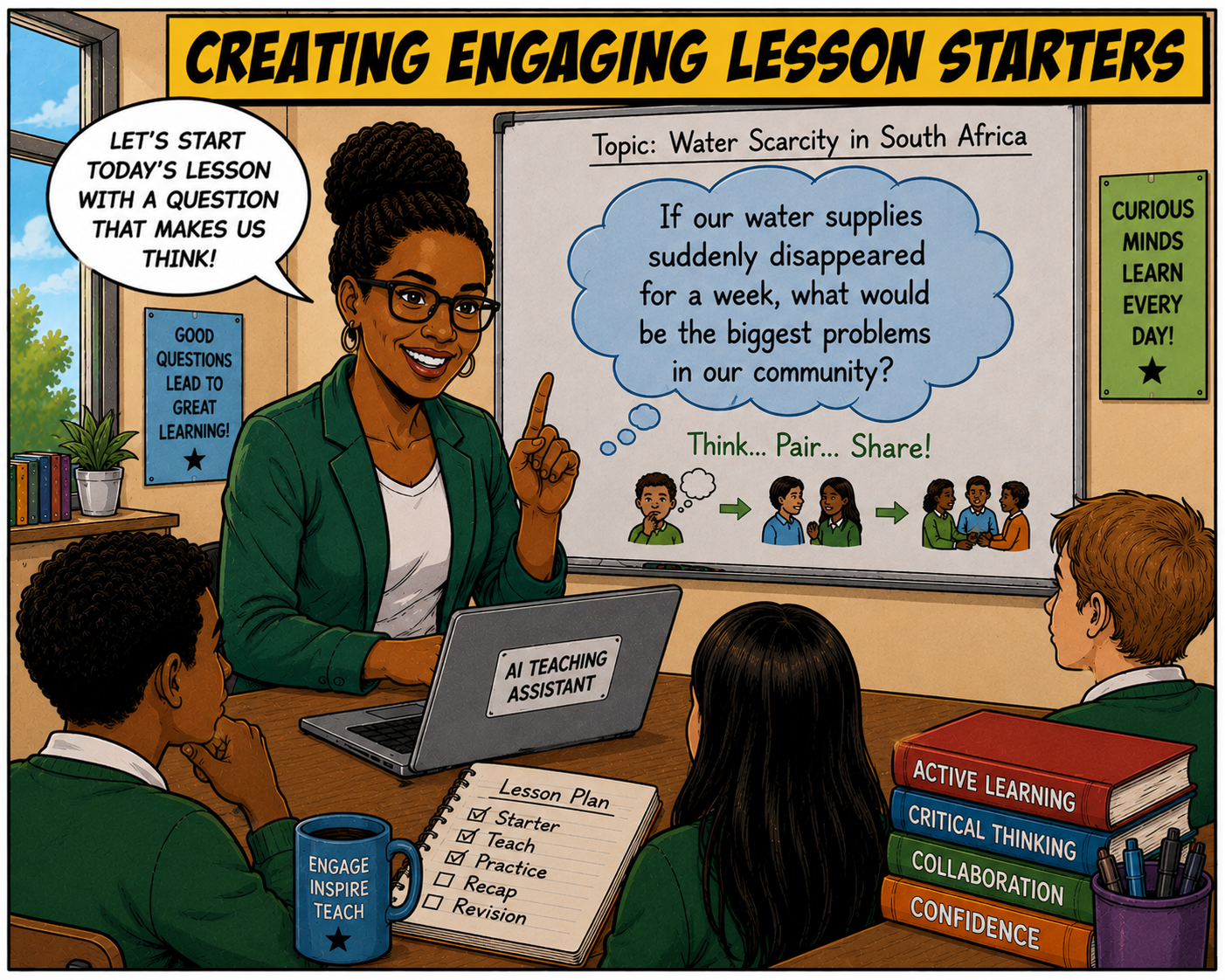
Creating Engaging Lesson Starters
The first five minutes of a lesson often determine learner attention.
A good starter:
Captures interest.
Activates previous knowledge.
Encourages curiosity.
Introduces the lesson naturally.
AI can generate many different starter activities.
For example:
Create a five-minute lesson starter for Grade 10 Geography about climate change.
The AI might suggest:
A surprising statistic.
A discussion question.
A short scenario.
A prediction exercise.
A picture analysis activity.
These activities immediately involve learners instead of beginning with lengthy explanations.
Activating Prior Knowledge
Learners understand new information more easily when they connect it to what they already know.
AI can create questions such as:
What did we learn yesterday?
Can you remember three key ideas?
Where have you seen this in everyday life?
What do you already know about this topic?
These simple questions help prepare learners for new content.
Using Curiosity Questions
Curiosity encourages learning.
AI can generate questions that make learners think before the lesson begins.
For example:
Business Studies:
"Why do some businesses succeed while others fail?"
Life Sciences:
"Could plants survive without sunlight?"
History:
"What would South Africa look like today if this event had never happened?"
These questions naturally lead into the lesson.
Creating Mystery Activities
Learners enjoy solving problems.
AI can generate mystery scenarios.
For example:
Show an unusual image.
Present a surprising fact.
Describe a mystery situation.
Ask learners to predict the explanation.
This encourages active participation before formal teaching begins.
Generating Short Classroom Polls
Quick opinion polls help involve every learner.
Examples include:
Raise your hand if…
Agree or disagree?
Which answer do you think is correct?
Vote for the best solution.
AI can generate poll questions related to almost any lesson topic.
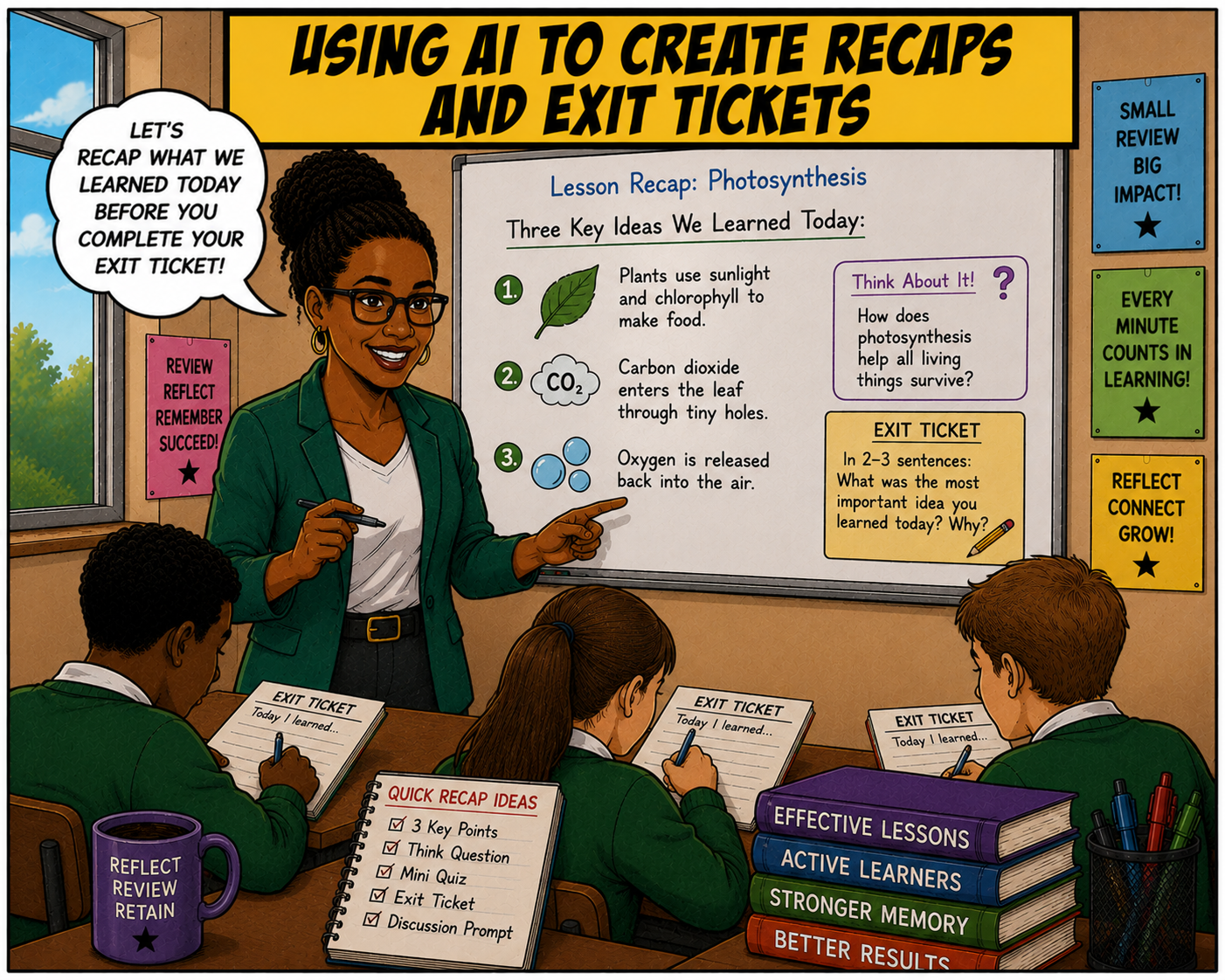
Producing Quick Recaps
At the end of a lesson, learners benefit from reviewing the most important ideas.
AI can create recap activities such as:
Three key facts.
Five important vocabulary words.
One-minute summaries.
Quick revision quizzes.
Matching exercises.
These reinforce learning before learners leave the classroom.
Creating Exit Tickets
Exit tickets provide immediate feedback.
AI can generate questions including:
What was today's most important idea?
What remains confusing?
Explain today's topic in one sentence.
Give one real-world example.
What question would you still like answered?
Educators can quickly identify areas requiring further teaching.
Generating Revision Questions
Revision should not only happen before examinations.
Frequent short revision activities improve long-term memory.
AI can create:
Multiple-choice questions.
Short-answer questions.
True-or-false activities.
Fill-in-the-blank exercises.
Vocabulary reviews.
Matching activities.
Five minutes of revision each lesson often has a greater impact than lengthy revision sessions before examinations.
Creating Think-Pair-Share Activities
Think-Pair-Share is an effective teaching strategy.
AI can generate prompts such as:
Think:
Consider the question independently.
Pair:
Discuss with a partner.
Share:
Present your ideas to the class.
This encourages participation from learners who may be reluctant to speak in front of the whole class.
Generating Reflection Questions
Reflection encourages deeper learning.
AI can generate questions such as:
What surprised you today?
Which part was most difficult?
What helped you understand?
How could you use this knowledge outside school?
What would you like to learn next?
Reflection helps learners take ownership of their learning.
Creating Subject-Specific Revision Activities
Different subjects require different revision approaches.
Mathematics
Generate:
Mental maths.
Error correction.
Step-by-step calculations.
Physical Sciences
Create:
Concept reviews.
Formula recall.
Practical application questions.
Life Sciences
Generate:
Labelling diagrams.
Classification activities.
Vocabulary quizzes.
Geography
Create:
Map interpretation.
Climate comparisons.
Location activities.
History
Generate:
Timeline reviews.
Source analysis.
Cause-and-effect questions.
Business Studies
Develop:
Case study summaries.
Business terminology quizzes.
Scenario analysis.
Using AI To Create Vocabulary Reviews
Many learners struggle with subject-specific terminology.
AI can generate:
Word-definition matching.
Flashcards.
Fill-in-the-blanks.
Vocabulary quizzes.
Sentence completion exercises.
Frequent vocabulary review improves learner confidence.
Creating Revision Games
Revision does not always need to involve worksheets.
AI can suggest games such as:
Classroom bingo.
Quiz competitions.
Team challenges.
Memory games.
Vocabulary races.
Mystery word activities.
"Who Wants to Be a Millionaire?" style quizzes.
Games encourage participation while reinforcing learning.
Generating Quick Homework Reviews
Many educators begin lessons by reviewing homework.
AI can generate:
Discussion questions.
Common mistake reviews.
Follow-up questions.
Application exercises.
These activities help connect previous learning with new lessons.
Supporting Mixed-Ability Learners
Lesson starters and revision activities should also support differentiation.
AI can generate:
Support version:
Simpler review questions.
Standard version:
Curriculum-level questions.
Extension version:
Higher-order thinking challenges.
This ensures all learners participate meaningfully.
Saving Preparation Time
Without AI, educators often spend considerable time searching for ideas online.
AI allows educators to request activities directly.
For example:
Create three five-minute recap activities for Grade 11 Accounting on financial statements.
Within seconds, several practical ideas become available.
The educator then selects and adapts the most appropriate options.
Creating Better AI Prompts
Specific prompts produce better teaching resources.
Instead of writing:
Create a quiz.
Try:
Create a five-question revision quiz for Grade 10 Life Sciences on ecosystems aligned with CAPS. Include two recall questions, two application questions, and one higher-order thinking question. Use simple English suitable for South African learners.
Detailed prompts produce much stronger results.
Building A Prompt Library
Educators should save prompts that consistently produce useful activities.
Categories might include:
Lesson starters.
Curiosity questions.
Discussion prompts.
Exit tickets.
Reflection questions.
Revision games.
Vocabulary reviews.
Homework reviews.
Recap activities.
Quick quizzes.
Over time, this becomes a valuable professional planning resource.
Checking AI Output Carefully
AI-generated classroom activities should always be reviewed.
Check:
Accuracy
Are the facts correct?
Curriculum Alignment
Does the activity support CAPS?
Language
Is it suitable for learners?
Timing
Can it realistically fit into the lesson?
Engagement
Will learners participate actively?
Inclusivity
Are examples culturally appropriate?
Professional judgement remains essential.
Common Mistakes To Avoid
When using AI for lesson starters and revision, avoid:
Making activities too long.
Using overly difficult questions.
Repeating the same activity every lesson.
Ignoring learner ability levels.
Forgetting lesson objectives.
Accepting AI responses without checking them.
Overloading learners with too many review activities.
Small, focused activities usually work best.
The Future Of AI In Lesson Design
AI will continue improving classroom preparation.
Future systems may help educators:
Generate personalised revision automatically.
Recommend recap activities based on learner performance.
Adapt revision to different ability levels.
Produce multilingual classroom resources.
Suggest intervention activities.
Identify concepts requiring additional review.
These developments will further reduce preparation time while improving learner engagement.
However, successful teaching will always depend on educators who know their learners and understand when encouragement, discussion, or another explanation is needed.
Technology supports learning.
Teachers inspire learning.
Conclusion
The small moments within a lesson often have the biggest impact. A thoughtful lesson starter captures learners' attention and prepares them for learning. A clear recap strengthens understanding. Regular revision activities improve memory, build confidence, and help learners retain knowledge over time.
AI provides educators with a practical way to generate these valuable teaching resources quickly. Warm-up questions, curiosity prompts, discussion activities, exit tickets, reflection questions, quizzes, vocabulary reviews, and revision games can all be created within minutes, giving teachers more time to focus on classroom interaction and learner support.
For South African educators working within busy teaching schedules, AI offers an opportunity to improve lesson quality without increasing preparation time. When combined with professional judgement and a strong understanding of the CAPS curriculum, AI becomes an effective teaching assistant that strengthens every stage of the lesson.
Ultimately, memorable lessons are built not only through excellent content but through thoughtful beginnings, meaningful endings, and regular opportunities for learners to revisit, discuss, and apply what they have learned. AI helps educators create these moments more efficiently, while teachers remain at the centre of every successful learning experience.
Additional Articles in the Using AI for Lesson Planning and Teaching Preparation Series
How Educators Can Use AI to Save Time on Lesson Planning
Using AI to Generate Class Activities and Teaching Examples
How AI Can Help You Differentiate Lessons for Mixed-Ability Classes
Using AI to Simplify Difficult Concepts for Learners
How to Use AI to Create Lesson Starters, Recaps, and Revision Activities
Disclaimer
AI Tools were used to assist with research. Remember to always cross-check everything that you read.