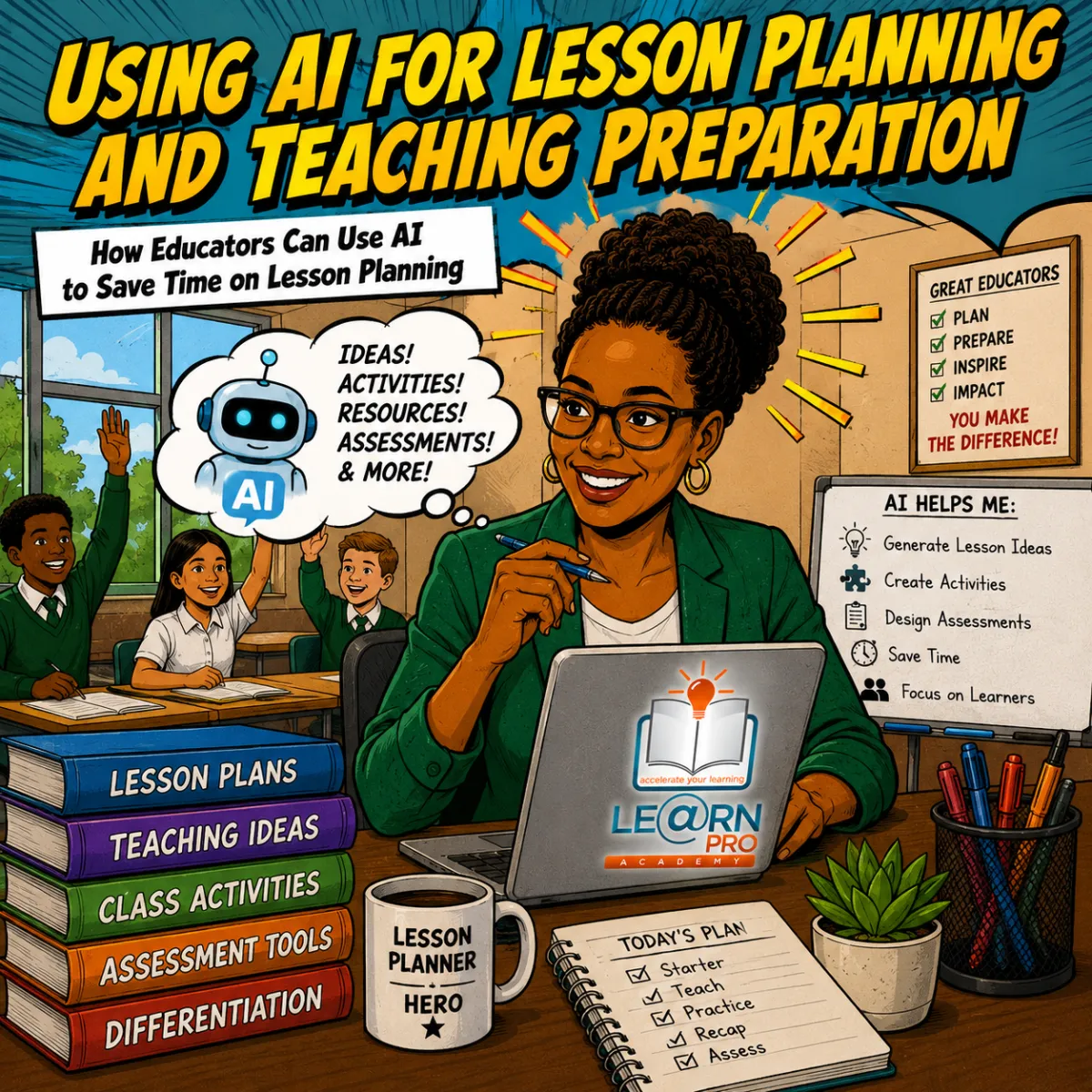
How Educators Can Use AI to Save Time on Lesson Planning
This is article #1 of 5 in the Using AI for Lesson Planning and Teaching Preparation Series
Introduction
Lesson planning is one of the most important responsibilities of every educator. A well-planned lesson gives learners clear direction, keeps the class focused, and helps teachers achieve the learning outcomes required by the curriculum. However, planning quality lessons takes time. For many South African high school educators, lesson planning happens alongside marking, administrative work, learner support, meetings, extracurricular activities, parent communication, and many other responsibilities.
It is not unusual for educators to spend several hours each week preparing lessons for multiple grades and subjects. Finding fresh examples, designing engaging activities, adjusting lessons for different learner abilities, and creating meaningful classroom discussions all require careful thought.
This is where Artificial Intelligence (AI) can become a valuable teaching assistant.
AI is not designed to replace educators. It cannot understand learners the way a teacher can. It cannot build relationships, manage a classroom, or make professional teaching decisions. Those responsibilities will always belong to qualified educators.
Instead, AI can help with one of the most time-consuming parts of teaching: creating the first draft.
Rather than starting every lesson with a blank page, educators can ask AI to generate lesson structures, activity ideas, discussion questions, examples, summaries, or explanations that can then be refined and adapted for their own learners.
The result is not less teaching quality—it is often better teaching efficiency.
This article explores practical ways educators can use AI to save time while still maintaining professional judgement, curriculum alignment, and high teaching standards.
Why Lesson Planning Takes So Much Time
Most people outside education assume that teaching mainly happens in the classroom.
Experienced educators know that much of the work happens long before learners arrive.
A single lesson often involves:
Reviewing curriculum requirements
Identifying learning outcomes
Selecting teaching methods
Planning learner participation
Finding suitable examples
Creating questions
Preparing activities
Predicting misconceptions
Planning assessment opportunities
Adjusting work for different learner abilities
When multiplied across several classes every week, planning becomes one of the largest demands on an educator's time.
AI cannot remove these responsibilities, but it can reduce the amount of time spent creating the initial draft.
AI Should Support Professional Expertise
One of the biggest misunderstandings about AI in education is that teachers should simply accept whatever AI produces.
This is not good practice.
Professional educators remain responsible for every lesson they teach.
Think of AI as a teaching assistant rather than a replacement teacher.
The educator should always:
Decide what learners need
Check curriculum alignment
Verify factual accuracy
Adapt language for learners
Remove unsuitable content
Improve examples
Adjust lesson timing
Include school policies and assessment requirements
AI provides ideas.
Teachers provide professional judgement.
That partnership produces better lessons than either could achieve alone.
Starting With A Lesson Objective
One of the easiest ways to use AI is by beginning with a clear learning objective.
Instead of asking:
"Create a Geography lesson."
Try asking:
"Create a Grade 11 Geography lesson outline that helps learners explain urbanisation in South Africa. Include learning objectives, class discussion ideas, a practical activity, and a five-minute recap."
Notice the difference.
The second prompt tells AI:
Grade level
Subject
Topic
Desired outcome
Lesson structure
The clearer the prompt, the better the result.
Generating A First Draft Lesson Plan
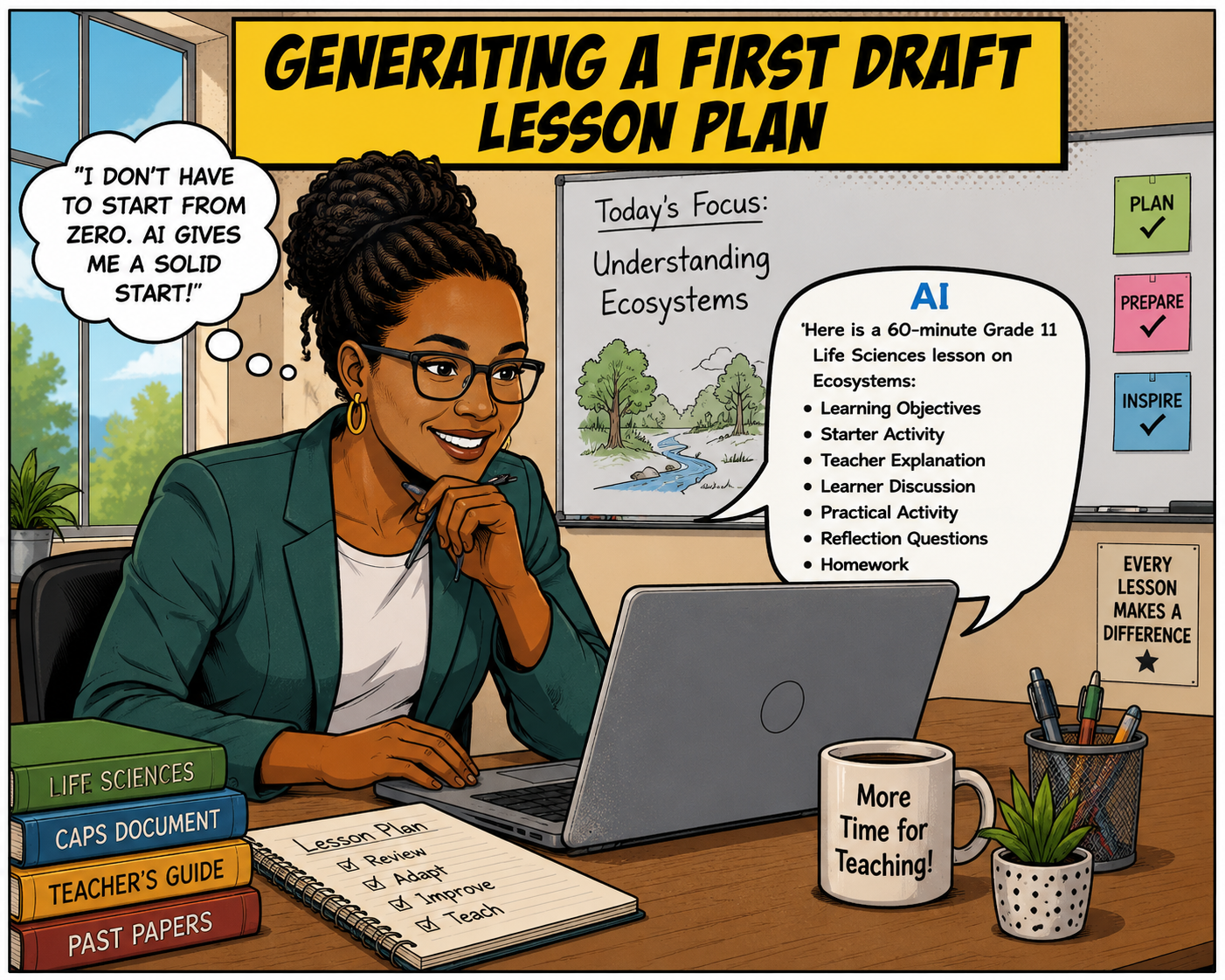
One of AI's greatest strengths is producing structured first drafts.
For example, an educator could request:
Create a 60-minute Grade 10 Life Sciences lesson on ecosystems. Include:
Lesson objectives
Starter activity
Teacher explanation
Learner discussion
Practical classroom activity
Reflection questions
Homework
Within seconds, AI can generate a complete lesson structure.
The educator then reviews it and adapts it to:
CAPS requirements
School pacing
Available resources
Learner ability
Classroom realities
Instead of spending an hour building the framework, the educator may spend twenty minutes improving it.
Creating Lesson Sequences Faster
Many topics require several lessons.
Planning these individually often takes considerable time.
AI can help create an entire teaching sequence.
For example:
Create a five-lesson sequence for Grade 12 Accounting on financial statements.
The AI may produce lessons covering:
Lesson 1:
Introduction to financial statements
Lesson 2:
Income statements
Lesson 3:
Balance sheets
Lesson 4:
Cash flow interpretation
Lesson 5:
Revision and practice
This gives educators a useful starting point that can then be aligned with their annual teaching plan.
Generating Teaching Ideas
Sometimes educators know what they want learners to learn but struggle to think of engaging teaching approaches.
AI can suggest ideas such as:
Role plays
Debates
Case studies
Simulations
Pair discussions
Group investigations
Think-pair-share activities
Problem-solving exercises
Visual learning activities
Real-world examples
Not every suggestion will suit every classroom.
However, even one useful idea can save valuable planning time.
Creating Better Classroom Discussions
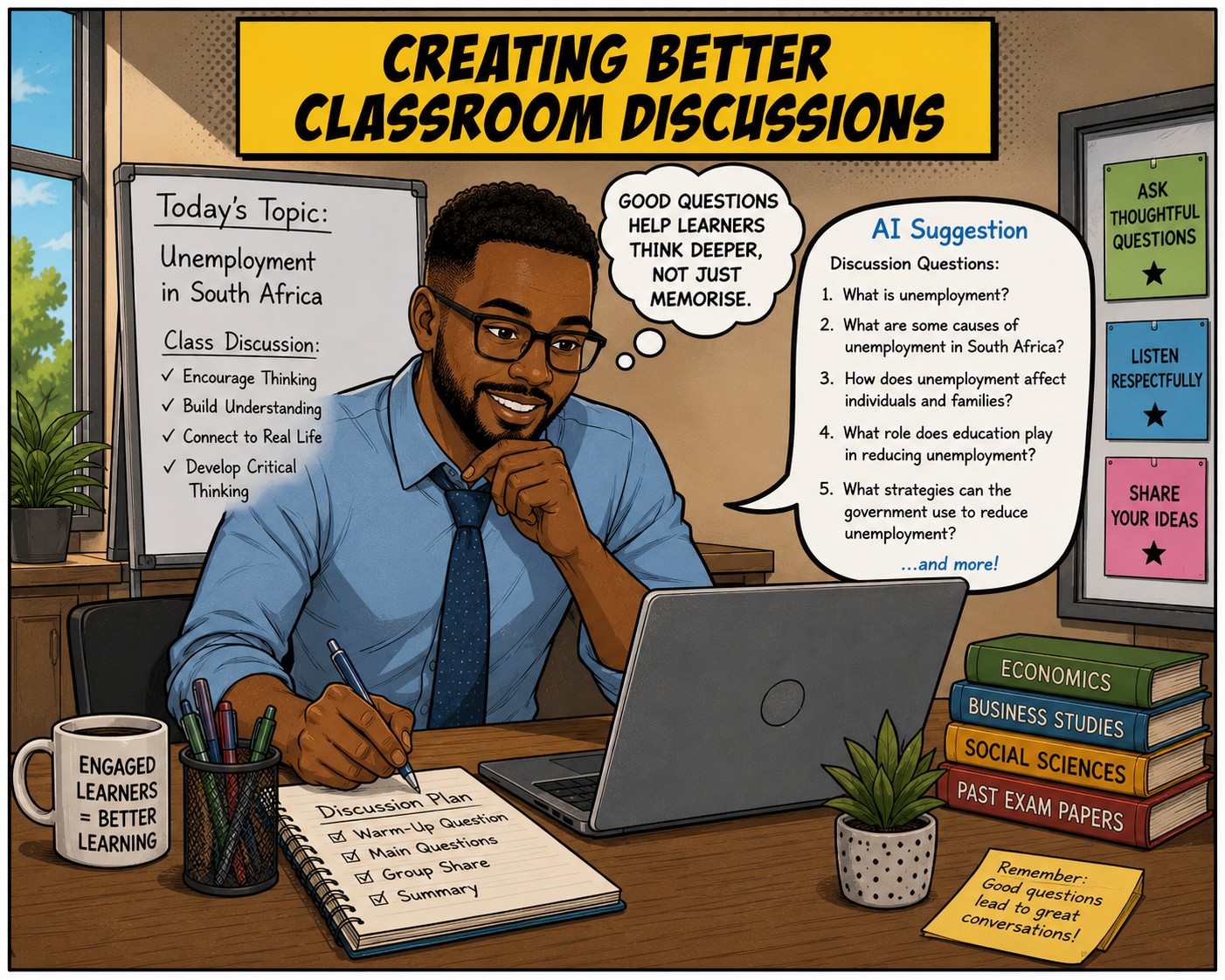
Discussion encourages learners to think rather than simply memorise.
AI can quickly generate discussion questions.
For example:
Instead of asking:
"What causes unemployment?"
An educator could ask AI:
Create ten discussion questions about unemployment in South Africa for Grade 11 learners, moving from simple understanding to critical thinking.
The questions might gradually progress from:
"What is unemployment?"
to
"What role should government and businesses play in reducing unemployment?"
This progression encourages deeper learning.
Producing Multiple Examples
Different learners understand concepts in different ways.
Sometimes one explanation is enough.
Sometimes learners need five different examples before understanding.
AI can rapidly produce examples from different contexts.
For example, when teaching percentages, AI could generate examples involving:
Shopping discounts
Sports statistics
School attendance
Election results
Population growth
Business profits
This variety helps educators reach more learners.
Explaining Difficult Concepts More Clearly
Every educator has experienced a lesson where learners simply do not understand the explanation.
Rather than searching multiple websites, AI can generate alternative explanations.
For example:
Explain photosynthesis:
for Grade 10 learners
using everyday language
using an analogy
in five simple steps
using farming examples
using South African plants
Different explanations help teachers identify the version that best suits their learners.
Saving Time On Resource Creation
Many classroom resources follow similar formats.
Examples include:
Question sheets
Vocabulary lists
Summary notes
True-or-false activities
Matching exercises
Multiple-choice questions
Short comprehension passages
Revision quizzes
AI can generate these quickly.
Educators then edit them to match:
lesson outcomes
curriculum standards
classroom ability
The final product remains teacher-approved.
Planning Practical Activities
Not every lesson should involve learners sitting quietly and listening.
AI can suggest practical activities appropriate for different subjects.
Examples include:
For Science:
Simple investigations
Observation tasks
Classification activities
For Geography:
Map interpretation
Climate comparisons
Population analysis
For Business Studies:
Company case studies
Marketing exercises
Entrepreneur interviews
For English:
Group discussions
Creative writing prompts
Peer editing activities
These ideas often spark further creativity.
Using AI To Plan Different Teaching Styles
Learners do not all learn in the same way.
Some learn through:
Reading
Discussion
Visual materials
Practical activities
Problem solving
Demonstrations
AI can suggest several teaching approaches for the same lesson.
An educator may ask:
Suggest three different ways to teach Newton's Laws to Grade 11 learners.
The responses may include:
Demonstrations
Sports examples
Practical experiments
Teachers can then choose what best suits their learners.
Supporting New Educators
New teachers often spend significantly longer planning lessons.
Everything feels new.
Experienced educators have years of classroom knowledge that helps them plan efficiently.
AI can help bridge this gap.
It provides:
Lesson structures
Activity ideas
Question suggestions
Assessment ideas
Discussion starters
This gives newer educators greater confidence while they continue developing their own teaching style.
Helping Experienced Teachers Refresh Lessons
Experienced educators often teach the same topics every year.
While experience is valuable, lessons can sometimes become repetitive.
AI can suggest:
New examples
Current events
Different activities
Updated case studies
Fresh discussion questions
This allows experienced teachers to refresh familiar lessons without starting from scratch.
Using AI To Adapt International Examples
Many online teaching resources use overseas examples.
South African learners often engage more easily with local contexts.
AI can help localise examples.
For instance:
Instead of discussing snowstorms when teaching weather systems, AI can suggest examples involving:
Cape winter rainfall
Gauteng thunderstorms
KwaZulu-Natal flooding
Karoo drought conditions
Local examples improve learner understanding because they connect new knowledge with familiar experiences.
Reducing Planning Fatigue
Decision fatigue affects many educators.
After teaching several classes, marking assessments, attending meetings, and completing administrative work, planning another lesson can feel overwhelming.
AI helps reduce the pressure of starting from nothing.
Instead of asking:
"What should I do tomorrow?"
The educator already has a structured draft to review.
This small change often reduces stress while improving productivity.
Maintaining Curriculum Alignment
One important reminder is that AI does not automatically understand every curriculum requirement.
South African educators should always compare AI-generated material against:
CAPS documents
Annual Teaching Plans
School assessment plans
Provincial guidelines
Examination requirements
AI should assist curriculum delivery—not replace curriculum planning.
Professional judgement remains essential.
Checking AI Output Carefully
Although AI is improving rapidly, it still makes mistakes.
Educators should always check:
Facts
Verify dates, formulas, scientific explanations, and definitions.
Curriculum Coverage
Ensure required outcomes are included.
Age Appropriateness
Check language and complexity.
Cultural Relevance
Use examples suitable for South African learners.
Bias
Avoid one-sided or inappropriate examples.
Practicality
Ensure activities fit available classroom time and resources.
A five-minute review can prevent classroom confusion later.
Developing Better AI Prompts
The quality of AI responses depends largely on the quality of the prompt.
Instead of writing:
"Plan a lesson."
Try including:
Subject
Grade
Topic
Lesson duration
CAPS outcomes
Teaching style
Learner ability
Available resources
Desired activities
Assessment type
The more information AI receives, the more useful its response becomes.
Example Prompt For Lesson Planning
A practical prompt might look like this:
Create a 60-minute Grade 10 Mathematics lesson aligned with CAPS on solving linear equations. Include learning objectives, an engaging starter activity, step-by-step teacher explanations, guided practice, independent learner work, questions for checking understanding, differentiation ideas for mixed-ability learners, a five-minute recap, and suitable homework. Use simple English and examples that South African learners can relate to.
Notice how specific this prompt is.
It provides AI with enough information to generate a lesson that requires refinement rather than complete redesign.
Combining AI With Your Own Resources
AI works best when combined with materials educators already trust.
For example:
CAPS documents
Previous successful lesson plans
Departmental resources
School-approved textbooks
Past examination papers
Teacher-created worksheets
Rather than replacing these resources, AI helps organise and expand them more efficiently.
Building Your Own Library Of AI Prompts
Many educators discover prompts that work particularly well.
Instead of creating new prompts every time, keep a collection organised by purpose.
You might create categories such as:
Lesson planning
Classroom discussions
Practical activities
Assessment questions
Homework ideas
Revision tasks
Differentiation
Lesson summaries
Over time, this prompt library becomes another valuable teaching resource that continues to save preparation time.
Common Mistakes To Avoid
Educators new to AI sometimes make avoidable mistakes.
These include:
Accepting AI responses without checking them
Using prompts that are too vague
Forgetting to align lessons with CAPS
Ignoring learner ability levels
Using unrealistic classroom activities
Assuming AI always provides correct information
Replacing professional judgement with AI suggestions
Avoiding these mistakes helps educators use AI responsibly and effectively.
The Future Of Lesson Planning
As AI continues to improve, lesson planning will become even more efficient.
Future AI tools may help educators:
Adapt lessons automatically for different ability levels
Recommend assessment ideas
Suggest teaching resources
Generate classroom visuals
Translate explanations into multiple languages
Identify common learner misconceptions
Recommend intervention activities based on assessment results
Even with these advances, the educator will remain the most important person in the classroom.
Technology can support teaching, but it cannot replace the relationships, encouragement, experience, and professional judgement that great educators bring to every lesson.
Conclusion
Lesson planning will always require professional expertise, thoughtful preparation, and a deep understanding of learners. AI does not change these responsibilities. Instead, it helps educators spend less time creating lesson frameworks and more time refining lessons that truly meet the needs of their learners.
Used responsibly, AI becomes a practical assistant rather than a replacement. It can generate lesson outlines, teaching activities, classroom examples, discussion questions, revision ideas, and learning sequences in minutes. This allows educators to focus on what matters most: adapting lessons to the CAPS curriculum, supporting learners with different abilities, building meaningful classroom relationships, and delivering engaging learning experiences.
For South African educators working under significant time pressures, AI offers an opportunity to reduce administrative workload while maintaining high professional standards. The most effective teachers will not be those who rely entirely on AI, but those who combine technology with their own knowledge, experience, creativity, and understanding of their learners.
When educators remain in control and use AI thoughtfully, lesson planning becomes more efficient, teaching becomes more flexible, and more time can be invested where it has the greatest impact—helping every learner succeed.
Additional Articles in the Using AI for Lesson Planning and Teaching Preparation Series
How Educators Can Use AI to Save Time on Lesson Planning
Using AI to Generate Class Activities and Teaching Examples
How AI Can Help You Differentiate Lessons for Mixed-Ability Classes
Using AI to Simplify Difficult Concepts for Learners
How to Use AI to Create Lesson Starters, Recaps, and Revision Activities
Disclaimer
AI Tools were used to assist with research. Remember to always cross-check everything that you read.