
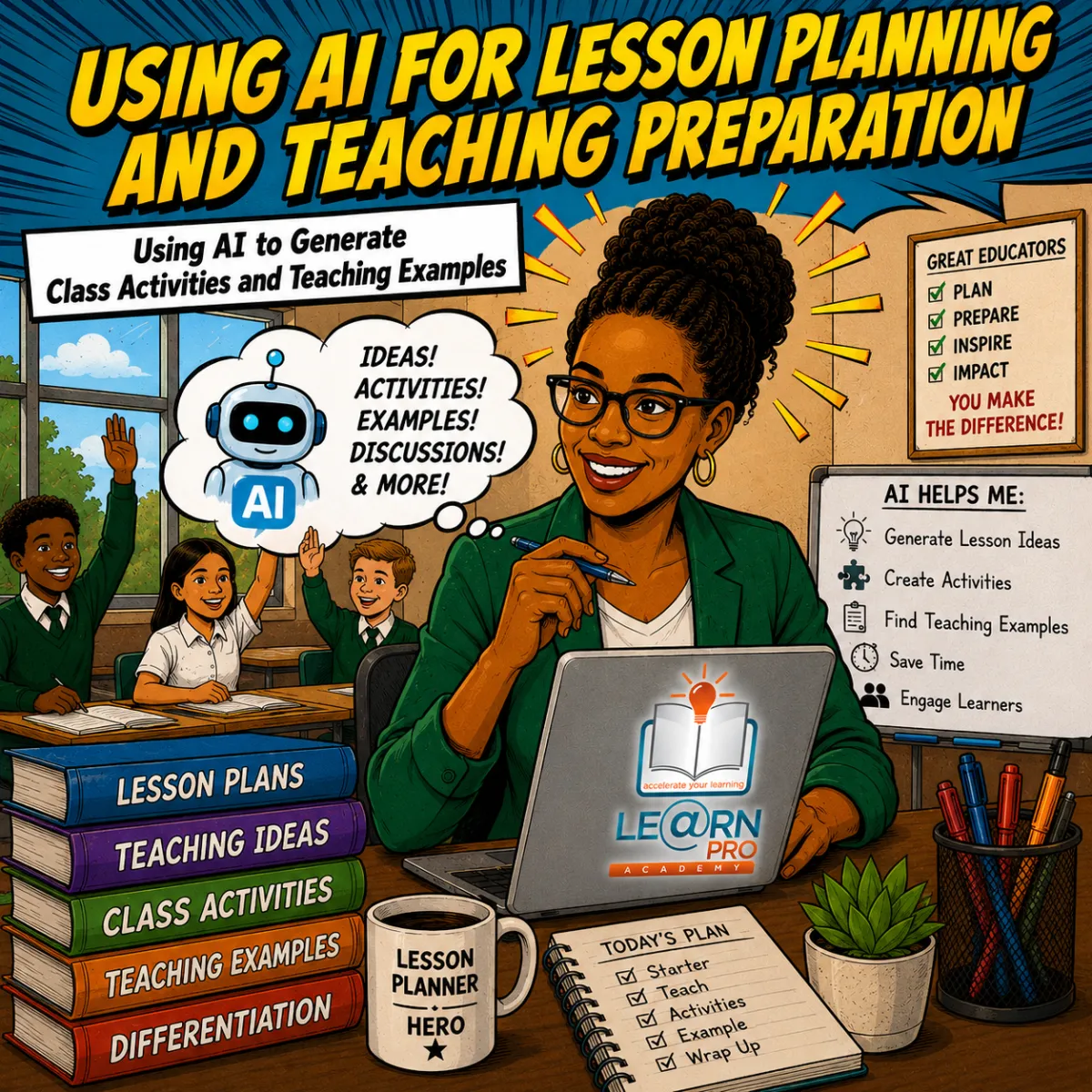
Using AI to Generate Class Activities and Teaching Examples
This is article #2 of 5 in the Using AI for Lesson Planning and Teaching Preparation Series
Introduction
One of the biggest challenges educators face is turning curriculum content into engaging classroom learning. Learners rarely remember information simply because they listened to a teacher explain it. They learn best when they participate, discuss ideas, solve problems, practise skills, and connect new knowledge to real-life situations.
Creating these learning opportunities, however, takes time.
Educators often spend hours developing classroom activities, searching for suitable examples, writing worksheets, preparing discussion questions, or finding practical scenarios that make lessons more meaningful. When teaching several classes across different grades, this preparation can become overwhelming.
Artificial Intelligence (AI) can help reduce this workload.
Rather than replacing an educator's creativity or professional judgement, AI can act as a planning assistant that quickly generates ideas, examples, tasks, and teaching resources. It provides a starting point that educators can adapt to suit their learners, the CAPS curriculum, and the realities of their own classrooms.
The most effective teachers will always bring the human elements that AI cannot provide—encouragement, classroom management, professional experience, empathy, and knowledge of their learners. AI simply helps educators spend less time creating first drafts and more time focusing on teaching.
This article explores practical ways educators can use AI to generate classroom activities and teaching examples that make learning more engaging, interactive, and effective.
Why Active Learning Matters
Research consistently shows that learners understand and remember information better when they actively participate in the learning process.
Simply listening to a lesson is only one part of learning.
Learners benefit when they:
Discuss ideas
Ask questions
Solve problems
Work in groups
Analyse examples
Complete practical tasks
Apply knowledge
Reflect on what they have learned
These activities encourage deeper thinking and help learners move beyond memorising facts.
AI can help educators generate many of these activities in minutes.
AI Is A Teaching Assistant, Not A Teaching Replacement
Before exploring specific examples, it is important to understand AI's role.
AI should never decide what learners need.
Instead, educators should decide:
The lesson objectives
The learning outcomes
The classroom approach
The assessment requirements
AI simply helps generate ideas more quickly.
The educator remains responsible for:
Checking accuracy
Ensuring CAPS alignment
Adapting activities
Managing classroom discussions
Supporting learners
Assessing understanding
Professional judgement always comes first.
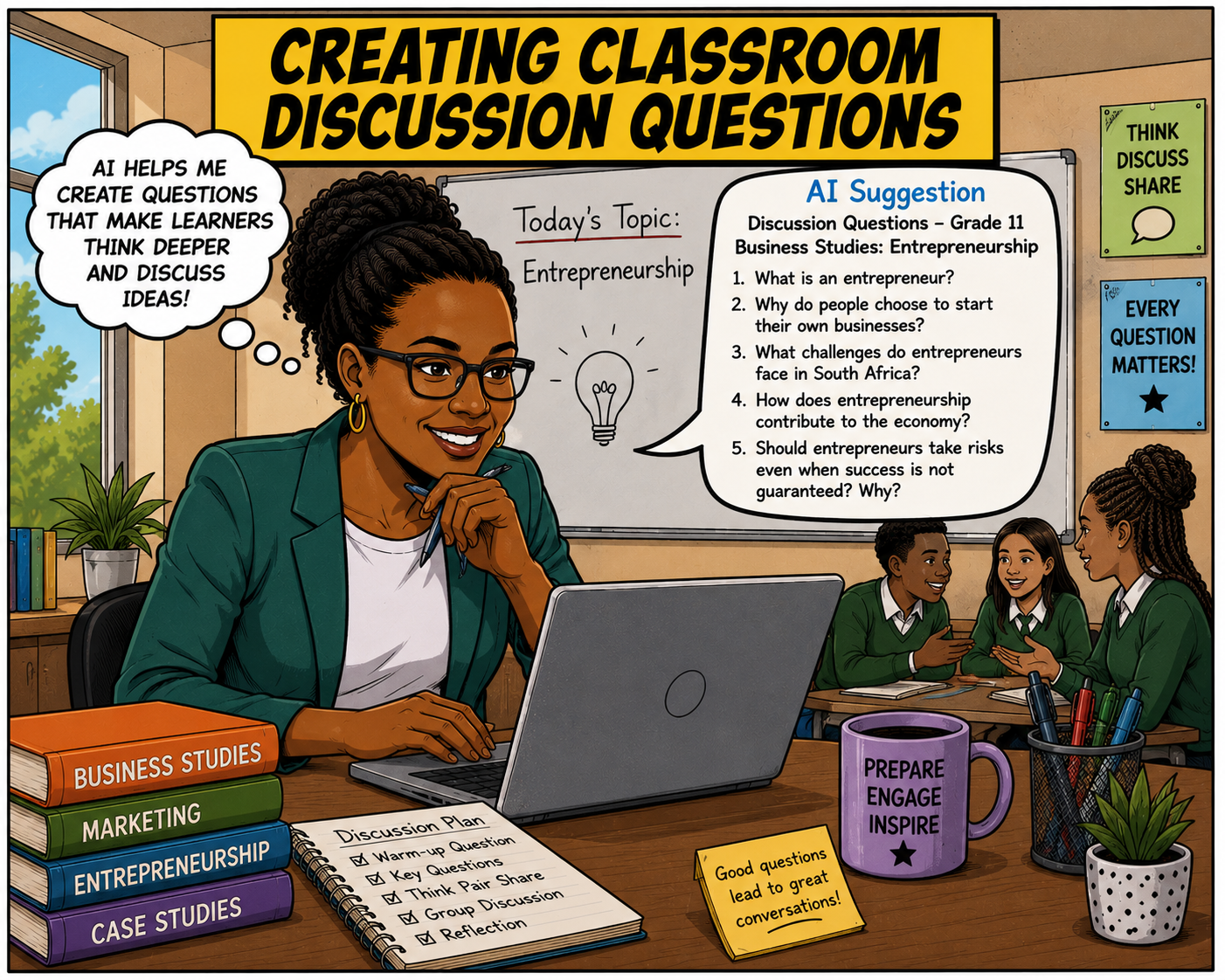
Generating Classroom Discussion Questions
Good discussions help learners think critically.
Unfortunately, creating thoughtful discussion questions takes time.
AI can quickly generate questions that move from basic understanding to higher-order thinking.
For example, an educator might ask:
Create ten discussion questions for a Grade 11 Business Studies lesson about entrepreneurship. Begin with simple understanding questions and progress to analytical and evaluative questions.
AI may generate questions such as:
What is an entrepreneur?
Why do people start businesses?
What challenges do entrepreneurs face in South Africa?
How does entrepreneurship create employment?
Should government do more to support small businesses? Explain your answer.
Instead of spending valuable preparation time writing discussion questions, educators can focus on selecting the ones most appropriate for their learners.
Creating Real-Life Teaching Examples
Many learners struggle because textbook examples feel distant from their daily lives.
AI can generate examples that relate more closely to South African experiences.
Instead of using unfamiliar situations, educators can request examples involving:
Local businesses
South African sport
Community issues
Environmental challenges
Public transport
Agriculture
Retail stores
Family budgeting
Youth employment
For example:
Rather than explaining inflation using overseas examples, AI could generate scenarios involving rising food prices, transport costs, or electricity expenses that learners recognise from everyday life.
These familiar contexts often make difficult concepts easier to understand.
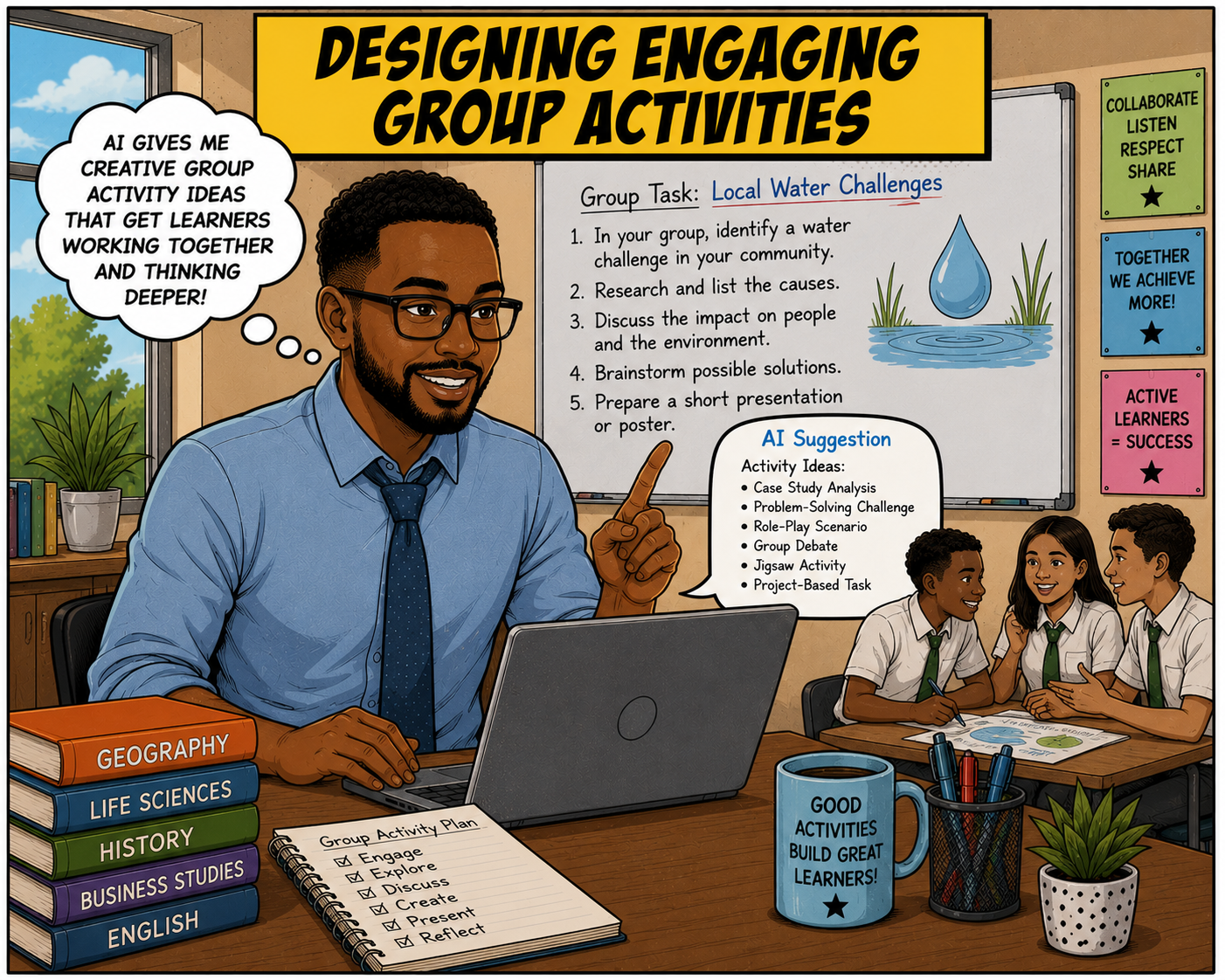
Designing Group Activities
Group work encourages communication, teamwork, and collaborative problem-solving.
AI can suggest structured activities suitable for different lesson objectives.
For example:
Create a 20-minute group activity for Grade 10 Geography on climate change.
AI may suggest:
Assigning different climate impacts to each group.
Researching causes and effects.
Preparing short presentations.
Comparing local and global examples.
Discussing possible solutions.
The educator can then adjust the activity according to available time, learner ability, and classroom resources.
Creating Role-Play Activities
Some subjects benefit greatly from role-play.
AI can generate realistic scenarios for learners to act out.
Examples include:
Business Studies
Learners simulate a business meeting.
English
Learners interview characters from a novel.
History
Learners debate historical decisions from different perspectives.
Life Orientation
Learners practise conflict resolution.
Economics
Learners negotiate wages between employers and employees.
Role-play helps learners apply knowledge while improving communication skills.
Generating Case Studies
Case studies encourage learners to analyse situations rather than memorise information.
AI can generate original case studies based on a topic.
For example:
Create a Grade 12 Accounting case study about a small retail business experiencing cash flow problems.
The AI may produce:
Business background
Financial information
Challenges
Questions for analysis
Possible solutions
Educators should review all financial figures and ensure they match CAPS requirements before using the activity.
Developing Subject-Specific Activities
AI can support almost every subject taught in high school.
Mathematics
Generate:
Word problems
Step-by-step practice
Mental maths activities
Error-finding exercises
Physical Sciences
Create:
Investigation ideas
Practical demonstrations
Hypothesis questions
Observation tasks
Life Sciences
Develop:
Classification exercises
Diagram labelling
Food web activities
Ecosystem investigations
Geography
Generate:
Map interpretation tasks
Climate comparisons
Population analysis
Urbanisation discussions
History
Create:
Source-based questions
Timeline activities
Historical debates
Cause-and-effect exercises
English
Generate:
Creative writing prompts
Comprehension questions
Vocabulary activities
Character analysis tasks
Business Studies
Develop:
Business scenarios
SWOT analysis activities
Marketing exercises
Entrepreneurship case studies
Every activity should still be reviewed by the educator before classroom use.
Creating Better Teaching Examples
Sometimes learners simply need another example.
AI can generate multiple explanations using different situations.
For example, if learners struggle with percentages, AI can produce examples involving:
Sports scores
School attendance
Shop discounts
Election results
Test marks
Business profits
Different examples help different learners.
An educator may only need one additional explanation to help the class understand.
Generating Practical Classroom Problems
Problem-solving develops critical thinking.
AI can generate practical situations that require learners to apply knowledge.
For example:
Business Studies:
"A local coffee shop has experienced declining sales. Suggest possible reasons and recommend solutions."
Geography:
"A town is experiencing rapid urban growth. What challenges might this create?"
Life Sciences:
"A farmer notices declining bee populations. How could this affect the ecosystem?"
These realistic situations encourage learners to think beyond memorising textbook information.
Creating Brainstorming Activities
Brainstorming encourages creativity.
AI can quickly generate prompts such as:
List possible solutions.
Predict future developments.
Suggest improvements.
Compare alternatives.
Identify risks.
Design new ideas.
For example:
Generate brainstorming questions about reducing plastic pollution in South Africa.
The resulting ideas can form the basis of group discussions or projects.
Designing Quick Lesson Starters
The first few minutes of a lesson often determine learner engagement.
AI can generate starter activities including:
Interesting facts
Mystery questions
"What do you notice?"
Short puzzles
Images to discuss
Poll questions
Prediction activities
For example:
Create a five-minute starter for Grade 10 Physical Sciences on electricity.
The AI may suggest showing everyday electrical appliances and asking learners to identify common features before introducing the lesson.
Generating Exit Tickets
Exit tickets help educators check understanding before learners leave the classroom.
AI can create quick questions such as:
What is one new thing you learned today?
Which concept remains confusing?
Explain today's topic in one sentence.
Give one real-life example.
What question do you still have?
These simple activities provide valuable feedback for future lesson planning.
Creating Revision Games
Revision does not always have to involve worksheets.
AI can suggest games such as:
Quiz competitions
Classroom bingo
Vocabulary races
Mystery word games
Team challenges
Matching activities
True-or-false competitions
These activities often increase learner motivation while reinforcing key concepts.
Producing Worksheets Faster
Many worksheets follow predictable structures.
AI can generate:
Multiple-choice questions
Short-answer questions
Matching exercises
Fill-in-the-blanks
Sequencing activities
Diagram labelling
Data interpretation
Educators can then edit the worksheet to suit learner ability and curriculum requirements.
Supporting Mixed-Ability Classes
Many classrooms contain learners performing at different academic levels.
AI can create several versions of the same activity.
For example:
Advanced learners receive:
Extension questions
Open-ended tasks
Independent research
Learners needing support receive:
Simpler language
Extra examples
Guided questions
Additional practice
This saves educators significant preparation time while supporting inclusive teaching.
Creating Activities For Limited Resources
Not every school has computer laboratories, science equipment, or reliable internet access.
AI can be prompted accordingly.
For example:
Create a classroom activity for Grade 11 Geography that requires no technology and only basic classroom materials.
AI can generate practical ideas using:
Paper
Whiteboards
Textbooks
Learner discussion
Group work
Observation
This makes activities more realistic for many South African schools.
Adapting Activities For Different Lesson Lengths
Sometimes educators have:
20 minutes
40 minutes
60 minutes
80 minutes
AI can adjust activities accordingly.
For example:
Adapt this Business Studies activity into a 15-minute revision exercise.
Or:
Expand this Geography activity into a full 60-minute lesson.
This flexibility helps educators make better use of available teaching time.
Creating Homework Tasks
Homework should reinforce classroom learning without overwhelming learners.
AI can generate homework that:
Reviews concepts
Encourages independent thinking
Builds practical skills
Prepares learners for the next lesson
Educators should ensure homework remains realistic and appropriate for learners' home environments.
Improving Question Variety
Many educators unintentionally repeat similar question styles.
AI can diversify classroom questioning by generating:
Recall questions
Application questions
Comparison questions
Evaluation questions
Reflection questions
Problem-solving questions
This supports higher-order thinking and improves learner engagement.
Developing Better AI Prompts
The quality of AI activities depends on the quality of the prompt.
Instead of asking:
"Create a worksheet."
Try asking:
Create a Grade 11 CAPS-aligned Business Studies worksheet on marketing strategies. Include ten multiple-choice questions, five short-answer questions, one case study, and one extension activity. Use simple English suitable for South African learners.
The more detail included, the better the result.
Building Your Own Activity Prompt Library
As educators discover prompts that work well, they should save them.
Possible categories include:
Discussion questions
Group work
Lesson starters
Worksheets
Case studies
Practical investigations
Homework
Revision activities
Extension tasks
Exit tickets
Over time, this prompt library becomes a valuable professional resource.
Common Mistakes To Avoid
When using AI to generate classroom activities, educators should avoid:
Using activities without reviewing them.
Ignoring CAPS requirements.
Making activities too difficult.
Making activities too easy.
Using unrealistic examples.
Forgetting available classroom resources.
Overloading lessons with too many activities.
Assuming AI-generated facts are always correct.
A short review before teaching can prevent many classroom problems.
The Future Of AI-Supported Classroom Activities
AI is becoming increasingly capable of supporting lesson preparation.
Future tools may help educators:
Generate personalised activities automatically.
Adapt work for different ability levels instantly.
Produce multilingual classroom resources.
Recommend interventions based on learner performance.
Suggest practical demonstrations.
Create visual teaching aids.
Develop interactive revision materials.
Even as technology advances, the educator will remain central to the learning process.
AI can generate activities.
Teachers create meaningful learning experiences.
That difference will always matter.
Conclusion
Creating engaging classroom activities and teaching examples is one of the most rewarding parts of teaching, but it is also one of the most time-consuming. AI gives educators a practical way to reduce preparation time by generating first drafts of discussion questions, worksheets, role-play scenarios, case studies, lesson starters, revision tasks, and subject-specific learning activities within minutes.
The real value of AI is not that it produces ready-made lessons. Its value lies in helping educators overcome the challenge of starting from a blank page. Teachers can then apply their professional knowledge, align activities with the CAPS curriculum, adapt resources for their learners, and create learning experiences that are meaningful, practical, and engaging.
For South African educators balancing teaching, marking, administration, and learner support, AI offers an opportunity to work more efficiently without compromising quality. When combined with professional judgement, creativity, and a deep understanding of learners, AI becomes a powerful classroom planning assistant that supports—not replaces—excellent teaching.
Additional Articles in the Using AI for Lesson Planning and Teaching Preparation Series
How Educators Can Use AI to Save Time on Lesson Planning
Using AI to Generate Class Activities and Teaching Examples
How AI Can Help You Differentiate Lessons for Mixed-Ability Classes
Using AI to Simplify Difficult Concepts for Learners
How to Use AI to Create Lesson Starters, Recaps, and Revision Activities
Disclaimer
AI Tools were used to assist with research. Remember to always cross-check everything that you read.