
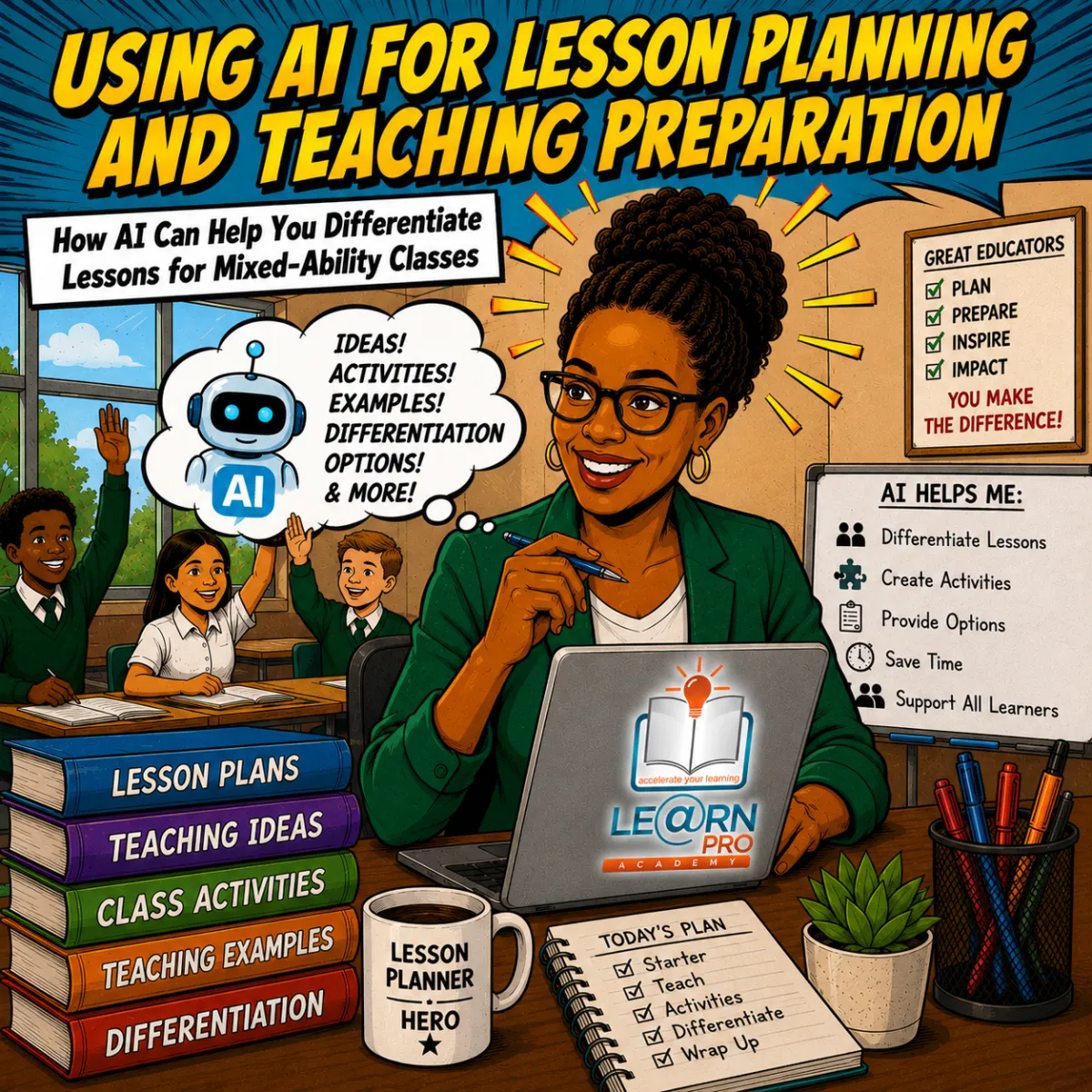
How AI Can Help You Differentiate Lessons for Mixed-Ability Classes
This is article #3 of 5 in the Using AI for Lesson Planning and Teaching Preparation Series
Introduction
Every educator has experienced it. You introduce a new topic, explain it carefully, ask a few questions, and quickly realise that your learners are not all in the same place. Some grasp the concept almost immediately and are ready for more challenging work. Others need additional explanations, simpler examples, or more time to understand the basics.
Mixed-ability classes are a reality in many South African high schools. Learners come from different educational backgrounds, have varying levels of confidence, learn at different speeds, and face different challenges both inside and outside the classroom. Some may excel academically, while others require additional support because of language barriers, learning gaps, or limited access to educational resources.
Differentiating lessons allows educators to meet these different learning needs without lowering expectations. However, creating multiple versions of the same lesson, activity, or assessment often requires significant planning time. Preparing extension work for advanced learners while also creating support materials for learners who are struggling can become overwhelming, especially when educators are already balancing marking, administration, and extracurricular responsibilities.
Artificial Intelligence (AI) offers a practical solution.
AI cannot replace an educator's understanding of individual learners, nor can it decide the best teaching approach for every classroom. What it can do is help educators generate differentiated explanations, activities, worksheets, examples, and questions much more quickly. Instead of starting from scratch each time, teachers can use AI to create a first draft and then adapt it to meet the needs of their learners.
This article explores how educators can use AI to support differentiated teaching while maintaining curriculum standards, promoting inclusion, and ensuring that every learner has the opportunity to succeed.
Understanding Mixed-Ability Classrooms
Very few classrooms consist of learners who all learn at exactly the same pace.
Within a single class, educators may have learners who:
Learn quickly and require additional challenges.
Understand concepts after guided practice.
Need repeated explanations before mastering a skill.
Experience language barriers.
Have learning support needs.
Lack confidence in certain subjects.
Missed previous work due to absenteeism.
Require enrichment because they consistently perform above grade expectations.
Teaching every learner using exactly the same lesson, examples, and activities may leave some learners behind while others become bored.
Differentiation aims to provide appropriate learning opportunities for everyone.
What Differentiation Really Means
Differentiation does not mean creating an entirely separate lesson for every learner.
Instead, it means adjusting parts of the learning experience to better meet different needs.
Educators might differentiate:
Explanations
Examples
Activities
Questions
Worksheets
Homework
Group tasks
Extension activities
Assessment support
Learning resources
The learning outcomes remain the same.
The path learners take to reach those outcomes may differ.
How AI Supports Differentiated Teaching
AI is particularly useful because it can produce multiple versions of the same material within seconds.
For example, an educator might ask:
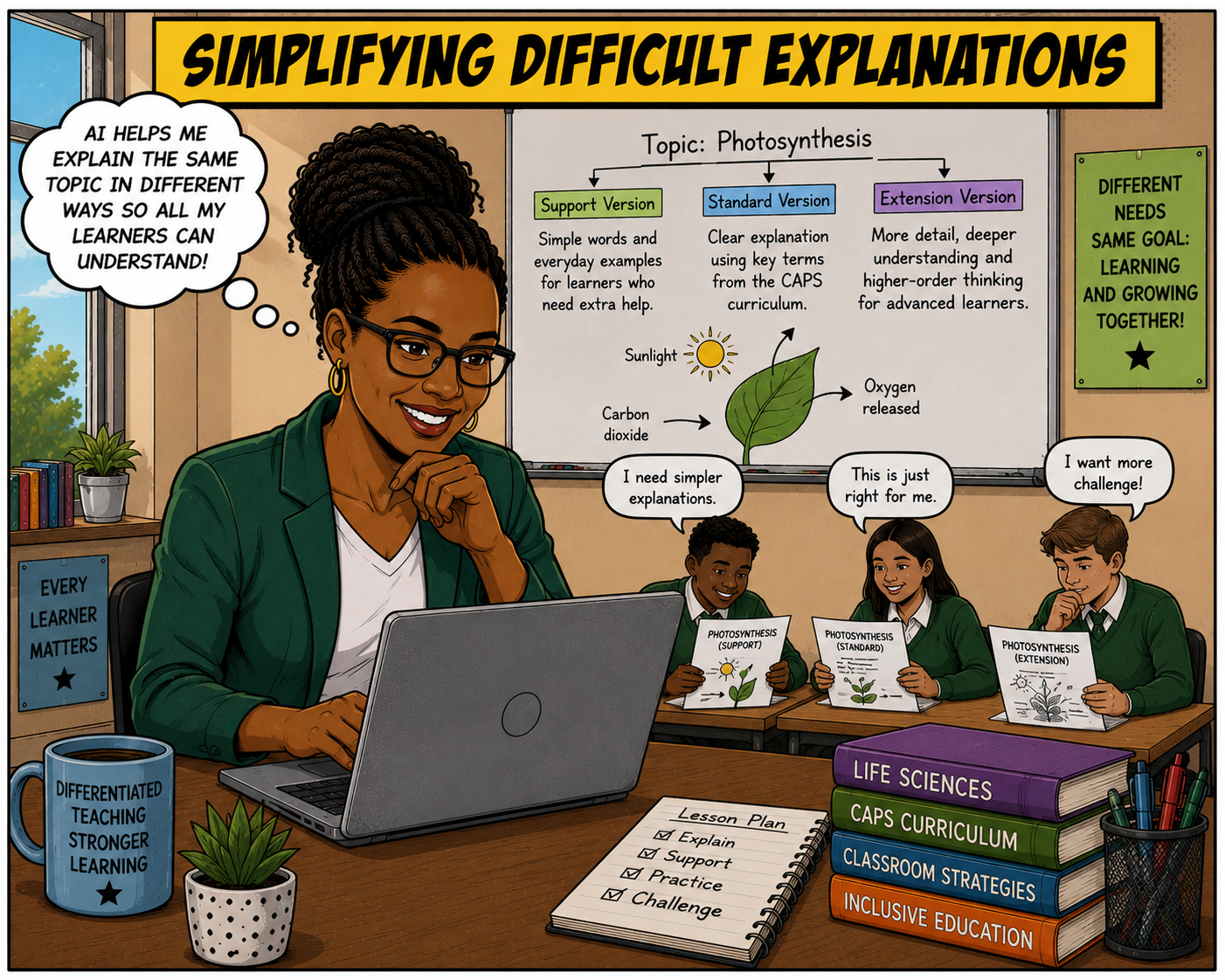
Explain photosynthesis for Grade 10 learners at three different ability levels.
The AI could produce:
Support Version
Simple vocabulary with everyday examples.
Standard Version
Normal curriculum explanation with key scientific terminology.
Extension Version
A more detailed explanation including biochemical processes and links to ecology.
Instead of writing three explanations manually, the educator only needs to review and refine the AI-generated drafts.
Simplifying Difficult Explanations
Some learners struggle because academic language feels overwhelming.
AI can rewrite explanations using simpler English while keeping the meaning accurate.
For example:
Instead of:
"Cellular respiration is the biochemical process by which glucose is converted into usable energy."
AI could generate:
"Cells break down glucose from food to release energy that helps the body work."
This makes the concept more accessible without changing the underlying science.
Educators should always check that simplified explanations still align with the CAPS curriculum.
Creating Extension Work For Advanced Learners
While some learners require support, others need additional challenges.
Without extension work, high-performing learners may lose interest or finish activities long before the rest of the class.
AI can quickly generate:
More complex questions
Research activities
Case studies
Independent investigations
Critical thinking tasks
Debates
Data analysis exercises
Project ideas
For example:
Create five extension questions for Grade 12 Geography learners studying climate change.
The AI can produce questions that encourage evaluation, analysis, and independent thinking.
Adapting Reading Materials
Reading ability often varies widely within one classroom.
AI can help by producing different versions of the same reading passage.
An educator could request:
Rewrite this Business Studies passage using simpler English suitable for English Second Language learners.
Or:
Expand this passage with additional detail for advanced learners.
This allows every learner to engage with the same topic while reading material suited to their ability.
Creating Different Question Levels
Not every learner should always receive exactly the same type of question.
AI can generate questions at different cognitive levels.
For example:
Level 1
Recall basic facts.
Level 2
Explain concepts.
Level 3
Apply knowledge to new situations.
Level 4
Analyse information.
Level 5
Evaluate different viewpoints.
This approach encourages progression while allowing educators to support learners appropriately.
Supporting English Second Language Learners
Many South African learners study in English even though it is not their home language.
AI can assist by:
Simplifying vocabulary.
Explaining difficult words.
Providing definitions.
Creating glossaries.
Generating sentence starters.
Rewriting instructions more clearly.
This supports language development without reducing academic expectations.
Generating Alternative Examples
Different learners understand concepts through different contexts.
AI can produce several examples explaining the same idea.
For percentages, examples could involve:
Shopping discounts.
Soccer statistics.
School attendance.
Election results.
Household budgeting.
Farming production.
If one example does not connect with learners, another might.
Differentiating Classroom Activities
Not every learner benefits from identical classroom tasks.
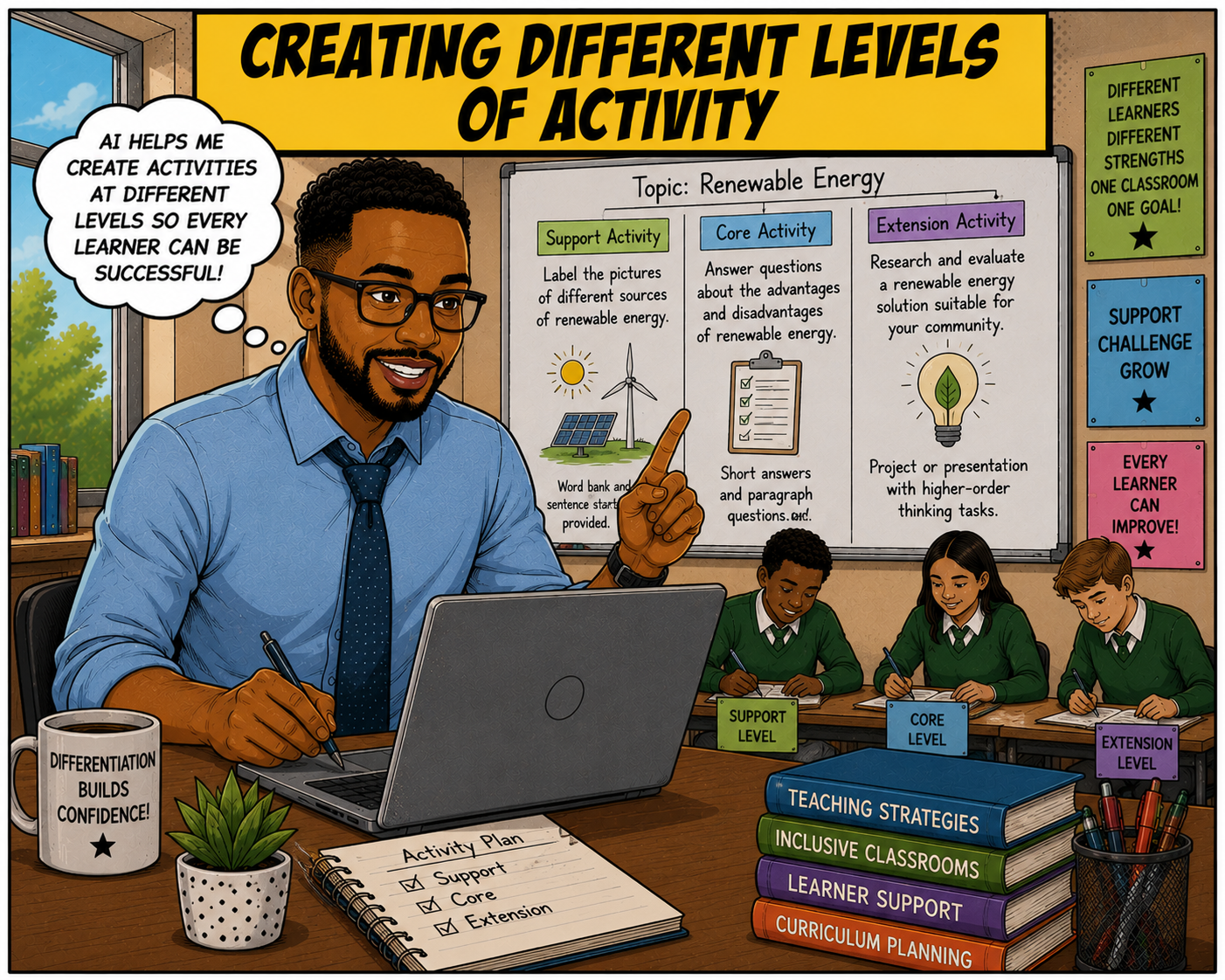
AI can generate variations such as:
Support Activity
Guided worksheet with hints.
Core Activity
Independent practice.
Extension Activity
Open-ended investigation.
Although all learners work towards the same learning outcome, the activities provide different levels of support.
Creating Scaffolded Learning
Scaffolding means gradually reducing support as learners become more confident.
AI can generate activities that move step by step.
For example:
Stage 1:
Worked example.
Stage 2:
Guided practice.
Stage 3:
Independent practice.
Stage 4:
Application task.
This structure helps learners build confidence while developing independence.
Planning Flexible Group Work
AI can suggest group activities that allow learners to contribute according to their strengths.
Examples include:
Mixed-ability teams.
Peer teaching.
Collaborative investigations.
Research projects.
Problem-solving challenges.
An educator remains responsible for deciding how learners should be grouped.
Creating Multiple Worksheet Versions
One worksheet rarely suits every learner.
AI can quickly generate:
Version A:
Additional guidance and hints.
Version B:
Standard curriculum questions.
Version C:
Extension questions requiring deeper analysis.
The educator chooses which version best meets each learner's needs.
Supporting Learners Who Miss Lessons
Absenteeism can leave learners with significant knowledge gaps.
AI can help generate:
Catch-up summaries.
Simplified notes.
Practice exercises.
Revision questions.
Key vocabulary lists.
These resources help learners rejoin classroom learning more confidently.
Encouraging Independent Learning
Differentiation is not only about teacher support.
It also encourages learners to take responsibility for their own progress.
AI can generate:
Self-check quizzes.
Revision plans.
Reflection questions.
Independent research tasks.
Goal-setting activities.
These resources help learners monitor their own learning.
Adapting Homework
Homework can also be differentiated.
For example:
Support homework:
Shorter tasks.
More guided questions.
Extra examples.
Extension homework:
Research activities.
Real-world applications.
Critical thinking tasks.
The educator ensures homework remains manageable and fair.
Differentiating Assessments
While formal assessments must meet school and CAPS requirements, AI can help educators prepare learners through differentiated practice.
For example:
Generate:
Easier practice questions.
Standard examination questions.
Challenging extension questions.
Learners build confidence before attempting formal assessments.
Using AI To Identify Learning Gaps
AI can help educators analyse learner performance data.
For example, after reviewing assessment results, an educator could ask:
Suggest revision activities for learners struggling with algebraic equations.
The AI can recommend targeted support activities rather than general revision.
Professional judgement remains essential when interpreting learner performance.
Creating Visual Learning Resources
Some learners understand better through visual information.
AI can help educators generate ideas for:
Diagrams.
Flowcharts.
Graphic organisers.
Timelines.
Comparison tables.
Mind maps.
Visual resources often make abstract concepts easier to understand.
Respecting Learner Dignity
Differentiation should never embarrass learners.
Support activities should not make learners feel labelled as "weak."
AI-generated materials should be used sensitively.
Educators can:
Provide different activities discreetly.
Rotate groups regularly.
Encourage peer support.
Celebrate progress rather than ability.
Every learner deserves respect and encouragement.
Checking AI Output Carefully
Educators should never use AI-generated differentiated materials without review.
Check:
Accuracy
Are the facts correct?
Curriculum Alignment
Does the content match CAPS?
Language
Is the vocabulary appropriate?
Difficulty Level
Is the activity genuinely suited to the intended learners?
Inclusivity
Are examples respectful and culturally appropriate?
Practicality
Can the activity realistically be completed in class?
These checks ensure AI supports high-quality teaching.
Developing Better AI Prompts
The quality of AI output depends heavily on the quality of the prompt.
Instead of writing:
Create a worksheet.
Try writing:
Create three versions of a Grade 10 Life Sciences worksheet on ecosystems aligned with CAPS. Include a support version with guided questions, a standard version for average learners, and an extension version with higher-order thinking questions. Use clear English suitable for South African learners.
Specific prompts produce much more useful results.
Building A Differentiation Prompt Library
Educators can save successful prompts for future use.
Possible categories include:
Simplified explanations.
Extension questions.
Reading adaptations.
ESL support.
Scaffolded worksheets.
Revision activities.
Homework.
Group work.
Assessment preparation.
Visual learning resources.
Over time, this collection becomes a valuable professional planning resource.
Common Mistakes To Avoid
When using AI for differentiated teaching, educators should avoid:
Assuming AI understands every learner's needs.
Giving all learners the same activities without adaptation.
Oversimplifying important concepts.
Challenging advanced learners too little.
Forgetting CAPS requirements.
Using AI without checking accuracy.
Labelling learners publicly by ability.
Replacing professional judgement with AI suggestions.
AI supports differentiation.
Teachers make differentiation effective.
The Future Of AI And Inclusive Teaching
AI technology continues to improve rapidly.
Future educational tools may help educators:
Automatically adapt reading levels.
Suggest intervention activities.
Generate personalised practice.
Recommend enrichment work.
Translate resources into multiple South African languages.
Identify common misconceptions.
Support inclusive classrooms more efficiently.
Despite these advances, successful differentiation will always depend on educators who know their learners, understand the curriculum, and make thoughtful professional decisions.
Technology may provide options.
Teachers provide opportunity.
Conclusion
Differentiating lessons for mixed-ability classes has always been one of the greatest challenges facing educators. Meeting the needs of learners who learn at different speeds, have different language abilities, or require different levels of support demands careful planning and considerable time.
AI offers educators a practical way to reduce this workload by generating differentiated explanations, worksheets, activities, extension tasks, reading materials, and practice questions within minutes. Instead of creating every version manually, teachers can begin with AI-generated drafts and then refine them using their professional knowledge and understanding of their learners.
For South African educators working in diverse classrooms, AI can become a valuable planning assistant that supports inclusive teaching while maintaining CAPS standards. The goal is not to treat learners differently because of their abilities, but to provide appropriate opportunities for every learner to succeed.
Ultimately, technology cannot replace the insight, empathy, and professional judgement of an educator. However, when AI is used thoughtfully and responsibly, it can help teachers create classrooms where every learner is challenged, supported, and given the opportunity to reach their full potential.
Additional Articles in the Using AI for Lesson Planning and Teaching Preparation Series
How Educators Can Use AI to Save Time on Lesson Planning
Using AI to Generate Class Activities and Teaching Examples
How AI Can Help You Differentiate Lessons for Mixed-Ability Classes
Using AI to Simplify Difficult Concepts for Learners
How to Use AI to Create Lesson Starters, Recaps, and Revision Activities
Disclaimer
AI Tools were used to assist with research. Remember to always cross-check everything that you read.