
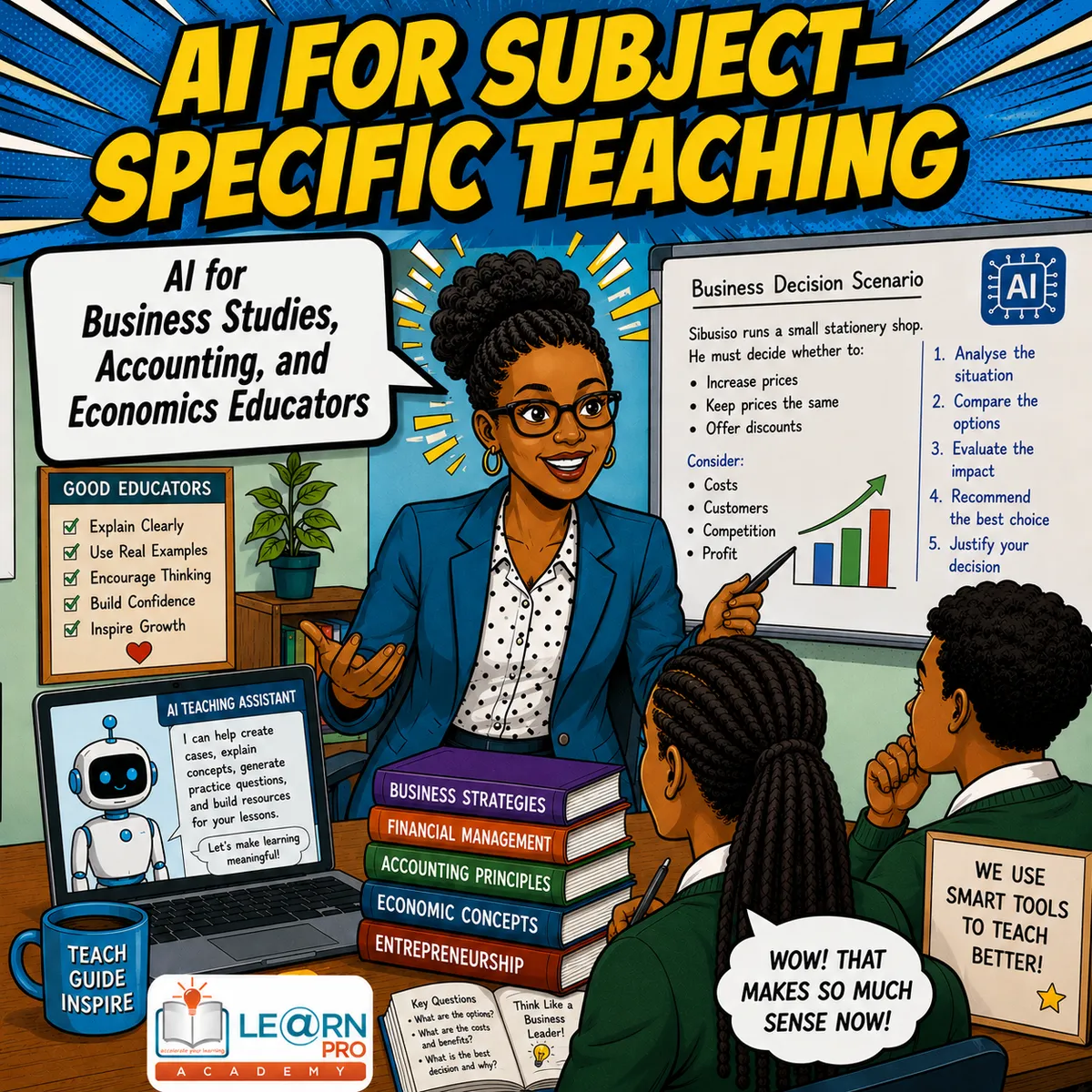
AI for Business Studies, Accounting, and Economics Educators
This is article #5 of 5 in the AI for Subject-Specific Teaching Series
Introduction
Business Studies, Accounting, and Economics help learners understand how organisations operate, how money is managed, how markets function, and how economic decisions affect individuals, businesses, and society. These subjects prepare learners for careers in commerce, entrepreneurship, finance, management, and many other professions while also equipping them with practical life skills.
Teaching commercial subjects, however, involves balancing theory with real-world application. Educators need to explain business concepts, interpret financial information, teach calculations, analyse case studies, discuss current economic events, and prepare learners for application-based examination questions. Creating engaging examples and relevant activities often requires significant preparation time.
Artificial Intelligence (AI) offers practical ways to support educators in these subjects. It can generate business scenarios, explain accounting principles, simplify economic concepts, create practice questions, develop case studies, and produce revision materials that save valuable planning time. AI can also help connect classroom learning to real business situations that learners recognise and understand.
However, AI should never replace critical thinking or independent problem-solving. Learners must still analyse information, interpret financial data, justify business decisions, calculate accurately, and evaluate different solutions. Simply accepting AI-generated answers without understanding them weakens the very skills these subjects are designed to develop.
The educator remains the expert who guides discussion, checks accuracy, encourages analysis, and helps learners apply theory to practical situations. AI should strengthen this work—not replace it.
This article explores practical ways South African Business Studies, Accounting, and Economics educators can use AI to make learning more relevant, engaging, and meaningful while maintaining strong commercial thinking skills.
Why Commercial Subjects Require More Than Memorisation
Commercial subjects involve much more than remembering definitions.
Learners need to understand:
How businesses make decisions
Why financial information matters
How markets influence prices
How economic events affect society
How theory applies in real situations
How to solve practical business problems
Understanding relationships is far more valuable than memorising textbook content.
AI should therefore support deeper understanding rather than simple recall.
AI Should Strengthen Commercial Thinking
Successful learners ask questions such as:
Why did this business make that decision?
What are the financial consequences?
Which option creates the greatest value?
How would this affect customers?
What economic factors influenced the outcome?
AI should encourage learners to think through these questions instead of providing ready-made answers.
Commercial education develops decision-makers, not memorisers.
Explaining Business Concepts More Clearly
Many commercial concepts seem abstract when learners first encounter them.
Examples include:
Supply and demand
Inflation
Profitability
Cash flow
Entrepreneurship
Corporate social responsibility
Opportunity cost
Competitive advantage
AI can generate multiple explanations using:
Simple English
Everyday examples
South African businesses
Visual comparisons
Practical scenarios
Different explanations help educators meet diverse learner needs.
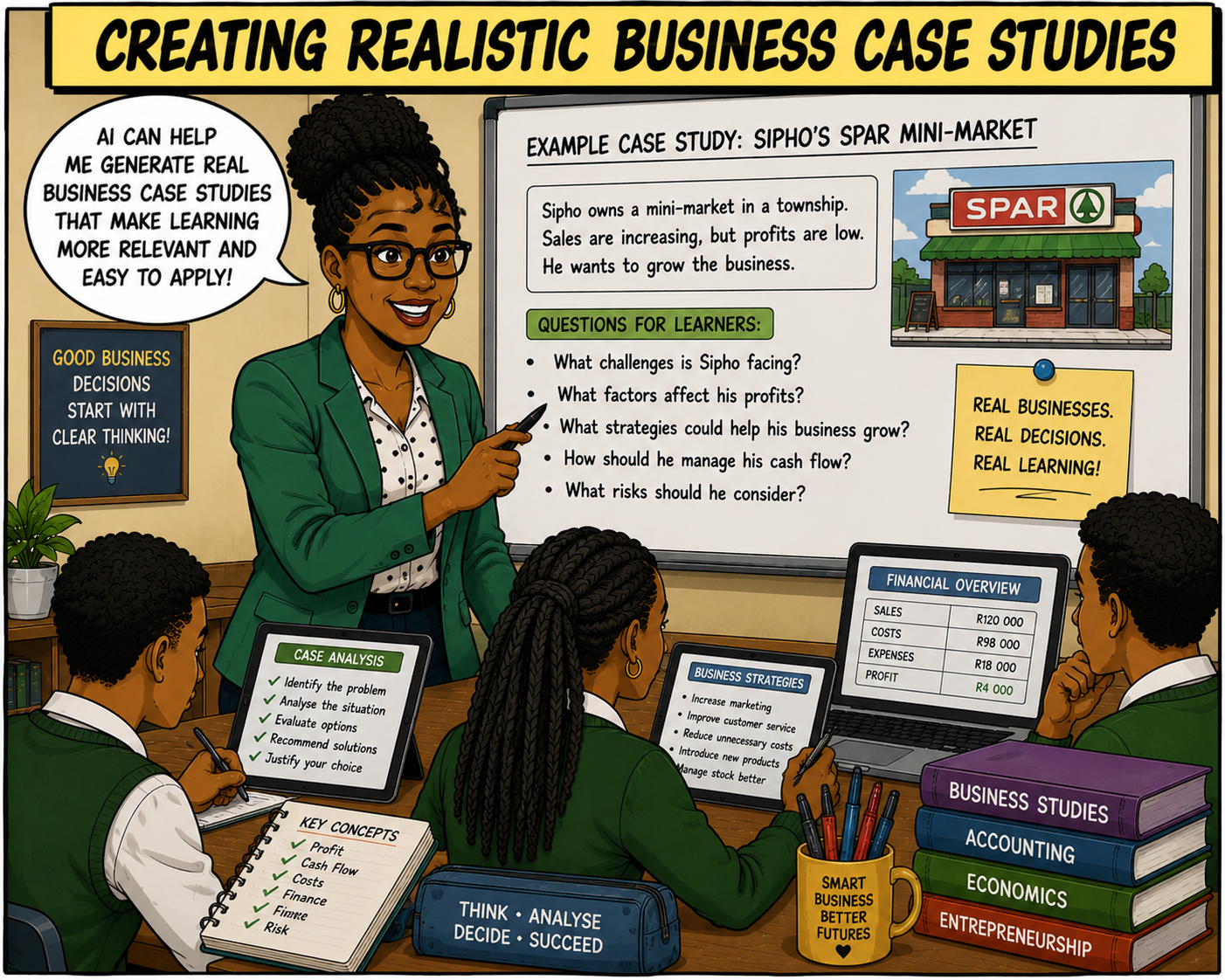
Creating Realistic Business Case Studies
Case studies help learners apply theory to practical situations. However, developing new case studies takes time.
AI can generate realistic examples involving:
Small businesses
Retail stores
Restaurants
Technology companies
Farms
Tourism businesses
Manufacturing companies
Service businesses
Educators should review and adapt these scenarios to ensure they match CAPS requirements and local contexts.
Using South African Business Examples
Learners engage more when examples feel familiar.
AI can generate scenarios involving:
Local entrepreneurs
Township businesses
Family-owned companies
South African retailers
Agricultural businesses
Tourism operators
Manufacturing firms
Small service businesses
These examples help learners see how classroom concepts apply in everyday life.
Supporting Accounting Calculations
Accounting requires learners to understand both concepts and calculations.
AI can generate:
Journal entry practice
Ledger exercises
Trial balances
Financial statements
Ratio calculations
Error correction activities
Teachers should always verify calculations before using AI-generated material.
Accuracy remains essential.
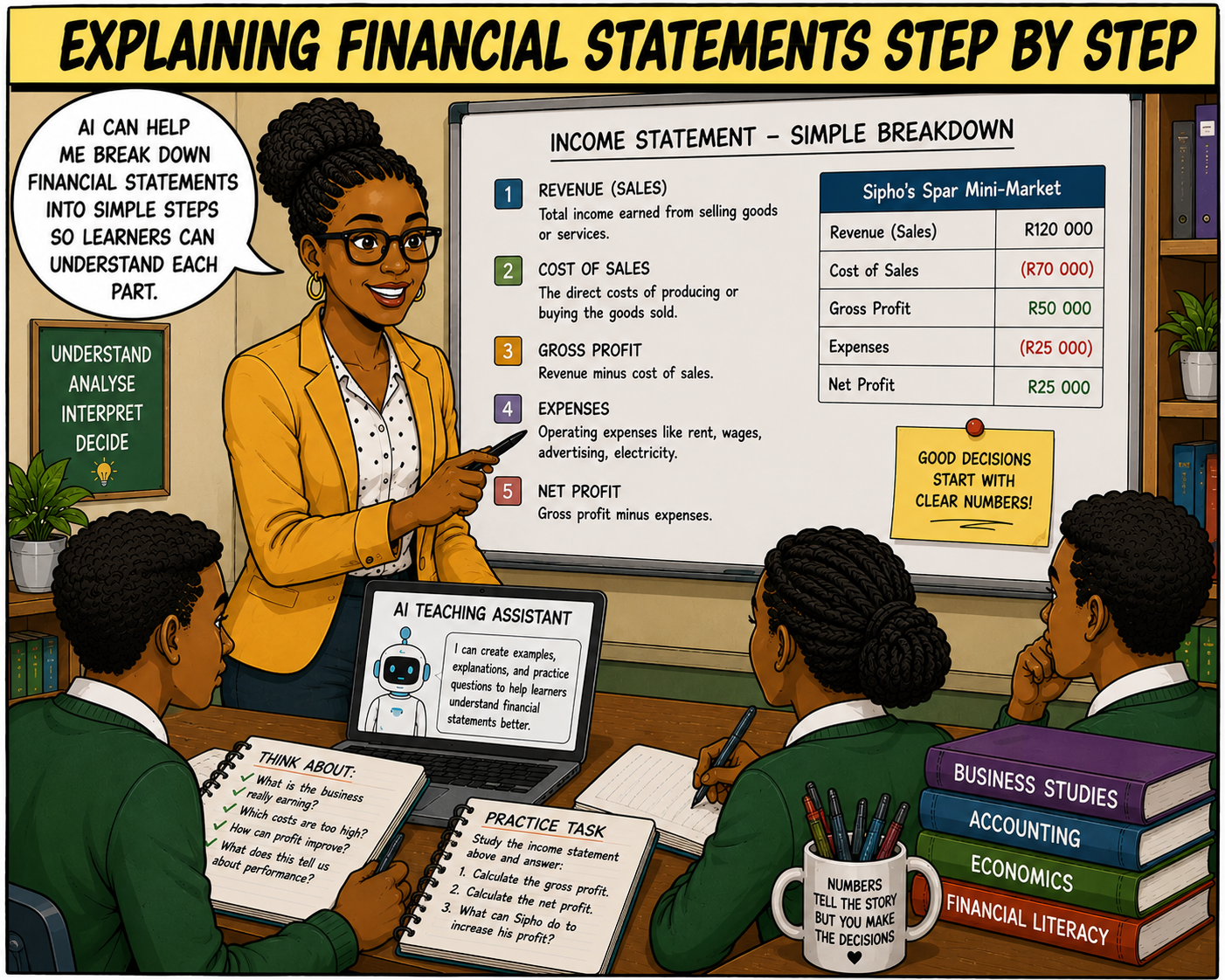
Explaining Financial Statements Step By Step
Many learners become overwhelmed by financial statements.
AI can help educators explain:
Income Statements
Balance Sheets
Cash Flow Statements
using:
Step-by-step guides
Colour-coded examples
Simplified terminology
Worked examples
Breaking complex information into smaller sections builds learner confidence.
Creating Economics Scenarios
Economics becomes more meaningful when connected to real events.
AI can generate scenarios involving:
Inflation
Interest rates
Unemployment
Exchange rates
Government spending
International trade
Economic growth
Load shedding and productivity
Teachers can use current South African examples to encourage discussion and analysis.
Supporting Business Decision-Making Activities
Business Studies encourages learners to evaluate different options.
AI can generate decision-making activities where learners compare:
Marketing strategies
Pricing decisions
Recruitment methods
Leadership styles
Investment choices
Business expansion plans
Rather than asking learners to identify one correct answer, educators can encourage discussion about the advantages and disadvantages of different approaches.
Creating Practice Questions At Different Levels
Every classroom includes learners with varying levels of understanding.
AI can generate activities that increase in difficulty.
Foundation Level
Definitions
Simple calculations
Basic explanations
Core Level
Standard examination questions
Business scenarios
Financial interpretation
Extension Level
Case study analysis
Strategic recommendations
Complex calculations
Evaluation questions
Differentiated resources help every learner progress.
Developing Higher-Order Thinking
Commercial subjects require learners to analyse rather than memorise.
AI can generate questions such as:
Which option would you recommend?
Justify your decision.
Evaluate the business strategy.
Explain the financial impact.
Predict possible outcomes.
Compare two business approaches.
These questions develop commercial reasoning and decision-making.
Supporting Examination Revision
Preparing revision materials takes considerable time.
AI can help educators create:
Topic summaries
Formula sheets
Revision quizzes
Flashcards
Case study questions
Financial interpretation exercises
Multiple-choice questions
Teachers should adapt revision materials to match CAPS assessment standards.
Encouraging Learners To Explain Their Reasoning
Correct answers alone do not demonstrate understanding.
Learners should explain:
Why they selected a solution
How they reached a calculation
Why a strategy may succeed
What evidence supports their recommendation
AI can generate discussion prompts that encourage learners to justify their thinking.
These conversations strengthen analytical ability.
Supporting Entrepreneurship Education
Many Business Studies learners are interested in starting businesses.
AI can help educators generate activities involving:
Business ideas
Business plans
Customer profiles
Marketing strategies
Budget planning
Pricing decisions
Risk analysis
These practical activities help learners connect classroom learning with future opportunities.
Helping Learners Understand Commercial Vocabulary
Commercial subjects introduce many unfamiliar terms.
Examples include:
Assets
Liabilities
Equity
Inflation
Monopoly
Liquidity
Dividend
Depreciation
AI can create:
Vocabulary lists
Flashcards
Definitions
Matching activities
Revision quizzes
Improved vocabulary strengthens examination performance.
Checking AI-Generated Financial Information
Educators should always verify AI-generated content.
Check:
Calculations
Financial statements
Ratios
Definitions
Economic explanations
Business terminology
South African legislation where applicable
CAPS alignment
Professional judgement remains essential.
Protecting Independent Commercial Thinking
Commercial education develops practical thinking skills.
Learners should continue asking:
Is this financially sensible?
What risks exist?
What alternatives are available?
What evidence supports this decision?
How would this affect customers?
Would this strategy succeed?
AI should help learners explore these questions — not answer them automatically.
Practical AI Prompt Ideas For Commercial Subject Educators
Well-designed prompts produce better classroom resources.
Examples include:
"Create a Grade 11 Business Studies case study about a small South African retail business."
"Generate five Accounting journal entry exercises with worked solutions."
"Explain inflation using simple English and South African examples."
"Create ten revision questions on cash flow management."
"Generate a SWOT analysis activity for a local restaurant."
"Develop an Economics case study on unemployment with discussion questions."
"Create a business scenario requiring learners to recommend a marketing strategy."
These prompts reduce preparation time while supporting high-quality teaching.
Best Practices For Responsible AI Use In Commercial Subjects
To use AI effectively, educators should follow several important principles:
Verify all calculations and financial information.
Review business examples for realism and accuracy.
Encourage learners to explain their reasoning.
Adapt AI-generated resources to CAPS requirements.
Use South African examples whenever possible.
Promote discussion rather than memorisation.
Teach learners to question AI-generated recommendations.
Continue developing practical decision-making skills.
These practices ensure AI strengthens commercial education without reducing independent thinking.
Preparing Learners For The Modern Business World
Today's workplaces increasingly use AI to support business decision-making.
Future accountants, entrepreneurs, managers, economists, marketers, and business owners will likely work alongside AI systems.
However, employers will still value people who can:
Think critically
Interpret financial information
Solve business problems
Communicate professionally
Make ethical decisions
Evaluate evidence
Adapt to changing markets
Educators play an important role in developing these future-ready skills.
By modelling responsible AI use in commercial subjects, teachers prepare learners for both further education and the evolving workplace.
Conclusion
Business Studies, Accounting, and Economics help learners understand how organisations operate, how financial decisions are made, and how economic forces shape everyday life. These subjects combine knowledge, analysis, calculations, and practical decision-making to prepare learners for future study, employment, entrepreneurship, and responsible citizenship.
Artificial Intelligence provides valuable opportunities to strengthen this learning. It can help educators generate realistic case studies, explain difficult concepts, create revision materials, develop differentiated activities, simplify commercial vocabulary, and save valuable preparation time. These advantages are particularly useful in South African classrooms, where educators often teach diverse groups of learners while balancing demanding workloads.
However, AI should never replace independent commercial thinking. Learners must still analyse business situations, interpret financial information, evaluate economic issues, justify recommendations, and solve practical problems. These are the skills that make commercial education valuable.
The educator remains the expert who guides discussion, encourages critical thinking, checks the accuracy of information, and helps learners connect classroom theory with the real business world. When AI is used thoughtfully and responsibly, it becomes a powerful teaching assistant that supports engaging, relevant, and future-focused commercial education while ensuring that learners continue to develop the judgement and problem-solving skills they will need throughout their careers.
Additional Articles in the AI for Subject-Specific Teaching Series
How Maths Educators Can Use AI to Explain Problem-Solving More Clearly
Using AI in Physical Sciences Teaching Without Losing Scientific Thinking
How Language Educators Can Use AI to Support Writing and Comprehension Skills
Using AI to Support History, Geography, and Other Content-Heavy Subjects
AI for Business Studies, Accounting, and Economics Educators
Disclaimer
AI Tools were used to assist with research. Remember to always cross-check everything that you read.