Using AI to Support History, Geography, and Other Content-Heavy Subjects
This is article #4 of 5 in the AI for Subject-Specific Teaching Series
Introduction
Subjects such as History, Geography, Tourism, Life Sciences, Religious Studies, and other content-heavy disciplines require learners to understand large amounts of information while also developing the ability to think critically about what they have learned. Learners are expected to remember important facts, understand key concepts, analyse information, identify relationships, and apply knowledge in different contexts.
For many learners, the biggest challenge is not a lack of effort but the sheer volume of material they need to study. They may struggle to organise notes, identify the most important ideas, connect topics across different chapters, or remember dates, terminology, maps, case studies, and processes. By the time examinations arrive, learners often feel overwhelmed by the amount of content they need to revise.
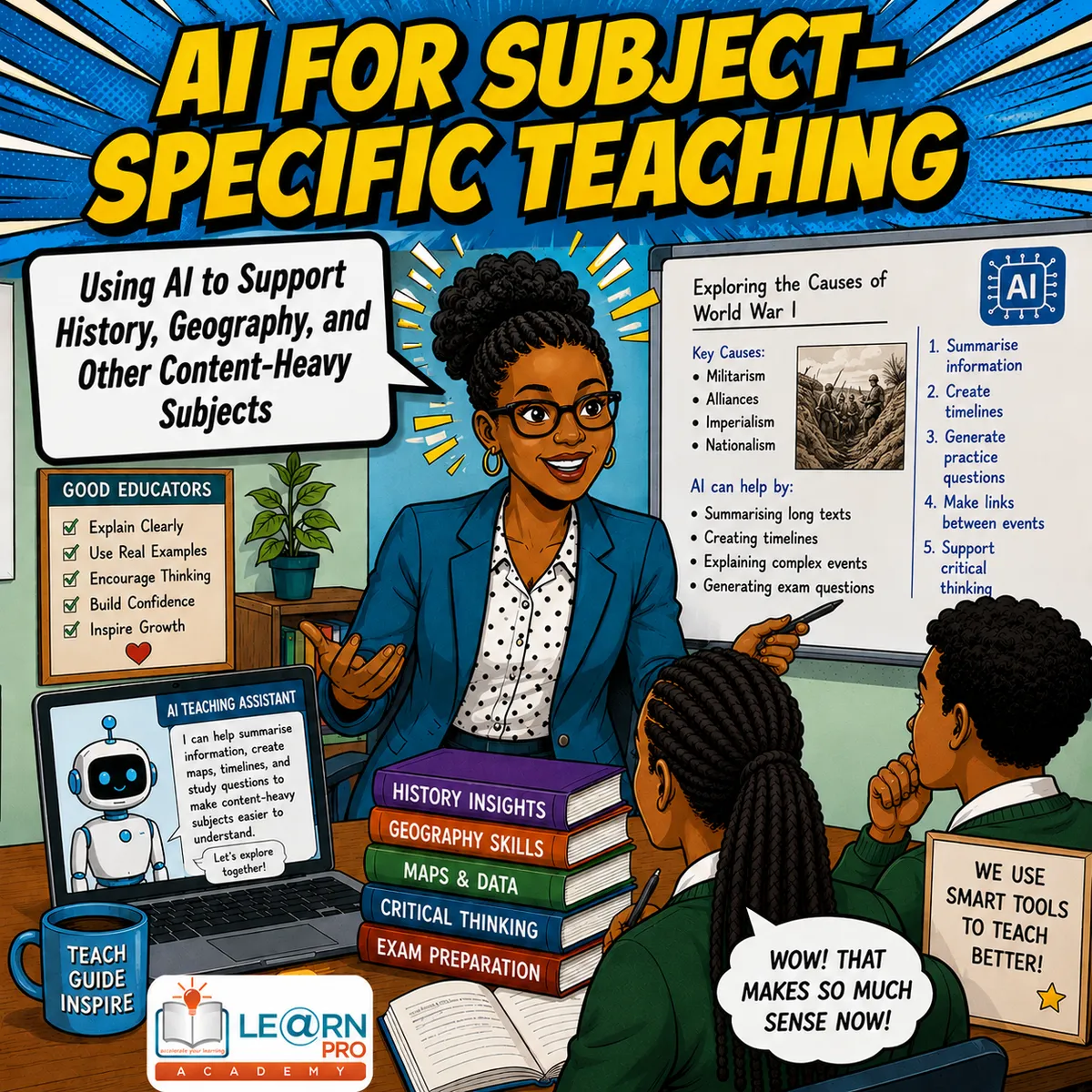
Artificial Intelligence (AI) offers practical ways to support educators in these subjects. It can generate summaries, create timelines, organise concepts into logical sections, develop revision questions, simplify complex explanations, and produce study resources that help learners prepare more effectively. Used wisely, AI reduces preparation time while helping learners focus on understanding instead of becoming lost in large amounts of information.
However, AI should never encourage learners to memorise summaries without thinking. Subjects like History and Geography require interpretation, analysis, evaluation, and evidence-based reasoning. Simply reading AI-generated summaries is not enough. Learners must still analyse sources, compare viewpoints, interpret maps, evaluate evidence, and develop independent conclusions.
The educator remains the expert who helps learners understand context, ask meaningful questions, and develop deeper understanding. AI should support this process — not replace it.
This article explores practical ways South African educators can use AI to strengthen teaching in content-heavy subjects while encouraging genuine understanding rather than shallow memorisation.
Why Content-Heavy Subjects Can Feel Overwhelming
Many learners believe they are "bad at History" or "bad at Geography." Often, the real challenge is organisation.
Content-heavy subjects require learners to manage:
Large volumes of reading
New terminology
Numerous case studies
Historical events
Geographic processes
Maps and diagrams
Statistics
Source-based questions
Essay preparation
Without an organised approach, learners quickly become overwhelmed.
AI can help educators organise information into manageable learning sections.
AI Should Build Understanding, Not Memorisation
The purpose of these subjects is not simply remembering information.
Learners should understand:
Causes and consequences
Relationships between events
Patterns and trends
Different viewpoints
Evidence supporting conclusions
Connections between concepts
AI should therefore encourage thinking rather than simply producing shorter notes.
Understanding always matters more than memorising.
Using AI To Create Clear Topic Summaries
Long textbook chapters can discourage learners.
AI can help educators create concise summaries that highlight:
Main ideas
Important concepts
Key terminology
Essential facts
Major themes
Examination focus areas
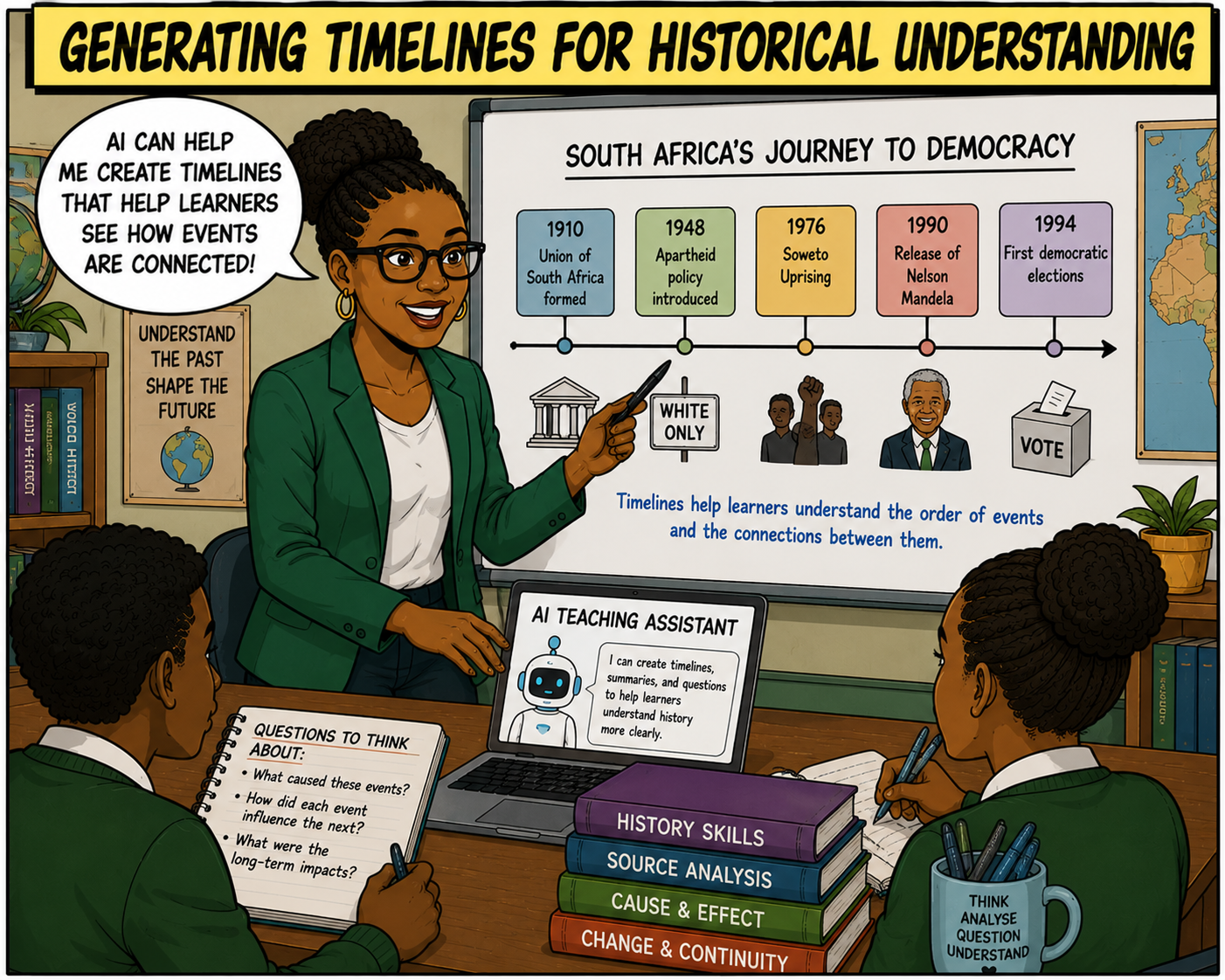
For example, a lengthy chapter on South Africa's transition to democracy can be condensed into an easy-to-follow overview before learners explore the topic in greater depth.
Teachers should always review summaries for accuracy and curriculum alignment.
Generating Timelines For Historical Understanding
History learners often struggle to remember the sequence of events.
AI can generate timelines that organise:
Historical periods
Important dates
Political developments
Scientific discoveries
Economic events
Social movements
Rather than memorising isolated dates, learners begin to understand how one event influenced another.
This strengthens chronological thinking.
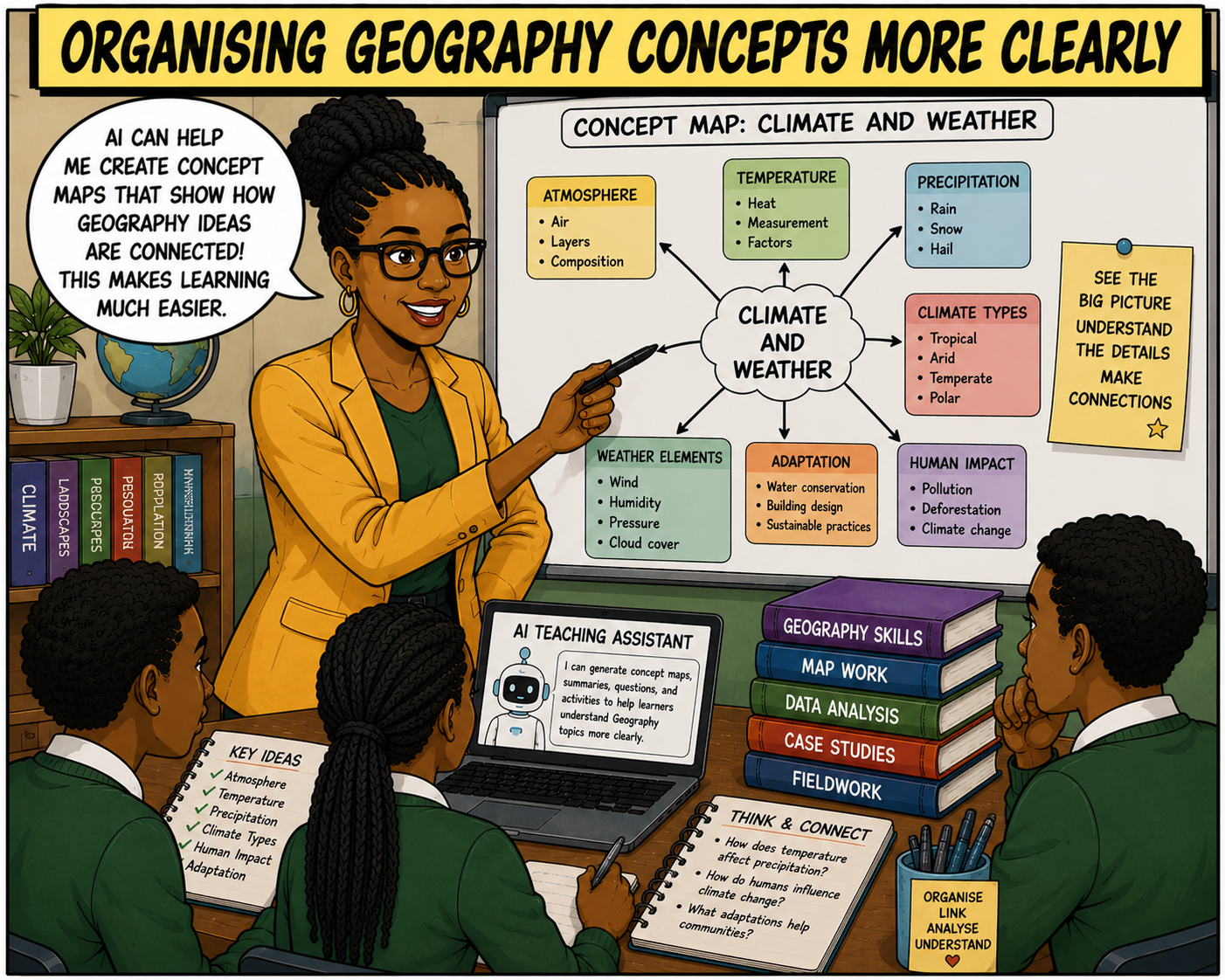
Organising Geography Concepts More Clearly
Geography includes many interconnected topics.
Examples include:
Climate
Weather systems
Rivers
Population
Urbanisation
Development
Resources
Sustainability
AI can organise these into logical concept maps that show how ideas connect.
Visual organisation often makes revision much easier.
Creating Revision Checklists
Learners often ask: "What do I actually need to know?"
AI can help educators create revision checklists covering:
Key concepts
Definitions
Case studies
Maps
Diagrams
Skills
Calculations where required
Examination terminology
Checklists help learners organise revision instead of feeling overwhelmed.
Generating Topic Overviews Before Teaching
Introducing a new topic becomes easier when learners first see the "big picture."
AI can generate:
Topic introductions
Learning objectives
Key questions
Vocabulary previews
Concept overviews
These resources help learners understand where individual lessons fit within the wider topic.
Simplifying Difficult Language
Many textbooks use academic language that challenges learners. This is particularly true in multilingual South African classrooms. AI can simplify explanations without changing the meaning.
For example: Instead of presenting complex academic paragraphs, educators can request simpler explanations suitable for Grade 10–12 learners.
This improves understanding while maintaining curriculum standards.
Supporting Vocabulary Development
Content-heavy subjects introduce many specialised terms.
Examples include:
History:
Colonialism
Nationalism
Apartheid
Industrialisation
Geography:
Erosion
Urbanisation
Migration
Sustainability
AI can generate:
Vocabulary lists
Definitions
Matching exercises
Flashcards
Context sentences
Revision quizzes
Strong vocabulary supports stronger examination performance.
Creating Source-Based Questions
Many CAPS assessments include source-based activities.
AI can help educators generate:
Document questions
Photograph analysis
Political cartoons
Maps
Graph interpretation
Newspaper extracts
Case study discussions
Teachers should verify all historical and geographical information before classroom use.
Developing Higher-Order Thinking Questions
Strong assessment requires more than factual recall.
AI can help educators create questions requiring learners to:
Analyse
Compare
Evaluate
Interpret
Justify
Explain
Predict
For example:
Instead of asking: "When did this happen?"
Teachers can ask:
Why did this happen?
What evidence supports this viewpoint?
How did this event influence later developments?
Which solution would be most effective?
These questions develop critical thinking.
Supporting Map And Diagram Skills
Many learners struggle with visual information.
AI can help educators prepare activities involving:
Map interpretation
Climate graphs
Population pyramids
Flow diagrams
Land-use maps
Historical maps
Infographics
Cross-sections
Visual interpretation is an important examination skill that requires regular practice.
Creating Differentiated Learning Resources
Not every learner processes information at the same pace.
AI can help educators prepare different versions of learning materials.
Foundation Support
Short summaries
Simple vocabulary
Guided questions
Visual organisers
Core Learning
Standard CAPS content
Mixed activities
Source-based practice
Extension Activities
Independent research
Comparative analysis
Essay planning
Evaluation tasks
Differentiation allows every learner to progress successfully.
Encouraging Independent Research Skills
AI can support research planning without replacing research itself.
Educators can ask AI to generate:
Research questions
Investigation plans
Topic outlines
Source evaluation checklists
Presentation structures
Learners should still locate, evaluate, and reference reliable information independently.
Research skills remain essential.
Preparing Examination Revision Resources
Revision often takes many hours to prepare.
AI can assist educators by creating:
Topic summaries
Practice quizzes
Flashcards
Matching activities
Essay planning guides
Revision schedules
Self-assessment checklists
Teachers can adapt these resources to meet the needs of individual classes.
Encouraging Learners To Make Connections
One of the strongest learning strategies is recognising connections between topics.
AI can generate comparison activities such as:
History:
Compare two historical leaders.
Compare different political systems.
Compare causes of different conflicts.
Geography:
Compare urban and rural settlements.
Compare developed and developing countries.
Compare renewable and non-renewable resources.
Making comparisons strengthens deeper understanding.
Checking AI-Generated Information Carefully
AI occasionally produces inaccurate or oversimplified information.
Educators should always check:
Historical accuracy
Geographic facts
Dates
Place names
Maps
Statistics
Sources
Curriculum alignment
Professional judgement remains essential before classroom use.
Protecting Critical Thinking
Content-heavy subjects are designed to develop thinking skills.
Learners should continue asking questions such as:
Why did this happen?
What evidence supports this conclusion?
Could another interpretation exist?
What were the consequences?
What patterns can be identified?
How does this affect South Africa today?
AI should support these discussions—not replace them.
The classroom should remain a place where ideas are questioned and debated.
Practical AI Prompt Ideas For Educators
Well-designed prompts help educators produce useful teaching resources quickly.
Examples include:
"Summarise the causes of the Anglo-Boer War for Grade 10 learners using simple English."
"Create a timeline of South Africa's democratic transition."
"Generate ten Geography revision questions on climate and weather."
"Develop a concept map explaining urbanisation."
"Write five source-based questions using this historical photograph."
"Create a vocabulary activity on sustainability suitable for Grade 11 learners."
"Generate an essay planning guide comparing formal and informal settlements."
These prompts can be adapted for different grades and topics while saving valuable preparation time.
Best Practices For Responsible AI Use In Content-Heavy Subjects
To use AI effectively, educators should follow several guiding principles:
Always verify AI-generated facts before classroom use.
Encourage understanding rather than memorisation.
Use AI to simplify — not oversimplify — complex concepts.
Adapt resources to CAPS requirements.
Include South African examples whenever possible.
Encourage learners to evaluate information critically.
Use AI to generate discussion rather than provide final answers.
Continue developing research, analysis, and communication skills.
These principles ensure that AI strengthens learning while preserving educational quality.
Preparing Learners For A Knowledge-Rich Future
Modern workplaces increasingly require people who can work with large amounts of information.
Future professionals must be able to:
Organise information
Evaluate evidence
Recognise patterns
Solve problems
Communicate clearly
Learn continuously
Use AI responsibly
These abilities are developed through subjects that require careful reading, thoughtful analysis, and informed decision-making.
By modelling responsible AI use, educators prepare learners for both further education and future careers.
Conclusion
History, Geography, and other content-heavy subjects challenge learners to understand complex ideas, interpret evidence, recognise patterns, and explain how people, places, and events are connected. These subjects are about much more than remembering facts—they develop informed, thoughtful citizens who can analyse the world around them.
Artificial Intelligence offers valuable opportunities to support this learning. It can help educators generate summaries, create timelines, organise concepts, build revision resources, simplify difficult language, and prepare differentiated activities more efficiently. These advantages are particularly valuable in South African classrooms, where educators often teach large classes with learners who have diverse educational needs and language backgrounds.
However, AI should never replace critical thinking. Learners must still analyse historical sources, interpret maps, evaluate evidence, compare viewpoints, and construct their own understanding. These skills remain essential in an age where information is abundant but not always accurate.
The educator remains the expert who provides context, encourages inquiry, guides discussion, and helps learners think deeply about the subjects they study. When AI is used thoughtfully and responsibly, it becomes a valuable teaching assistant that supports meaningful learning while ensuring that understanding always comes before memorisation.
Additional Articles in the AI for Subject-Specific Teaching Series
How Maths Educators Can Use AI to Explain Problem-Solving More Clearly
Using AI in Physical Sciences Teaching Without Losing Scientific Thinking
How Language Educators Can Use AI to Support Writing and Comprehension Skills
Using AI to Support History, Geography, and Other Content-Heavy Subjects
AI for Business Studies, Accounting, and Economics Educators
Disclaimer
AI Tools were used to assist with research. Remember to always cross-check everything that you read.