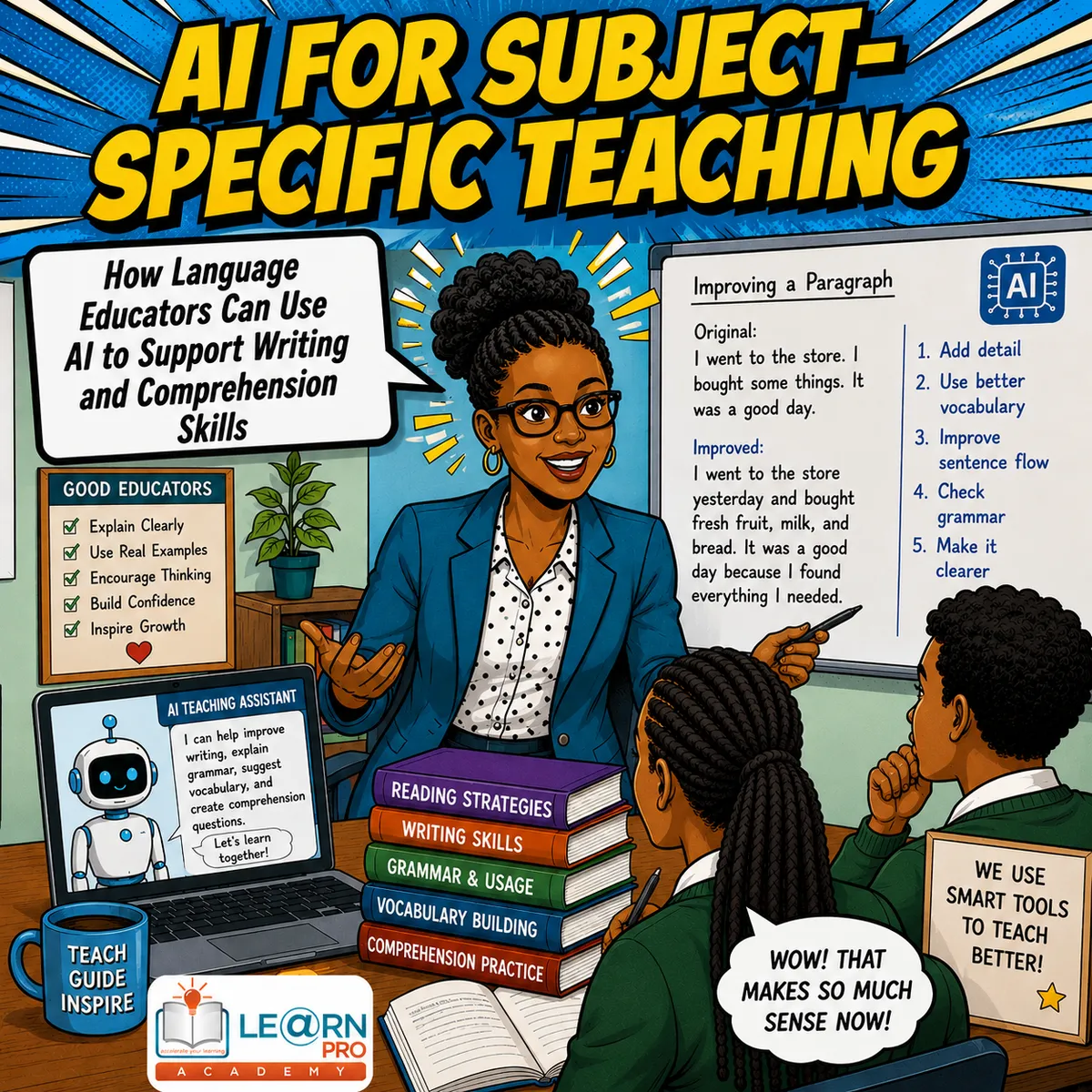
How Language Educators Can Use AI to Support Writing and Comprehension Skills
This is article #3 of 5 in the AI for Subject-Specific Teaching Series
Introduction
Language education is about much more than teaching grammar rules and correcting spelling mistakes. It helps learners communicate clearly, think critically, express ideas confidently, and understand the world around them. Strong reading, writing, listening, and speaking skills support success in every school subject and prepare learners for future study, work, and everyday life.
For language educators, however, teaching literacy is both rewarding and demanding. Planning comprehension activities, creating vocabulary exercises, marking essays, providing individual writing feedback, and supporting learners with different language abilities require significant time and effort. In many South African classrooms, educators also teach learners who speak English as a second or even third language, making differentiated support even more important.
Artificial Intelligence (AI) offers practical ways to support this work. It can generate grammar exercises, create reading passages, suggest writing prompts, explain language concepts in simple English, build vocabulary activities, and provide examples of different writing styles. These tools can reduce preparation time while giving educators more opportunities to support learners individually.
However, AI should never replace authentic language learning. Learners still need to think for themselves, develop their own voice, read carefully, write independently, and communicate with confidence. If learners rely entirely on AI to write essays or answer comprehension questions, they lose valuable opportunities to develop these essential skills.
The educator remains the language expert who encourages creativity, provides meaningful feedback, develops critical readers, and helps learners become confident communicators. AI should strengthen this work — not replace it.
This article explores practical ways South African language educators can use AI to support writing and comprehension while protecting authentic learner voice and meaningful literacy development.
Why Language Learning Requires Active Participation
Language cannot be mastered simply by reading rules.
Learners improve when they:
Read regularly.
Write frequently.
Speak confidently.
Listen carefully.
Build vocabulary.
Practise grammar in context.
Receive constructive feedback.
Language develops through repeated use.
AI can provide additional opportunities for practice, but learners must still complete the thinking and communication themselves.
AI Should Support Authentic Communication
One of the greatest risks of AI is that learners may allow it to do all their writing. This does not build language skills.
Instead, AI should help learners:
Improve drafts
Understand grammar
Learn new vocabulary
Organise ideas
Recognise writing patterns
Reflect on feedback
The final writing should always remain the learner's own work whenever assessment requires independent writing.
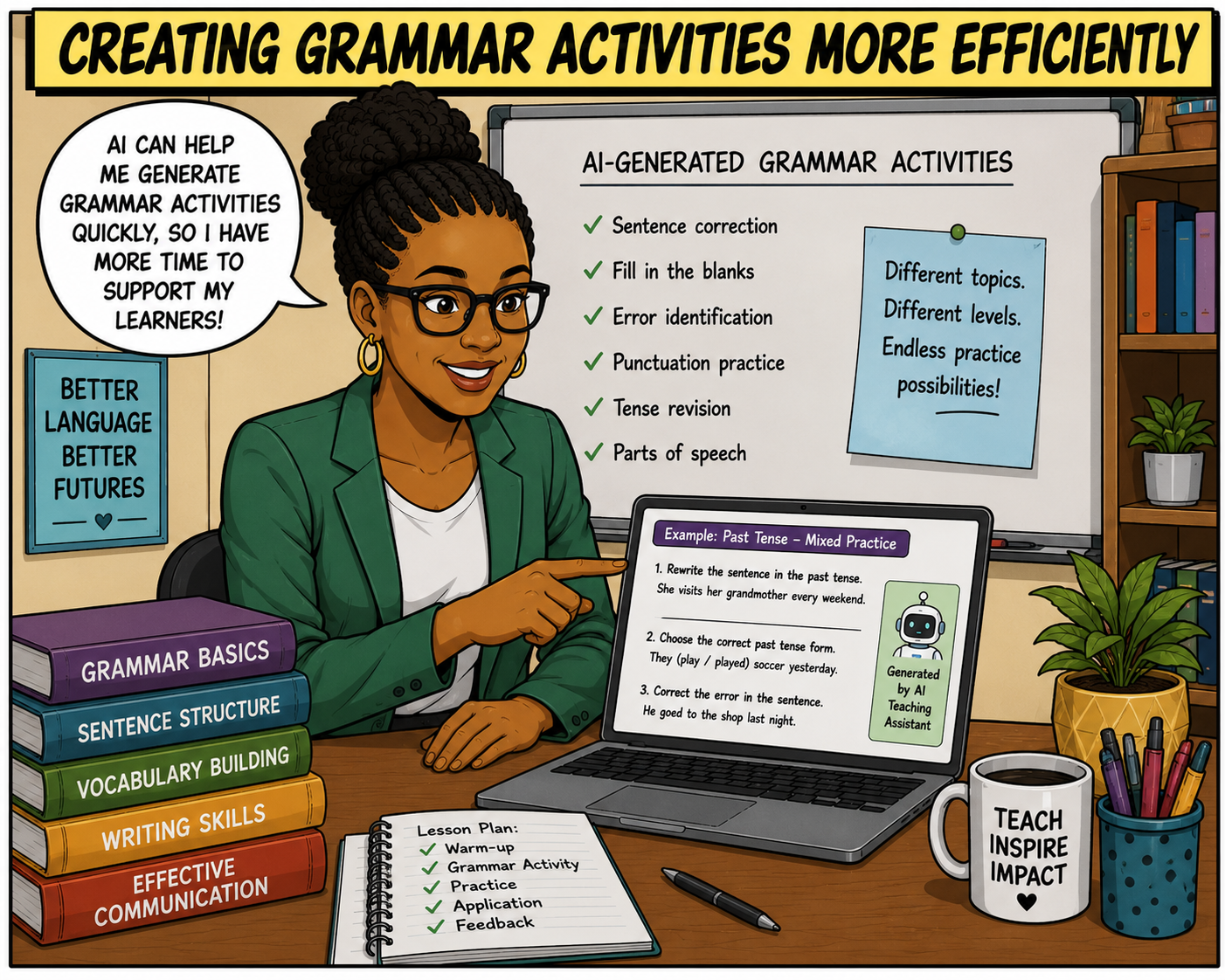
Creating Grammar Activities More Efficiently
Grammar teaching requires regular practice. Creating fresh exercises every week can be time-consuming.
AI can generate:
Sentence correction activities
Multiple-choice questions
Fill-in-the-blank exercises
Error identification tasks
Punctuation practice
Tense revision
Parts of speech activities
Educators can request exercises that match a specific grade level or grammar topic before reviewing and adapting them for classroom use.
Explaining Grammar In Simple English
Grammar terminology can be confusing, particularly for English Second Additional Language learners. AI can generate explanations using simpler language.
For example:
Instead of providing only formal definitions, AI can explain concepts such as:
Nouns
Verbs
Adjectives
Adverbs
Clauses
Active and passive voice
using everyday examples that learners can understand more easily.
Teachers should always review these explanations to ensure they are accurate and suitable for their learners.
Generating Reading Comprehension Passages
Creating suitable reading passages often takes considerable preparation time.
AI can help educators generate passages based on:
Current affairs
South African topics
Environmental issues
Technology
Sport
Culture
History
Career development
Educators can then develop or adapt accompanying comprehension questions.
Using locally relevant reading material often increases learner engagement.
Creating Differentiated Reading Activities
Not every learner reads at the same level.
AI can generate multiple versions of the same passage.
For example:
Foundation Level
Short sentences
Simple vocabulary
Direct questions
Intermediate Level
More detail
Richer vocabulary
Inference questions
Extension Level
Complex texts
Critical analysis
Evaluation questions
Differentiated reading activities allow every learner to participate meaningfully.
Supporting Vocabulary Development
Vocabulary growth is essential for language development.
AI can generate:
Word lists
Definitions
Synonyms
Antonyms
Context sentences
Word families
Vocabulary quizzes
Matching activities
Teachers can also ask AI to select vocabulary appropriate for a specific grade or topic.
Repeated exposure to new words strengthens both reading and writing skills.
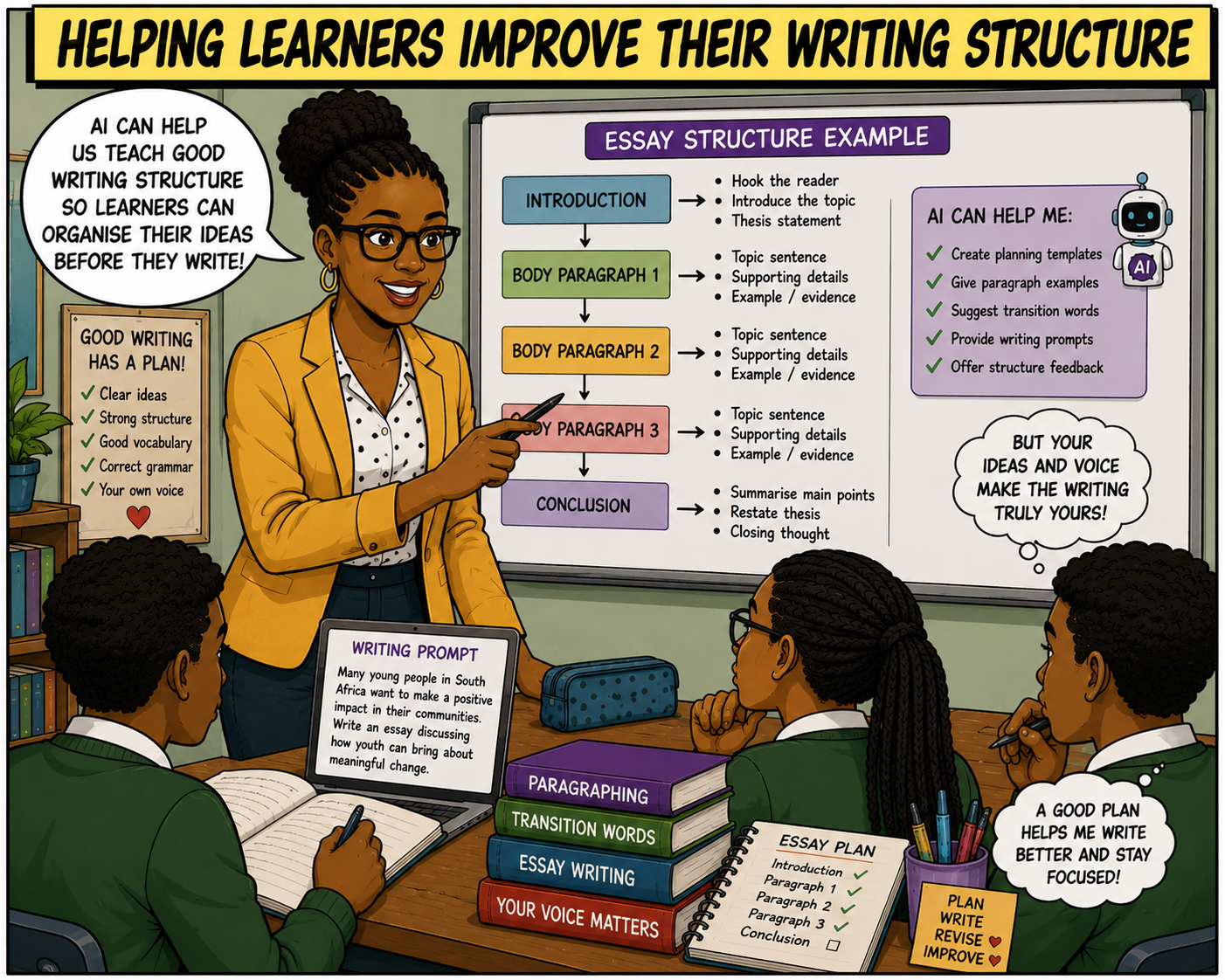
Helping Learners Improve Their Writing Structure
Many learners know what they want to say but struggle to organise their ideas.
AI can help educators teach writing structures for:
Essays
Reports
Speeches
Newspaper articles
Friendly letters
Formal letters
Reviews
Transactional writing
Rather than writing the assignment for learners, AI can generate planning templates and examples that demonstrate good organisation.
This allows learners to produce their own original writing using a clear structure.
Using AI To Generate Writing Prompts
Learners often struggle to begin writing because they cannot think of ideas.
AI can generate engaging prompts for:
Creative writing
Descriptive essays
Narrative essays
Discursive writing
Reflective writing
Opinion pieces
Speeches
Teachers can adapt prompts to suit current classroom topics or local South African contexts.
Interesting prompts often produce more enthusiastic writing.
Supporting Essay Planning
Planning is one of the most important writing skills.
AI can help educators create planning activities such as:
Brainstorming maps
Essay outlines
Paragraph plans
Topic sentence examples
Supporting detail organisers
Conclusion frameworks
Learners should still complete their own planning wherever possible.
AI provides guidance — not completed essays.
Encouraging Learners To Develop Their Own Voice
Every learner has unique experiences, opinions, and ways of expressing ideas.
Language education should celebrate individuality.
Educators should encourage learners to:
Share personal experiences.
Develop original ideas.
Express thoughtful opinions.
Experiment with descriptive language.
Write for real audiences.
AI can suggest possibilities, but authentic learner voice should remain central to every writing task.
Providing More Individual Writing Feedback
Giving meaningful feedback to every learner takes time.
AI can help educators generate examples of constructive feedback categories such as:
Organisation
Grammar
Vocabulary
Sentence variety
Paragraph development
Clarity
Tone
Teachers should personalise feedback before sharing it with learners.
Individual guidance remains one of the most valuable aspects of language teaching.
Creating Activities For Literature Lessons
AI can also support literature teaching.
Educators can generate activities including:
Character profiles
Theme discussions
Chapter summaries
Context questions
Higher-order thinking questions
Creative response activities
These resources can support classroom discussion while ensuring learners still read the original literary text.
AI summaries should never replace reading prescribed literature.
Supporting Critical Reading Skills
Strong readers do more than understand words.
They ask questions such as:
Who is the intended audience?
What is the author's purpose?
What evidence supports this opinion?
Is the information reliable?
What assumptions are being made?
AI can generate critical thinking questions that encourage learners to analyse texts rather than simply recall information.
These skills become increasingly important in an age of AI-generated content.
Helping Learners Recognise AI-Generated Writing
As AI becomes more common, learners need to recognise the difference between authentic writing and machine-generated content.
Educators can compare:
Human writing
AI-generated writing
Strong writing
Weak writing
Learners can discuss:
Tone
Originality
Personal voice
Accuracy
Creativity
Emotional impact
These comparisons build both literacy and digital awareness.
Supporting Multilingual Classrooms
South African classrooms are linguistically diverse.
Many learners think in one language while learning in another.
AI can help educators create:
Simplified explanations
Vocabulary support
Bilingual word lists where appropriate
Reading activities
Sentence-building exercises
These resources can reduce language barriers while keeping English language development as the primary goal where required by the curriculum.
Checking AI-Generated Language Content
Although AI is increasingly capable, educators should always review AI-generated language resources.
Check for:
Grammar accuracy
Appropriate vocabulary
Correct spelling
Cultural sensitivity
Age appropriateness
CAPS alignment
Reading level
Accuracy of literary references
Professional review ensures that learners receive high-quality language input.
Practical AI Prompt Ideas For Language Educators
Clear prompts produce more useful teaching resources.
Examples include:
"Create a Grade 10 comprehension passage about water conservation in South Africa with ten questions."
"Generate five paragraph writing prompts suitable for Grade 11 English learners."
"Explain active and passive voice using simple English and practical examples."
"Create a vocabulary quiz using words from this reading passage."
"Generate constructive feedback comments for common essay-writing mistakes."
"Write a model introduction for a discursive essay without completing the full essay."
"Create higher-order literature discussion questions for this chapter."
These prompts save preparation time while keeping educators in control of the final classroom materials.
Best Practices For Responsible AI Use In Language Teaching
To use AI effectively, educators should follow several important principles:
Always review AI-generated language before using it.
Encourage learners to think independently before using AI support.
Protect authentic learner writing and personal voice.
Use AI to improve learning rather than complete assignments.
Adapt resources to CAPS requirements.
Include South African contexts where appropriate.
Balance technology with discussion, reading, speaking, and writing.
Teach learners to evaluate AI-generated language critically.
These practices help AI become a valuable teaching assistant rather than a substitute for meaningful literacy development.
Preparing Learners For Communication In An AI World
Communication remains one of the most valuable skills in every profession.
Whether learners become teachers, engineers, healthcare professionals, business owners, technicians, or entrepreneurs, they will need to communicate clearly, think critically, and express ideas confidently.
Future workplaces will increasingly include AI tools, but employers will still value people who can:
Write clearly.
Read critically.
Communicate professionally.
Solve problems creatively.
Present ideas confidently.
Adapt language to different audiences.
By modelling responsible AI use in language classrooms, educators prepare learners for both academic success and future employment.
Conclusion
Language education is about helping learners become confident readers, thoughtful writers, effective speakers, and critical thinkers. These skills influence success not only in English or Home Language classes but across every subject and throughout life.
Artificial Intelligence offers valuable opportunities to support this work. It can help educators generate grammar activities, create reading passages, develop vocabulary exercises, build writing prompts, prepare differentiated resources, and save valuable preparation time. These advantages are particularly valuable in South African classrooms, where educators often teach learners with diverse language backgrounds and varying levels of literacy.
However, AI should never replace authentic communication. Learners still need to read independently, write in their own words, express original ideas, and receive meaningful guidance from skilled educators. These experiences develop confidence, creativity, and genuine language proficiency.
The educator remains the expert who nurtures literacy, encourages curiosity, celebrates learner voice, and teaches thoughtful communication. When AI is used responsibly, it becomes a practical teaching assistant that strengthens language education while ensuring that learners continue to develop the communication skills they will need throughout their lives.
Additional Articles in the AI for Subject-Specific Teaching Series
How Maths Educators Can Use AI to Explain Problem-Solving More Clearly
Using AI in Physical Sciences Teaching Without Losing Scientific Thinking
How Language Educators Can Use AI to Support Writing and Comprehension Skills
Using AI to Support History, Geography, and Other Content-Heavy Subjects
AI for Business Studies, Accounting, and Economics Educators
Disclaimer
AI Tools were used to assist with research. Remember to always cross-check everything that you read.