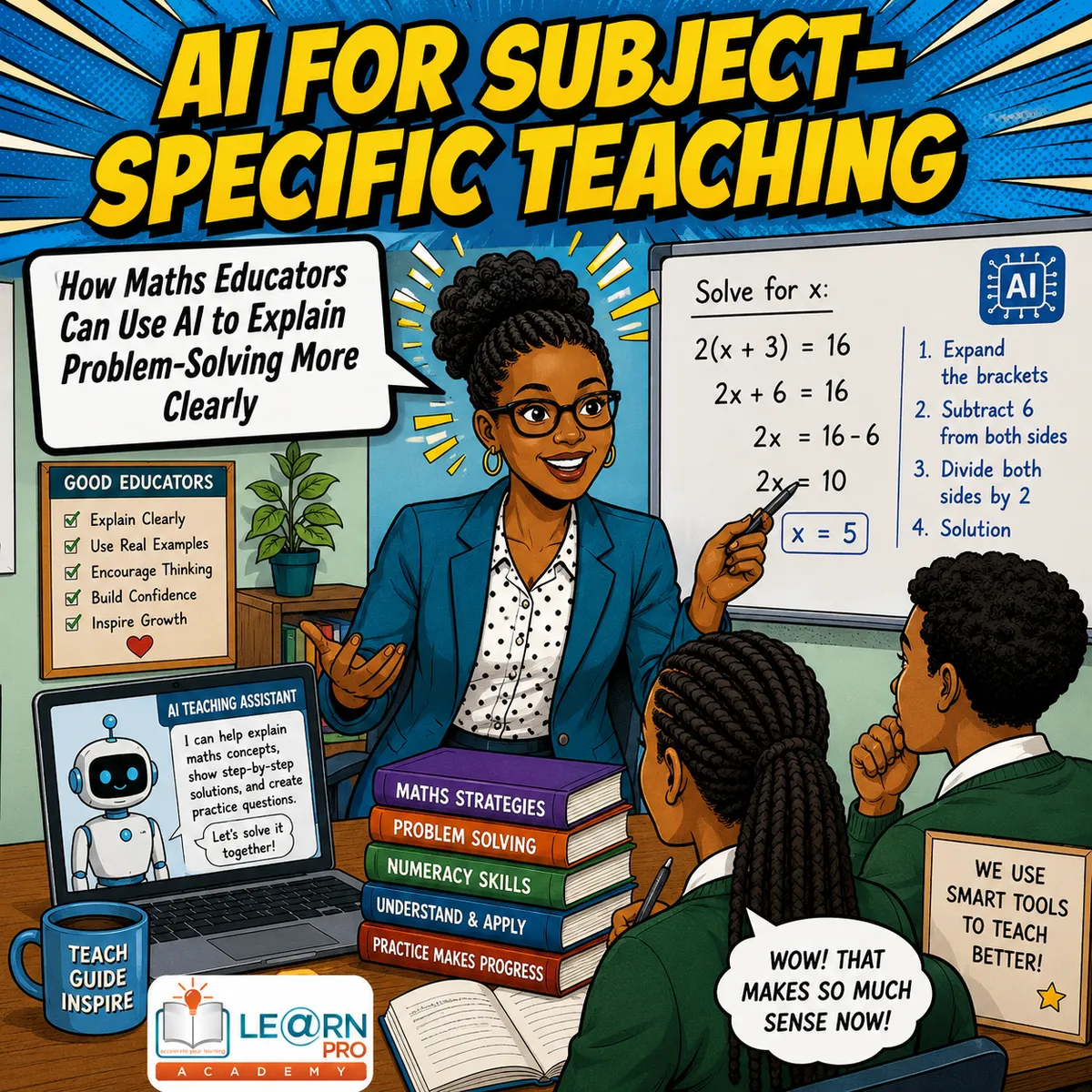
How Maths Educators Can Use AI to Explain Problem-Solving More Clearly
This is article #1 of 5 in the AI for Subject-Specific Teaching Series
Introduction
Mathematics is one of the most rewarding subjects to teach, but it is also one of the subjects where learners often lose confidence the quickest. A single missed step in a calculation, a misunderstanding of a formula, or confusion about mathematical language can make an entire problem seem impossible. Many learners do not struggle because they lack ability — they struggle because they cannot see how one step leads to the next.
This is where Artificial Intelligence (AI) can become a valuable teaching assistant. AI can generate worked examples, explain concepts in multiple ways, create additional practice questions, and suggest different approaches for learners with varying ability levels. Used wisely, AI helps educators spend less time preparing repetitive resources and more time supporting learners during lessons.
However, AI should never replace mathematical thinking. Mathematics is about reasoning, identifying patterns, solving problems, and justifying answers. If learners simply copy AI-generated solutions without understanding them, they miss the very skills the subject is designed to develop.
The educator remains responsible for selecting appropriate methods, correcting errors, encouraging logical thinking, and helping learners develop confidence through practice. AI works best when it supports excellent teaching rather than replacing it.
This article explores practical ways South African Mathematics educators can use AI to explain problem-solving more clearly while keeping learners actively engaged in genuine mathematical reasoning.
Why Learners Often Struggle With Mathematics
Before considering how AI can help, it is important to understand why many learners find Mathematics difficult.
In many cases, the problem is not the final answer—it is everything that happens before the answer.
Common challenges include:
Missing one important step in a process
Forgetting mathematical rules
Weak understanding of earlier concepts
Difficulty translating word problems into mathematical expressions
Anxiety about making mistakes
Trying to memorise instead of understand
Many learners also become discouraged when they compare themselves to classmates who appear to solve problems quickly.
As educators know, strong mathematical ability develops through repeated practice, careful explanation, and growing confidence.
AI cannot remove these challenges, but it can provide additional explanations and examples that support classroom teaching.
AI Should Support Thinking, Not Replace It
One of the biggest misconceptions about AI is that it should solve problems for learners.
That is not good mathematics education.
Instead, AI should help learners understand:
Why each step is necessary
Which mathematical rules are being used
Where mistakes commonly occur
How different solution methods compare
How similar problems can be solved independently
The goal is always independent problem-solving.
AI should act like another explanation — not another shortcut.
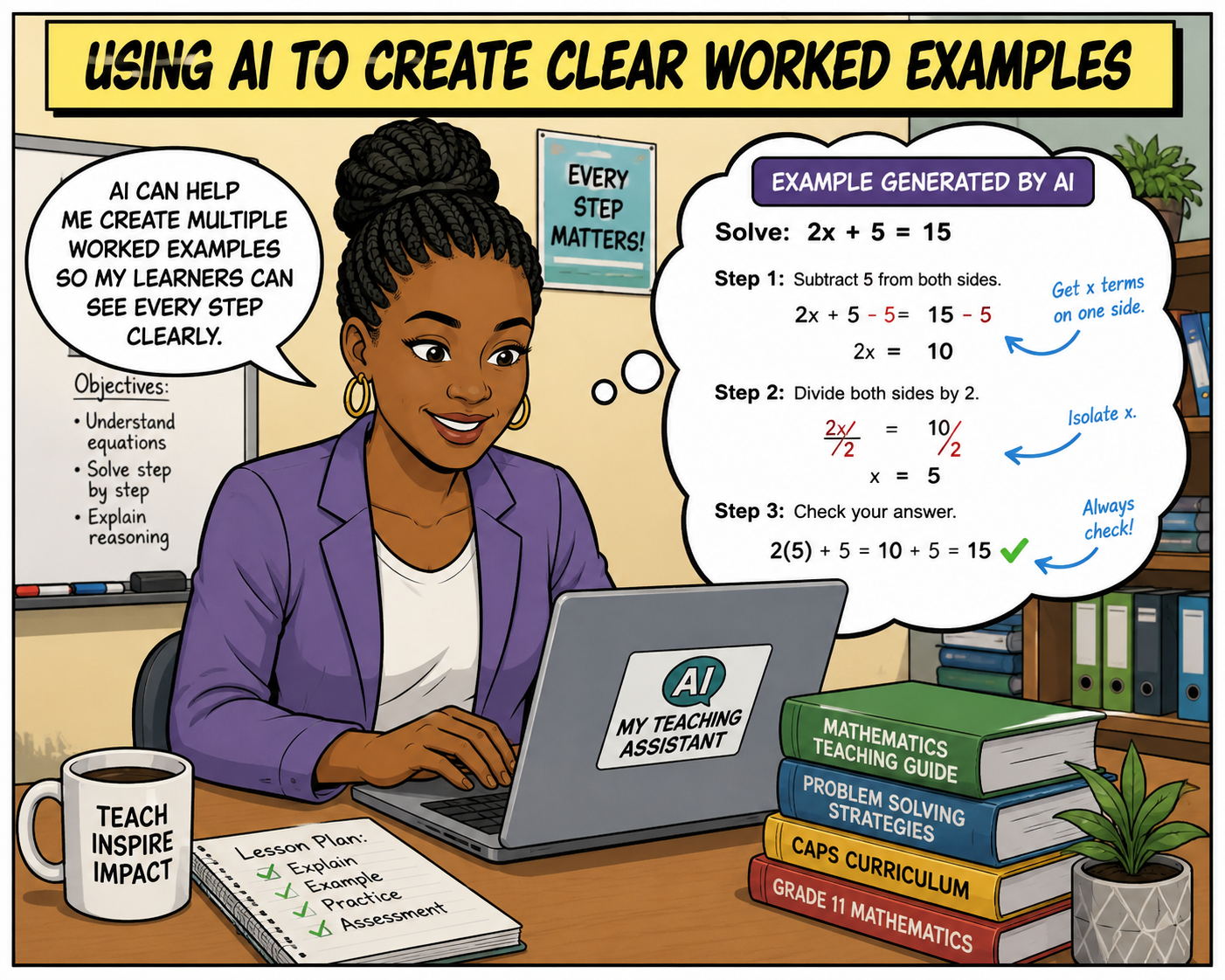
Using AI To Create Clear Worked Examples
Worked examples are among the most effective Mathematics teaching tools.
Unfortunately, creating multiple examples often takes considerable preparation time.
AI can quickly generate:
Basic examples
Intermediate examples
Examination-level examples
Fully worked solutions
Alternative solution methods
Instead of writing every example manually, educators can use AI to generate draft examples before reviewing and adapting them.
For example, a teacher could request: "Generate three Grade 11 algebra examples showing different ways to solve simultaneous equations with full step-by-step solutions."
The teacher can then:
Check mathematical accuracy
Adjust language
Match CAPS requirements
Remove unnecessary complexity
Add classroom discussion questions
The educator remains fully in control of the final resource.
Explaining One Concept In Different Ways
Not every learner understands the first explanation:
Some learners need visual explanations.
Others need practical examples.
Some prefer patterns.
Others prefer logical reasoning.
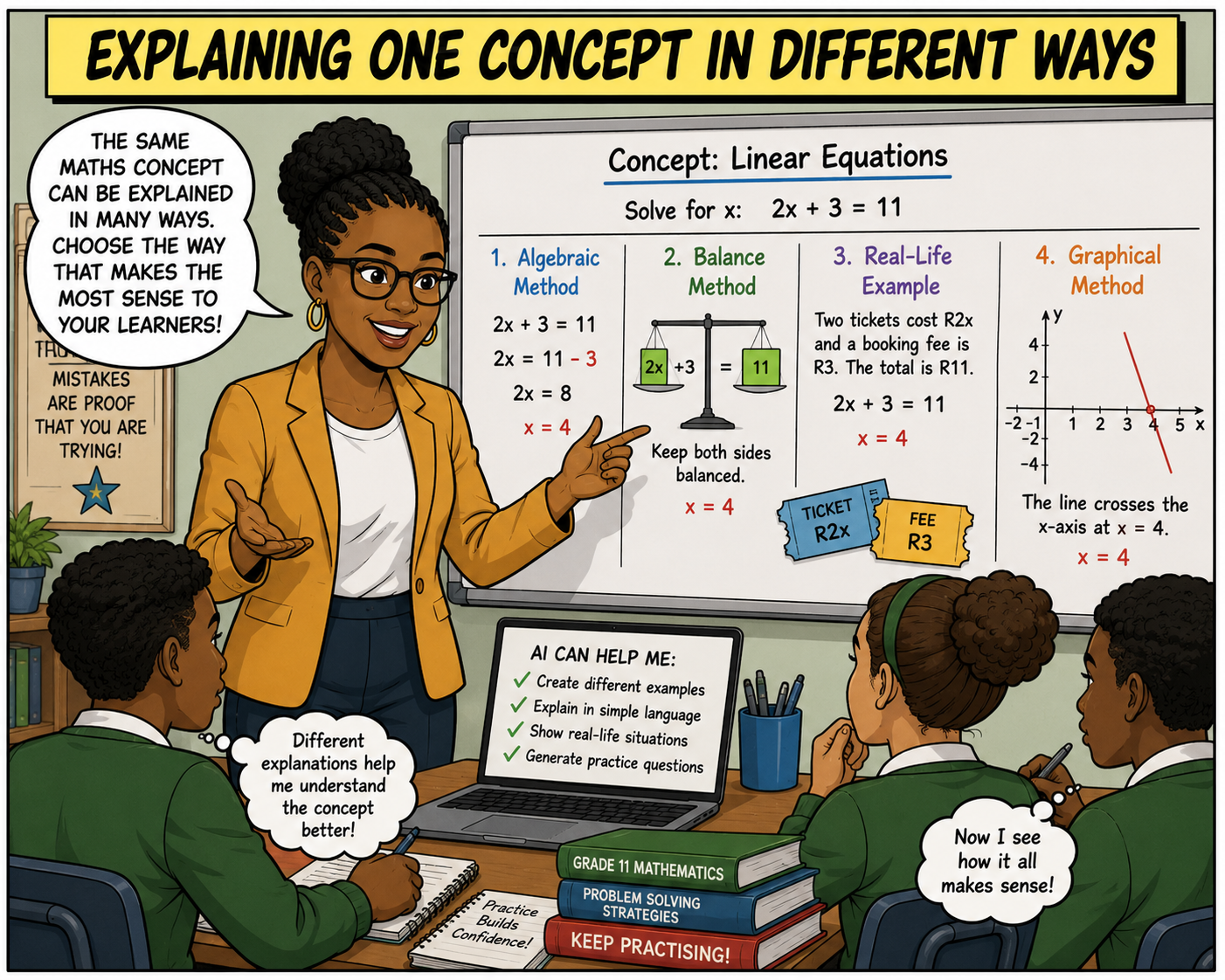
AI can generate multiple explanations of exactly the same concept.
For example, when teaching quadratic equations, an educator could request explanations that use:
Graphs
Real-life situations
Number patterns
Area models
Step-by-step algebraic reasoning
Having several explanations available allows educators to choose the one that best fits their class.
Generating Extra Practice Questions
Practice remains essential in Mathematics. However, creating dozens of new questions every week requires time.
AI can generate:
Similar practice questions
Mixed revision exercises
Increasing levels of difficulty
Topic-specific worksheets
Homework activities
Quick classroom exercises
For example: Instead of giving learners only ten examples from a textbook, teachers can quickly create another ten questions focusing on exactly the skills learners still find difficult.
More practice usually leads to greater confidence.
Creating Progressive Difficulty Levels
One challenge in mixed-ability classrooms is that learners progress at different speeds. Some learners still need basic revision. Others are ready for more challenging applications.
AI can help educators build activities that gradually increase in complexity.
For example:
Level 1: Simple substitution.
Level 2: Multi-step calculations.
Level 3: Word problems.
Level 4: Real-life applications.
Level 5: Higher-order examination questions.
This gradual progression helps learners experience success before tackling more complex tasks.
Helping Learners Understand Mathematical Language
Many learners struggle because they misunderstand the language used in Mathematics rather than the calculations themselves.
Terms such as:
Evaluate
Simplify
Expand
Factorise
Rationalise
Differentiate
Prove
Estimate
may confuse learners who are still developing academic English.
AI can help educators generate:
Simple definitions
Everyday explanations
Vocabulary lists
Sentence examples
Short quizzes
This is particularly valuable in multilingual South African classrooms where English is often a second or third language.
Supporting Word Problem Interpretation
Word problems require more than calculation.
Learners must first identify:
Important information
Irrelevant information
Mathematical relationships
Appropriate operations
Units of measurement
AI can create multiple word problems based on one concept while varying the context.
For example:
A teacher could request ratio problems involving:
Shopping
Sport
Farming
Transport
Small businesses
Household budgeting
Using familiar South African examples often increases learner engagement.
Using AI To Generate Common Mistakes For Discussion
Sometimes learners learn best by analysing incorrect solutions.
AI can generate realistic mistakes such as:
Sign errors
Incorrect substitution
Formula confusion
Decimal mistakes
Unit conversion errors
Calculator errors
Educators can ask learners:
What went wrong?
Which step is incorrect?
How should it be corrected?
This develops mathematical reasoning rather than memorisation.
Encouraging Learners To Explain Their Thinking
One of the strongest indicators of understanding is whether learners can explain how they reached an answer.
Rather than asking only: "What is the answer?"
Educators can ask:
Why did you choose this method?
Which rule applies here?
Could there be another solution?
How do you know your answer is reasonable?
AI can generate discussion prompts that encourage mathematical communication.
These conversations help learners develop deeper conceptual understanding.
Differentiating Support For Different Learners
Every Mathematics class contains learners with different strengths and needs.
AI can help educators prepare differentiated resources without creating every worksheet from scratch.
For example:
Support Group
Simple numbers
More guidance
Extra hints
Larger working spaces
Core Group
Standard curriculum questions
Moderate complexity
Mixed practice
Extension Group
Challenging applications
Investigation tasks
Olympiad-style questions
Open-ended problems
Differentiation helps every learner work at an appropriate level while remaining part of the same lesson.
Using AI To Prepare Revision Activities
Revision is far more effective when learners actively engage with concepts.
Instead of simply rereading notes, educators can use AI to generate:
Quick quizzes
Matching activities
Error correction exercises
Formula recall challenges
Mental maths activities
Exit tickets
Mini tests
These activities provide regular opportunities for retrieval practice, helping learners strengthen long-term memory while allowing teachers to identify misconceptions early.
Supporting Visual Learning In Mathematics
Many mathematical concepts become easier to understand when learners can see relationships rather than only read about them.
AI can help educators plan visual resources such as:
Number lines
Coordinate graphs
Function sketches
Geometry diagrams
Tables showing numerical patterns
Flow diagrams for solving equations
Although educators should verify the accuracy of any AI-generated diagrams, these resources can save valuable preparation time and make abstract concepts more accessible.
Visual representations are particularly useful when introducing new topics or revising difficult sections before examinations.
Helping Learners Build Confidence Through Small Successes
Confidence plays a significant role in Mathematics achievement.
Learners who experience repeated failure often become reluctant to attempt new problems, even when they have the necessary ability.
AI can help educators create learning sequences that begin with achievable tasks before progressing to more demanding questions.
For example, a lesson on trigonometry might begin with:
Identifying the sides of a right-angled triangle
Choosing the correct trigonometric ratio
Solving simple calculations
Applying the concept in examination-style questions
This structured progression allows learners to experience success at each stage, building confidence alongside competence.
Checking AI-Generated Mathematics Carefully
Although AI has become increasingly capable, it is not perfect.
Mathematics educators should always review AI-generated content before using it in class.
Areas to check include:
Correct calculations
Appropriate formulas
Accurate diagrams
Logical working steps
Correct mathematical notation
CAPS alignment
Appropriate grade level
Suitable terminology
Even small errors can confuse learners, so professional review remains essential.
Maintaining Genuine Mathematical Thinking
The greatest value of Mathematics lies not in obtaining answers but in developing logical reasoning.
Educators should continue encouraging learners to:
Show every step of their working.
Explain their reasoning.
Check whether answers are reasonable.
Compare different methods.
Learn from mistakes.
Solve unfamiliar problems independently.
AI should support these habits — not replace them.
When learners rely entirely on AI-generated solutions, they lose opportunities to develop persistence, creativity, and analytical thinking.
The teacher's role is to ensure that AI remains a learning aid rather than a substitute for mathematical effort.
Practical AI Prompt Ideas For Mathematics Educators
The quality of AI responses often depends on the quality of the prompt. Clear, detailed instructions usually produce more useful teaching resources.
Examples include:
"Create five Grade 10 linear equation problems with fully worked solutions."
"Explain the Pythagorean Theorem in simple English suitable for ESL learners."
"Generate ten algebra questions that gradually increase in difficulty."
"Create a revision quiz on functions with answers and brief explanations."
"Write three realistic word problems involving percentages using South African shopping examples."
"Generate common learner mistakes when simplifying algebraic expressions and explain how to correct them."
"Provide two different methods for solving this quadratic equation and compare the advantages of each."
These prompts can be adapted to different grades, topics, and learner needs while reducing preparation time.
Best Practices For Responsible AI Use In Mathematics Classrooms
To gain the greatest benefit from AI, educators should follow a few guiding principles:
Always verify mathematical accuracy before sharing AI-generated material.
Use AI to support lesson preparation, not to replace professional judgement.
Encourage learners to understand each step rather than memorise answers.
Adapt AI-generated examples to match the CAPS curriculum and the needs of your class.
Use local, relevant contexts that learners recognise.
Promote discussion, reasoning, and collaborative problem-solving.
Remind learners that mistakes are valuable opportunities to learn.
Continue using hands-on teaching, questioning, and feedback alongside AI tools.
When these principles are followed, AI becomes a practical assistant that enhances rather than diminishes high-quality Mathematics teaching.
Conclusion
Mathematics education has always been about much more than finding the correct answer. It develops logical reasoning, careful thinking, persistence, and confidence — skills that learners will use throughout their education and future careers.
Artificial Intelligence offers exciting opportunities to make Mathematics teaching more effective. It can help educators generate worked examples, create differentiated practice activities, explain difficult concepts in multiple ways, produce revision resources, and save valuable preparation time. These benefits are especially valuable in busy South African classrooms where teachers often balance large classes, diverse learning needs, and demanding workloads.
Yet AI is most effective when it supports, rather than replaces, excellent teaching. Learners still need to wrestle with problems, explain their reasoning, identify mistakes, and experience the satisfaction of solving challenges independently. These experiences build the resilience and analytical thinking that Mathematics is designed to develop.
The educator remains the expert who guides learning, asks thoughtful questions, provides encouragement, and ensures that every AI-generated resource serves a clear educational purpose. By combining professional expertise with carefully used AI tools, Mathematics teachers can create classrooms where explanations are clearer, practice is more meaningful, and learners develop both the understanding and confidence needed to succeed.
Additional Articles in the AI for Subject-Specific Teaching Series
How Maths Educators Can Use AI to Explain Problem-Solving More Clearly
Using AI in Physical Sciences Teaching Without Losing Scientific Thinking
How Language Educators Can Use AI to Support Writing and Comprehension Skills
Using AI to Support History, Geography, and Other Content-Heavy Subjects
AI for Business Studies, Accounting, and Economics Educators
Disclaimer
AI Tools were used to assist with research. Remember to always cross-check everything that you read.