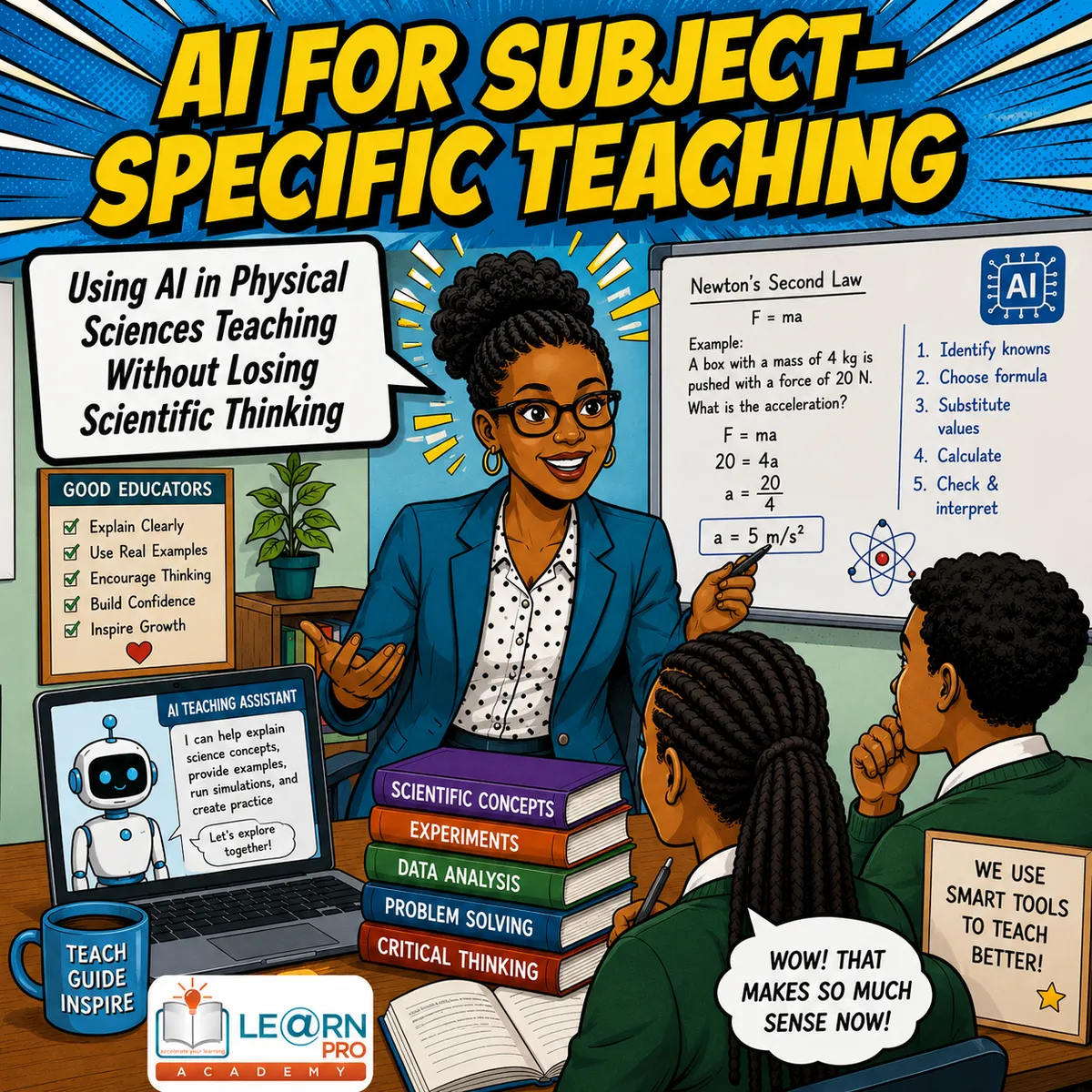
Using AI in Physical Sciences Teaching Without Losing Scientific Thinking
This is article #2 of 5 in the AI for Subject-Specific Teaching Series
Introduction
Physical Sciences is one of the most demanding subjects in the high school curriculum because it requires learners to understand scientific concepts, apply mathematical skills, interpret evidence, and think logically. Success depends on far more than memorising facts. Learners must ask questions, identify patterns, analyse information, solve problems, and explain why scientific principles work.
Many learners struggle because they try to memorise formulas and definitions without fully understanding the underlying concepts. They may remember Newton's Laws, chemical equations, or electrical formulas for a test, but they often find it difficult to apply this knowledge when faced with unfamiliar questions.
Artificial Intelligence (AI) offers exciting opportunities to support Physical Sciences teaching. It can explain difficult concepts in different ways, generate revision questions, create worked examples, simplify complex scientific language, and provide additional practice activities. These tools can help educators save preparation time while giving learners more opportunities to strengthen their understanding.
However, Physical Sciences education must never become dependent on AI-generated answers. Scientific thinking involves questioning evidence, testing ideas, evaluating results, and understanding cause-and-effect relationships. If learners simply copy AI explanations without thinking critically, they miss the very skills that science education is designed to develop.
The educator remains the scientific guide who encourages curiosity, asks challenging questions, corrects misconceptions, and helps learners build genuine understanding. AI should support this work — not replace it.
This article explores practical ways South African Physical Sciences educators can use AI to strengthen teaching while protecting inquiry, reasoning, and scientific thinking.
Why Physical Sciences Requires More Than Memorisation
Many learners believe that success in Physical Sciences depends on remembering formulas and definitions.
In reality, success depends on understanding.
Learners need to understand:
Why scientific principles work
How variables affect outcomes
What experimental evidence shows
How formulas relate to real situations
How scientific ideas connect
For example, simply memorising Newton's Second Law does not mean a learner understands how force, mass, and acceleration interact in different situations.
AI should therefore be used to improve understanding rather than encourage rote learning.
AI Should Support Scientific Thinking
Scientific thinking includes asking questions such as:
Why did this happen?
What evidence supports this conclusion?
What variables changed?
Could there be another explanation?
What would happen if one condition changed?
These habits are central to science education.
AI should help learners explore these questions rather than provide answers without explanation.
Good science teaching always encourages curiosity.
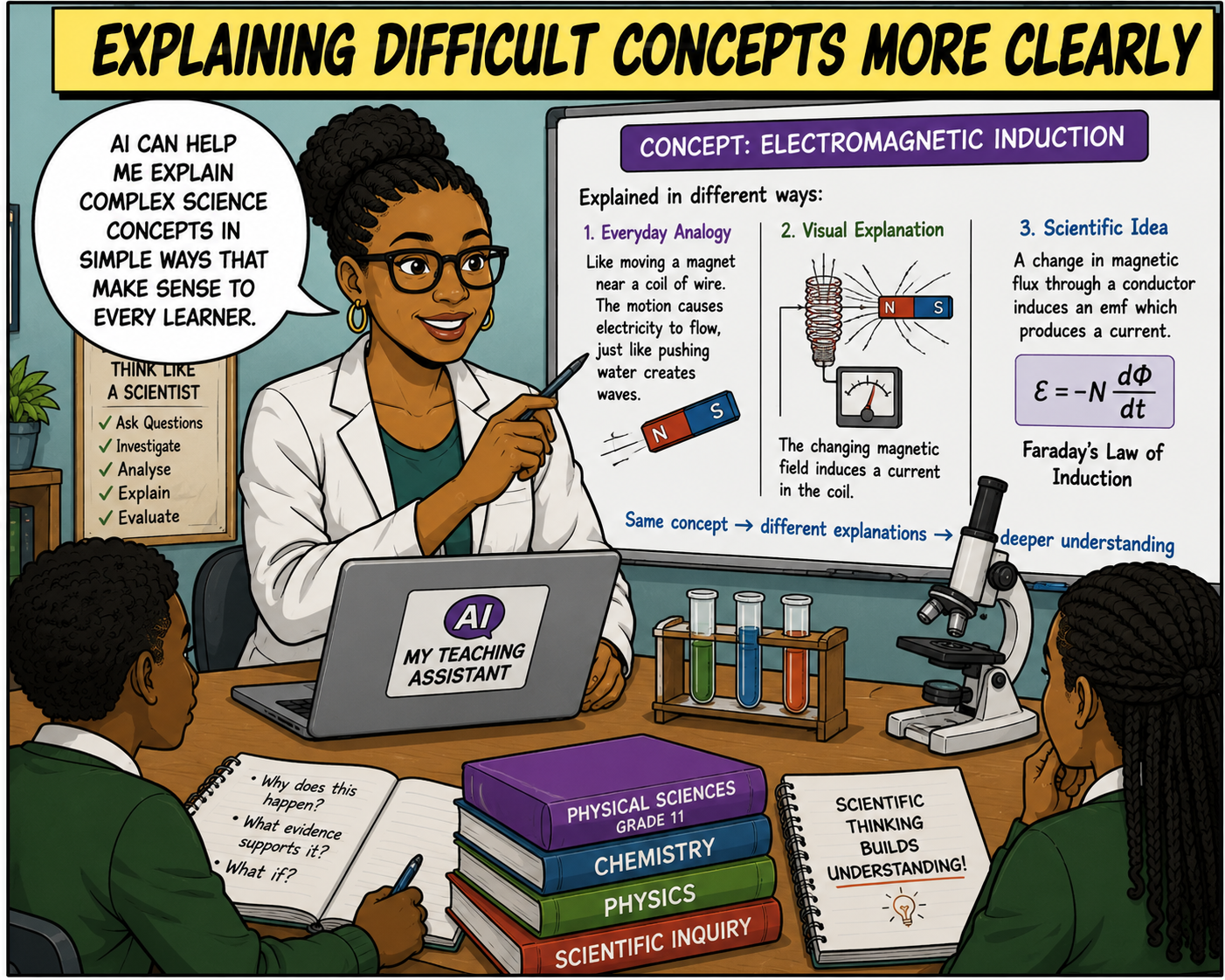
Using AI To Explain Difficult Concepts More Clearly
Some Physical Sciences concepts are highly abstract.
Examples include:
Electric fields
Magnetic induction
Atomic structure
Chemical bonding
Momentum
Energy transfer
Wave behaviour
Different learners understand these topics in different ways.
AI can generate explanations using:
Everyday language
Simple analogies
Visual descriptions
Step-by-step reasoning
Practical examples
For example, an educator might ask: "Explain electromagnetic induction in simple English suitable for Grade 11 learners using everyday examples."
The AI-generated explanation should always be reviewed before classroom use.
Creating Multiple Explanations For Different Learners
Not every learner understands the same explanation:
Some learners prefer diagrams.
Others learn through stories.
Some need mathematical reasoning.
Others need practical demonstrations.
AI can generate several versions of the same explanation.
For example, chemical equilibrium could be explained using:
Traffic flow
People entering and leaving a room
Water flowing into and out of a tank
Reversible reactions illustrated with particles
Having several teaching approaches allows educators to meet diverse learning needs.
Generating Additional Worked Examples
Physical Sciences combines conceptual understanding with calculations.
Learners often need many examples before they recognise patterns.
AI can generate:
Formula application examples
Calculation exercises
Unit conversion problems
Graph interpretation questions
Practical investigation scenarios
Instead of creating every example manually, educators can use AI as a starting point before reviewing and adapting the material.
This saves preparation time while maintaining educational quality.
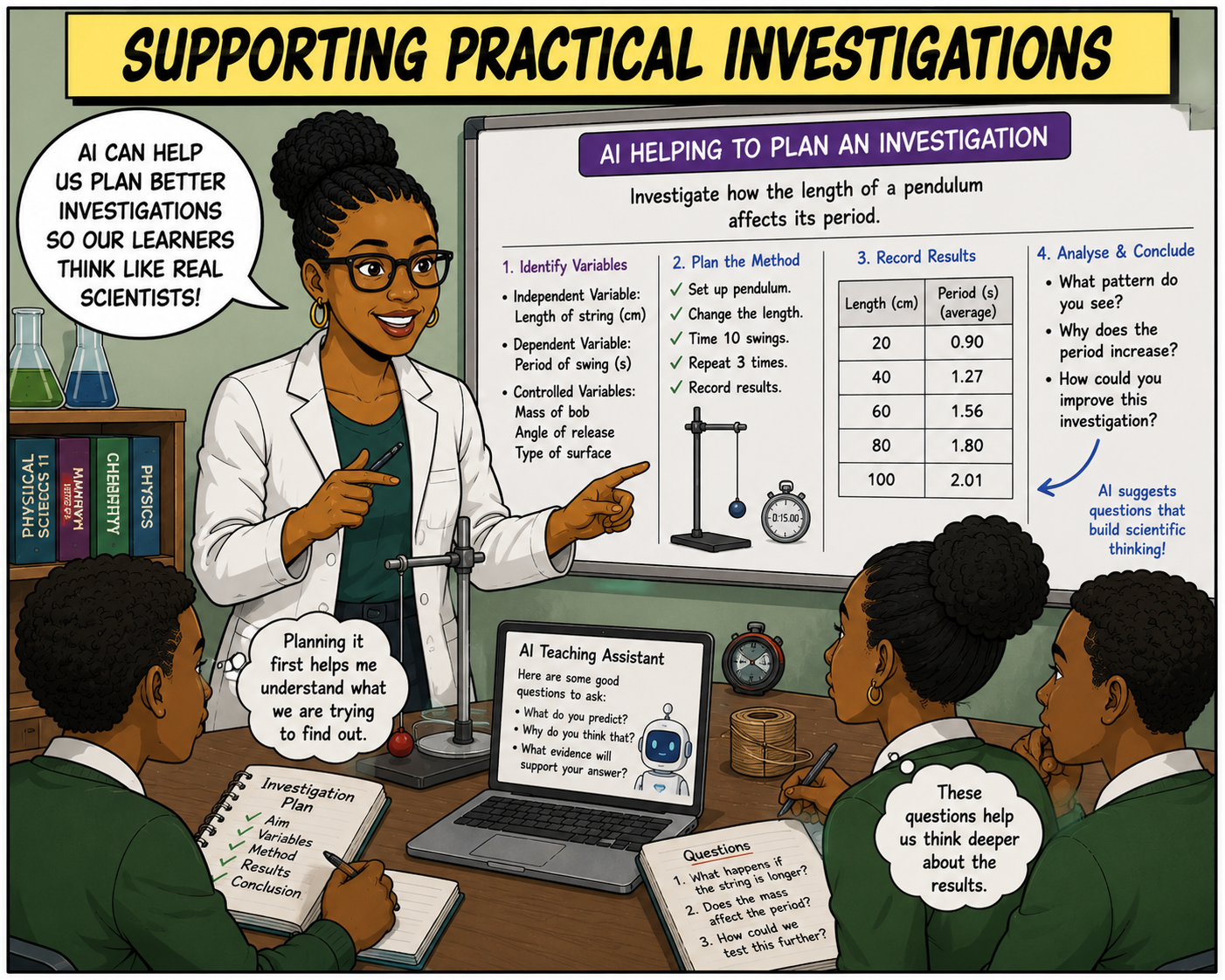
Supporting Practical Investigations
Practical investigations are an important part of Physical Sciences.
Although AI cannot replace laboratory work, it can help educators prepare investigation materials such as:
Hypothesis examples
Investigation planning guides
Variable identification exercises
Observation tables
Data analysis questions
Reflection activities
For example, before conducting an experiment, learners could use AI-generated planning questions to predict what they expect to observe.
The actual investigation should still be completed through real observation wherever possible.
Helping Learners Understand Scientific Vocabulary
Physical Sciences introduces many technical terms that can overwhelm learners.
Examples include:
Acceleration
Resistance
Oxidation
Reduction
Enthalpy
Momentum
Refraction
Equilibrium
In multilingual South African classrooms, scientific vocabulary may be one of the biggest learning barriers.
AI can help educators create:
Simple definitions
Vocabulary lists
Flashcards
Matching exercises
Sentence examples
Revision quizzes
Clear language improves scientific understanding.
Using AI To Generate Revision Questions
Revision should involve active thinking rather than passive reading.
AI can quickly generate:
Multiple-choice questions
Short-answer questions
Data interpretation activities
Graph questions
Calculation problems
Scenario-based questions
Teachers can also ask AI to produce questions at different levels of difficulty.
This allows learners to build confidence before attempting more demanding examination questions.
Encouraging Learners To Explain Scientific Reasoning
Correct answers alone do not always show understanding.
Learners should regularly explain:
Why they selected a formula
Why a reaction occurred
Why a prediction makes sense
Why evidence supports a conclusion
AI can help generate prompts such as:
Explain your reasoning.
Justify your answer.
Describe the scientific principle involved.
What evidence supports your conclusion?
These prompts encourage deeper thinking.
Using AI To Analyse Common Learner Mistakes
Many mistakes occur repeatedly in Physical Sciences.
Examples include:
Incorrect unit conversions
Sign errors
Formula substitution mistakes
Misreading graphs
Confusing related concepts
Ignoring significant figures
AI can generate examples containing realistic mistakes.
Educators can ask learners:
Identify the mistake.
Explain why it is incorrect.
Correct the solution.
Prevent the error in future.
Learning from mistakes develops stronger reasoning than simply seeing correct answers.
Supporting Graph Interpretation Skills
Graphs appear throughout the Physical Sciences curriculum.
Many learners struggle because they focus only on the numbers instead of interpreting relationships.
AI can help educators generate practice involving:
Motion graphs
Heating and cooling curves
Energy changes
Reaction rates
Experimental data
Teachers should encourage learners to describe trends before performing calculations.
Understanding the story behind the graph is just as important as finding the answer.
Connecting Science To Everyday Life
Learners often ask: "When will I ever use this?"
AI can help educators generate local, familiar examples involving:
Solar energy
Load shedding solutions
Water purification
Motor vehicles
Household electricity
Mobile phones
Recycling
Mining
Agriculture
Using South African contexts makes scientific ideas feel more relevant and meaningful.
Differentiating Learning Activities
Every Physical Sciences classroom contains learners with different levels of understanding.
AI can help teachers prepare differentiated resources.
Foundation Support
Simpler language
Guided questions
Basic calculations
More diagrams
Core Activities
Standard CAPS questions
Mixed calculations
Concept application
Extension Activities
Investigation design
Complex calculations
Data analysis
Open-ended scientific problems
Differentiation allows every learner to work at an appropriate level while progressing together.
Preparing Examination Revision
Examination preparation often requires extensive resource creation.
AI can assist by generating:
Topic summaries
Formula revision sheets
Concept checklists
Mixed revision papers
Practical investigation reviews
Self-assessment quizzes
Educators should still ensure that revision activities reflect CAPS requirements and current examination standards.
Encouraging Scientific Curiosity
One of the greatest strengths of science education is curiosity.
Educators should continue encouraging learners to ask:
What would happen if…?
Why does this happen?
Could we test this differently?
What evidence supports this idea?
What variables might affect the result?
AI can generate interesting "what if" questions that stimulate classroom discussion.
However, learners should still investigate, debate, and reason through possible answers themselves.
Checking AI-Generated Scientific Information
Although AI has improved significantly, it is not always scientifically accurate.
Educators should always verify:
Scientific facts
Chemical equations
Formula use
Units
Diagrams
Experimental procedures
Graph accuracy
Scientific terminology
Even small inaccuracies can create misconceptions that are difficult to correct later.
Professional judgement remains essential.
Protecting Inquiry-Based Learning
Physical Sciences is built on investigation.
Learners should continue to:
Observe carefully.
Measure accurately.
Record evidence honestly.
Analyse data.
Draw conclusions.
Evaluate results.
Suggest improvements.
AI should support these activities by helping educators prepare better lessons, not by replacing genuine scientific investigation.
Where practical experiments are available, learners should experience science through observation and experimentation rather than relying only on AI explanations.
Practical AI Prompt Ideas For Physical Sciences Educators
Well-designed prompts help educators produce useful classroom resources more efficiently.
Examples include:
"Explain Newton's Laws in simple English suitable for Grade 10 learners."
"Generate five Grade 12 electricity calculation questions with worked solutions."
"Create a practical investigation worksheet on reaction rates."
"Write ten multiple-choice questions on chemical bonding with explanations."
"Generate common learner misconceptions about momentum and explain how to correct them."
"Create a revision summary of organic chemistry using simple language."
"Develop a real-life case study on renewable energy in South Africa with discussion questions."
These prompts can be adapted to different grades and topics while reducing preparation time.
Best Practices For Responsible AI Use In Physical Sciences
To use AI effectively, educators should follow several guiding principles:
Always verify scientific accuracy before using AI-generated content.
Keep inquiry and investigation at the centre of learning.
Encourage learners to explain their reasoning.
Use AI to create additional explanations, not shortcuts.
Adapt all resources to the CAPS curriculum.
Include South African examples whenever possible.
Promote discussion, experimentation, and evidence-based thinking.
Teach learners to question information rather than accept it automatically.
These practices ensure that AI strengthens scientific learning instead of weakening it.
Preparing Learners For A Scientific Future
Scientific literacy has never been more important.
Many future careers in engineering, medicine, environmental science, technology, agriculture, renewable energy, and manufacturing require strong scientific thinking.
While AI will become an increasingly common workplace tool, future professionals must still know how to:
Evaluate evidence
Solve unfamiliar problems
Think critically
Interpret data
Make informed decisions
Work ethically with technology
By modelling responsible AI use in the Physical Sciences classroom, educators help learners develop both scientific competence and digital confidence.
Conclusion
Physical Sciences is far more than a collection of formulas, definitions, and laboratory activities. It teaches learners to investigate, question, analyse evidence, solve problems, and understand the natural world through careful reasoning. These habits of mind remain essential, regardless of how technology continues to evolve.
Artificial Intelligence provides valuable opportunities to support this learning. It can help educators generate clearer explanations, create differentiated resources, produce revision activities, develop worked examples, simplify scientific vocabulary, and save valuable preparation time. These benefits are especially valuable in South African schools, where educators often teach large classes with learners who have diverse educational backgrounds and language needs.
However, AI should never become a replacement for scientific thinking. Learners must still observe carefully, ask thoughtful questions, conduct investigations, evaluate evidence, explain their reasoning, and learn from mistakes. These experiences build the critical thinking skills that science education is intended to develop.
The educator remains the expert who guides inquiry, encourages curiosity, checks the accuracy of information, and creates opportunities for meaningful scientific discovery. When AI is used thoughtfully and responsibly, it becomes a powerful teaching assistant that supports excellent science education while ensuring that learners continue to think like scientists rather than simply accepting answers.
Additional Articles in the AI for Subject-Specific Teaching Series
How Maths Educators Can Use AI to Explain Problem-Solving More Clearly
Using AI in Physical Sciences Teaching Without Losing Scientific Thinking
How Language Educators Can Use AI to Support Writing and Comprehension Skills
Using AI to Support History, Geography, and Other Content-Heavy Subjects
AI for Business Studies, Accounting, and Economics Educators
Disclaimer
AI Tools were used to assist with research. Remember to always cross-check everything that you read.