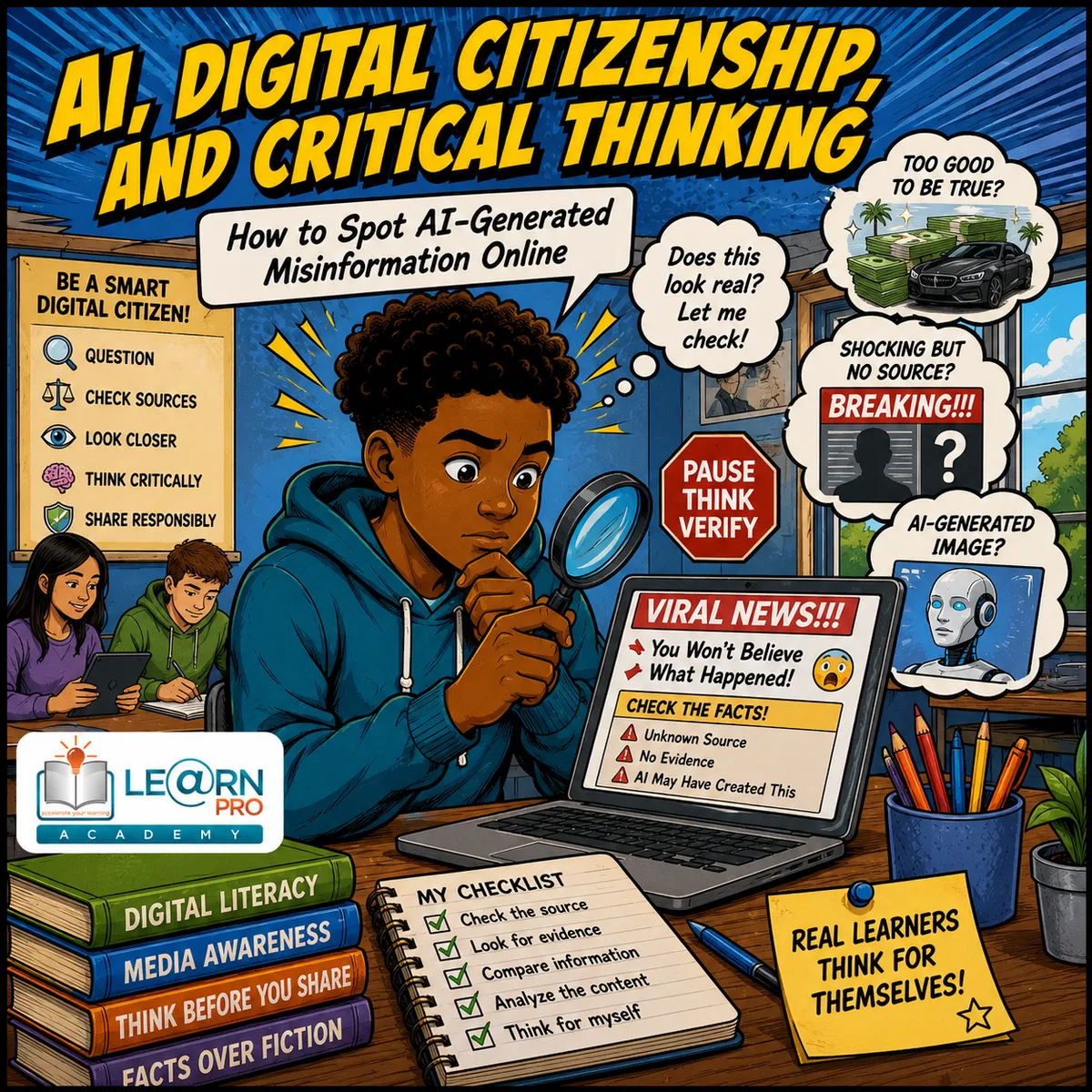
How to Spot AI-Generated Misinformation Online
This is article #1 of 5 in the AI, Digital Citizenship, and Critical Thinking Series
Introduction
The internet has changed the way people learn. Today, learners can find information about almost any topic within seconds. Whether you are studying Mathematics, History, Geography, Life Sciences, Physical Sciences, or preparing for a school project, the internet has become one of the most important learning tools available.
At the same time, the internet also contains incorrect information, misleading stories, fake images, and false videos. Some of this misinformation has always existed, but artificial intelligence (AI) has made it much easier and faster to create content that looks real. AI can now write articles, generate realistic pictures, create convincing voices, and even produce videos of people appearing to say things they never actually said.
This creates a challenge for everyone — not only adults but also students. If you believe false information, it can affect your schoolwork, your opinions, your decisions, and even your safety. One fake social media post can spread to millions of people within a few hours.
The good news is that you do not need to become an AI expert to protect yourself. You simply need to become a careful and thoughtful digital citizen. Just as you would not believe every rumour you hear at school, you should not believe everything you see online.
This article will help you understand what AI-generated misinformation is, why it spreads so quickly, how to recognise warning signs, and what practical steps you can take before believing or sharing online information.
Understanding Misinformation
Before learning how to spot misinformation, it helps to understand what the word actually means.
Misinformation is information that is false or misleading, whether it was shared accidentally or on purpose. Sometimes people honestly believe something is true and pass it on without checking. Other times, someone deliberately creates false information to trick, influence, entertain, or confuse people.
AI has made this much easier because it can generate huge amounts of realistic-looking content within minutes.
Examples include:
Fake news articles
Fake social media posts
AI-generated photographs
Edited videos
Fake celebrity interviews
Fake voice recordings
Incorrect AI-written explanations
Images that never happened
Made-up historical events
False scientific "facts"
Some misinformation is obvious, but much of it looks surprisingly convincing.
That is why critical thinking has become one of the most valuable skills learners can develop.
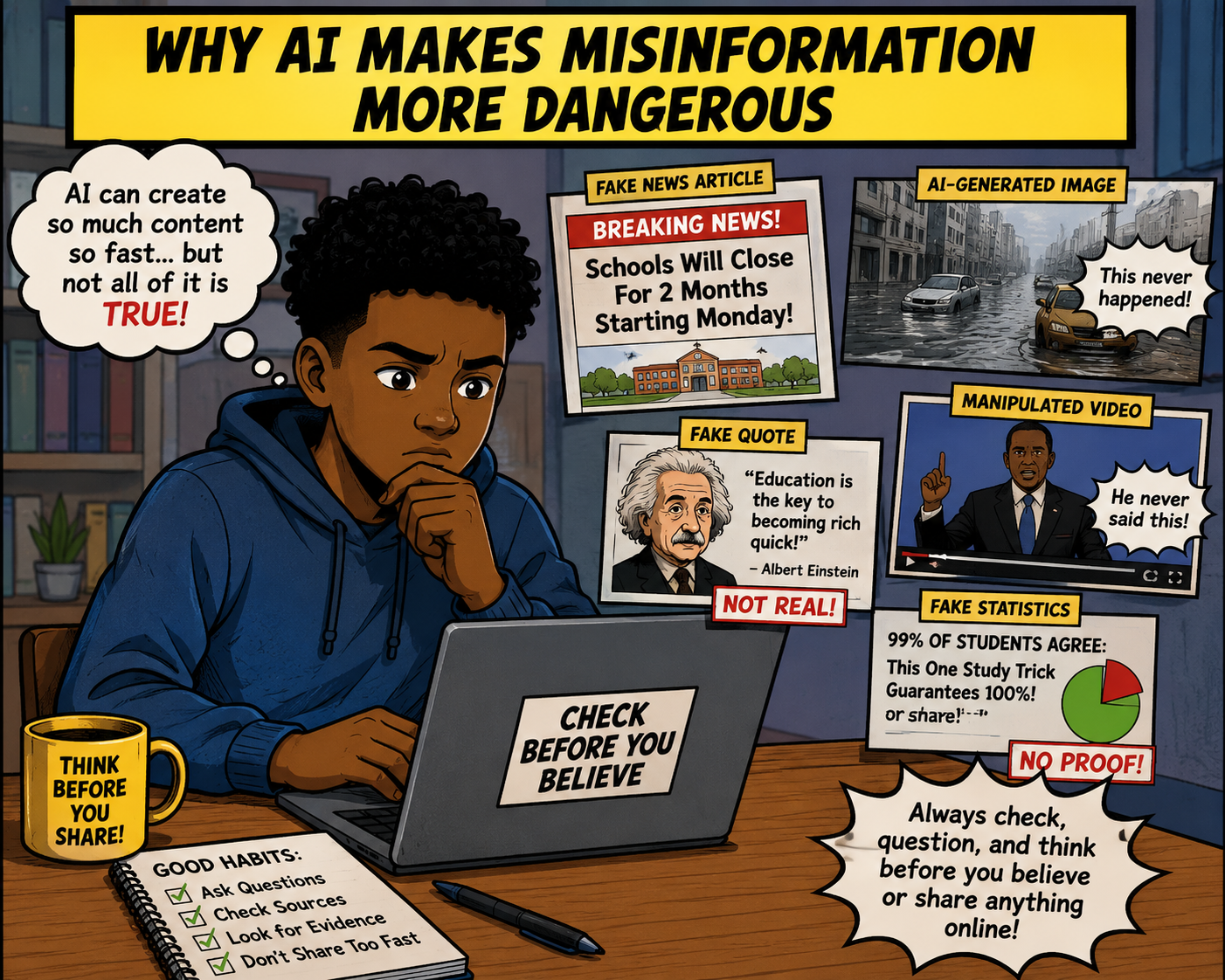
Why AI Makes Misinformation More Dangerous
Years ago, creating fake content required expensive software and expert editing skills. Today, AI tools can produce realistic content with just a short prompt.
Someone could ask AI to generate:
a photograph of a famous person,
a news report about an event that never happened,
an interview with someone who never spoke,
a realistic speech using another person's voice,
or hundreds of social media posts promoting the same false story.
Because AI works so quickly, false information can spread much faster than corrections. Many people only read headlines instead of full articles. Others immediately share exciting stories without checking whether they are true.
AI therefore increases both the speed and the scale of misinformation.
Why People Believe False Information
Many intelligent people fall for misinformation. This does not necessarily mean they are careless.
Our brains naturally like information that is:
surprising,
emotional,
shocking,
funny,
exciting,
or confirms what we already believe.
This makes us less likely to stop and ask important questions.
For example:
Imagine you see a social media post saying: "Schools across South Africa will close for two extra months!"
Many learners would immediately become excited.
Instead of checking whether the information comes from an official source, they may instantly share it with friends.
Excitement can sometimes replace careful thinking.
Good digital citizens learn to pause before reacting.
AI Can Be Wrong Too
Many learners are surprised to discover that AI itself can generate incorrect information. AI does not always know whether something is true.
Instead, it predicts what words are most likely to come next based on patterns in its training. Sometimes this produces excellent answers.
Sometimes it produces:
incorrect facts,
fake references,
imaginary quotations,
invented statistics,
wrong dates,
inaccurate summaries,
or completely false explanations.
This is why your teachers encourage you to use trusted sources rather than relying on AI alone.
AI is an assistant — not a perfect source of truth.
Warning Sign 1: Emotional Headlines
One of the easiest warning signs is an emotional headline. False information often tries to make you feel something before you start thinking.
Look out for headlines like:
"You Won't Believe This!"
"This Changes Everything!"
"The Government Doesn't Want You To Know!"
"Scientists Are Shocked!"
"Share Before It Gets Deleted!"
These headlines are designed to trigger curiosity or fear.
Reliable information usually uses calmer, more balanced language.
Warning Sign 2: No Source Is Mentioned
Trustworthy information usually tells you where it came from.
Ask yourself:
Who wrote this?
Which organisation published it?
Where did the information come from?
Can I find the original source?
If none of these questions can be answered, be careful.
Anonymous information is harder to trust.
Warning Sign 3: It Sounds Too Good Or Too Terrible To Be True
Extreme claims deserve extra checking.
Examples include:
"This study method guarantees 100% marks."
"Eating one food cures every disease."
"One app will make you rich overnight."
"This video proves history was completely fake."
Real life is usually more complicated.
Extraordinary claims require strong evidence.
Warning Sign 4: Poor Quality Images
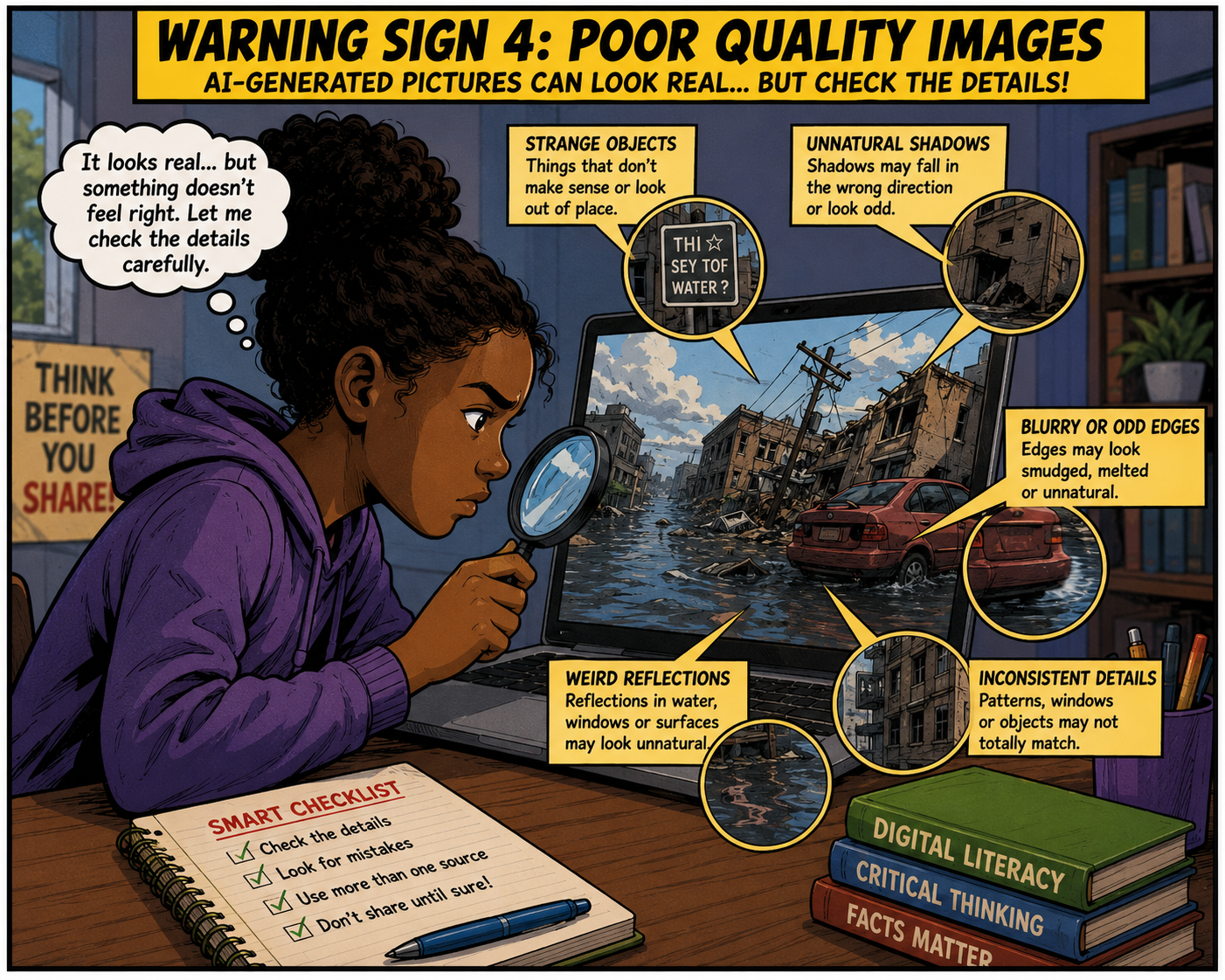
AI-generated images have improved dramatically, but mistakes still happen.
Look carefully for:
strange fingers,
unusual shadows,
objects that blend together,
unreadable signs,
distorted faces,
impossible reflections,
inconsistent lighting,
missing details,
unnatural backgrounds.
Sometimes everything looks correct until you examine the small details.
Learning to slow down helps you notice these clues.
Warning Sign 5: Videos That Feel Unnatural
AI-generated videos are becoming increasingly realistic.
However, some warning signs include:
unnatural blinking,
strange lip movements,
awkward facial expressions,
unusual voice patterns,
inconsistent lighting,
blurred edges around faces,
movements that appear slightly unnatural.
Technology continues improving, so these clues may become harder to spot.
That is why checking the source remains more important than only studying the video itself.
Warning Sign 6: Fake Quotes
People often create fake quotations from famous people. Sometimes AI helps generate these fake quotes.
Before believing a quotation, ask:
Where was this said?
Is there a video?
Is there an official interview?
Do trusted news organisations report it?
Many fake quotes spread online simply because people enjoy sharing them.
Warning Sign 7: No Other Websites Report The Story
Imagine you discover a shocking news story.
Ask yourself: "If this were really true, would only one unknown website be talking about it?" Major events are normally reported by multiple reliable organisations.
If only one small website is making a dramatic claim, it deserves extra investigation.
Warning Sign 8: The Information Has No Date
Old information often returns as if it were new.
Always check:
publication date,
update date,
when the event actually happened.
A story from five years ago might suddenly appear in your social media feed today.
Without checking the date, you could misunderstand the situation completely.
Warning Sign 9: AI-Generated Text That Sounds Confident
AI often writes confidently — even when it is wrong. Confidence is not proof.
Some AI-generated articles sound very professional while including:
incorrect statistics,
invented experts,
fake research,
inaccurate explanations,
false references.
Never assume information is correct simply because it sounds convincing.
Warning Sign 10: Everyone Seems To Be Saying The Same Thing
Sometimes AI creates hundreds or thousands of similar posts across different accounts. This can make a false story appear popular.
Just because many people repeat something does not automatically make it true.
Always ask: "What evidence supports this claim?"
Facts do not become true because many people repeat them.
Why Images Can Mislead You
People naturally trust photographs. For many years, seeing a photograph meant something probably happened. AI has changed this.
Today, images can be created from simple text instructions.
Someone can generate:
imaginary disasters,
fake wildlife photographs,
invented historical pictures,
fake sports celebrations,
celebrities at events they never attended,
politicians saying things they never said.
Always remember: A realistic image is not automatically proof.
Why Videos Can Mislead You
Videos feel even more believable than photographs.
Many people think: "If I saw it on video, it must be true."
Unfortunately, AI can now create convincing fake videos called deepfakes.
A deepfake may show someone:
speaking,
singing,
smiling,
giving a speech,
or answering interview questions,
even though none of it actually happened.
As technology improves, learners must rely more on evidence than appearance.
The Importance Of Asking Questions
Critical thinking begins with simple questions.
Whenever you find surprising information online, ask yourself:
Who created this?
Why was it created?
What evidence supports it?
Can another trusted source confirm it?
Is the information current?
Could this image or video be edited?
Am I reacting emotionally?
Have I actually read the full article?
Could AI have helped create this content?
These questions only take a minute but can prevent serious mistakes.
How Fact-Checking Works
Professional journalists rarely publish important stories after checking only one source. Instead, they compare information from several reliable places. You can develop the same habit.
When researching school assignments:
compare different websites,
check textbooks,
use educational resources,
read official government information,
consult your teacher,
compare AI answers with trusted sources.
The more sources agree, the more confidence you can have in the information.
Be Careful Before Sharing
One of the biggest reasons misinformation spreads is that people share first and think later.
Before pressing the "Share" button, ask yourself:
Is this true?
Have I checked it?
Could this harm someone?
Am I helping people or spreading confusion?
Once false information spreads, it can be very difficult to correct.
Responsible digital citizens understand that every share matters.
Using AI Responsibly
AI is an excellent learning tool when used wisely.
It can help you:
understand difficult topics,
explain concepts,
create study notes,
generate practice questions,
improve your writing,
organise ideas,
prepare for exams.
However, AI should never replace your own judgement.
Treat AI like a helpful study partner — not the final authority.
Always verify important facts.
Classroom Example
Imagine your History class is researching Nelson Mandela. You ask an AI chatbot for information. It provides several facts, dates, and quotations.
Instead of copying everything immediately, you decide to:
compare the information with your History textbook,
check reliable educational websites,
verify important dates,
confirm quotations,
ask your teacher about anything that seems unusual.
You have used AI responsibly. You benefited from its speed while still checking its accuracy.
This is exactly the type of digital literacy that modern learners need.
Building Strong Digital Habits
Learning to recognise misinformation is not about becoming suspicious of everything.
Instead, it is about developing smart online habits.
Good habits include:
reading beyond the headline,
checking more than one source,
looking for evidence,
questioning emotional claims,
checking dates,
examining images carefully,
verifying quotations,
thinking before sharing,
asking teachers when unsure,
using AI as a tool rather than a replacement for critical thinking.
These habits will help you throughout school, university, your career, and everyday life.
Conclusion
Artificial intelligence is changing how information is created and shared. It can produce useful educational content, but it can also generate convincing misinformation that spreads faster than ever before. As AI continues to improve, learners must become more thoughtful consumers of digital information.
The most important skill is not memorizing every warning sign — it is developing a habit of asking questions. Instead of accepting every article, image, video, or AI-generated answer as true, pause and investigate. Look for evidence, compare reliable sources, and think carefully before believing or sharing information.
Your education is about more than learning facts. It is also about learning how to think. By combining curiosity with critical thinking, you can enjoy the benefits of AI while protecting yourself from misinformation. In an increasingly digital world, that ability will be one of the most valuable skills you ever develop.
Additional Articles in the AI, DIgital Citizenship, and Critical ThinkingSeries
How to Spot AI-Generated Misinformation Online
What Is AI Bias and Why Should Students Care?
Deepfakes, Fake Images, and Digital Truth: What Learners Need to Know
How AI and Social Media Can Shape What You Think
Thinking for Yourself in an AI World
Disclaimer
AI Tools were used to assist with research. Remember to always cross-check everything that you read.