Using AI To Simplify Difficult Concepts For Learners
This is article #4 of 5 in the AI for Writing, Assignments, and School Projects Series
Introduction
Some school topics seem impossible to understand the first time you hear them. You may sit in class, listen carefully, take notes, and still wonder, "What does this actually mean?"
This happens to almost every learner. It does not mean you are lazy or unintelligent. Many school subjects introduce new words, complex ideas, and abstract concepts that take time to understand.
Think about topics such as:
Quadratic equations in Mathematics
Chemical bonding in Physical Sciences
DNA and genetics in Life Sciences
Supply and demand in Economics
Democracy and governance in History
Financial statements in Accounting
These topics can feel confusing because they often build on knowledge you have learned over several years.
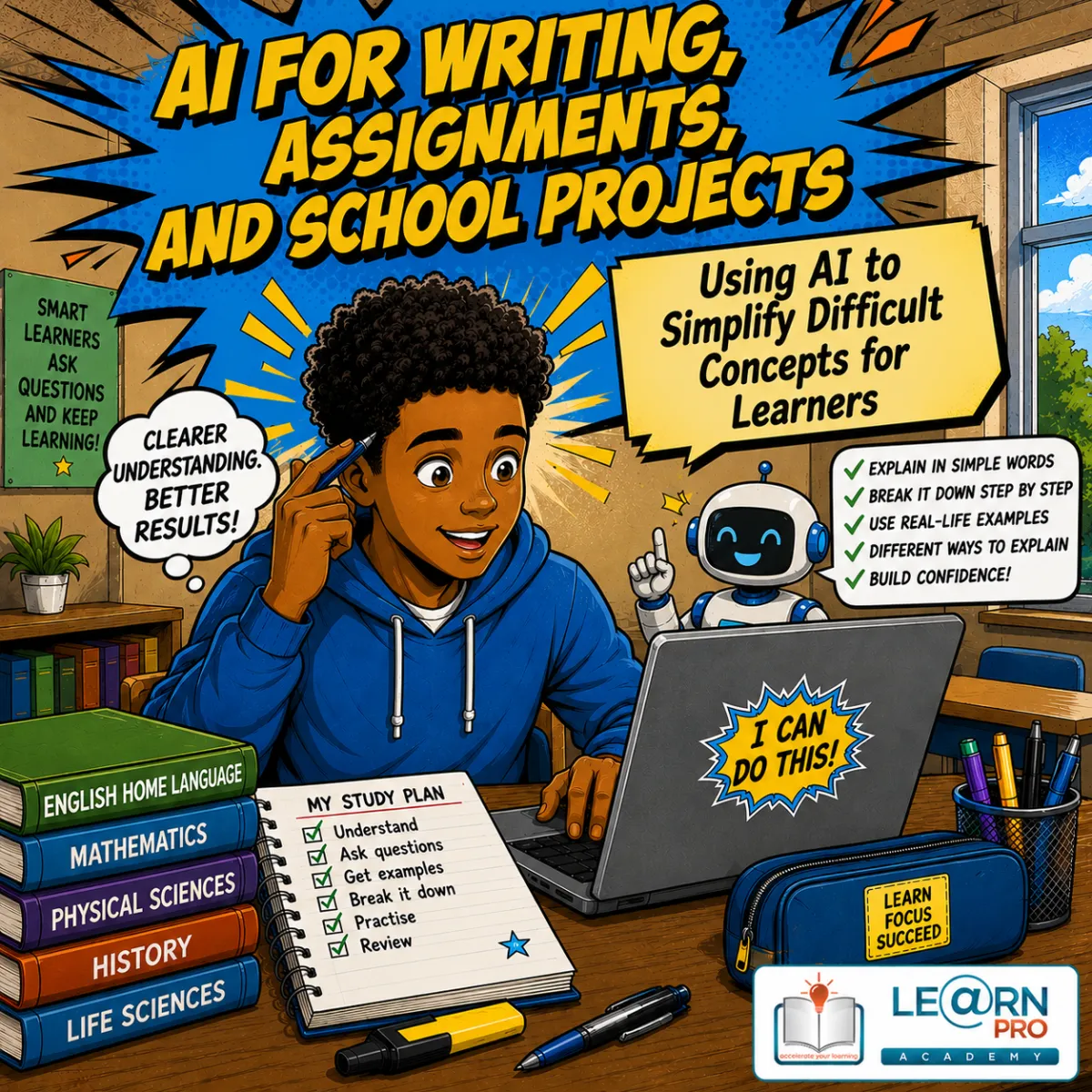
Artificial Intelligence (AI) can help make learning easier by explaining difficult concepts in simpler language, using everyday examples, breaking ideas into smaller steps, and answering your questions whenever you need extra help.
However, AI should not replace your teacher, your textbook, or your own thinking. Instead, it should act like a patient tutor who can explain something in different ways until it makes sense.
In this article, you will learn how to use AI responsibly to simplify difficult school concepts while still developing the knowledge and critical thinking skills you need to succeed in Grade 10, Grade 11, and Grade 12.
Why Some School Topics Feel Difficult
Every learner finds certain subjects challenging. Some struggle with Mathematics. Others find Physical Sciences difficult. Some enjoy History but battle with Geography. Others understand Business Studies but find Accounting confusing.
There are many reasons why a topic may seem difficult:
It introduces unfamiliar vocabulary.
It builds on earlier work you may have forgotten.
It contains several ideas that connect together.
It uses diagrams, formulas, or technical language.
It moves too quickly during class.
Understanding these challenges is important because it reminds you that struggling with a topic is a normal part of learning.
The goal is not to avoid difficult concepts.
The goal is to learn how to understand them.
AI Is A Learning Coach, Not A Shortcut
Many learners think AI is only useful for answering homework questions. In reality, one of its greatest strengths is explaining ideas. Imagine asking a teacher to explain a difficult concept. If you still do not understand, you ask them to explain it differently.
AI can do the same thing.
For example, you could ask:
"Can you explain this in simpler English?"
"Can you explain this as if I am a Grade 10 learner?"
"Can you use a real-life example?"
"Can you explain it one step at a time?"
Instead of giving up when something feels confusing, AI gives you another opportunity to learn.
Start By Asking Simple Questions
Many learners feel embarrassed to ask questions in class. Perhaps they worry that everyone else already understands. AI gives you a private place to ask questions without feeling uncomfortable.
Instead of asking: "Explain electricity."
Try asking: "What is electricity in simple English?"
Or: "Explain electricity using examples from everyday life."
The more specific your question is, the more useful the explanation usually becomes.
Ask AI To Explain Difficult Words
Sometimes one unfamiliar word prevents you from understanding an entire lesson.
Imagine reading this sentence: "Photosynthesis converts carbon dioxide into glucose using chlorophyll."
If you do not understand the words photosynthesis, glucose, or chlorophyll, the whole sentence becomes confusing.
Ask AI questions like:
"What does chlorophyll mean?"
"Explain glucose using simple words."
"Use chlorophyll in an example sentence."
Building your vocabulary helps every subject become easier.
Break Big Ideas Into Smaller Steps
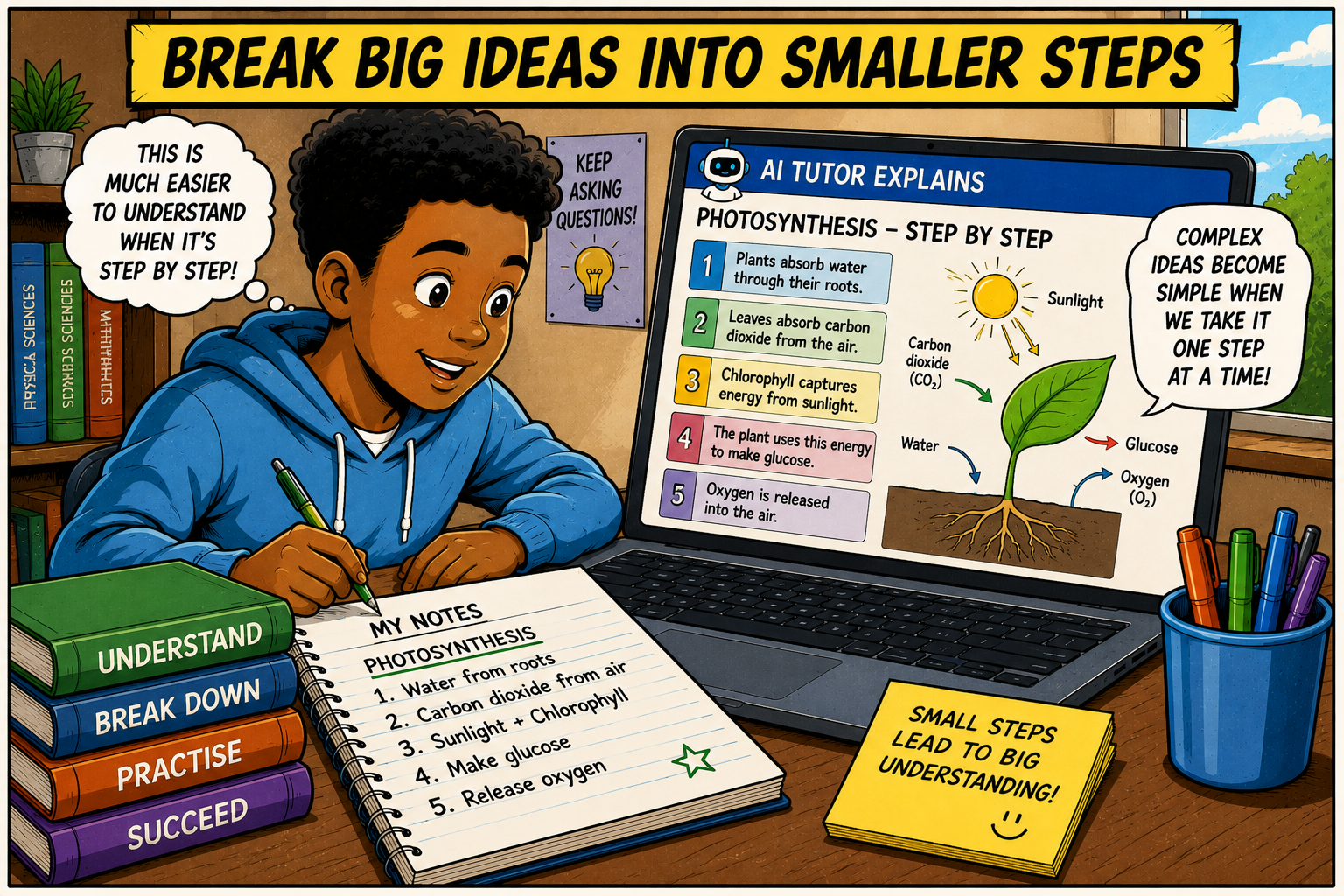
Complex concepts often become much easier when they are divided into smaller parts. Suppose you are learning how photosynthesis works. Instead of trying to remember everything at once, AI could explain it as follows:
Step 1: Plants absorb water through their roots.
Step 2: Leaves absorb carbon dioxide from the air.
Step 3: Chlorophyll captures energy from sunlight.
Step 4: The plant uses this energy to make glucose.
Step 5: Oxygen is released into the air.
Learning one step at a time is much less overwhelming than trying to understand everything at once.
Learn Through Everyday Examples
One of the best ways to understand difficult ideas is to connect them to everyday life. AI can help by creating familiar examples.
For example:
Supply And Demand
Instead of giving only textbook definitions, AI might explain: Imagine your favourite sneaker becomes very popular.
Many people want to buy it, but only a few pairs are available. Because demand is high and supply is low, the price increases.
This simple example makes the concept much easier to understand.
Compare New Ideas To Things You Already Know
Your brain learns more easily when new information connects to something familiar. AI can help create comparisons.
For example:
The Human Heart
AI might compare the heart to a water pump. Just as a pump moves water through pipes, the heart pumps blood through blood vessels.
Simple comparisons help learners build stronger understanding.
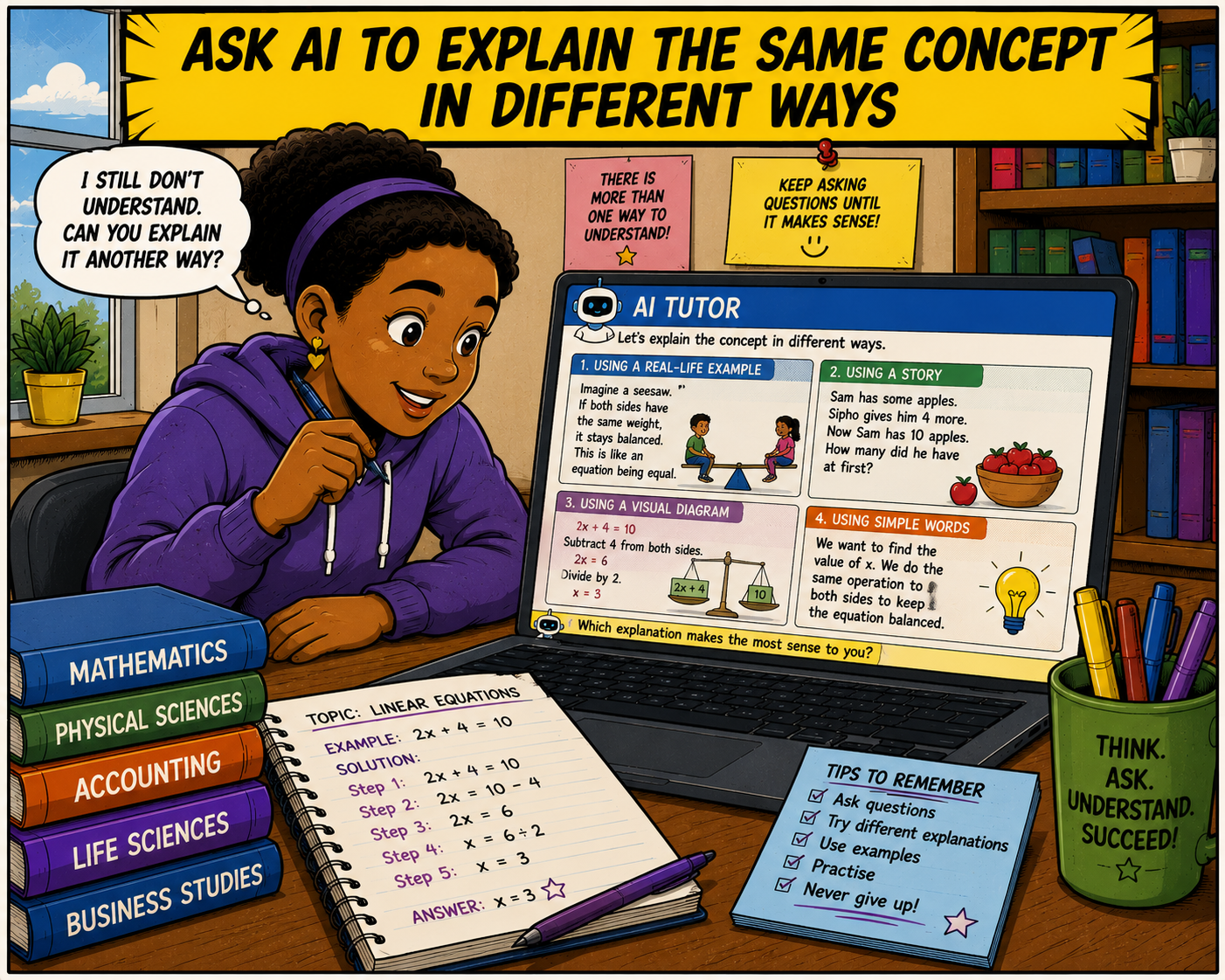
Ask AI To Explain The Same Concept In Different Ways
Not every explanation works for every learner. If you still do not understand something, ask AI to explain it differently.
You might ask:
"Can you explain it another way?"
"Can you use an analogy?"
"Can you explain it using sport?"
"Can you explain it using farming?"
"Can you explain it with a simple story?"
Sometimes one new explanation is all you need.
Use AI To Prepare Before Class
AI is not only useful after school. It can also help before a lesson. Suppose tomorrow's Life Sciences lesson is about genetics.
Ask AI:
"What should I already know about genetics?"
"What important words will I hear?"
"Can you give me a simple introduction?"
When you arrive in class already familiar with the basic ideas, your teacher's explanation will make much more sense.
Use AI After Class To Review
Reviewing a lesson on the same day helps move information into your long-term memory. After school, ask AI:
"Can you summarise today's lesson?"
"Can you test my understanding?"
"What are the five most important ideas?"
This helps reinforce what you learned in class.
Ask AI To Create Practice Questions
Understanding improves through practice.
After studying a topic, ask AI:
"Create five easy questions."
"Now create five more difficult questions."
"Give me the answers after I have tried."
This allows you to check whether you truly understand the concept.
Learn At Your Own Pace
One of AI's greatest advantages is patience. Your teacher must teach an entire class.
AI focuses only on you.
If you need the same explanation five times, AI will explain it five times.
If you want ten examples instead of two, AI can provide them.
Learning at your own pace helps build confidence.
Use Diagrams And Visual Descriptions
Some learners understand pictures better than words.
Ask AI questions such as:
"Describe a diagram of the water cycle."
"Explain how I should draw this process."
"Describe the parts of a cell."
You can then compare these descriptions with diagrams in your textbook.
Combining words and visuals improves understanding.
Keep Asking "Why?"
Strong learners are curious. Instead of memorising facts, they ask why things happen.
For example:
Instead of asking: "What is erosion?"
Ask:
Why does erosion happen?
Why is erosion harmful?
Why is erosion worse in some places?
Why is soil conservation important?
These questions help you think more deeply.
Helpful AI Prompts You Can Use
Here are some practical prompts.
Simple Explanation: "Explain this topic in simple English for a Grade 10 learner."
Step-By-Step Learning: "Break this concept into five easy steps."
Real-Life Example: "Give me a South African example that explains this idea."
Different Explanation: "Explain this another way because I still don't understand."
Vocabulary: "Explain these difficult words one at a time."
Self-Test: "Ask me ten questions to check whether I understand this topic."
These prompts encourage active learning instead of passive reading.
Mistakes To Avoid
AI is a useful learning tool, but avoid these common mistakes:
Accepting the first explanation without thinking.
Memorising AI's words without understanding them.
Ignoring your textbook and teacher.
Depending on AI instead of studying.
Not asking follow-up questions.
Skipping practice exercises.
Assuming AI is always correct.
Learning happens when you understand ideas—not when you simply read them.
Combine AI With Other Learning Resources
The best learning happens when you use several resources together.
A good study routine might include:
Listen carefully during class.
Read your textbook.
Ask your teacher questions.
Use AI to simplify confusing ideas.
Practise questions.
Review your notes.
Teach the concept to someone else.
Each resource supports the others.
Together, they help you build a deeper understanding.
Becoming A More Confident Learner
Every learner experiences moments when a lesson feels confusing. The difference between successful learners and struggling learners is not that one group never finds work difficult. The difference is that successful learners keep asking questions until they understand.
Artificial Intelligence gives you another way to ask those questions. It can explain ideas in simpler language, use familiar examples, break complex topics into smaller steps, and help you practise what you have learned. Used responsibly, it becomes a patient learning partner that supports your education rather than replacing it.
Remember that your teacher remains your most important guide, your textbook provides trusted information, and your own effort is what leads to real learning. AI is simply another tool that can make difficult concepts easier to understand.
As you continue through high school, don't be afraid of challenging topics. Every difficult concept you master builds your confidence for the next one. By combining curiosity, consistent study habits, and responsible use of AI, you will develop stronger understanding, greater confidence, and the problem-solving skills you need for success at school and beyond.
Disclaimer
AI Tools were used to assist with research. Remember to always cross-check everything that you read.