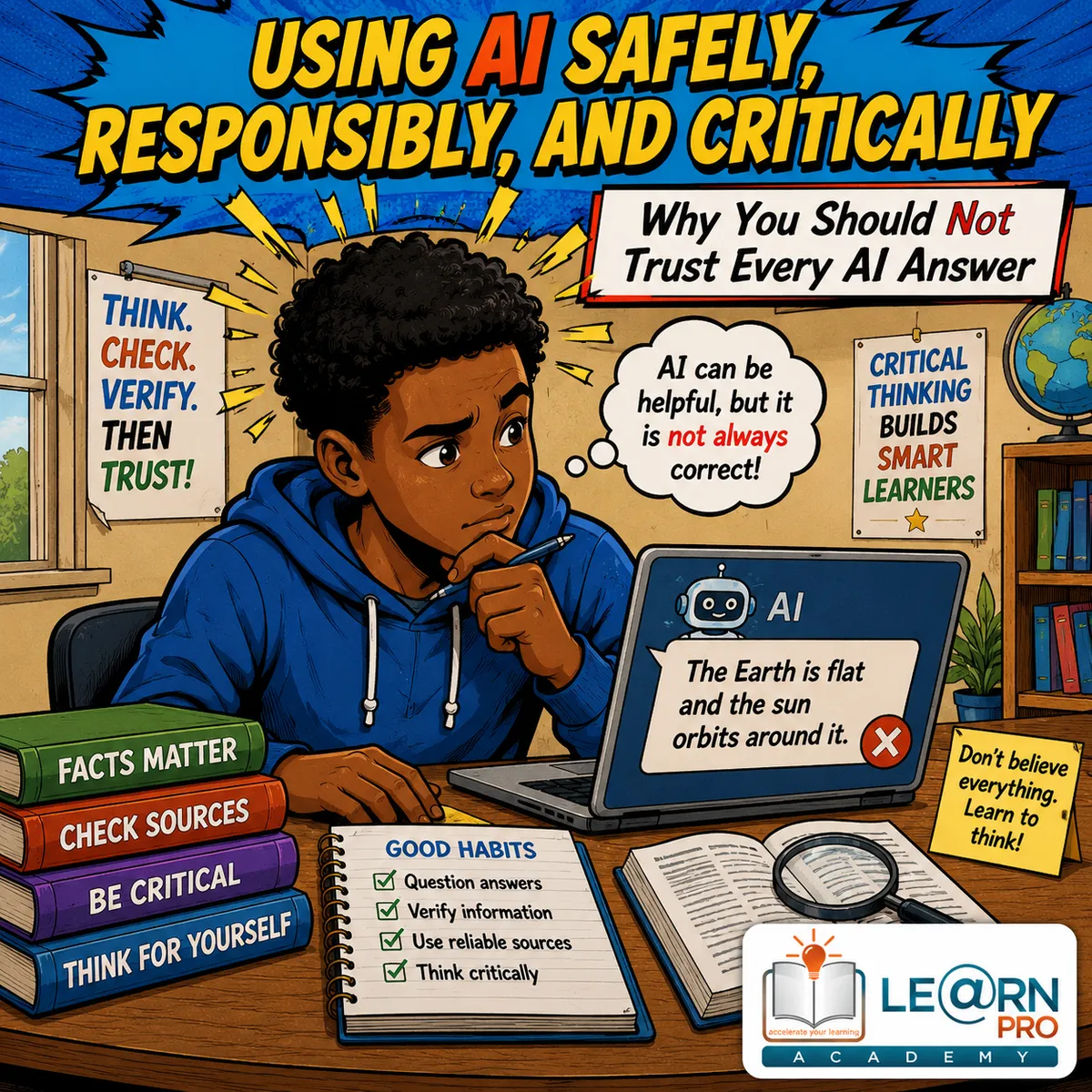
Why You Should Not Trust Every AI Answer
This is article #1 of 5 in the Using AI Safely, Responsibly, and Critically Series
Introduction
Artificial Intelligence (AI) is changing the way learners study, complete assignments, and prepare for exams. Today, many students use AI tools to explain difficult concepts, create summaries, answer questions, and even help plan projects. These tools can save time and make learning easier, but there is one important fact that every learner must understand:
AI is not always right.
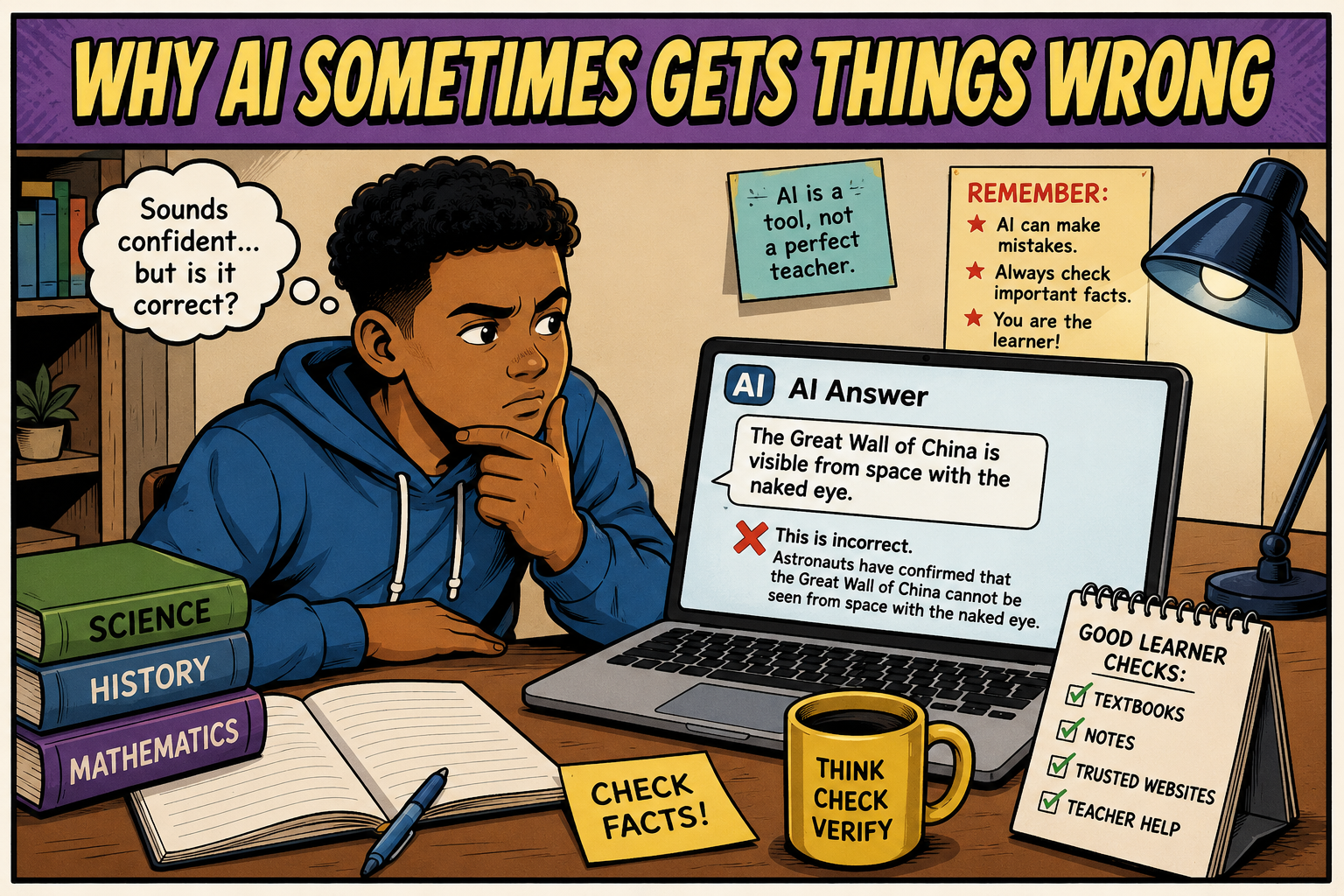
One of the biggest mistakes students make is believing that because AI sounds confident, every answer it gives must be correct. Unfortunately, that is not true. AI can make mistakes, misunderstand questions, leave out important information, or even create information that is completely false.
Imagine copying an incorrect answer into your assignment because AI presented it confidently. You could lose marks even though you believed you were doing the right thing. Even worse, if you keep learning incorrect information, it becomes harder to succeed in tests and exams.
That does not mean AI is bad. In fact, AI can be one of the most useful learning tools available today. The key is learning how to use it wisely. Instead of treating AI as a teacher who is always correct, think of it as a helpful study partner whose answers should always be checked.
This article will help you understand why AI sometimes makes mistakes, how those mistakes happen, and what you can do to protect yourself. By developing strong critical thinking skills, you will become a smarter learner who uses AI responsibly while still building your own knowledge and confidence.
Understanding What AI Really Does
Before learning why AI can be wrong, it helps to understand what AI actually does.
Many students imagine AI as a giant digital brain that knows every fact in the world. That is not how it works.
AI does not think like a human being. It does not attend school, perform experiments, or understand the world through personal experience. Instead, AI analyses enormous amounts of written information and predicts which words are most likely to come next when answering your question.
Because of this, AI is extremely good at producing natural-sounding language. It can explain ideas clearly, answer questions quickly, and organise information into useful formats.
However, sounding intelligent is not the same as always being correct.
Sometimes AI predicts an answer that sounds believable but is actually inaccurate.
This is why learners should always remember an important rule:
A confident answer is not always a correct answer.
Why AI Sometimes Gets Things Wrong
There are several reasons why AI can produce incorrect information.
Understanding these reasons helps you become a smarter AI user.
AI Can Mix Different Facts Together
Sometimes AI combines information from different sources into one answer.
Imagine asking about two different historical events.
Instead of keeping them separate, AI might accidentally combine details from both events.
The result may sound logical, but parts of the answer could be incorrect.
AI May Use Outdated Information
Some AI systems are trained using information collected over time.
If important facts have changed since that information was collected, AI may provide answers that are no longer accurate.
For example:
Government policies change.
Scientific discoveries are updated.
Technology improves.
Laws are amended.
Sports records are broken.
If AI has not accessed the latest information, its answer may already be out of date.
AI Can Misunderstand Your Question
Sometimes the problem is not the answer.
The problem is that AI misunderstood the question.
For example, if you ask: "Tell me about bats."
Do you mean:
the flying animal?
a cricket bat?
a baseball bat?
Without enough detail, AI may answer the wrong question.
This is why writing clear prompts is so important.
AI Can Invent Information
One surprising fact about AI is that it sometimes creates information that does not exist.
This may include:
fake quotations
incorrect statistics
imaginary research studies
books that were never published
websites that do not exist
references that cannot be found
The information often sounds convincing, making it difficult to spot the mistake.
This is one of the biggest dangers of relying on AI without checking its answers.
Why AI Sounds So Confident
One reason students trust AI too easily is the way it writes. Unlike a human who might say: "I'm not completely sure." AI often writes statements that sound definite.
For example: "The answer is..."
or "This happened because..."
The writing style sounds professional and confident. Unfortunately, confidence does not guarantee accuracy.
Think about people in everyday life. Someone can speak confidently while still being wrong. The same is true for AI.
Never judge an answer by how confident it sounds.
Judge it by whether the information can be verified.
The Difference Between Information And Knowledge
Reading information is not the same as understanding it. AI provides information. You are responsible for turning that information into knowledge.
Knowledge comes from:
reading
thinking
questioning
comparing ideas
solving problems
practising
discussing concepts
making mistakes and learning from them
AI cannot do this learning for you.
Only you can build real understanding.
Why Critical Thinking Matters More Than Ever
Critical thinking means carefully evaluating information before accepting it as true.
It involves asking questions like:
Does this make sense?
Is there evidence?
Can I find the same information somewhere else?
Does this agree with my textbook?
Would my teacher explain it this way?
Critical thinking protects you from mistakes.
It also helps you become a stronger learner because you are actively engaging with the information instead of simply copying it.
Students who develop critical thinking skills usually perform better in school because they understand concepts more deeply.
Real-Life Example: AI Gets A Science Answer Wrong
Imagine a Grade 11 learner asks: "Why do plants need sunlight?"
AI replies: "Plants use sunlight to create oxygen."
This answer is only partly correct.
Plants use sunlight for photosynthesis, a process that allows them to make their own food (glucose). Oxygen is produced as a by-product, but creating oxygen is not the main purpose of sunlight for the plant.
A learner who copies the incomplete answer into a test may lose marks.
A learner who checks a science textbook will discover the full explanation and understand the topic properly.
Real-Life Example: A History Assignment
A student asks AI to explain an important historical event. AI provides dates, names and descriptions. Everything looks excellent.
However, one important date is incorrect. The student copies the answer without checking.
When the assignment is marked, the incorrect date affects the final result.
This could have been avoided by checking the information against:
the history textbook
class notes
trusted educational websites
teacher guidance
Real-Life Example: Mathematics
Many learners believe AI is perfect at mathematics. AI can solve many maths problems correctly.
However, it can also make calculation mistakes or misunderstand the question.
For example:
If the learner enters the wrong numbers, AI may solve the wrong problem perfectly.
If the question is unclear, AI may use the wrong method.
This is why you should always work through the solution yourself.
Understanding the process is more valuable than simply seeing the answer.
Subjects Where You Should Be Especially Careful
Although AI can help with almost every school subject, some areas require extra attention.
Mathematics
Always check:
calculations
formulas
working steps
final answers
One small mistake early in the calculation can affect everything that follows.
Science
Check:
definitions
scientific processes
units of measurement
diagrams
formulas
Science depends on accuracy.
History
Verify:
dates
timelines
historical figures
locations
causes and consequences
Small factual errors can completely change historical meaning.
Geography
Always confirm:
maps
statistics
climate information
population figures
environmental facts
Many geographical facts change over time.
Life Sciences
Check:
biological processes
scientific names
body systems
ecological relationships
Precision is important.
Languages
AI is often useful for grammar and writing ideas.
However, you should still check:
spelling
punctuation
meaning
tone
context
Especially if English is your additional language.
Why Copying AI Answers Can Hurt Your Learning
Imagine two learners:
Learner A copies every AI answer.
Learner B reads the AI answer, asks questions, checks the textbook, and rewrites the explanation in their own words.
Who is more prepared for the exam?
The answer is obvious:
Learner B has actually learned the material.
Learner A has only copied information.
During exams, AI will not be available.
Your own understanding is what matters.
The Importance Of Asking Better Questions
Sometimes AI gives poor answers because learners ask poor questions.
Compare these prompts.
Poor prompt: "Explain chemistry."
Better prompt: "Explain chemical bonding for a South African Grade 11 learner using simple English and everyday examples."
The second prompt gives AI much clearer instructions. Better questions usually produce better answers.
Learning how to write clear prompts is an important digital skill.
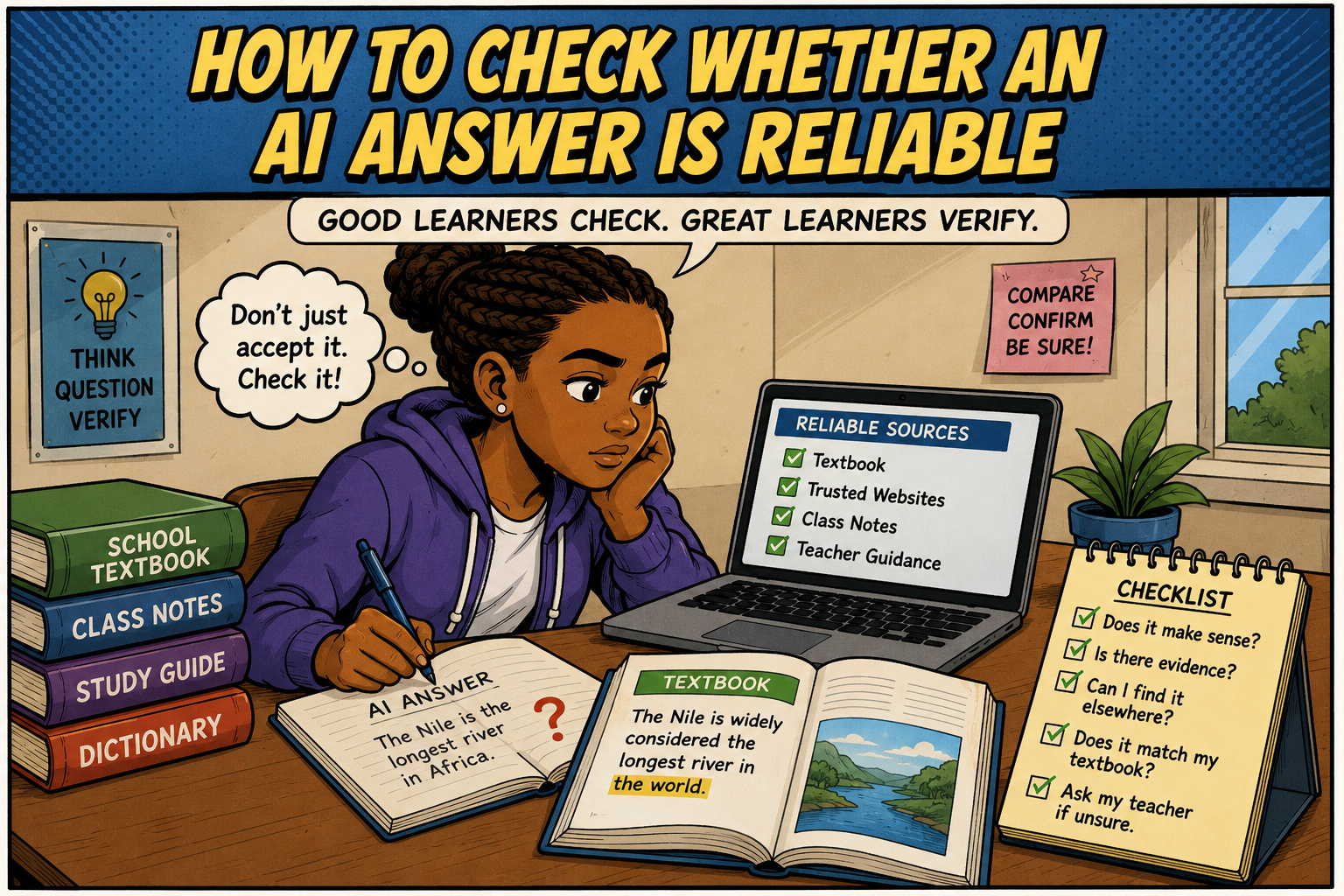
How To Check Whether An AI Answer Is Reliable
Whenever AI gives you information, pause before accepting it.
Ask yourself:
Does this sound reasonable?
Can I explain it myself?
Have I seen this information before?
Does it match my class notes?
Can I find another source that agrees?
If you cannot answer these questions confidently, investigate further.
Good learners check.
Great learners verify.
Trusted Sources You Should Use
AI should never be your only source of information.
Compare AI answers with:
your prescribed textbook
class notes
your teacher's explanations
official educational websites
reliable reference books
reputable educational videos
Using multiple sources reduces the chance of learning incorrect information.
Warning Signs That An AI Answer May Be Wrong
Watch out for these warning signs.
The answer:
sounds too general
contains no explanation
has no examples
contradicts your textbook
uses strange facts
gives impossible numbers
mixes unrelated topics
changes its answer when asked again
cannot explain how it reached its conclusion
If you notice these signs, check the information before using it.
AI Is A Tool, Not A Replacement For Learning
Think about a calculator. A calculator is useful. But if you never learn basic mathematics, you become dependent on it.
AI works the same way. It is a powerful learning tool.
It should never replace:
reading
thinking
practising
writing
solving problems
asking teachers for help
The goal is not to let AI do your learning.
The goal is to let AI support your learning.
Building Good AI Habits
Successful learners develop responsible AI habits.
These include:
reading AI answers carefully
checking important facts
comparing multiple sources
asking follow-up questions
rewriting information in their own words
admitting when they do not understand
asking teachers for clarification
thinking before accepting any answer
These habits will help you throughout school and beyond.
Preparing For A Future With AI
AI will become even more common in universities and workplaces. Future employers will not simply ask whether you can use AI. They will ask whether you can use AI wisely.
People who succeed will be those who can:
think critically
solve problems
identify mistakes
verify information
make informed decisions
These are human skills that AI cannot replace.
By developing these abilities now, you prepare yourself for lifelong learning and future careers.
Practical Tips Every Learner Should Remember
Whenever you use AI for schoolwork, remember these simple rules:
Never assume AI is always correct.
Check important facts using trusted sources.
Compare information from more than one source.
Ask clear and specific questions.
Read your textbook alongside AI explanations.
Rewrite ideas in your own words.
Ask your teacher when you are unsure.
Learn the concept instead of memorising the answer.
Treat AI as a study assistant, not an expert who can never be wrong.
Keep developing your own thinking skills.
These habits may take a little extra time, but they will help you achieve better marks and become a more confident learner.
Conclusion
Artificial Intelligence is one of the most exciting learning tools available to today's students. It can explain difficult topics, generate practice questions, help organise study plans, and make revision more efficient. Used wisely, it can become an excellent study partner.
However, AI is not perfect. It can misunderstand questions, provide outdated information, combine facts incorrectly, or even invent details that sound believable. That is why trusting every AI answer without checking it can lead to mistakes in assignments, poor understanding of important concepts, and lower exam marks.
The best learners are not the ones who accept every answer they receive. They are the ones who think carefully, ask questions, compare different sources, and verify important information before using it. These habits develop critical thinking, improve problem-solving skills, and build genuine understanding that will benefit you far beyond school.
Remember, AI is a powerful assistant — but you are still the learner. Your curiosity, judgement, effort, and ability to think critically are what will help you succeed in Grade 10, Grade 11, Grade 12, and in whatever path you choose after school. Use AI to support your learning, not to replace it, and you will gain the greatest benefit from this remarkable technology.
Additional Articles in the Using AI Safely, Responsibly, and Critically Series
Why You Should Not Trust Every AI Answer
How to Fact-Check Information You Get from AI
The Risk of Becoming Too Dependent on AI for Schoolwork
Protecting Your Privacy When Using AI Tools as a Student
Using AI with Integrity: How to Stay Honest and Still Get Help
Disclaimer
AI Tools were used to assist with research. Remember to always cross-check everything that you read.