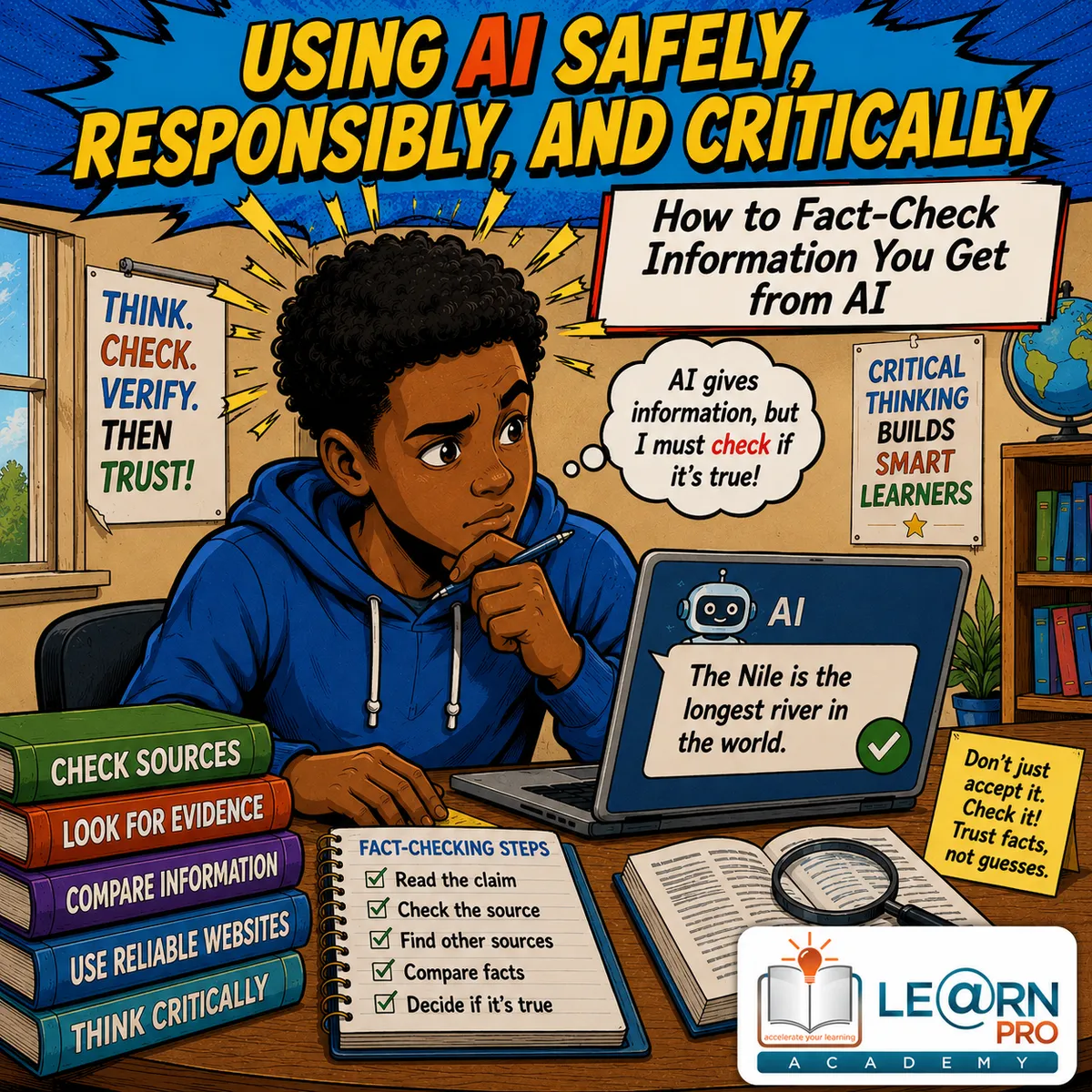
How to Fact-Check Information You Get from AI
This is article #2 of 5 in the Using AI Safely, Responsibly, and Critically Series
Introduction
Artificial Intelligence (AI) has become one of the most useful learning tools available to today's students. It can explain difficult concepts, summarise long chapters, answer questions, generate practice quizzes, and even help you organise your study schedule. Used wisely, AI can save time and make learning more enjoyable.
However, there is one important rule every learner should remember:
Never assume an AI answer is automatically correct.
AI is designed to generate helpful responses, but it can sometimes make mistakes. It may misunderstand a question, leave out important details, mix different facts together, or even produce information that is completely incorrect. Because AI often writes confidently, it can be difficult to spot these mistakes.
This is why successful learners develop another important skill alongside using AI — they learn how to fact-check.
Fact-checking means checking whether information is true before you believe it or use it in your schoolwork. It is a skill used by journalists, scientists, teachers, researchers, and professionals around the world. It is also one of the most valuable digital skills you can develop as a learner.
Imagine submitting an assignment that contains incorrect dates, false statistics, or an invented quotation simply because AI told you it was true. Those mistakes could cost you marks and damage your understanding of the topic.
The good news is that fact-checking is not difficult. Once you learn a few simple habits, you will be able to use AI with much greater confidence while protecting yourself from mistakes.
In this article, you will learn why AI sometimes gets facts wrong, how to recognise information that needs checking, and practical ways to verify AI-generated answers before using them in assignments, projects, or exam preparation.
What Does Fact-Checking Mean?
Fact-checking means confirming that information is accurate before accepting it as true.
It involves asking questions like:
Is this information correct?
Can I find the same answer somewhere else?
Does my textbook agree?
Is this information up to date?
Can I trust the source?
Fact-checking is not about proving AI is wrong.
It is about making sure you are learning the correct information.
Think of it like checking your maths calculations before handing in a test.
Even if you believe your answer is correct, checking reduces mistakes.
The same idea applies when using AI.
Why AI Sometimes Makes Mistakes
Before learning how to fact-check, it helps to understand why AI can sometimes provide incorrect information.
AI Predicts Language Instead Of Thinking
AI does not think like a human.
It predicts words based on patterns it has learned from large amounts of information.
Most of the time this works well.
Sometimes it predicts the wrong information because it cannot truly understand the topic the way a teacher or expert can.
AI Can Mix Different Sources Together
AI learns from many different kinds of information.
Sometimes it accidentally combines facts from different sources into one answer.
This can create explanations that sound believable but contain errors.
AI May Leave Out Important Details
Sometimes an AI answer is partly correct.
Unfortunately, leaving out one important detail can completely change the meaning.
For example, an explanation of photosynthesis that never mentions glucose is incomplete.
The learner may think they understand the topic when they do not.
AI Can Invent Information
This surprises many students.
AI can sometimes create:
fake quotations
imaginary books
incorrect references
false statistics
non-existent websites
These are sometimes called AI hallucinations.
Although the name sounds unusual, it simply means the AI generated information that is not true.
Why Fact-Checking Is An Essential Study Skill
Fact-checking is no longer only for journalists.
In today's digital world, learners see information from:
AI tools
social media
websites
videos
blogs
online forums
messaging apps
Not all of this information is accurate.
Learning how to verify information helps you:
improve assignment quality
avoid losing marks
understand topics better
become a stronger critical thinker
avoid spreading false information
prepare for university and future careers
These skills will remain valuable long after you leave school.
When Should You Fact-Check AI Answers?
Although checking every single sentence may not always be necessary, some information should always be verified.
These include:
dates
names
quotations
statistics
scientific facts
historical events
mathematical formulas
definitions
legal information
medical information
examination requirements
If the information could affect your marks, it is worth checking.
Step 1: Read The AI Answer Carefully
Many learners copy the first answer they receive. Instead, slow down. Read every sentence carefully.
Ask yourself:
Does this make sense?
Is anything confusing?
Does the explanation seem complete?
Are there any surprising facts?
Sometimes you can identify mistakes simply by paying attention.
Step 2: Compare It With Your Textbook
Your school textbook is usually your most reliable learning resource. If AI explains a topic differently from your textbook, investigate further.
For example:
AI says: "There are three branches of government."
Your textbook explains:
Executive
Legislature
Judiciary
The information agrees. That increases your confidence. If AI listed different branches, you would know something needs checking.
Your prescribed textbook should usually be your first reference.
Step 3: Check Your Class Notes
Teachers often explain topics in ways that match your curriculum.
Your class notes may include:
important definitions
diagrams
examples
exam tips
corrections made during lessons
Compare AI's explanation with what your teacher taught.
If they differ, ask your teacher which explanation is correct.
Step 4: Use Trusted Educational Websites
The internet contains excellent educational resources. However, not every website is trustworthy.
Good educational websites usually:
explain who created the content
provide accurate information
update information regularly
focus on education rather than advertising
Avoid trusting the first website you find.
Compare information from more than one reliable source.
Step 5: Ask Your Teacher
Teachers remain one of the best sources of information. If something seems confusing, simply ask.
For example: "AI explained photosynthesis this way. Is this correct?"
Teachers appreciate learners who ask thoughtful questions.
It shows you are trying to understand the topic properly.
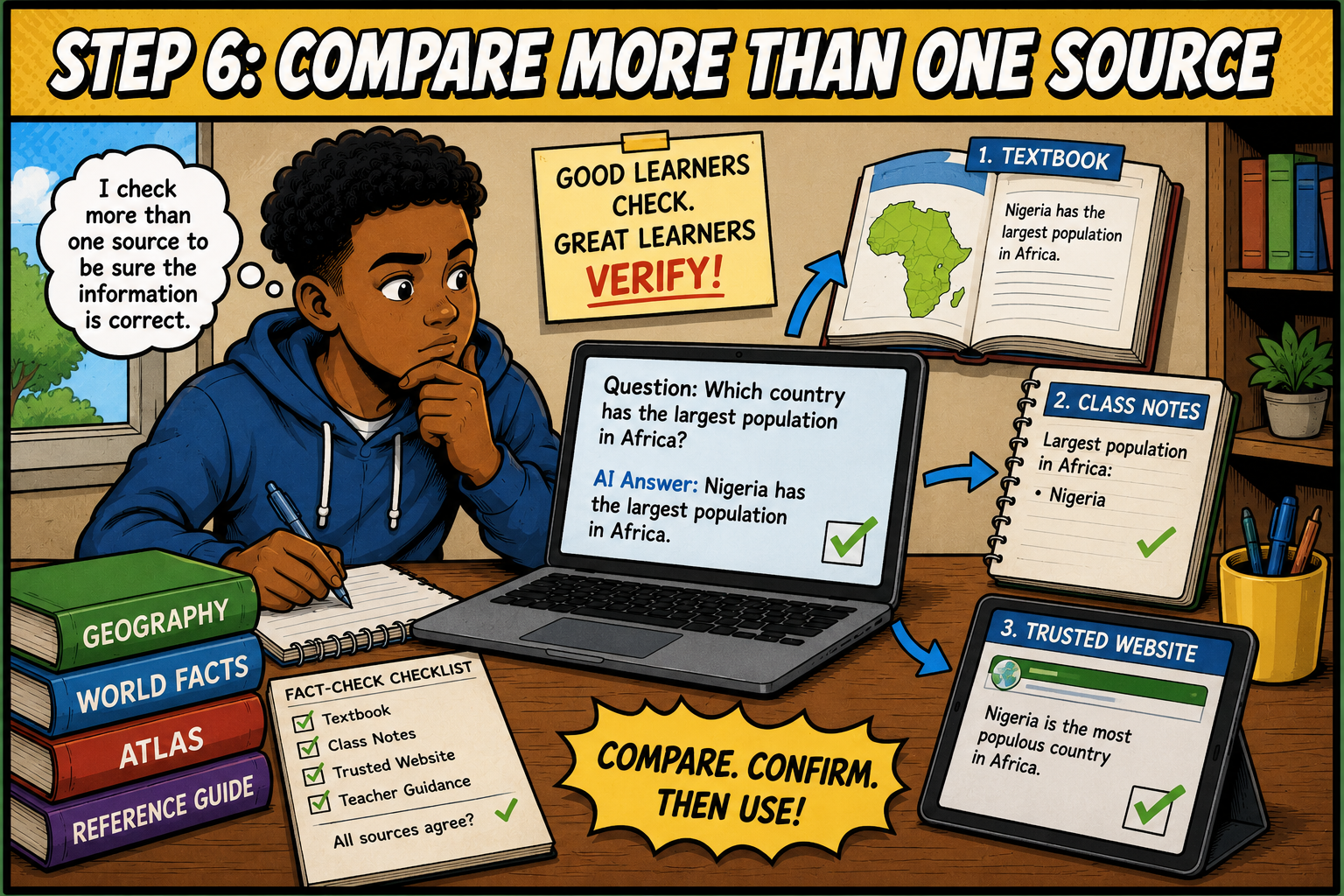
Step 6: Compare More Than One Source
Imagine asking three trusted sources the same question. If all three agree, the information is probably reliable. If each source gives a completely different answer, more investigation is needed.
Never rely on only one source when researching important topics.
A Practical Example Of Fact-Checking
Imagine your Geography assignment asks: "Which country has the largest population in Africa?"
You ask AI. It replies: "Nigeria has the largest population in Africa."
Should you copy it immediately?
No.
Instead:
Check your Geography textbook.
Compare another trusted educational source.
Look at recent population data if required.
If they all agree, you can confidently use the information. This process only takes a few minutes but greatly improves accuracy.
How To Check Statistics
Numbers change frequently.
Examples include:
population
inflation
unemployment
sports records
rainfall
exchange rates
AI may provide older statistics. Always check recent figures using trusted sources.
For school assignments, your teacher may also specify which data should be used.
How To Check Dates
History learners should be especially careful. Imagine AI gives the wrong year for an important event. That one mistake could affect your assignment.
Always compare:
historical dates
timelines
important events
with your prescribed History textbook or teacher's notes.
How To Check Quotations
AI sometimes invents quotations. If AI claims someone famous said something, ask yourself: Can I find this quotation in a reliable source?
If you cannot verify it, do not use it. Never include quotations that cannot be confirmed.
How To Check Scientific Information
Science depends on precision.
When AI explains:
chemical reactions
body systems
ecosystems
electricity
genetics
compare the explanation with:
your textbook
diagrams
class notes
Make sure the explanation includes all the important steps.
How To Check Mathematics
AI can solve mathematical problems quickly. However, mistakes still happen.
Always:
check the calculations
follow each working step
solve the problem yourself
compare your answer
Remember: Understanding the method is more important than copying the answer.
How To Spot Warning Signs
Some AI answers should immediately make you cautious.
Watch out for answers that:
sound too vague
contain no examples
include unusual facts
contradict your teacher
use strange statistics
cannot explain their reasoning
change when asked the same question again
These are signs that further checking is needed.
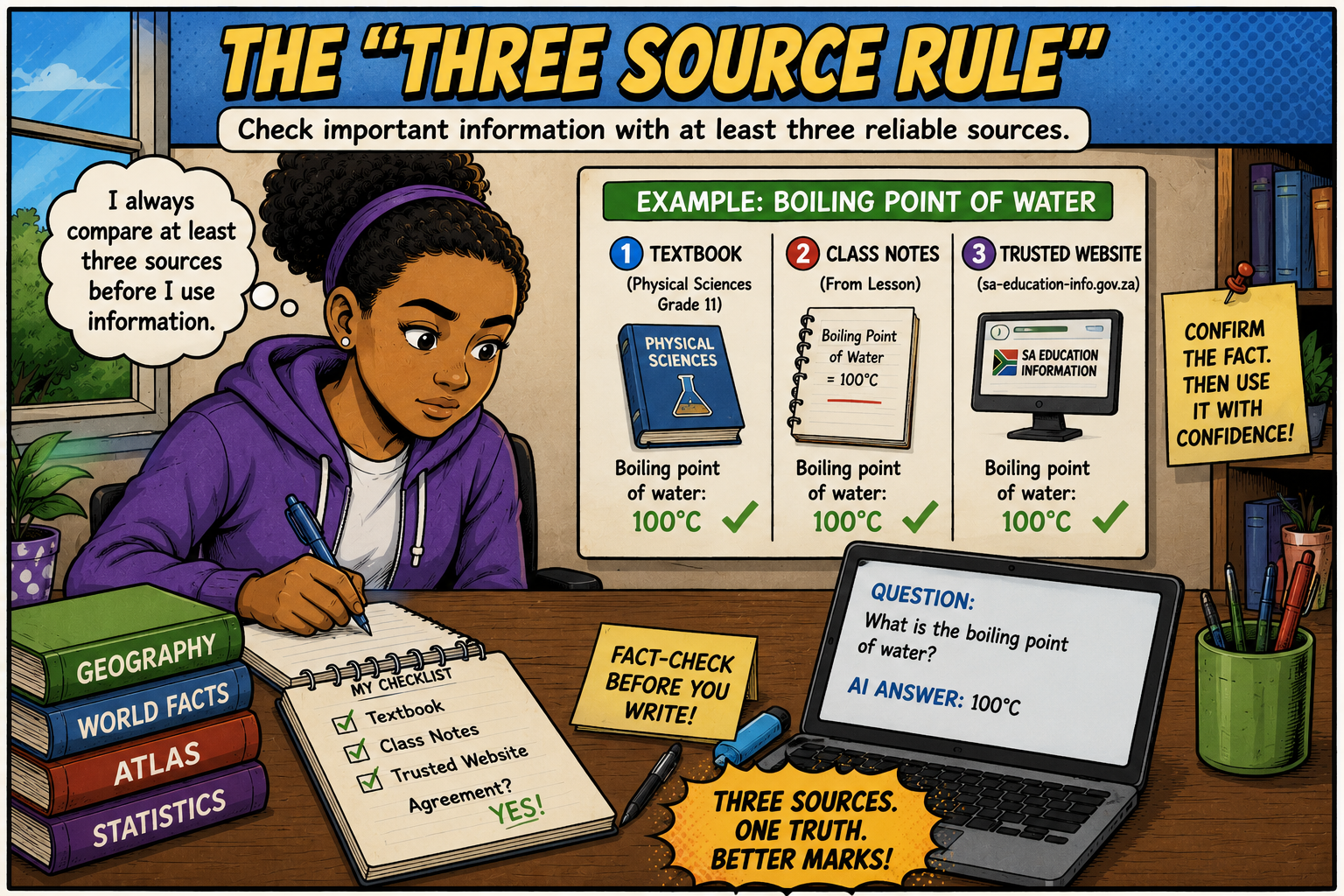
The "Three Source Rule"
One useful habit is the Three Source Rule. Before using important information, compare it with at least three reliable sources.
For example:
Source 1: Your textbook.
Source 2: Your class notes.
Source 3: A trusted educational website or your teacher.
If all three agree, you can be much more confident.
Ask AI To Explain Its Answer
One advantage of AI is that you can ask follow-up questions.
Instead of asking only: "What is climate change?"
also ask:
Why?
How?
Can you explain that differently?
Can you give an example?
Can you explain it for Grade 11?
Sometimes asking additional questions helps you identify weaknesses in the original explanation.
Ask AI For Its Sources
Many AI tools can suggest sources or recommend where you can read more.
You can ask:
"Where can I verify this information?"
"Which textbook explains this topic?"
"Can you recommend reliable sources?"
Remember that even suggested sources should be checked to make sure they are genuine and relevant.
Why Critical Thinking Is More Important Than Memorising
Good learners do not simply collect information. They think about it.
Critical thinking means asking questions such as:
Does this make sense?
Why is this true?
Could there be another explanation?
What evidence supports this?
These questions help you become an active learner instead of a passive reader.
Common Fact-Checking Mistakes Learners Make
Many students unintentionally skip important steps. Here are some common mistakes.
Copying The First Answer:
Never assume the first answer is perfect.
Read it carefully first.
Checking Only One Source:
One source is rarely enough.
Compare multiple reliable sources.
Ignoring Your Textbook:
Some learners trust AI more than their prescribed textbook.
This is usually a mistake.
Your textbook follows your curriculum.
Believing Everything On The Internet:
Not every website is trustworthy.
Choose reliable educational sources.
Rushing:
Fact-checking takes a little extra time.
However, those few minutes can prevent many mistakes.
Building Good Fact-Checking Habits
Successful learners develop routines.
Whenever you use AI:
Read the answer carefully.
Compare it with your textbook.
Check your notes.
Verify important facts.
Ask questions if unsure.
Rewrite the information in your own words.
These habits soon become automatic.
A Classroom Scenario
Sipho is preparing a Life Sciences assignment. He asks AI to explain DNA. The explanation looks excellent.
Instead of copying it, Sipho:
checks his textbook
compares the diagram
reads his class notes
notices AI left out one important detail
corrects the explanation
His assignment becomes more accurate. He also understands the topic much better. His friend copies the original AI answer without checking.
During the test, Sipho remembers the complete explanation. His friend remembers the incomplete version.
This simple example shows why fact-checking improves learning, not just assignments.
Becoming A Responsible Digital Citizen
Using technology responsibly is an important life skill.
Responsible digital citizens:
question information
verify facts
respect evidence
avoid spreading misinformation
admit when they are unsure
continue learning
These habits make you a better learner and a more responsible internet user.
Preparing For Your Future
Fact-checking is not only useful at school. Many careers require people to verify information every day.
These include:
doctors
engineers
journalists
scientists
lawyers
accountants
teachers
business owners
Even AI professionals regularly verify AI-generated information.
Knowing how to check facts will continue helping you throughout your education and career.
Practical Tips Every Learner Can Use
Whenever you use AI for schoolwork, remember these simple guidelines:
Never assume AI is always correct.
Read every answer carefully.
Compare important facts with your textbook.
Check your class notes.
Use trusted educational websites.
Ask your teacher when you are unsure.
Verify quotations and statistics.
Rewrite information in your own words.
Think critically before accepting any answer.
Use AI as a study assistant, not as your only source of information.
Following these habits will help you produce more accurate assignments, improve your understanding of school subjects, and prepare you for success beyond the classroom.
Conclusion
Artificial Intelligence is an exciting and valuable learning tool, but it should never replace careful thinking and good research habits. AI can explain difficult concepts, save time, and support your studies, but it can also make mistakes, leave out important information, or confidently present incorrect facts. That is why fact-checking is one of the most important digital skills every learner should develop.
The strongest learners are not those who simply collect information. They are the ones who question it, compare it, and verify it before using it in their schoolwork. By checking AI answers against your textbook, class notes, trusted educational websites, and your teacher's guidance, you reduce mistakes and build a much deeper understanding of every subject.
As AI becomes more common in schools, universities, and workplaces, your ability to evaluate information critically will become even more valuable. Technology will continue to evolve, but your judgement, curiosity, and commitment to learning the truth will always be your greatest strengths.
Remember this simple rule whenever you use AI: Don't just accept the answer — check it. Fact-checking is not about distrusting technology; it is about becoming a smarter, more confident, and more responsible learner.
Additional Articles in the Using AI Safely, Responsibly, and Critically Series
Why You Should Not Trust Every AI Answer
How to Fact-Check Information You Get from AI
The Risk of Becoming Too Dependent on AI for Schoolwork
Protecting Your Privacy When Using AI Tools as a Student
Using AI with Integrity: How to Stay Honest and Still Get Help
Disclaimer
AI Tools were used to assist with research. Remember to always cross-check everything that you read.