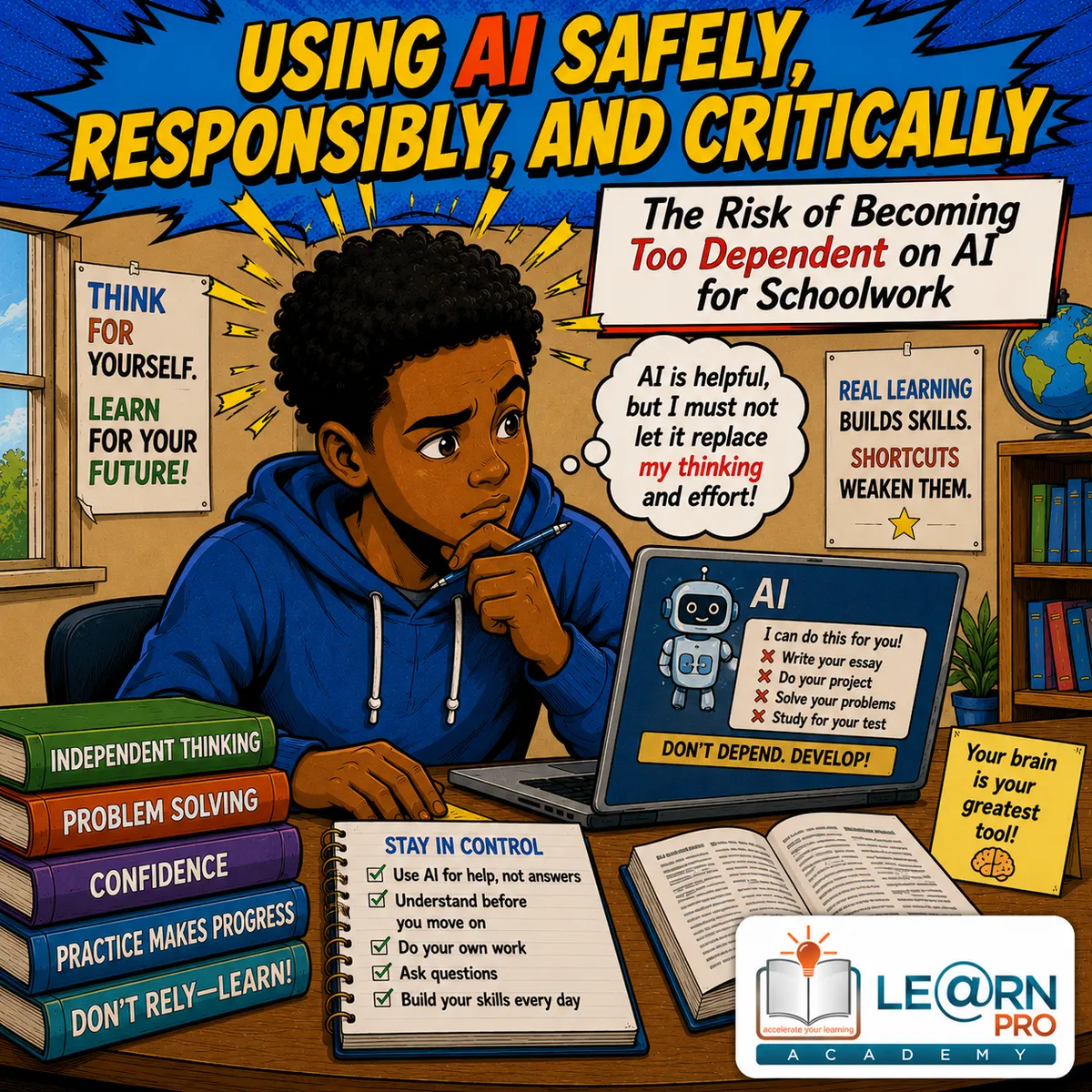
The Risk of Becoming Too Dependent on AI for Schoolwork
This is article #3 of 5 in the Using AI Safely, Responsibly, and Critically Series
Introduction
Artificial Intelligence (AI) is becoming an important part of education. Many learners use AI to explain difficult concepts, create study notes, answer questions, generate practice tests, and improve their writing. These tools can make studying easier, save time, and help learners understand subjects that they find challenging.
Used correctly, AI is an excellent study assistant.
However, there is another side to the story.
Like any powerful tool, AI can become a problem if it is used in the wrong way. Instead of helping learners become smarter and more independent, it can slowly encourage them to stop thinking for themselves. Some students begin asking AI to answer every question, solve every problem, write every assignment, and even make every decision.
At first, this seems convenient.
But over time, something important begins to happen.
The learner starts relying on AI instead of developing their own knowledge, confidence, and problem-solving abilities.
This is called overdependence.
Being dependent on AI does not happen overnight. It usually develops slowly through small habits that seem harmless at first. Eventually, learners may struggle to complete work without AI, lose confidence in their own abilities, and perform poorly when technology is unavailable—especially during examinations.
The purpose of this article is not to tell you to stop using AI.
Instead, it will help you learn how to use AI in a balanced way that strengthens your learning instead of weakening it. You will discover the risks of becoming too dependent on AI, recognise warning signs, and learn practical habits that allow you to stay in control while still enjoying the benefits of modern technology.
What Does It Mean To Be Dependent On AI?
Being dependent on AI means relying on it so much that you struggle to complete schoolwork without it.
Instead of using AI as a helper, it becomes your first and only solution.
For example, you might:
ask AI every homework question before trying it yourself
copy AI explanations without reading your textbook
use AI to write every assignment
depend on AI to solve every maths problem
ask AI to summarise every chapter without reading it
The problem is not using AI.
The problem is stopping yourself from learning.
AI Should Support Learning, Not Replace It
Imagine learning to ride a bicycle. At first, training wheels help you stay balanced. Eventually, the training wheels must come off. If they never do, you never learn to ride independently.
AI works in a similar way.
It should help you understand difficult topics, organise your ideas, and practise your skills. It should not do all the thinking for you.
Your goal is to become a stronger learner — not someone who cannot study without AI.
Why It Is Easy To Become Too Dependent
AI is fast. It answers questions in seconds. It explains concepts instantly. It even rewrites paragraphs and solves problems.
Compared to reading a textbook or working through difficult questions yourself, using AI often feels easier.
Our brains naturally enjoy taking the easier option.
If you always choose the quickest solution, you may slowly stop practising the skills that help you learn.
Without realising it, convenience becomes dependence.
Learning Requires Mental Effort
Many learners believe that if something feels difficult, they are failing. The opposite is often true.
When you struggle with a problem, your brain is learning.
Each time you:
solve a question
remember information
correct a mistake
explain a concept
write an answer
your brain becomes stronger.
Learning is like exercising a muscle.
If you never exercise your muscles, they become weaker.
If you never exercise your brain, your thinking skills become weaker too.
AI should reduce unnecessary frustration — not remove healthy thinking.
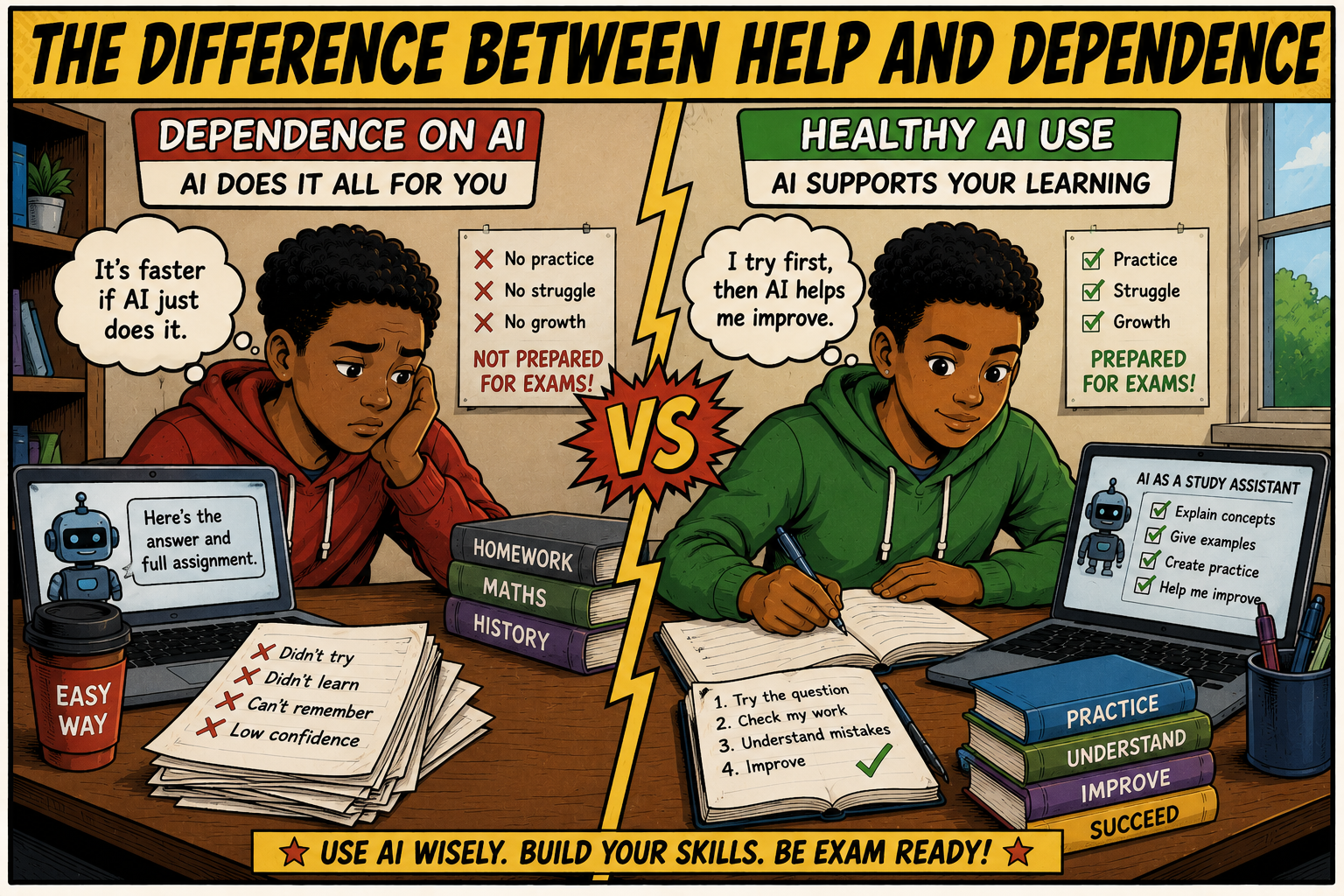
The Difference Between Help And Dependence
There is an important difference between asking for help and becoming dependent.
Healthy AI use looks like this:
trying the question first
asking AI to explain where you went wrong
checking your understanding
creating practice questions
improving your own writing
Unhealthy AI use looks like this:
copying answers immediately
never attempting questions yourself
letting AI complete assignments
asking AI to make every decision
believing you cannot work without AI
One builds independence.
The other slowly removes it.
Signs That You May Be Becoming Too Dependent On AI
Sometimes learners do not realise their habits are changing.
Ask yourself these questions.
Do you:
open AI before opening your textbook?
copy answers without understanding them?
panic when AI is unavailable?
avoid solving difficult questions yourself?
use AI even for simple homework?
trust AI more than your teacher?
struggle to explain answers without reading AI's response?
If you answered "yes" to several of these questions, it may be time to develop healthier study habits.
Why Exams Reveal The Problem
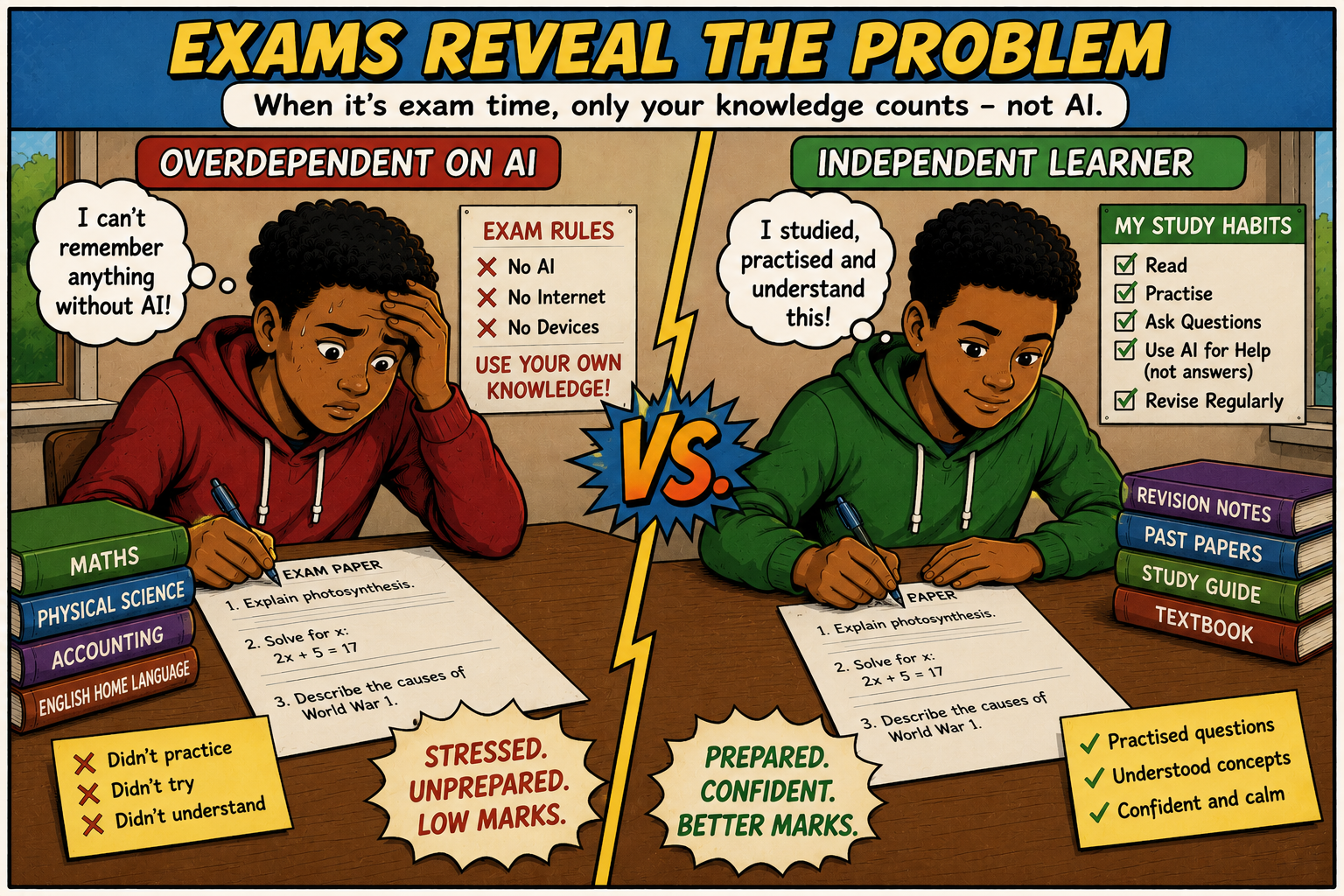
One of the biggest dangers of AI dependence appears during examinations.
Most exams require learners to work independently.
There is:
no AI
no internet
no instant answers
Only your own knowledge matters.
Imagine two learners:
Learner A lets AI answer every homework question.
Learner B attempts every question first before using AI for support.
When exam day arrives:
Learner A struggles.
Learner B remembers the work because they actually practised it.
The exam measures your understanding, not AI's.
You Cannot Build Confidence By Copying
Confidence grows through experience. Each time you solve a difficult problem yourself, your confidence increases. If AI solves every challenge, you miss those opportunities.
Eventually you may start believing: "I can't do this without AI." That belief is often false.
You may simply have stopped giving yourself the chance to try.
Confidence grows through effort, mistakes, and practice.
Why Making Mistakes Is Important
Many learners fear making mistakes. However, mistakes are one of the best teachers. When you answer incorrectly and discover why, your understanding becomes stronger.
If AI prevents you from making any mistakes, you lose valuable learning experiences.
Mistakes help you:
improve memory
identify weak areas
understand concepts more deeply
become a better problem solver
Do not fear mistakes.
Learn from them.
AI Cannot Sit Your Exam
This is one of the simplest but most important facts:
AI cannot write your school examination.
AI cannot attend your oral presentation.
AI cannot complete your practical assessment.
Eventually, you must demonstrate your own knowledge.
Everything you do before that moment should prepare you for success.
Subjects Where Dependence Can Become A Serious Problem
Some subjects require continuous practice.
Mathematics
Reading maths solutions is not enough.
You must solve problems yourself.
Mathematics improves through practice.
Physical Sciences
Understanding scientific concepts requires:
observation
calculations
reasoning
applying formulas
Watching AI solve problems cannot replace practising them yourself.
Accounting
Accounting develops through repetition.
Learners need to complete many exercises before they become confident.
Languages
Writing skills improve by writing.
Reading AI essays will not automatically improve your own writing.
You must:
write
edit
improve
receive feedback
Life Sciences
Understanding biological systems requires careful study. Reading summaries alone is not enough.
You need to understand relationships, processes, and terminology.
The Importance Of Productive Struggle
Educational researchers often talk about something called productive struggle. This means working through a difficult task before receiving help. Although it feels challenging, it helps learning.
For example:
Instead of asking AI immediately: "Solve this maths problem."
Try: "I've attempted the problem. Can you explain where I made a mistake?"
This keeps your brain actively involved.
How AI Can Actually Improve Your Learning
AI becomes much more valuable when used correctly.
Instead of replacing your work, ask AI to:
explain difficult concepts
provide examples
create quizzes
test your knowledge
simplify textbook language
generate flashcards
suggest revision plans
explain mistakes
recommend study techniques
These activities strengthen your learning instead of replacing it.
The "Try First" Rule
One simple habit can prevent AI dependence. Always try first.
Before asking AI:
answer the question
solve the equation
write the paragraph
explain the concept
Even if your attempt is incomplete, you have already started learning.
Then ask AI to help improve your understanding.
The 70/30 Study Rule
A useful guideline is to spend most of your study time actively learning yourself.
For example:
70% independent study
30% AI support
This is not a strict mathematical rule. It is simply a reminder that you should do most of the thinking.
AI should support your effort — not replace it.
How To Build Independent Thinking
Independent learners ask themselves questions before asking AI.
For example:
What do I already know?
What is the question asking?
Which chapter covers this?
Can I solve part of the problem?
What information am I missing?
These questions activate your own thinking before seeking assistance.
Why Reading Still Matters
Some learners ask AI to summarise every chapter. Summaries are useful. However, they should not replace reading.
Textbooks include:
examples
diagrams
explanations
activities
important details
Summaries often leave out valuable information.
Reading develops concentration and comprehension skills that AI cannot build for you.
Building Strong Study Habits
Healthy learners combine different learning methods.
For example:
attending class
listening carefully
taking notes
reading textbooks
asking teachers questions
practising exercises
revising regularly
using AI when appropriate
Notice that AI is only one part of the learning process.
A Real-Life Example
Imagine two Grade 12 learners preparing for final examinations.
Thandi:
Every evening she asks AI to summarise her chapters.
She copies practice answers without attempting questions herself.
Everything seems easy.
Kabelo:
He studies his textbook first.
He answers practice questions.
Only afterwards does he ask AI to explain topics he still finds difficult.
Six months later they write the same examination.
Kabelo remembers the work because he actively studied it.
Thandi struggles because she depended on AI instead of building her own understanding.
The difference was not intelligence.
It was study habits.
Balancing Technology And Learning
Technology should make learning better — not replace learning.
Think of AI like:
a calculator
a dictionary
a map
a spell checker
These tools are useful.
But they cannot replace understanding.
A calculator cannot replace mathematical reasoning.
A dictionary cannot replace vocabulary development.
Likewise, AI cannot replace learning.
Becoming A Lifelong Learner
The world is changing rapidly. New technology will continue to appear. Successful people will not be those who depend completely on technology.
They will be those who know how to learn, adapt, question, and solve problems independently.
These skills include:
critical thinking
communication
creativity
problem-solving
decision-making
curiosity
AI can assist these skills.
It cannot replace them.
Practical Habits To Avoid Becoming Too Dependent On AI
Develop these healthy habits every time you study:
Read the question carefully before asking AI.
Attempt difficult questions first.
Use your textbook regularly.
Take your own notes.
Ask AI to explain rather than answer.
Practise without AI before tests.
Review mistakes yourself.
Rewrite explanations in your own words.
Ask teachers for guidance.
Keep challenging yourself.
These habits will help you remain an independent learner.
Questions To Ask Yourself Before Using AI
Before opening an AI tool, pause for a moment.
Ask yourself:
Have I tried this myself?
What do I already understand?
Could my textbook help first?
Am I asking AI to teach me or to do the work for me?
Will I remember this during an exam?
Am I learning or simply copying?
These simple questions help keep your learning on track.
The Goal Is Smarter Learning
The purpose of AI is not to remove thinking. The purpose is to make learning more effective.
Good learners remain curious:
They ask questions.
They investigate.
They solve problems.
They make mistakes.
They improve.
AI becomes most powerful when it supports these habits rather than replacing them.
Conclusion
Artificial Intelligence is one of the most useful learning tools available to today's students, but like every powerful tool, it must be used wisely. AI can explain concepts, create study materials, generate practice questions, and help you organise your learning. These benefits can save time and improve your understanding when AI is used as a study assistant.
The danger begins when learners stop thinking for themselves. If AI starts answering every question, writing every assignment, or solving every problem, important academic skills begin to weaken. Over time, this can reduce confidence, limit critical thinking, and leave learners unprepared for examinations where they must rely on their own knowledge.
The best learners use AI to support their learning, not replace it. They attempt questions before asking for help, read their textbooks, practise regularly, learn from mistakes, and use AI to deepen their understanding rather than avoid effort.
Remember, every challenge you solve on your own helps your brain grow stronger. Every mistake you correct teaches you something valuable. AI can guide you along the way, but it can never replace your curiosity, determination, and ability to learn.
Use AI wisely, stay actively involved in your learning, and continue building the knowledge and confidence that will help you succeed in school, university, and your future career.
Additional Articles in the Using AI Safely, Responsibly, and Critically Series
Why You Should Not Trust Every AI Answer
How to Fact-Check Information You Get from AI
The Risk of Becoming Too Dependent on AI for Schoolwork
Protecting Your Privacy When Using AI Tools as a Student
Using AI with Integrity: How to Stay Honest and Still Get Help
Disclaimer
AI Tools were used to assist with research. Remember to always cross-check everything that you read.