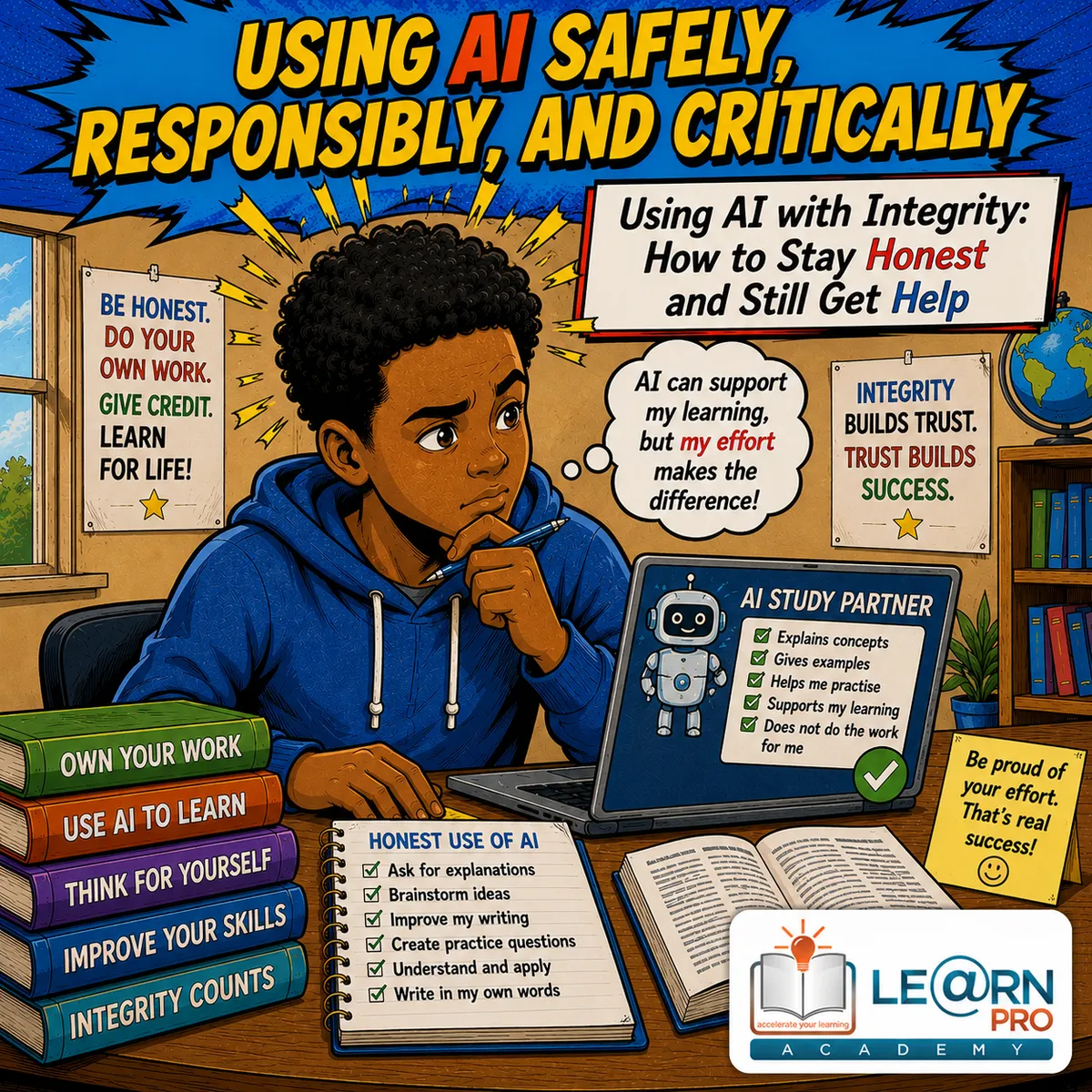
Using AI with Integrity: How to Stay Honest and Still Get Help
This is article #5 of 5 in the Using AI Safely, Responsibly, and Critically Series
Introduction
Theme: Using AI Safely, Responsibly, and Critically
Artificial Intelligence (AI) is changing the way students learn. It can explain difficult topics, create study notes, generate practice questions, improve writing, and help learners prepare for tests and examinations. Used responsibly, AI can become one of the most valuable study tools available to today's learners.
However, with these opportunities comes an important responsibility.
As AI becomes more common in schools, learners must think carefully about how they use it. AI should support learning, not replace it. There is a big difference between using AI to understand a topic and using AI to complete work that should represent your own thinking.
This is where integrity becomes important.
Integrity means doing the right thing, even when nobody is watching. It means being honest, taking responsibility for your work, and respecting the learning process. A learner with integrity values understanding more than simply getting good marks.
Imagine two learners who receive the same assignment.
The first learner asks AI to explain the topic, reads the textbook, researches the information, and writes the assignment in their own words.
The second learner asks AI to write the entire assignment and submits it without understanding what it says.
Both hand in completed work. But only one has truly learned something.
In today's world, using AI responsibly is becoming an important digital skill. Schools, universities, and employers increasingly expect people to use technology ethically while still demonstrating their own knowledge and abilities.
This article will explain what integrity means, why honesty still matters in the age of AI, and how you can use AI to become a better learner without crossing the line into academic dishonesty.
What Does Integrity Mean?
Integrity means being honest, responsible, and trustworthy.
A learner with integrity:
completes their own work
admits mistakes
respects school rules
gives credit when required
values learning over shortcuts
does not pretend someone else's work is their own
Integrity is about your character.
It is about making good choices because they are the right choices—not simply because you might get caught.
Why Integrity Still Matters In The AI Age
Some learners wonder: "If AI can do the work, why shouldn't I use it?"
The answer is simple.
School is not only about completing assignments.
It is about developing knowledge, skills, and habits that will help you throughout your life.
Assignments help you practise:
thinking
writing
analysing
solving problems
researching
communicating
If AI completes all of these tasks for you, you lose valuable opportunities to learn.
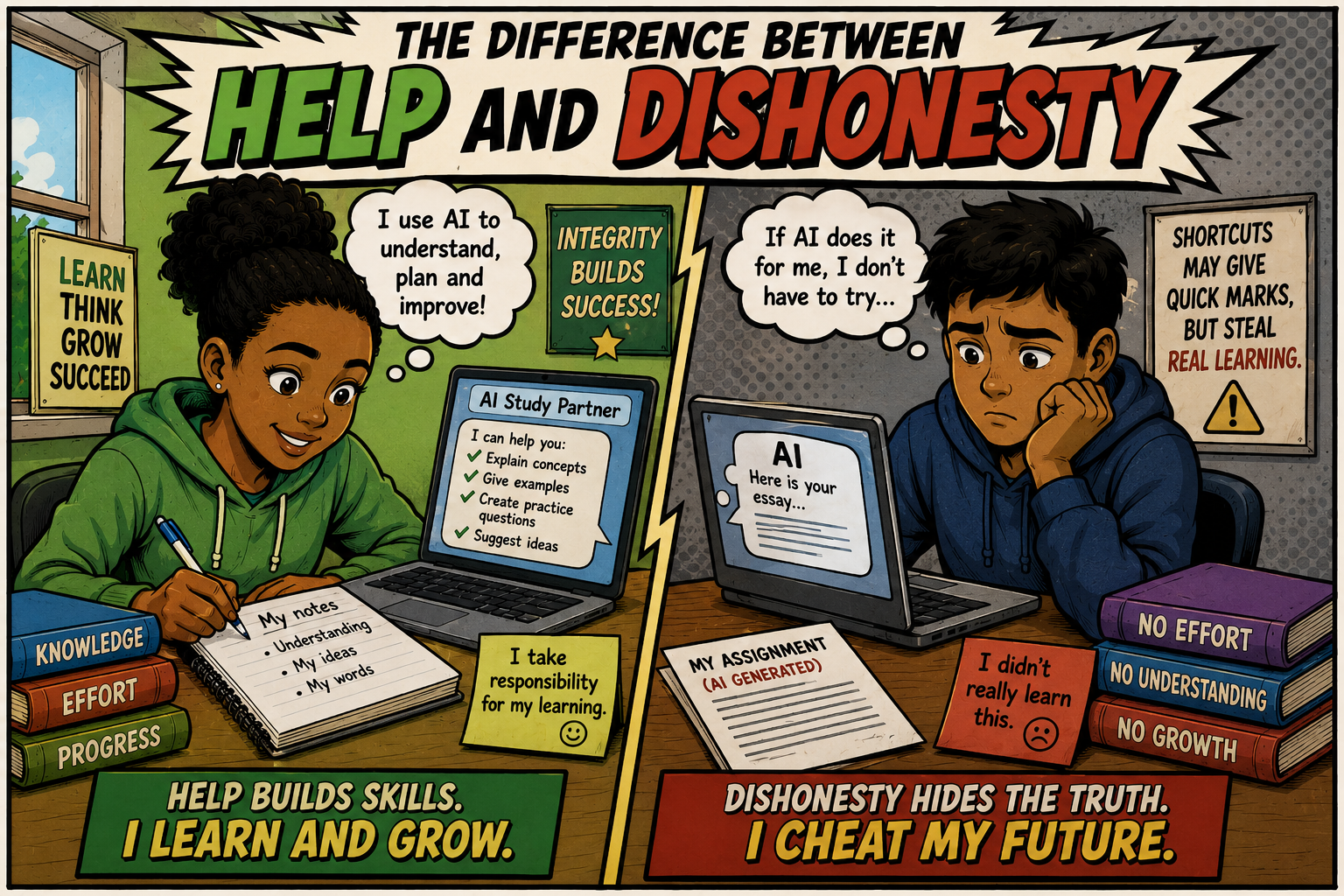
The Difference Between Help And Dishonesty
AI itself is not dishonest. The way you use it determines whether your actions are honest or dishonest. Here are some examples.
Honest Use
asking AI to explain a difficult concept
creating practice quizzes
improving grammar in your own writing
brainstorming project ideas
summarising a chapter after reading it
creating revision flashcards
These activities support learning.
Dishonest Use
submitting AI-written essays as your own
copying AI answers during homework without understanding them
using AI to complete assessments that require your own work
pretending AI-generated ideas are entirely your own
avoiding all independent thinking
These actions prevent learning and may break your school's academic rules.
Why Schools Want You To Think For Yourself
Teachers do not give assignments simply to collect papers.
They want to see:
what you understand
how you solve problems
how you explain ideas
how your skills are improving
If AI completes the work instead of you, your teacher cannot accurately assess your learning.
This makes it difficult to know where you need help.
Learning Is More Important Than Marks
Many learners focus only on getting high marks. While good marks are important, they are not the only goal.
Imagine receiving full marks on an AI-written assignment. Now imagine writing the examination without AI. Would you still achieve those marks?
Probably not.
Real success comes from understanding the work yourself.
Knowledge stays with you long after the assignment has been graded.
AI Should Be Your Study Partner
Think of AI as a study partner rather than a replacement for your effort.
A good study partner:
explains difficult ideas
asks questions
helps you revise
encourages learning
A good study partner does not sit the examination for you.
AI should do the same.
When AI Is Helpful
AI can make learning more effective in many ways.
For example, you can ask AI to:
explain algebra step by step
simplify difficult English passages
create revision questions
generate flashcards
suggest essay structures
explain scientific processes
provide examples
test your understanding
create study schedules
These uses help you become a better learner.
When AI Becomes A Problem
Problems begin when learners stop doing their own thinking.
For example:
copying every answer
submitting AI-generated work unchanged
asking AI to complete assignments from beginning to end
using AI during assessments where it is not allowed
relying on AI instead of reading textbooks
These habits weaken important learning skills.
Academic Honesty
Academic honesty means completing schoolwork fairly and honestly.
It includes:
doing your own work
acknowledging help where appropriate
following your teacher's instructions
respecting school assessment rules
avoiding plagiarism
Academic honesty helps build trust between learners and teachers.
What Is Plagiarism?
Plagiarism means presenting someone else's work or ideas as your own. Traditionally, this meant copying from books or websites. Today, it can also include copying AI-generated writing without making it your own.
If you copy an entire AI response and submit it as your assignment, you are not showing your own understanding.
Instead, use AI as a starting point.
Read the explanation.
Understand it.
Then write your own answer.
Using AI To Brainstorm Ideas
Brainstorming is one of the best ways to use AI. Suppose your English teacher asks you to write an essay about protecting the environment.
Instead of asking: "Write my essay."
Ask: "Give me ten ideas I could include in an essay about protecting the environment."
Now you have inspiration while still writing the essay yourself.
Using AI To Improve Your Writing
Imagine you have written an essay.
Instead of asking AI to replace it, ask questions such as:
Is my introduction clear?
Can I improve my conclusion?
Are there grammar mistakes?
Which sentences could be shorter?
How can I make my argument stronger?
This allows you to improve your own work.
Using AI For Revision
Revision is another excellent use of AI.
Ask AI to:
create quizzes
ask oral questions
explain difficult concepts
generate flashcards
summarise key ideas after you have studied
These activities strengthen your understanding before examinations.
Using AI To Understand Difficult Topics
Some textbook chapters are challenging. Instead of giving up, ask AI: "Explain this topic using simple English suitable for a Grade 11 learner."
If you still do not understand, ask for:
examples
diagrams
comparisons
step-by-step explanations
Learning is the goal.
The Importance of Reading Your Textbook
AI should never replace your prescribed textbook.
Textbooks contain:
curriculum-aligned information
diagrams
examples
activities
explanations approved for your course
Use AI alongside your textbook — not instead of it.
Ask Yourself This Question
Whenever you use AI, ask yourself: "Am I learning, or am I avoiding learning?" This simple question helps guide responsible decisions.
Real-Life Scenario
Imagine two Grade 11 learners preparing a History project.
Lerato:
She reads her textbook first.
She asks AI to explain difficult events.
She researches additional information.
She writes the project in her own words.
She understands every section.
Ethan:
He asks AI to write the complete project.
He changes a few words.
He submits it.
When the teacher asks questions about the project, Ethan cannot explain the answers.
Lerato can.
Who has learned more?
Clearly, Lerato has.
Why Employers Value Integrity
Employers want people they can trust.
They value employees who:
solve problems honestly
accept responsibility
continue learning
use technology responsibly
think independently
Using AI ethically today helps prepare you for future careers.
Building Confidence Through Honest Learning
Confidence comes from knowing that you achieved success through your own effort.
When you solve problems yourself, improve your writing, and understand difficult topics, your confidence grows naturally.
Copied success rarely builds confidence because you know the work was not truly yours.
AI Cannot Replace Human Skills
Technology continues improving.
However, employers and universities still value skills such as:
communication
creativity
teamwork
leadership
critical thinking
decision-making
ethical judgement
These skills develop through practice — not through copying AI.
Good Questions To Ask AI
Instead of asking AI to complete your work, ask questions like:
Can you explain this concept?
Can you give another example?
Can you test my understanding?
Can you create five practice questions?
Can you explain why my answer is incorrect?
Can you suggest ways to improve this paragraph?
These prompts support learning.
Questions You Should Avoid
Avoid prompts like:
Write my assignment.
Complete my homework.
Give me the final answer only.
Write an essay that I can submit.
Finish my project for me.
These requests encourage dependence instead of learning.
Respect Your Teacher's Instructions
Different teachers may have different rules about AI. Some may encourage certain uses. Others may limit AI during specific assignments.
Always follow your teacher's instructions. If you are unsure, ask.
Being honest includes respecting classroom expectations.
Balancing Technology And Personal Effort
Successful learners combine many learning methods.
These include:
attending lessons
reading textbooks
taking notes
practising questions
asking teachers
discussing ideas with classmates
revising regularly
using AI responsibly
AI becomes one part of a balanced learning strategy.
Practical Habits For Using AI With Integrity
Develop these habits every time you study:
Attempt the work first.
Use AI to explain — not replace.
Read your textbook.
Verify important facts.
Rewrite ideas in your own words.
Practise without AI before examinations.
Ask teachers when unsure.
Learn from mistakes.
Respect assessment rules.
Keep improving your own skills.
A Simple Integrity Checklist
Before submitting any assignment, ask yourself:
Did I understand everything I wrote?
Did I complete most of the thinking myself?
Did AI help me learn rather than do the work?
Could I explain this work to my teacher?
Would I feel comfortable telling my teacher exactly how I used AI?
If you answer "yes" to these questions, you are probably using AI responsibly.
Becoming A Responsible Digital Citizen
Responsible digital citizens:
use technology honestly
protect their privacy
respect other people's work
verify information
think critically
continue learning
Integrity is an important part of responsible technology use.
Preparing For A Future With AI
AI will continue becoming part of education, business, healthcare, engineering, science, and many other careers.
Future success will depend not only on knowing how to use AI but also on knowing when and how to use it responsibly.
People who combine technology with honesty, creativity, and independent thinking will always have an advantage.
Practical Tips Every Learner Should Remember
Whenever you use AI, remember these important guidelines:
Use AI to learn, not to avoid learning.
Write your own assignments.
Read your textbook first.
Ask AI to explain difficult topics.
Improve your own work instead of replacing it.
Follow your teacher's instructions.
Think critically about AI responses.
Keep developing your own skills.
Be honest about your work.
Value learning more than shortcuts.
These habits will help you become a confident learner and prepare you for future success.
Conclusion
Artificial Intelligence is a powerful learning tool that can help you understand difficult topics, improve your writing, organise your study time, and prepare more effectively for tests and examinations. When used responsibly, AI supports learning and helps you become a more confident and capable student.
However, technology should never replace honesty, effort, or personal responsibility. Using AI with integrity means allowing it to guide your learning while ensuring that the thinking, understanding, and final work remain your own. It means asking for explanations instead of shortcuts, improving your own writing instead of copying someone else's words, and valuing genuine learning over quick results.
The habits you develop today will shape the learner — and the person — you become tomorrow. By choosing honesty, respecting your teacher's expectations, thinking critically, and using AI as a study partner rather than a replacement, you build skills that will benefit you throughout school, university, and your future career.
Remember, AI can provide information, suggestions, and support, but your integrity is something only you can provide. When you combine responsible AI use with hard work, curiosity, and honesty, you gain far more than good marks — you gain the knowledge, confidence, and character needed for lifelong success.
Additional Articles in the Using AI Safely, Responsibly, and Critically Series
Why You Should Not Trust Every AI Answer
How to Fact-Check Information You Get from AI
The Risk of Becoming Too Dependent on AI for Schoolwork
Protecting Your Privacy When Using AI Tools as a Student
Using AI with Integrity: How to Stay Honest and Still Get Help
Disclaimer
AI Tools were used to assist with research. Remember to always cross-check everything that you read.