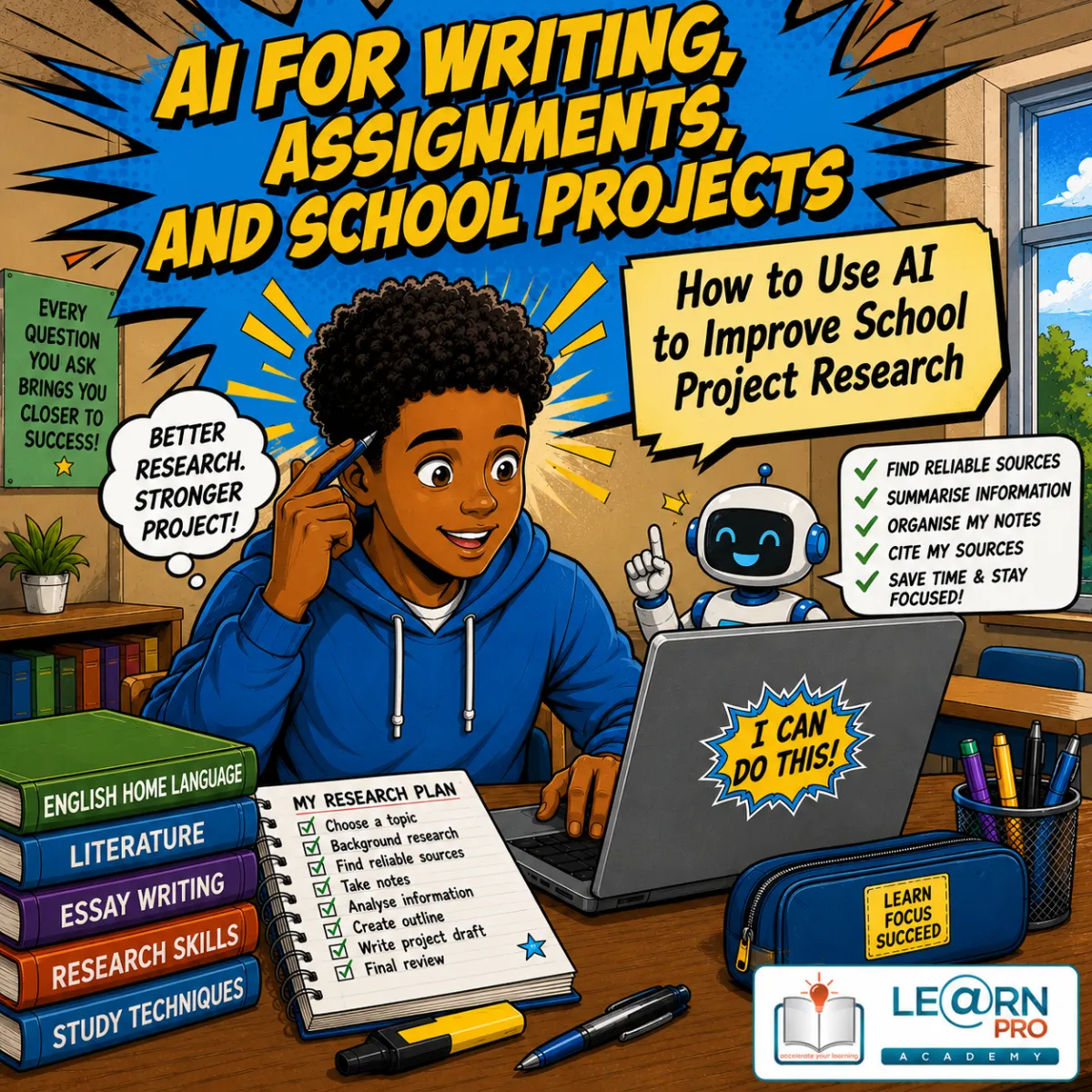
How to Use AI to Improve School Project Research
This is article #3 of 5 in the AI for Writing, Assignments, and School Projects Series
Introduction
Every school learner has experienced it at some point. Your teacher gives you a research project, and at first, you feel excited. Then you look at the topic and realise you have no idea where to begin.
You may ask yourself:
What does this topic actually mean?
Where can I find reliable information?
How do I know if a website is trustworthy?
How do I organise everything I find?
Research projects are designed to help you learn how to investigate a topic, think critically, and present information clearly. They are not just about finding facts — they are about understanding those facts and explaining them in your own words.
Artificial Intelligence (AI) can make this process much easier.
Instead of replacing your research, AI can help you understand unfamiliar topics, generate useful questions, explain difficult concepts, suggest keywords for searching, and organise your research into a clear plan. However, AI should never become your only source of information. It sometimes makes mistakes, provides outdated information, or presents incorrect facts confidently.
The smartest learners use AI as a starting point, not the finish line.
In this article, you will learn how to use AI responsibly to improve your school project research while still thinking independently, checking your facts, and using trusted sources.
Why Research Skills Matter
Research is a skill you will use throughout your life.
At school, you use research to complete assignments and projects. Later, you may use it at university, college, in the workplace, or when making important personal decisions.
Good researchers know how to:
Ask the right questions.
Find reliable information.
Compare different sources.
Identify facts and opinions.
Organise information clearly.
Draw sensible conclusions.
These skills are valuable in every subject, including English, History, Geography, Life Sciences, Business Studies, Tourism, Consumer Studies, and Life Orientation.
Learning how to research properly today will benefit you long after you leave school.
AI Is A Research Assistant, Not A Research Replacement
Many learners believe AI should provide every answer they need. That is not how it should be used. Think of AI as an experienced librarian.
A librarian does not complete your assignment.
Instead, they help you:
understand the topic
suggest useful books
recommend search terms
explain difficult ideas
point you in the right direction
AI should play the same role.
It helps you begin your research, but you are responsible for checking the facts and building your own understanding.
Start By Understanding The Research Topic
One of the biggest reasons learners struggle with projects is that they do not fully understand the topic.
Imagine your teacher asks you to research:
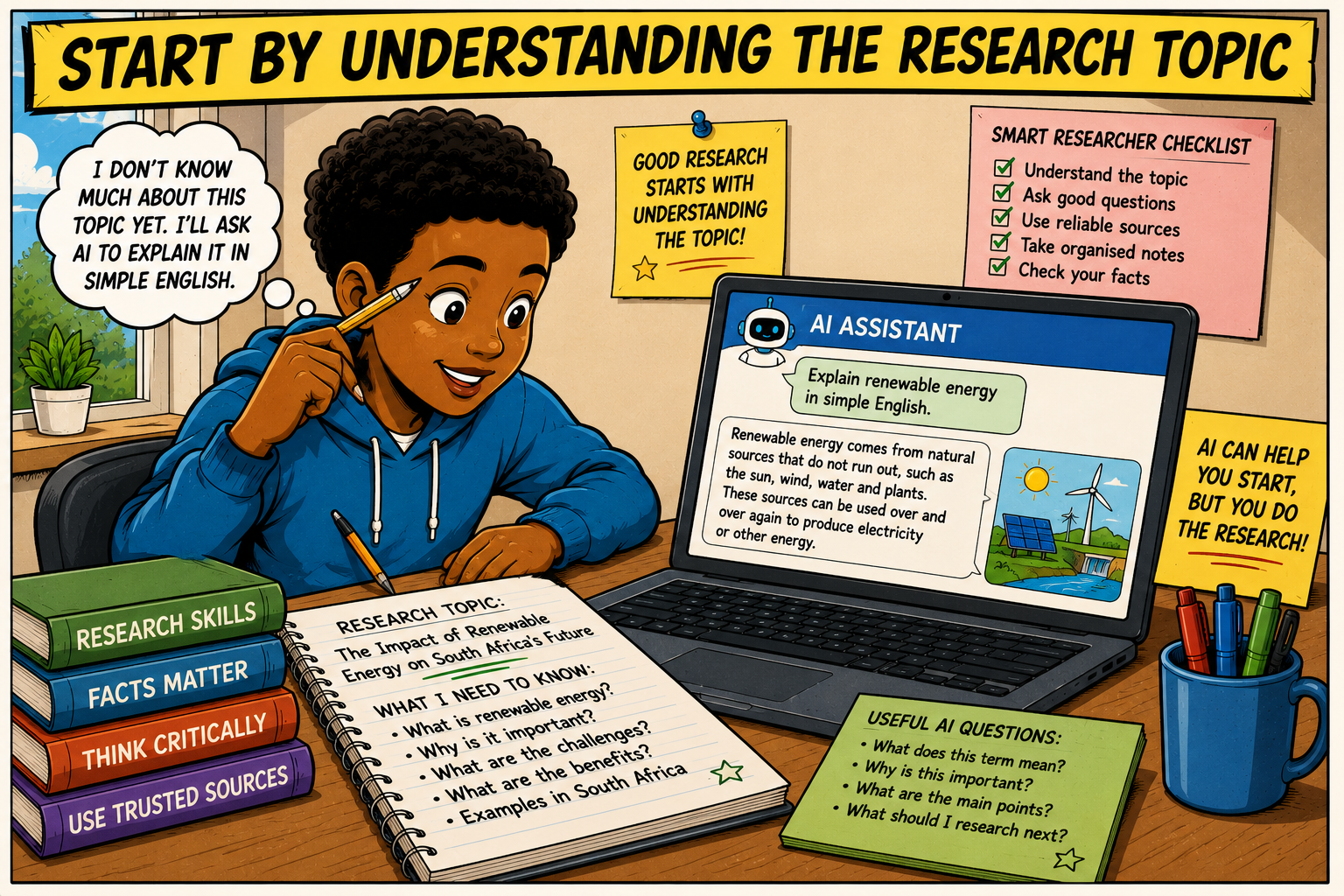
"The Impact Of Renewable Energy On South Africa's Future."
Some learners immediately start searching for information without understanding what "renewable energy" or "impact" really means.
Instead, begin by asking AI:
"Explain renewable energy in simple English."
"What does the word impact mean in this context?"
"Why is renewable energy important in South Africa?"
Within minutes, AI can give you a simple explanation that helps you understand the topic before you begin reading more detailed information.
This first step makes the rest of your research much easier.
Break A Large Topic Into Smaller Questions
Large topics often feel overwhelming. AI can help you divide one big question into several smaller questions.
For example:
Main Topic: Water Conservation In South Africa
AI could suggest questions such as:
Why is water conservation important?
What causes water shortages?
How do households save water?
How do farmers conserve water?
What role does government play?
What can learners do to save water?
Instead of trying to answer one huge question, you now have several smaller questions to investigate.
This makes research much easier to manage.
Use AI To Generate Better Search Keywords
Many learners type entire assignment questions into Google and hope for the best. A better approach is to search using important keywords. AI can suggest useful search terms.
Suppose your topic is:
Plastic Pollution In South Africa
AI may recommend searching for:
plastic pollution South Africa
ocean pollution South Africa
recycling programmes
environmental conservation
waste management
marine pollution
Better keywords usually lead to better search results.
Learn The Background Before Reading Difficult Sources
Some websites assume that readers already understand the topic. This can make research frustrating.
AI can provide simple background information before you move on to textbooks and reliable websites.
For example:
Before researching climate change, ask AI: "Explain climate change as if you are teaching a Grade 10 learner."
Once you understand the basics, you will find it much easier to understand more detailed information from trusted sources.
Think of AI as your introduction to a topic.
Find Questions You Had Not Considered
Good research often begins with curiosity. AI can help you think more deeply about your project. Suppose your project is about artificial intelligence.
Instead of asking only: "What is AI?"
AI might suggest additional questions such as:
How is AI used in healthcare?
How does AI help businesses?
What jobs use AI?
What are the dangers of AI?
How should AI be used responsibly?
These extra questions help you explore your topic more thoroughly.
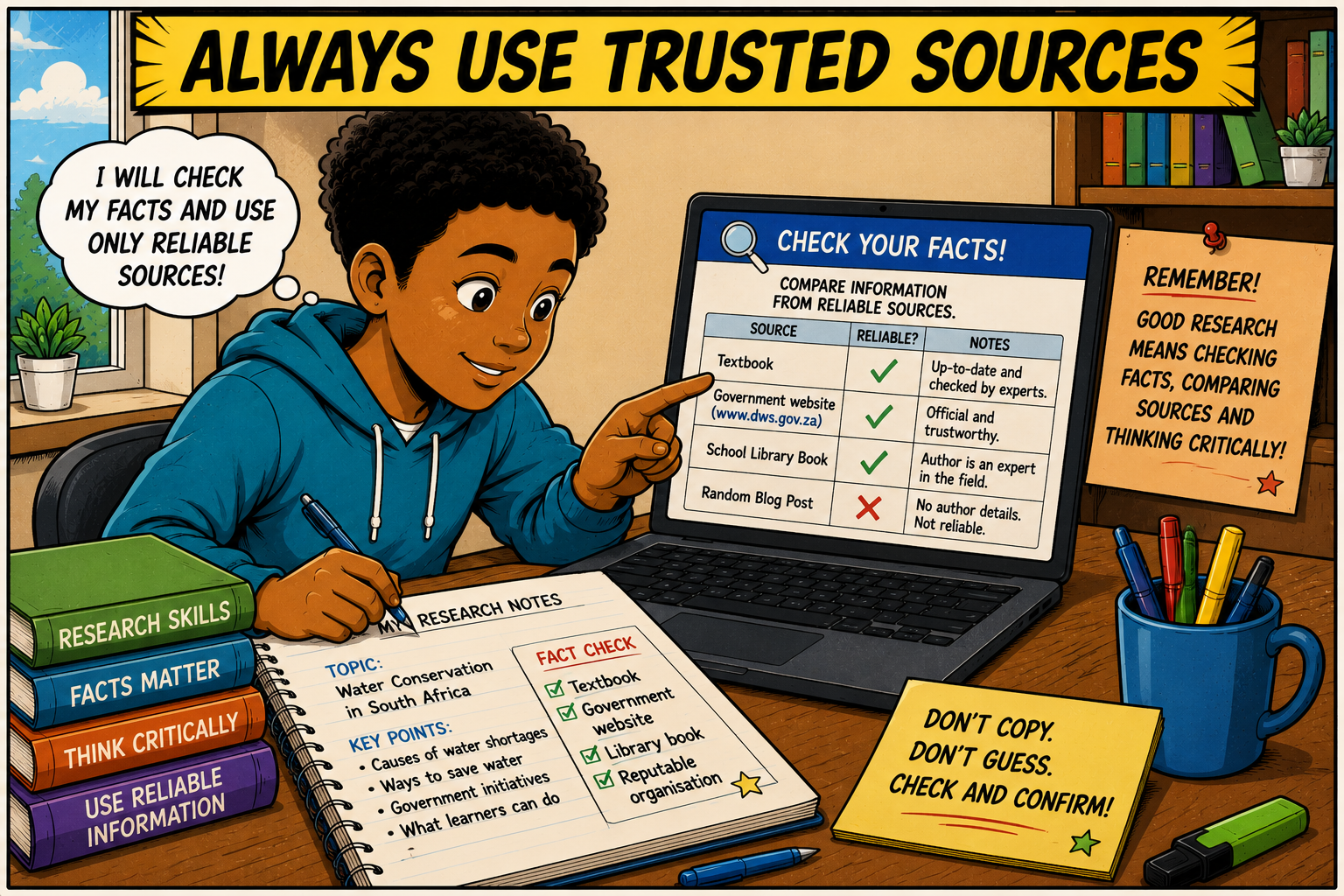
Always Use Trusted Sources
This is one of the most important lessons in this article. AI should never be your only source of information.
Always confirm important facts using trusted sources such as:
your school textbook
class notes
library books
government websites
university websites
respected educational organisations
reputable news organisations when current information is required
Reliable research involves comparing several trustworthy sources before deciding what information to include.
Check The Facts AI Gives You
AI sometimes produces information that sounds convincing but is incorrect. This is why fact-checking is essential. Suppose AI tells you that a certain national park was established in a particular year.
Instead of accepting the answer immediately, verify it using:
SANParks
government publications
encyclopaedias
educational websites
Checking information helps you avoid including mistakes in your project. Professional researchers verify information all the time.
You should too.
Learn To Identify Reliable Websites
Not every website on the internet is trustworthy. Some websites are created by experts. Others are written by people with little knowledge of the topic.
When researching, ask yourself:
Who wrote this information?
Is the organisation trustworthy?
Is the information current?
Does another reliable source agree?
Does the website provide evidence?
AI can even explain why certain websites may be more reliable than others.
Learning this skill will help you throughout your education.
Organise Your Research Notes
Many learners collect lots of information but struggle to organise it. AI can help you create categories for your notes.
Imagine you are researching:
The Benefits Of Solar Energy
Your notes could be organised under headings such as:
Introduction
How Solar Panels Work
Advantages
Challenges
South African Examples
Future Developments
Conclusion
This simple structure prevents your notes from becoming a confusing collection of random facts.
Summarise Information In Your Own Words
Reading large amounts of information can be tiring. AI can help you understand long passages by creating shorter summaries. However, never copy these summaries directly into your project.
Instead:
Read the summary.
Understand the meaning.
Close the screen.
Explain the idea in your own words.
This helps you remember the information and reduces the risk of plagiarism.
Ask AI To Explain Difficult Words
Research often includes words you have never seen before.
For example:
biodiversity
infrastructure
sustainability
conservation
urbanisation
Instead of skipping these words, ask AI: "Explain this word in simple English and use it in a sentence."
Building your vocabulary improves both your understanding and your writing.
Plan Your Research Before You Start Writing
One mistake many learners make is writing while they are still researching.
Instead, separate the two tasks.
First:
understand the topic
collect information
organise your notes
verify your facts
Only then should you begin writing.
A good research plan saves time and leads to a much stronger project.
Use AI To Prepare Interview Questions
Some school projects require learners to interview people. AI can help you prepare thoughtful questions.
For example, if you are interviewing a local business owner, AI could suggest questions such as:
What challenges do small businesses face?
How has technology changed your business?
What advice would you give young entrepreneurs?
You can then adapt these questions to suit your project.
Create A Research Timeline
Large projects become stressful when learners leave everything until the last minute. AI can help you create a simple schedule.
Example:
Monday: Understand the topic.
Tuesday: Research books and websites.
Wednesday: Take notes.
Thursday: Organise information.
Friday: Write the first draft.
Saturday: Edit and improve.
Breaking a project into smaller tasks makes it much easier to complete.
Helpful AI Prompts For Research
Here are some useful prompts you can use.
Understanding A Topic: "Explain this topic in simple English for a Grade 11 learner."
Generating Questions: "What questions should I answer in this research project?"
Finding Search Terms: "Suggest useful keywords I can use when researching this topic."
Explaining Vocabulary: "Explain this difficult word with an example."
Organising Notes: "Help me organise these research notes into logical sections."
Checking Understanding: "Ask me five questions to test whether I understand this topic."
These prompts encourage learning rather than copying.
Mistakes To Avoid During Research
Avoid these common mistakes:
Using AI as your only source.
Copying information without understanding it.
Forgetting to verify important facts.
Using unreliable websites.
Leaving research until the last minute.
Copying and pasting paragraphs directly into your assignment.
Ignoring your teacher's instructions.
Research is about learning — not collecting random information.
Becoming A Better Researcher
Research is much more than searching the internet. It is the process of asking questions, finding reliable information, thinking critically, and presenting your own understanding of a topic. These are valuable skills that will help you throughout school, further education, and your future career.
Artificial Intelligence can make research easier by helping you understand unfamiliar topics, generate useful questions, organise your ideas, and explain difficult concepts in simple language. Used correctly, it becomes a study partner that helps you learn more effectively rather than a shortcut that does the work for you.
The best learners do not simply accept the first answer they receive. They compare information, check facts, ask more questions, and continue learning until they truly understand the topic. This curiosity is what turns an ordinary project into an excellent one.
Remember, AI should open the first door to your research journey — but it should never be the only door you walk through. By combining AI with textbooks, trusted websites, class notes, library resources, and your own critical thinking, you will develop stronger research skills, produce higher-quality school projects, and become a more confident learner.
Additional Articles in the AI for Writing, Assignments, and School Projects Series
How to Use AI to Improve Your English in School Assignments
Using AI to Plan Essays Before You Start Writing
How to Use AI to Improve School Project Research
Using AI to Simplify Difficult Concepts for Learners
What Counts as Cheating When You Use AI for Schoolwork?
Disclaimer
AI Tools were used to assist with research. Remember to always cross-check everything that you read.