
Using AI to Simplify Difficult Concepts for Learners
This is article #4 of 5 in the Using AI for Lesson Planning and Teaching Preparation Series
Introduction
Every educator has experienced that moment when a lesson seems clear during preparation but becomes confusing once it is presented to learners. Faces begin to look puzzled, questions become more frequent, and despite repeated explanations, some learners still struggle to understand the concept.
This does not necessarily mean the learners are not trying.
Many topics are difficult because they introduce unfamiliar vocabulary, abstract ideas, complex relationships, or processes that cannot easily be seen. Subjects such as Mathematics, Physical Sciences, Life Sciences, Geography, Accounting, Economics, History, and Business Studies all contain concepts that learners often find challenging.
South African classrooms add another layer of complexity. Many learners study in English even though it is not their home language. Others have gaps in prior knowledge that make new learning more difficult. Some learners understand ideas quickly, while others need concepts explained several different ways before everything makes sense.
One of the greatest strengths of an experienced educator is the ability to recognise when learners are confused and to explain the same idea differently.
Artificial Intelligence (AI) can become a valuable partner in this process.
AI cannot replace an educator's understanding of learners or classroom dynamics. However, it can help teachers generate simpler explanations, create relatable examples, produce helpful analogies, develop step-by-step guides, and present difficult concepts in multiple ways.
Instead of replacing professional teaching, AI helps educators explain more effectively while saving valuable preparation time.
This article explores practical ways teachers can use AI to simplify difficult concepts without reducing academic standards or oversimplifying the CAPS curriculum.
Why Learners Find Some Concepts Difficult
Learning becomes difficult for many different reasons.
Sometimes the concept itself is complex.
Sometimes the language is unfamiliar.
Sometimes learners missed earlier work that the new lesson depends on.
Sometimes they simply need the information presented differently.
Common reasons learners struggle include:
Too many new terms at once.
Abstract ideas without practical examples.
Long textbook explanations.
Limited background knowledge.
English as a second or third language.
Fear of making mistakes.
Information presented too quickly.
Few opportunities to ask questions.
Understanding these barriers helps educators provide better support.
AI Supports Teaching Rather Than Replacing It
One important principle should always guide AI use in education.
AI generates ideas.
Educators make teaching decisions.
Teachers understand:
Their learners.
Their curriculum.
Their classroom environment.
Learner misconceptions.
Appropriate teaching pace.
School expectations.
AI simply provides alternative ways of explaining concepts more efficiently.
Professional judgement remains essential.
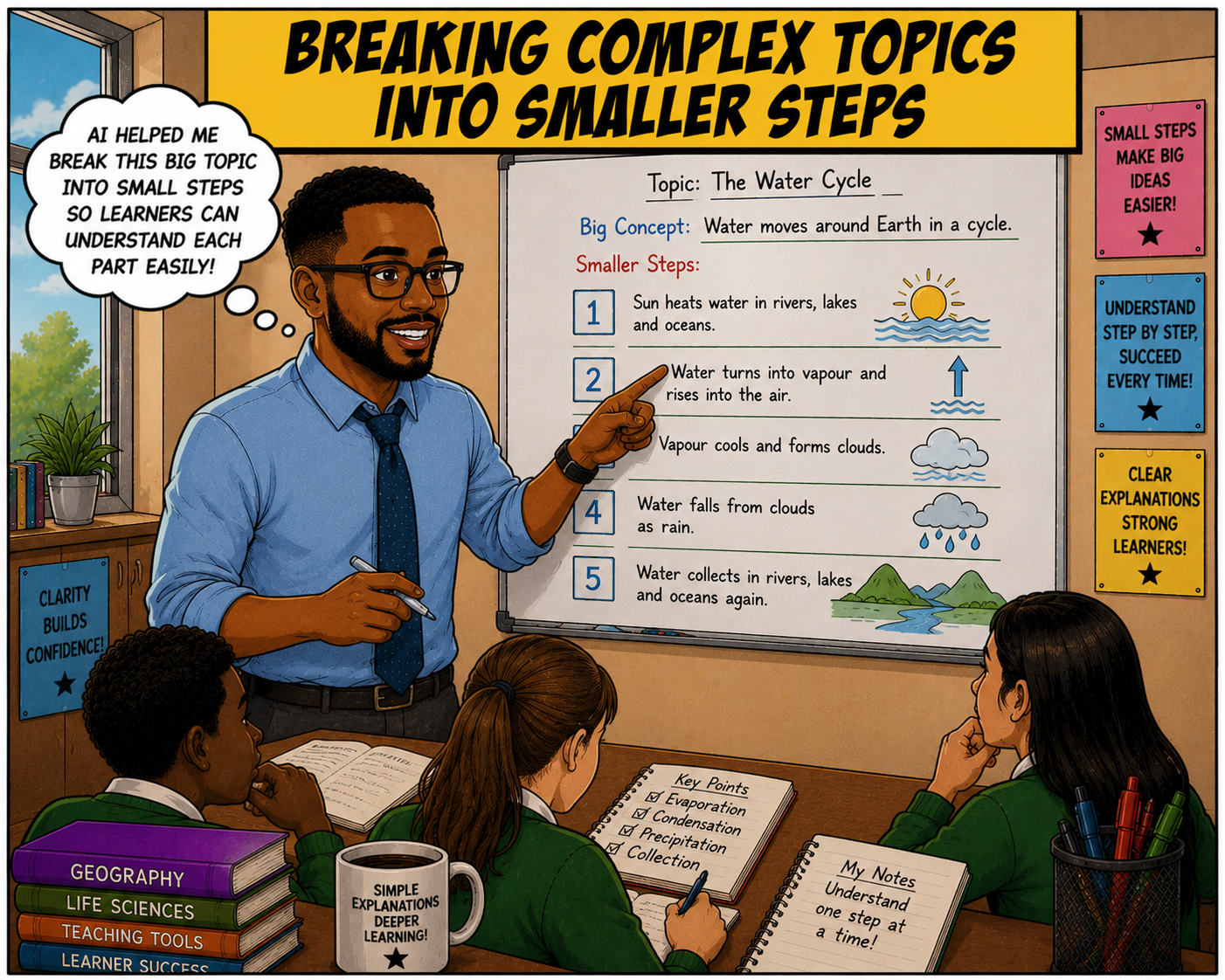
Breaking Complex Topics Into Smaller Steps
Large concepts often become easier when divided into manageable sections.
Instead of explaining an entire topic at once, AI can help educators create learning sequences.
For example, when teaching photosynthesis, an educator could ask:
Break photosynthesis into six simple teaching steps for Grade 10 learners.
AI might produce:
Step 1:
What plants need to survive.
Step 2:
The role of sunlight.
Step 3:
How chlorophyll works.
Step 4:
How plants make food.
Step 5:
Oxygen production.
Step 6:
Why photosynthesis matters.
Smaller steps reduce learner overload and improve understanding.
Simplifying Academic Language
Many learners struggle because of the language rather than the concept.
AI can rewrite explanations using simpler vocabulary.
For example:
Original:
"Inflation refers to the sustained increase in the general price level of goods and services over time."
Simplified:
"Inflation means that prices usually become higher over time, so people can buy fewer things with the same amount of money."
The meaning stays the same, but the language becomes easier to understand.
Educators should always ensure simplified explanations remain academically accurate.
Creating Everyday Examples
Many difficult ideas become easier when connected to everyday experiences.
AI can generate practical examples based on familiar South African situations.
For example:
Economics
Explain inflation using grocery shopping.
Mathematics
Explain percentages using rugby scores or shopping discounts.
Geography
Explain erosion using local rivers or farms.
Business Studies
Explain profit using a tuck shop.
Accounting
Explain assets and liabilities using a family budget.
These examples help learners connect new ideas with familiar experiences.
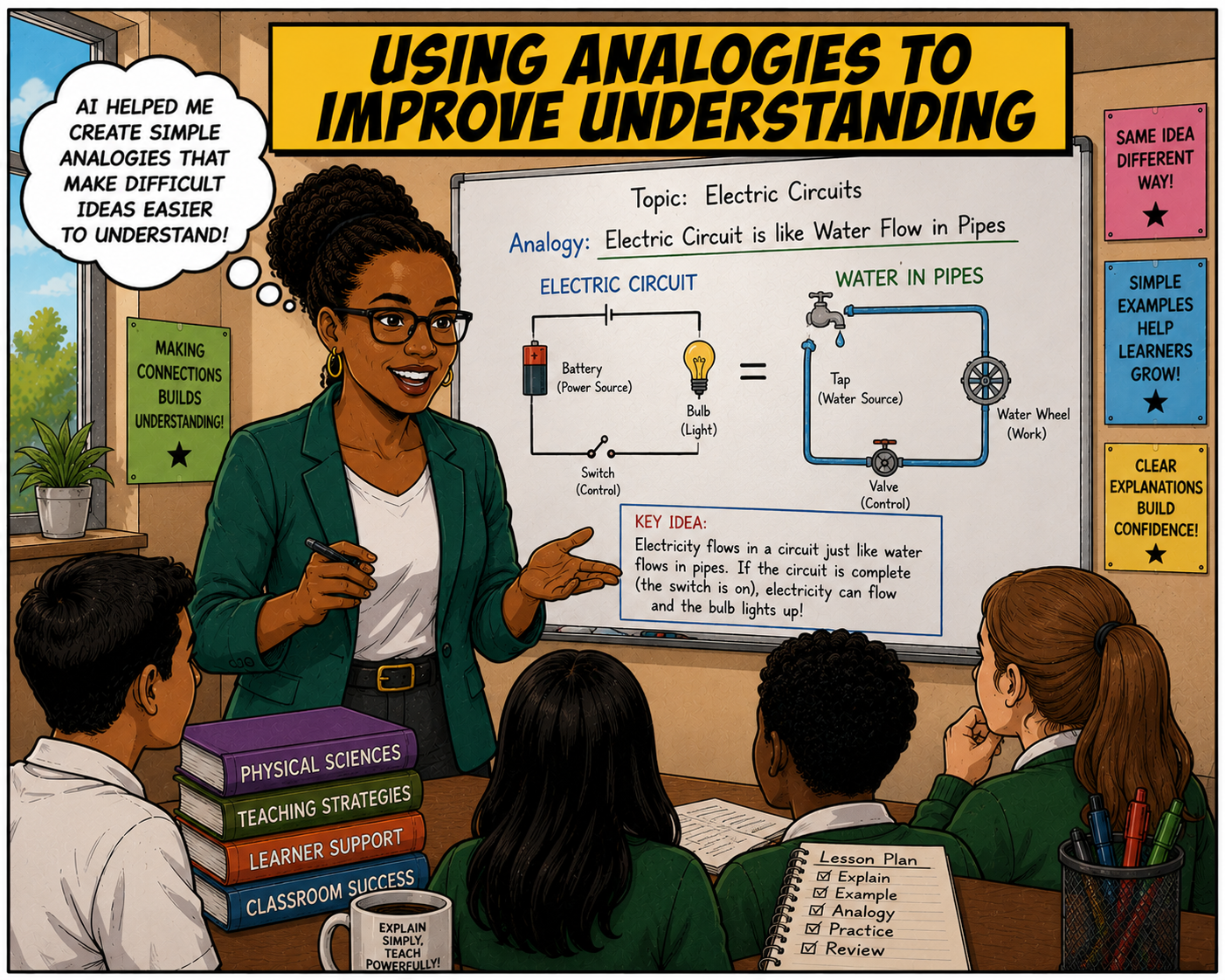
Using Analogies To Improve Understanding
Analogies compare unfamiliar concepts with familiar ones.
AI is particularly effective at generating these comparisons.
Examples include:
The human heart works like a pump.
Electric circuits work like water flowing through pipes.
The internet works like a network of roads connecting cities.
A business budget works like planning pocket money.
Learners often remember analogies long after formal definitions.
Generating Multiple Explanations
Not every explanation works for every learner.
AI can provide several versions of the same concept.
For example:
Explain gravity:
In simple English.
Using a sports example.
Using a farming example.
For Grade 10 learners.
For English Second Language learners.
Educators can then choose whichever explanation best fits their class.
Supporting English Second Language Learners
Many South African learners understand concepts better than they can express them in English.
AI can assist by:
Simplifying sentence structure.
Explaining difficult vocabulary.
Creating glossaries.
Providing sentence starters.
Rephrasing instructions.
Generating vocabulary lists.
This supports language development while maintaining curriculum standards.
Explaining Processes Step By Step
Many learners become confused when several processes happen at once.
AI can break procedures into numbered steps.
For example:
Balancing accounting equations.
Solving algebraic equations.
Completing scientific investigations.
Writing essays.
Analysing historical sources.
Following one step at a time reduces learner anxiety.
Generating Visual Teaching Ideas
Some learners understand better through visual learning.
Although AI may not always generate the actual image, it can suggest visual teaching approaches.
Examples include:
Flowcharts.
Mind maps.
Timelines.
Comparison tables.
Concept maps.
Diagrams.
Graphic organisers.
Educators can use these suggestions to create classroom resources.
Creating Better Classroom Questions
Good questions help learners think through difficult concepts.
AI can generate questions that gradually increase in difficulty.
For example:
Start with:
"What is photosynthesis?"
Then:
"Why is photosynthesis important?"
Finally:
"How would life change if photosynthesis stopped?"
This progression supports deeper understanding.
Identifying Common Misconceptions
Many learners make similar mistakes.
AI can help educators identify these misconceptions before teaching.
For example:
Ask:
What common misconceptions do Grade 11 learners have about chemical reactions?
AI may identify areas requiring extra explanation.
Educators can then plan lessons that address misunderstandings early.
Creating Guided Practice
Learners often need support before working independently.
AI can generate:
Worked examples.
Guided questions.
Hint boxes.
Partially completed exercises.
Scaffolded worksheets.
These gradually build learner confidence.
Developing Better Revision Notes
Revision notes should be concise without leaving out important ideas.
AI can help create:
Topic summaries.
Key definitions.
Formula sheets.
Vocabulary lists.
Examination tips.
Memory aids.
These become valuable revision resources before tests and examinations.
Adapting Reading Passages
Sometimes textbooks are written at a level that overwhelms learners.
AI can simplify passages while preserving important information.
For example:
Rewrite this Geography passage using simpler English suitable for Grade 10 learners studying in English as an additional language.
The educator then reviews the output to ensure CAPS alignment.
Creating Subject-Specific Examples
Different subjects benefit from different teaching approaches.
Mathematics
Generate step-by-step calculations.
Physical Sciences
Create practical demonstrations.
Life Sciences
Use familiar plants and animals.
History
Develop historical scenarios.
Geography
Use South African locations.
Business Studies
Create business case studies.
Economics
Explain concepts through household finances.
Subject-specific examples improve learner engagement.
Encouraging Learners To Ask Better Questions
AI can also help learners become more active participants.
Educators can teach learners to ask:
Can you explain this another way?
Can you give another example?
Can you compare these ideas?
Can you explain it step by step?
Can you simplify this paragraph?
These questions encourage independent learning.
Supporting Learners With Different Abilities
Not every learner requires the same explanation.
AI can generate:
Support version.
Standard version.
Extension version.
This allows educators to differentiate explanations while teaching the same lesson.
Saving Preparation Time
Without AI, educators may search:
Textbooks.
Websites.
Videos.
Teacher groups.
Previous lesson plans.
AI combines many of these tasks into one conversation.
Within minutes it can generate:
Alternative explanations.
Additional examples.
Simplified notes.
Discussion questions.
Lesson summaries.
The educator spends less time searching and more time refining.
Checking AI Output Carefully
AI explanations should never be accepted without review.
Always check:
Accuracy
Are the facts correct?
Curriculum Alignment
Does the explanation match CAPS?
Vocabulary
Is the language appropriate?
Examples
Will South African learners understand them?
Oversimplification
Has important information been removed?
Professional judgement remains essential.
Developing Better AI Prompts
Specific prompts produce better results.
Instead of asking:
Explain ecosystems.
Try:
Explain ecosystems for Grade 10 Life Sciences learners using simple English, everyday South African examples, and a step-by-step approach. Include one analogy and three classroom discussion questions.
The additional detail helps AI produce more useful responses.
Building A Prompt Library
Educators should save prompts that work well.
Useful categories include:
Simplifying explanations.
Creating analogies.
Generating examples.
Vocabulary support.
Step-by-step guides.
Discussion questions.
Revision summaries.
Guided practice.
ESL support.
Visual teaching ideas.
A prompt library becomes a valuable long-term planning resource.
Common Mistakes To Avoid
When using AI to simplify concepts, avoid:
Oversimplifying important ideas.
Removing essential terminology.
Using inaccurate analogies.
Ignoring curriculum requirements.
Assuming AI explanations are always correct.
Giving learners only simplified material without progressing to academic language.
Forgetting to check examples for cultural relevance.
AI should simplify learning—not lower standards.
The Future Of AI-Supported Explanations
Educational AI is improving rapidly.
Future systems may help educators:
Automatically identify learner misunderstandings.
Adapt explanations to reading ability.
Create multilingual teaching resources.
Generate personalised revision material.
Suggest intervention activities.
Recommend visual demonstrations.
Identify knowledge gaps from assessment data.
These developments will make lesson preparation even more efficient.
However, successful teaching will always depend on educators who understand their learners and know when a different explanation is needed.
Conclusion
Helping learners understand difficult concepts is one of the most important parts of effective teaching. When learners struggle, the solution is not simply to repeat the same explanation more loudly or more often. Instead, educators need multiple ways of presenting the same idea so that different learners can make meaningful connections.
AI provides valuable support by generating simpler explanations, step-by-step guides, relatable examples, analogies, discussion questions, revision notes, and differentiated teaching materials within minutes. This allows educators to spend less time searching for resources and more time focusing on learner understanding.
For South African teachers working with diverse classrooms and learners who often study in English as an additional language, AI offers practical ways to make complex concepts more accessible while maintaining CAPS standards and academic expectations.
The most effective classrooms will not be those where AI replaces teaching, but those where educators combine technology with their professional expertise, creativity, and knowledge of their learners. Used responsibly, AI becomes another teaching tool that helps every learner move from confusion to confidence, one clear explanation at a time.
Additional Articles in the Using AI for Lesson Planning and Teaching Preparation Series
How to Use AI to Improve Your English in School Assignments
Using AI to Plan Essays Before You Start Writing
How to Use AI to Improve School Project Research
Using AI to Simplify Difficult Concepts for Learners
What Counts as Cheating When You Use AI for Schoolwork?
Disclaimer
AI Tools were used to assist with research. Remember to always cross-check everything that you read.