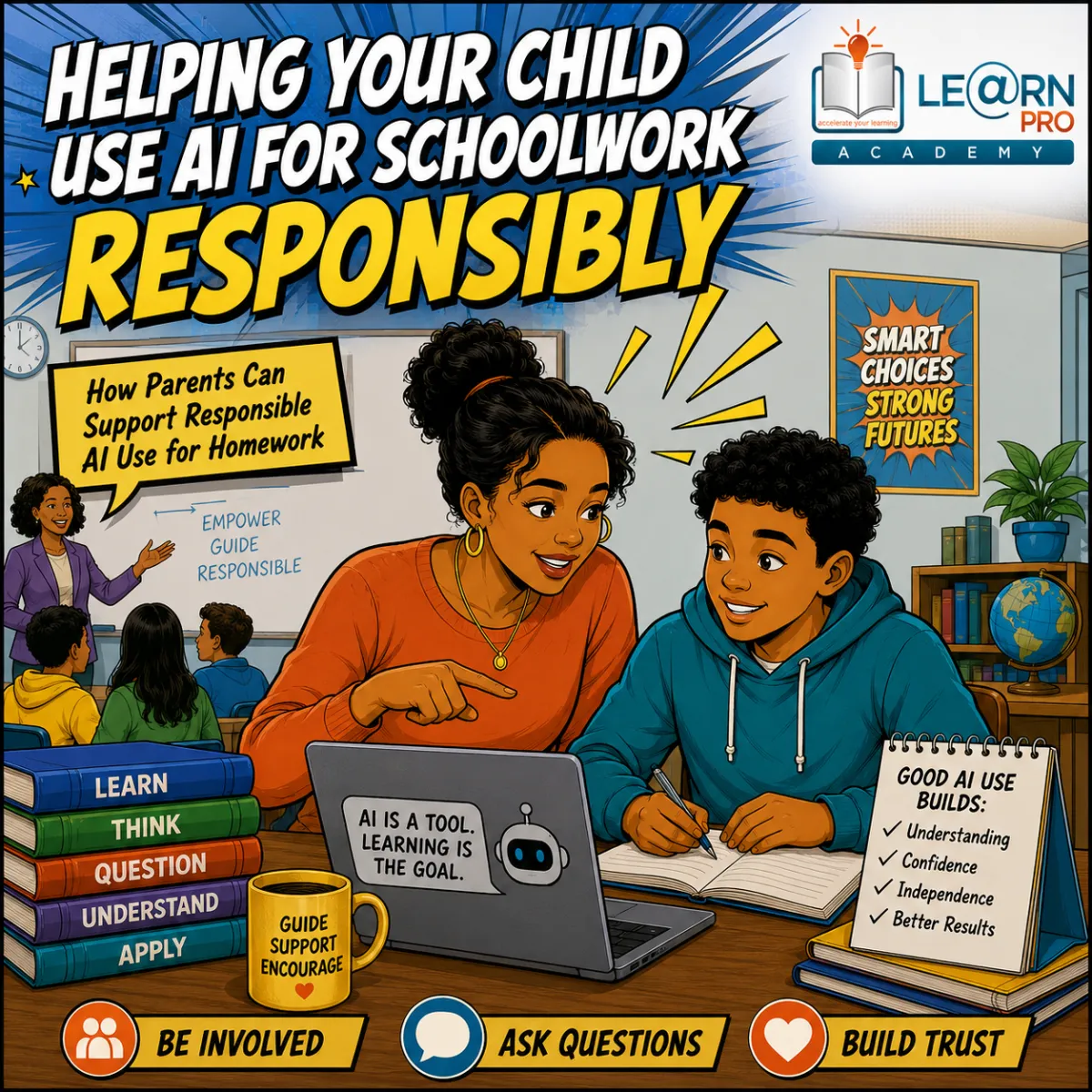
How Parents Can Support Responsible AI Use for Homework
This is article #1 of 5 in the Helping Your Child Use AI for Schoolwork Responsibly Series
Introduction
Artificial intelligence (AI) is becoming part of everyday life, and many high school learners are already using it to help with homework. They may ask AI to explain a difficult Mathematics problem, summarise a History chapter, suggest ideas for an English essay, or check whether an answer makes sense. Used wisely, AI can become a valuable study partner that supports learning and builds confidence.
However, AI also creates new challenges for parents. Because it can generate answers in seconds, learners may be tempted to copy work instead of understanding it. Homework that looks neat and complete may hide confusion rather than demonstrate learning. Parents often wonder whether AI is helping their child become a better learner or simply making homework easier without any real educational benefit.
The good news is that parents do not need to become AI experts to guide their children well. They do not need to understand every AI tool or learn complicated technology. What matters most is helping learners develop good study habits, honesty, responsibility, and independent thinking.
This article explains how parents can support responsible AI use for homework while making sure learning remains the main goal.
Why Homework Still Matters
Homework is about much more than completing tasks for a teacher.
It helps learners:
Practise new skills
Remember classroom learning
Build confidence
Develop independent thinking
Learn time management
Prepare for tests and examinations
Sometimes learners believe the purpose of homework is simply to hand in the correct answers. In reality, homework is part of the learning process. Making mistakes, asking questions, and working through difficult problems are all valuable experiences.
If AI removes all of that struggle, it also removes many opportunities for learning.
Parents can remind their children that homework is not simply about getting everything right. It is about growing their understanding.
Understanding AI As A Homework Tool
Parents often hear people say that AI is "good" or "bad" for education. The truth is much more balanced.
AI is simply a tool. Like a calculator, dictionary, or internet search engine, it can be used wisely or poorly.
Responsible uses include:
Explaining difficult concepts
Giving extra examples
Creating practice questions
Checking grammar
Summarising notes
Helping learners organise study plans
Suggesting different ways to understand a topic
Irresponsible uses include:
Copying complete homework answers
Writing essays without any learner input
Solving every Mathematics problem without explanation
Completing projects that learners never actually worked on
Avoiding thinking altogether
Parents should focus less on whether AI was used and more on how it was used.
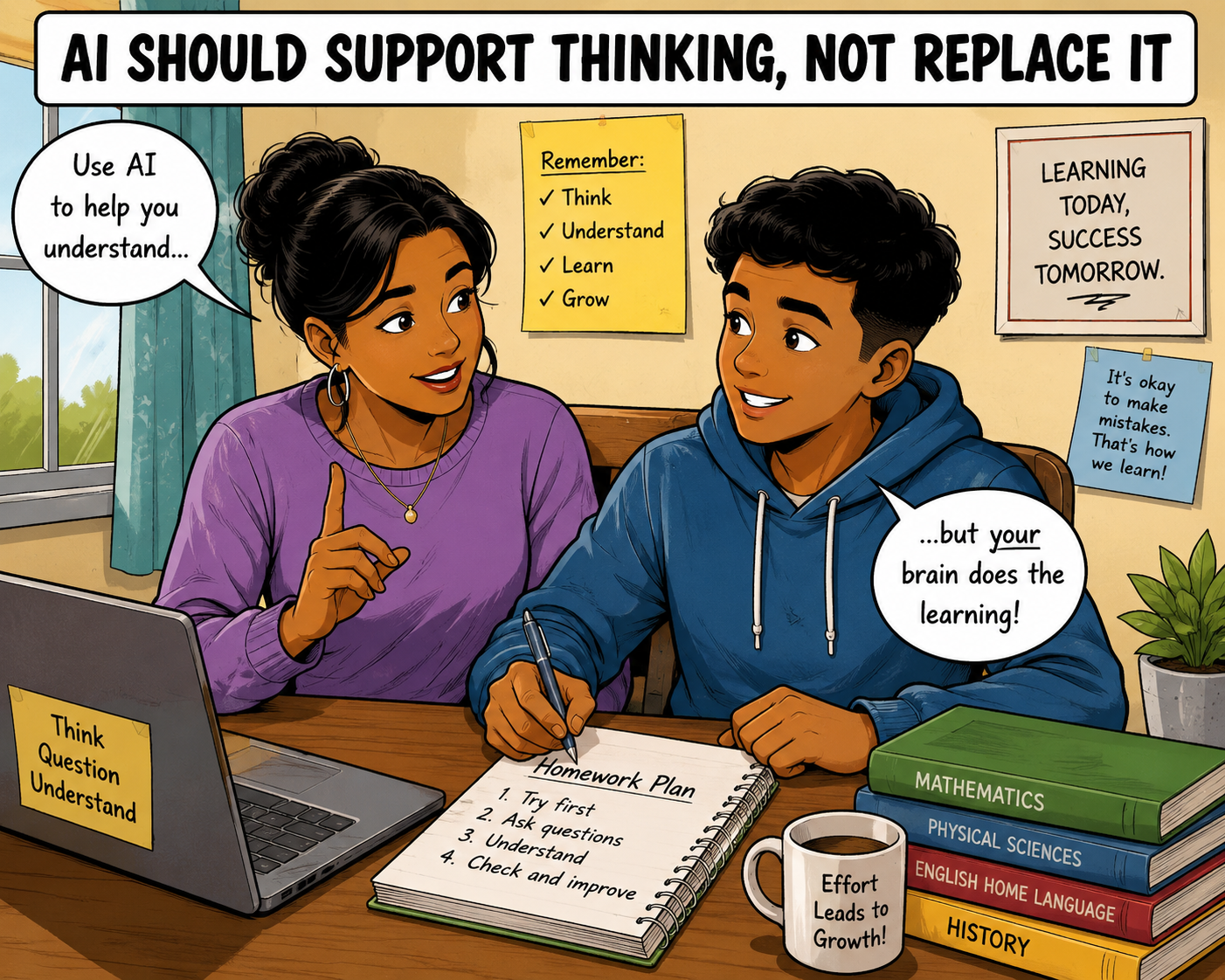
AI Should Support Thinking, Not Replace It
One of the biggest dangers of AI is that it makes avoiding effort very easy. Learning requires thinking.
Learners build knowledge by:
Reading
Solving problems
Asking questions
Making mistakes
Correcting errors
Explaining ideas
Practising repeatedly
These activities strengthen understanding. If AI simply produces the final answer every time, those important learning experiences disappear.
Parents can encourage a simple rule: "Use AI to help you think, not to think for you."
This principle works for almost every school subject.
What Responsible AI Use Looks Like
Responsible AI use often follows a healthy learning process.
For example, a learner might:
Read the homework question carefully.
Attempt the work independently.
Identify where they are stuck.
Ask AI to explain that specific part.
Try solving the problem again.
Compare their answer with the explanation.
Correct mistakes.
Complete the homework in their own words.
This approach keeps the learner actively involved throughout the process. The AI becomes a tutor rather than a replacement.
Signs That AI Is Helping Learning
Parents sometimes worry because they cannot always see what their child is doing online. Fortunately, there are practical signs that AI is being used well.
A learner is probably using AI responsibly if they:
Can explain their answers afterwards.
Continue writing in their own style.
Ask questions instead of copying responses.
Improve gradually over time.
Still make some normal mistakes.
Discuss what they learned.
Use AI mainly when they are stuck.
These learners remain actively engaged with their schoolwork. AI supports their learning instead of replacing it.
Signs That AI Is Becoming A Shortcut
Parents should also watch for warning signs.
Possible concerns include:
Homework suddenly becomes perfect overnight.
The learner cannot explain what they wrote.
Answers sound far more advanced than the learner's usual language.
Homework is completed unusually quickly every day.
The learner becomes frustrated when asked simple follow-up questions.
They immediately open AI before even reading the homework.
They avoid doing rough work or showing calculations.
They become dependent on AI for every subject.
None of these signs automatically mean a learner is cheating. Instead, they suggest that parents should start a calm conversation.
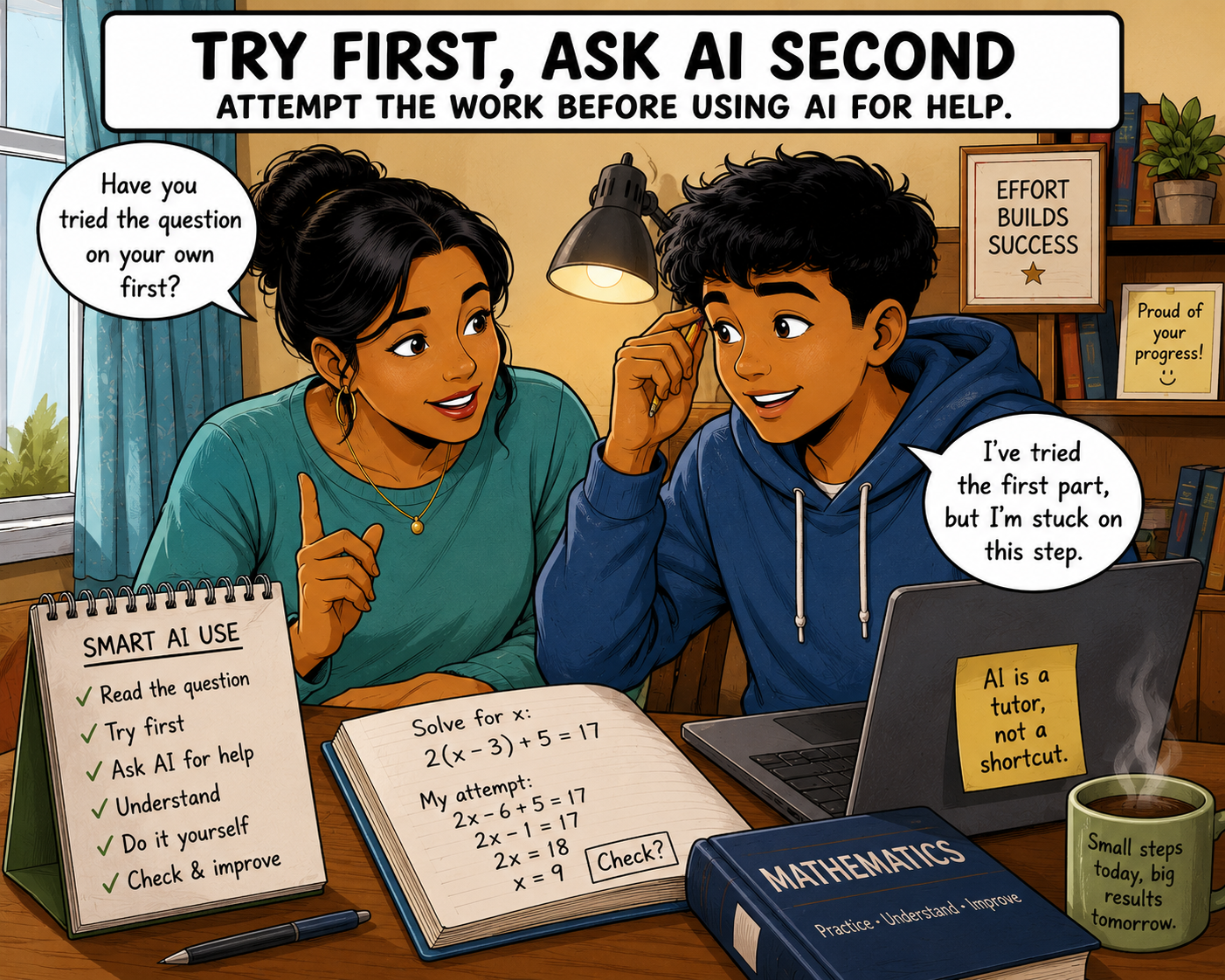
Encourage "Try First, Ask AI Second"
One of the healthiest homework habits parents can teach is to attempt the work before using AI. A learner who struggles for ten or fifteen minutes has already started thinking about the problem.
When they then ask AI for help, they usually understand the explanation much better because they already know where they became confused.
Parents can encourage questions such as:
"What have you tried already?"
"Which part is confusing?"
"What do you understand so far?"
"Can you explain where you got stuck?"
These questions encourage problem-solving before technology becomes involved.
Teach Children To Ask Better AI Questions
The quality of AI answers depends greatly on the questions learners ask.
Instead of saying: "Give me the answer."
They could ask:
"Explain this topic in simple English."
"Show me another example."
"Explain this like I'm in Grade 10."
"Why is my answer incorrect?"
"Can you explain each step?"
"Give me three practice questions."
These prompts encourage learning rather than copying. Parents do not need to know the perfect prompts themselves. Simply encouraging curiosity instead of shortcuts makes a big difference.
Keep Parents Involved Without Taking Over
Many parents worry that they are not familiar with the school curriculum. Fortunately, they do not need to teach every subject. Instead, they can stay involved by showing interest.
Simple questions include:
"What are you learning today?"
"What did AI explain?"
"Did that explanation make sense?"
"Can you teach it back to me?"
"What was the hardest part?"
Children often remember information better when they explain it to someone else. Parents become learning partners rather than homework supervisors.
Encourage Honest Conversations About AI
Some learners hide their AI use because they fear punishment. This secrecy prevents parents from guiding them. Instead, create an environment where AI can be discussed openly.
For example, parents might say: "I don't mind if you use AI to help you understand your work. I just want to make sure you are still doing the learning yourself."
This type of conversation builds trust. Children are more likely to ask for advice when they know they will not immediately be criticised.
Every Subject Can Benefit Differently
Responsible AI use looks different across school subjects.
Mathematics
AI should explain methods and show worked examples.
The learner should still solve the problems independently.
Physical Sciences
AI can explain scientific concepts using simpler language and everyday examples.
The learner should still understand the scientific reasoning.
English
AI can help improve grammar, vocabulary, and structure.
The learner should still write their own ideas.
History
AI can explain historical events, timelines, and causes.
The learner should still interpret information independently.
Geography
AI can clarify concepts, maps, climate systems, and terminology.
The learner should still complete the required analysis.
Business Studies
AI can explain business concepts and provide examples.
The learner should still apply those concepts using their own thinking.
Help Learners Develop Digital Responsibility
Using AI responsibly is becoming an important life skill.
Just as parents teach children:
honesty,
kindness,
responsibility,
respect,
they can also teach responsible technology use.
This includes:
checking facts,
protecting personal information,
avoiding plagiarism,
using AI ethically,
thinking critically,
recognising mistakes.
These habits will benefit learners long after they leave school.
The South African School Context
South African schools differ widely in their access to technology. Some learners have personal laptops and reliable internet access. Others depend on shared family devices, school computer centres, or mobile phones with limited data.
Parents should remember that responsible AI use is not about having the newest technology. It is about using whatever technology is available in a thoughtful and honest way.
For many South African families, AI may only be used occasionally because of data costs. Even then, it can still provide valuable support when learners need help understanding difficult concepts.
Parents should also remember that AI explanations are not always perfectly aligned with the Curriculum and Assessment Policy Statement (CAPS). Encourage learners to compare AI explanations with their class notes, textbooks, and teacher guidance. This helps ensure that they study the material expected by their school.
Simple Family Rules For AI Homework
Many families find it helpful to agree on a few clear guidelines.
Examples include:
Read the question before opening AI.
Attempt the work first.
Use AI to explain, not to complete.
Always write final answers in your own words where appropriate.
Check information from more than one source when necessary.
Ask a teacher if AI explanations remain confusing.
Be honest about when AI has been used.
Remember that learning is more important than finishing quickly.
Simple rules are easier to remember and encourage consistent habits.
Mistakes Are Still Part Of Learning
Parents sometimes worry when their child gets homework wrong. Yet mistakes are one of the most valuable parts of learning. AI should not remove every mistake. Instead, it should help learners understand why mistakes happened.
When children correct their own errors, they build stronger understanding and become more confident problem-solvers.
Parents can praise effort, persistence, and improvement rather than only correct answers. This encourages a healthy attitude towards learning that will benefit children throughout their education.
Building Lifelong Learning Habits
Technology will continue changing throughout today's learners' lives. The specific AI tools available today may look very different in five or ten years. However, the habits children develop now will remain valuable.
Learners who know how to:
ask thoughtful questions,
evaluate information,
think independently,
solve problems,
learn from mistakes,
use technology responsibly,
will be far better prepared for future study, employment, and everyday life. Parents play a vital role in helping children develop these habits at home.
Conclusion
AI is changing the way many learners approach homework, but it does not change the purpose of learning. Homework should still build understanding, confidence, and independent thinking rather than simply produce correct answers. When parents encourage children to attempt work first, ask thoughtful questions, and use AI to explain rather than replace learning, they help create healthy study habits that will last beyond school.
Parents do not need to become technology experts to guide responsible AI use. By showing interest in what their child is learning, having honest conversations about AI, and focusing on understanding instead of speed or perfection, they can ensure that technology remains a helpful study partner rather than an easy shortcut. Used wisely, AI can support homework while keeping the learner at the centre of the learning process.
Additional Articles in the Helping Your Child Use AI for Schoolwork Responsibly Series
How Parents Can Support Responsible AI Use for Homework
When AI Helps Learning — and When It Becomes a Shortcut
Helping Your Child Use AI to Understand Difficult Subjects
How to Talk to Your Child About AI and School Assignments
Questions Parents Can Ask to Check Whether AI Is Helping or Hiding Learning Gaps
Disclaimer
AI Tools were used to assist with research. Remember to always cross-check everything that you read.