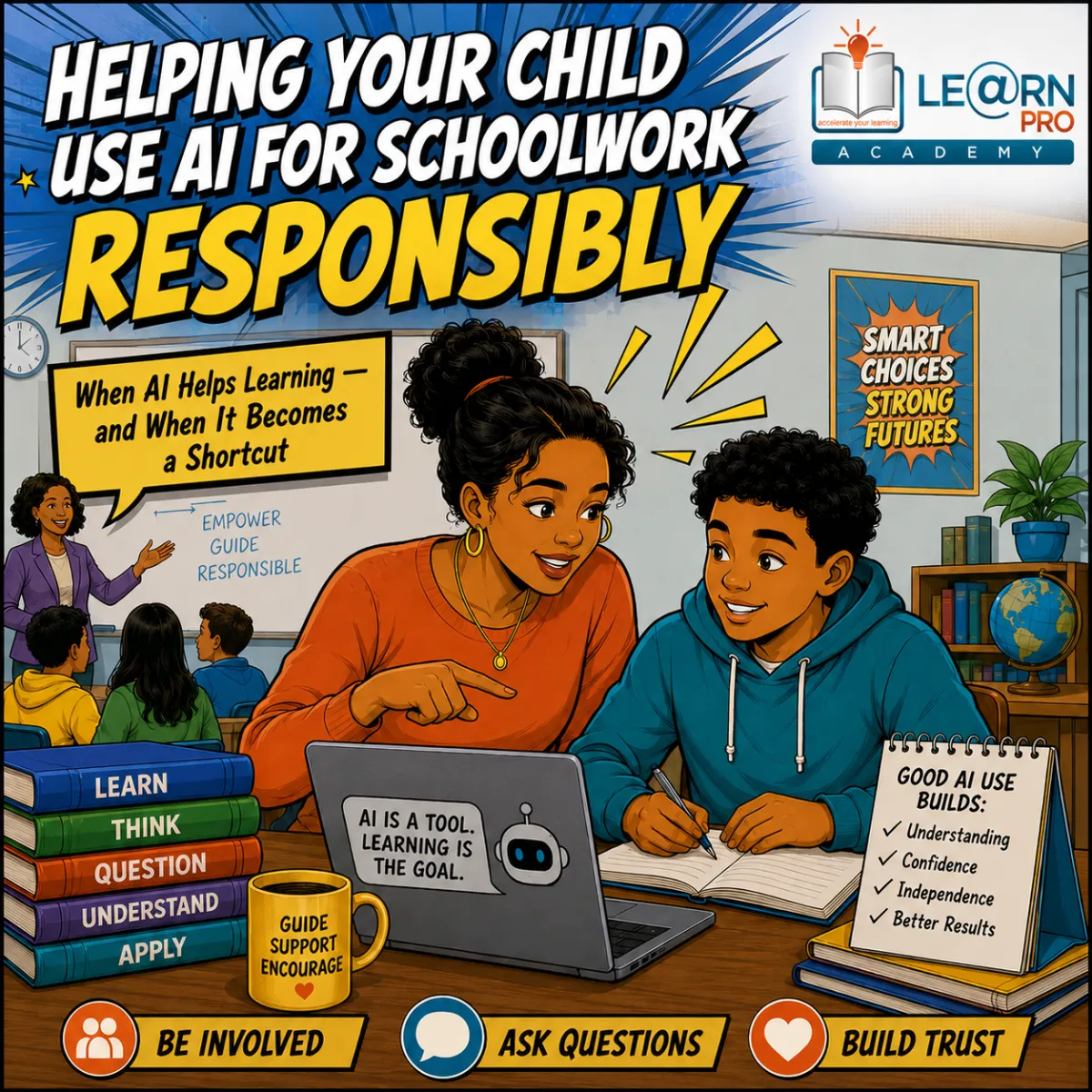
When AI Helps Learning — and When It Becomes a Shortcut
This is article #2 of 5 in the Helping Your Child Use AI for Schoolwork Responsibly Series
Introduction
Artificial intelligence (AI) is becoming a normal part of many learners' school lives. Whether they are studying for exams, completing homework, writing essays, or revising difficult topics, many high school learners now turn to AI for support. For parents, this creates both exciting opportunities and understandable concerns.
On the one hand, AI can act like a patient tutor that is available any time of the day. It can explain concepts in simpler language, provide extra examples, create practice questions, and help learners organise their studies. Used responsibly, AI can increase confidence and make learning less stressful.
On the other hand, AI can also make it very easy for learners to avoid thinking for themselves. Instead of solving a Mathematics problem, writing an essay, or working through a challenging question, a learner may simply ask AI to produce the answer. While this may save time, it often weakens genuine understanding and leaves learning gaps hidden beneath polished work.
Parents do not need to become technology experts to recognise the difference. By understanding when AI is helping learning and when it is becoming a shortcut, they can guide their children towards habits that build knowledge, confidence, and integrity.
This article explores the difference between productive AI use and unhealthy dependence, while providing practical strategies for supporting responsible learning at home.
Why AI Is Not Automatically Good Or Bad
Many discussions about AI focus on whether it should be allowed in education. This is not the most useful question. The more important question is: How is the learner using AI?
The same tool can either strengthen learning or weaken it depending on how it is used. Imagine two learners studying the same Biology chapter.
The first learner asks AI: "Can you explain photosynthesis in simple English with an example?"
The second learner asks: "Write my Biology homework."
Both learners used AI. Only one used it to learn.
Parents should therefore focus on the learner's behaviour rather than the technology itself.
Understanding The Difference Between Learning And Completing
One of the biggest misunderstandings about schoolwork is believing that completing homework means learning has taken place.
These are not the same thing.
A learner can:
Submit perfect homework.
Receive good marks.
Finish assignments quickly.
Yet still understand very little.
Real learning happens when learners:
Think through problems.
Make connections.
Practise skills.
Learn from mistakes.
Ask questions.
Build confidence through effort.
AI should support these processes, not replace them.
When AI Supports Real Learning
AI becomes a powerful learning tool when it helps learners understand something they could not understand on their own.
Examples include:
Explaining Difficult Topics
A learner who struggles with Algebra can ask AI to explain a concept step by step. Instead of simply giving the answer, AI can break the problem into smaller pieces. This builds understanding.
Providing Extra Examples
Sometimes one classroom example is not enough. AI can generate additional examples until the learner feels confident.
Using Simpler Language
Many learners struggle because textbooks use difficult vocabulary. AI can explain the same concept using simpler English without changing the meaning. This is especially valuable for many South African learners who study in English as an additional language.
Creating Practice Questions
Practice develops confidence. AI can generate quizzes, revision questions, and mock tests that allow learners to practise before formal assessments.
Organising Revision
AI can help learners create study timetables, revision plans, flashcards, and summaries. This supports organisation without replacing learning.
When AI Becomes A Shortcut
Problems begin when learners stop using AI to understand and start using it to avoid effort.
Common examples include:
Copying AI answers into homework.
Submitting AI-written essays.
Using AI before even attempting the work.
Asking AI to solve every Mathematics problem.
Memorising AI answers without understanding them.
Completing projects they never actually researched.
In these situations, homework gets completed, but learning does not happen.
Why Struggle Is Part Of Learning
Many parents naturally want to help when they see their child becoming frustrated. However, a certain amount of struggle is normal. Learning often feels uncomfortable because the brain is building new connections.
If AI removes every challenge immediately, learners lose opportunities to:
Think independently.
Solve problems.
Develop persistence.
Build resilience.
Gain confidence.
Healthy learning involves effort. Parents can remind children that being confused does not mean they are failing.
It often means they are learning.
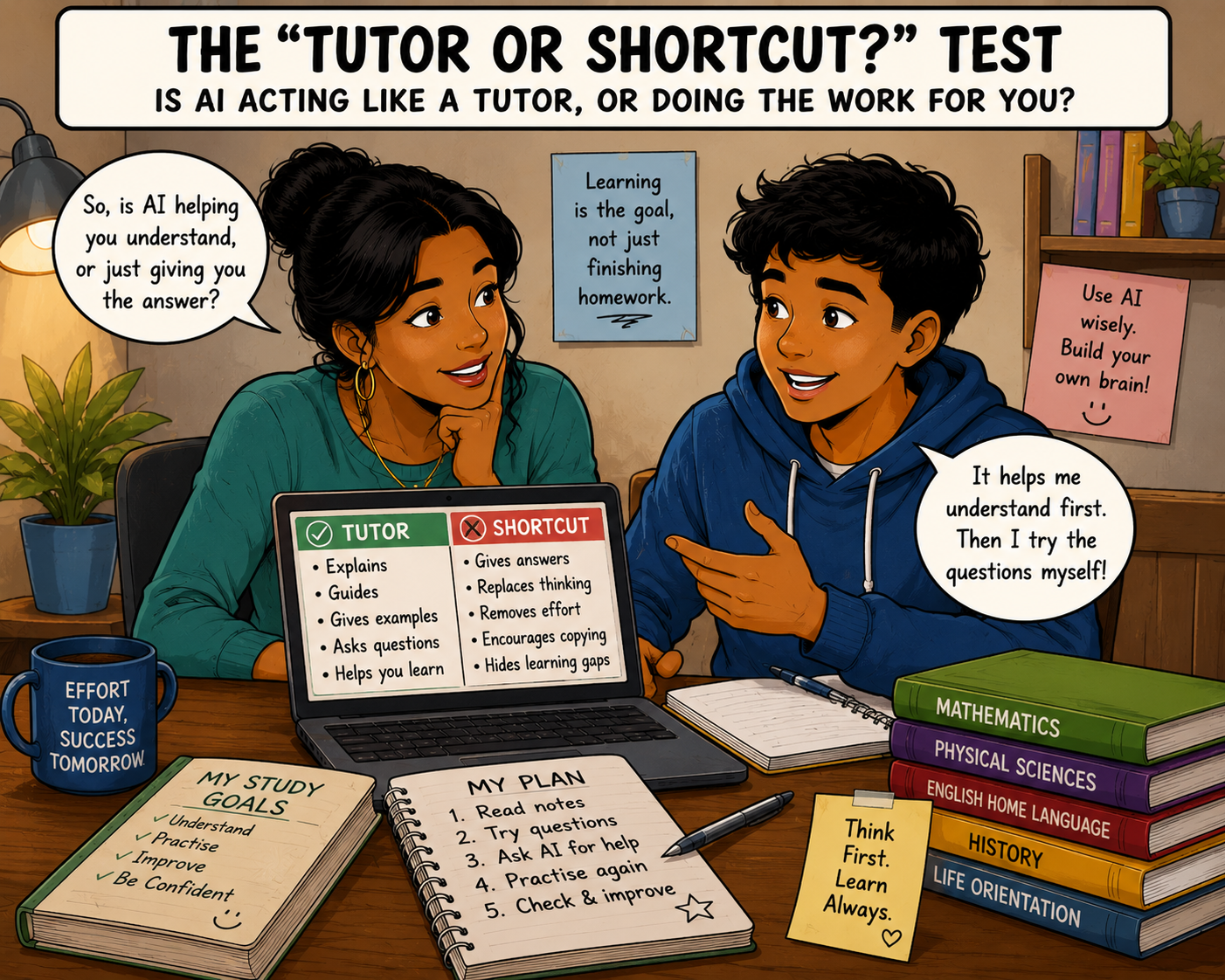
The "Tutor Or Shortcut?" Test
One simple question can help parents judge whether AI is being used responsibly: Is AI acting like a tutor, or is it doing the work instead?
A tutor:
Explains.
Guides.
Demonstrates.
Encourages questions.
Corrects mistakes.
Supports learning.
A shortcut:
Produces answers.
Replaces thinking.
Removes effort.
Encourages copying.
Hides learning gaps.
Parents can use this simple test whenever they discuss AI with their children.
Healthy AI Habits Parents Can Encourage
Parents can help learners build good habits without constantly supervising every homework session.
Encourage your child to:
Attempt The Work First
Trying independently helps identify what is already understood and where help is needed.
Ask Specific Questions
Instead of asking: "Give me the answer."
Try asking: "Can you explain why this method works?"
Compare Different Explanations
Learners benefit from comparing:
Teacher notes
Textbooks
AI explanations
Educational videos
Seeing information presented in different ways often improves understanding.
Rewrite In Their Own Words
After reading an AI explanation, learners should explain it themselves. This helps move information into long-term memory.
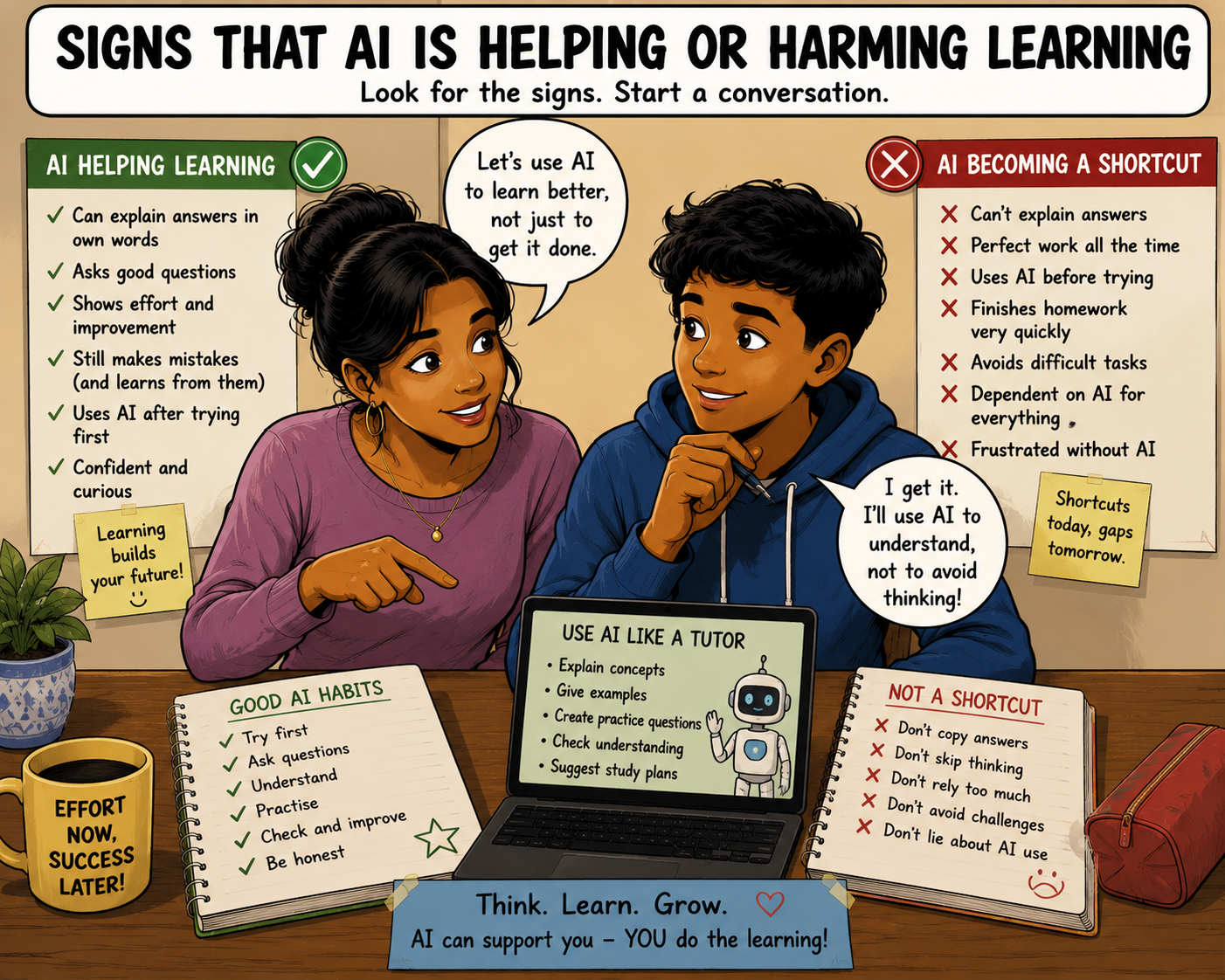
Signs That AI Is Supporting Learning
Parents may notice positive changes when AI is being used responsibly.
These include:
Increased confidence.
Better classroom participation.
Improved understanding.
More thoughtful questions.
Steady academic improvement.
Greater independence.
Reduced frustration.
Better study organisation.
Importantly, the learner can explain what they have learned.
Signs That AI Is Replacing Learning
Parents should also recognise warning signs.
These may include:
Homework suddenly becomes perfect.
Assignments sound unlike the learner's normal writing.
The learner cannot explain their own answers.
They panic when AI is unavailable.
They ask AI before reading the question.
They avoid difficult tasks completely.
They become less willing to think independently.
These behaviours suggest that AI is becoming a dependency instead of a learning aid.
Encourage Curiosity Instead Of Speed
Modern technology often encourages people to find answers as quickly as possible. Education is different. Learning depends on curiosity.
Parents can encourage questions like:
Why?
How?
What happens if...?
Can you explain that differently?
Can I solve this another way?
Curiosity turns AI into a learning partner rather than an answer machine.
Helping Learners Reflect On Their AI Use
Reflection is an excellent way to build responsible habits.
After homework, parents might ask:
What did AI help you understand?
What did you figure out by yourself?
Which part was still difficult?
Could you explain this topic to a friend?
What would you do differently next time?
These conversations shift attention from completing work to understanding it.
The Importance Of Independent Thinking
One of the greatest risks of overusing AI is losing confidence in one's own thinking. Learners sometimes begin believing that AI always knows better.
Parents should remind children that:
AI can make mistakes.
AI does not replace judgement.
AI does not know everything.
AI cannot think for the learner.
Independent thinking remains one of the most valuable skills a young person can develop. Schools, universities, and employers all value people who can analyse information, solve problems, and make sound decisions.
The South African School Context
South African families experience very different levels of access to technology.
Some learners have laptops, fibre internet, and multiple digital devices. Others rely on:
Shared smartphones.
Mobile data.
School computer centres.
Public libraries.
Community internet access.
Responsible AI use is not determined by the amount of technology available. Instead, it depends on the habits learners develop.
Parents should also remember that AI may not always explain topics exactly as they are taught through the Curriculum and Assessment Policy Statement (CAPS). Encourage learners to compare AI explanations with their textbooks, teacher notes, and classroom examples to make sure they are studying the correct material.
Creating Family Expectations Around AI
Families benefit from clear expectations.
Simple household guidelines might include:
Try the work before using AI.
Ask AI to explain rather than complete.
Always check AI answers.
Write assignments in your own words.
Tell the truth about using AI.
Ask teachers when unsure.
Keep learning as the priority.
These rules encourage responsibility without making AI seem forbidden.
Remember That Mistakes Help Learning
Many learners believe mistakes should be avoided. In reality, mistakes provide valuable feedback.
AI should help learners understand:
Why an answer is wrong.
How to improve.
What concept was misunderstood.
Parents can praise effort and improvement rather than expecting perfection. This encourages a healthy growth mindset that supports lifelong learning.
Preparing Children For A Future With AI
AI will almost certainly remain part of education and many future careers. The goal is therefore not to prevent learners from using AI. Instead, parents should help them become responsible users.
Children who learn to:
think critically,
question information,
solve problems independently,
use technology ethically,
communicate clearly,
continue learning,
will be well prepared for both university and the workplace. These skills will remain valuable regardless of how technology changes.
Conclusion
AI can either strengthen learning or weaken it, depending on how it is used. When learners use AI to explain difficult concepts, generate practice questions, organise revision, or improve understanding, it becomes a valuable educational partner. When they use it to avoid thinking, writing, or solving problems independently, it becomes a shortcut that limits real learning.
Parents play an essential role in helping children recognise this difference. By encouraging curiosity, effort, honesty, and independent thinking, they can ensure that AI remains a tool for growth rather than a replacement for learning. The aim is not to remove AI from education but to help learners use it wisely so they build the knowledge, confidence, and problem-solving skills they will need throughout their lives.
Additional Articles in the Helping Your Child Use AI for Schoolwork Responsibly Series
How Parents Can Support Responsible AI Use for Homework
When AI Helps Learning — and When It Becomes a Shortcut
Helping Your Child Use AI to Understand Difficult Subjects
How to Talk to Your Child About AI and School Assignments
Questions Parents Can Ask to Check Whether AI Is Helping or Hiding Learning Gaps
Disclaimer
AI Tools were used to assist with research. Remember to always cross-check everything that you read.