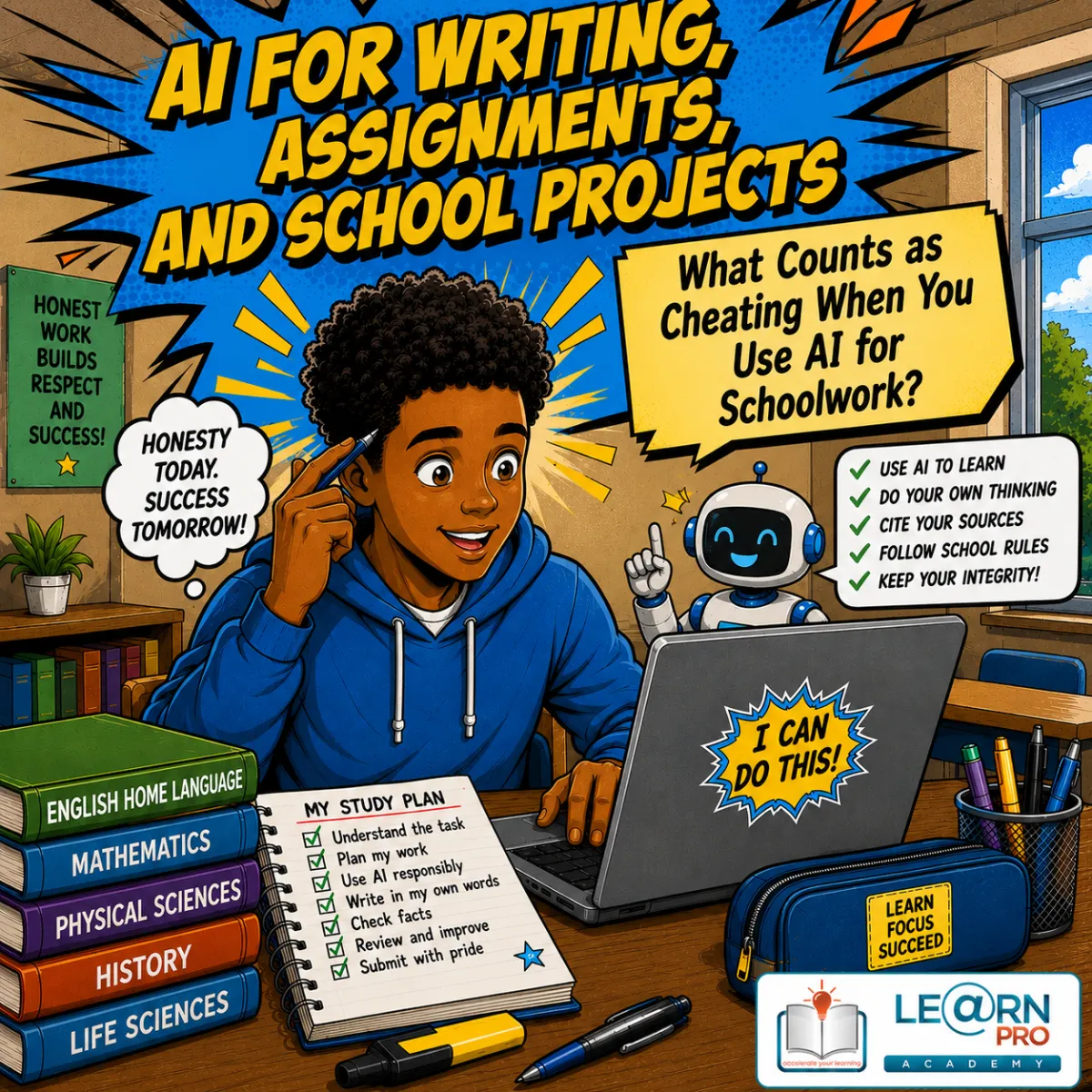
What Counts as Cheating When You Use AI for Schoolwork?
This is article #5 of 5 in the AI for Writing, Assignments, and School Projects Series
Introduction
Artificial Intelligence (AI) is changing the way people learn, work, and solve problems. Today, many South African learners use AI to explain difficult topics, improve their English, generate practice questions, organise essay plans, and prepare for exams.
These are all positive ways to use AI.
However, AI also raises an important question:
When does helpful AI support become cheating?
Many learners are unsure where the line is. If AI helps correct your grammar, is that cheating? If it explains a difficult Mathematics problem, is that allowed? What if it writes your entire History essay? What if you copy an AI answer into your assignment without changing anything?
These are important questions because schools, teachers, universities, and employers are becoming more aware of AI. They want learners to develop real knowledge and skills, not simply submit work created by a computer.
The good news is that AI can be used honestly and responsibly. The key is understanding that AI should help you learn — not replace your own thinking, effort, and creativity.
In this article, you will learn what responsible AI use looks like, what behaviour may be considered dishonest, and how you can benefit from AI while maintaining your academic integrity.
Why Schools Care About Academic Honesty
Every assignment, project, test, and examination has a purpose. Teachers do not only want to see the final answer.
They want to understand:
what you know
how you think
how well you solve problems
how clearly you communicate
what skills you still need to improve
If someone else completes your work, your teacher cannot accurately assess your learning. In the past, learners sometimes copied from textbooks, friends, or websites.
Today, AI has become another possible shortcut. The technology may be new, but the principle remains the same.
Your schoolwork should demonstrate your own understanding.
What Is Academic Integrity?
Academic integrity means being honest about your work.
It means:
doing your own thinking
acknowledging help when appropriate
using information responsibly
following your school's rules
learning instead of taking shortcuts
Integrity is about your character. Even when nobody is watching, you choose to do what is right.
These habits become important later in university, college, and the workplace.
People trust individuals who produce honest work.
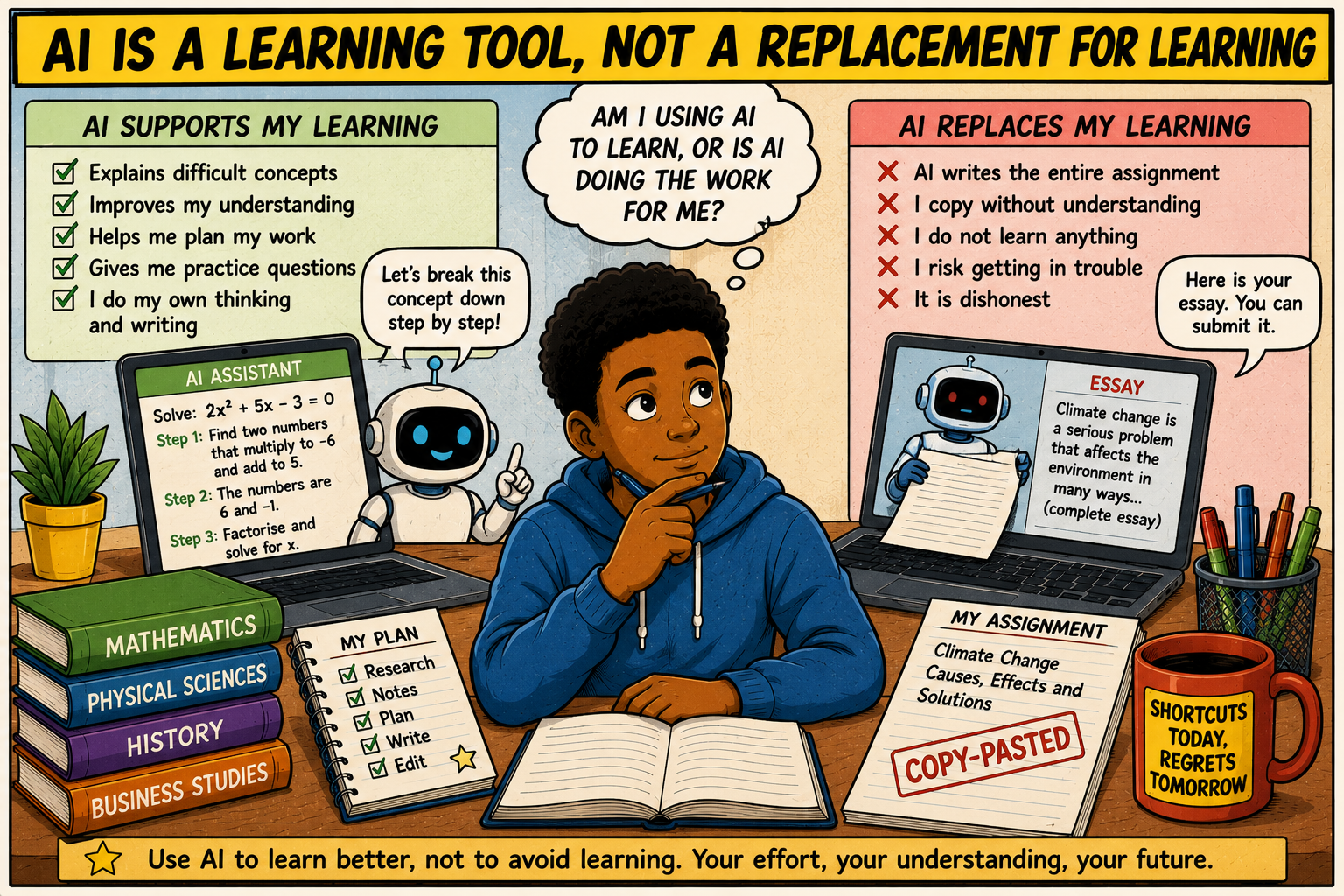
AI Is A Learning Tool, Not A Replacement For Learning
Think about a calculator. A calculator helps you perform calculations faster. However, your Mathematics teacher still expects you to understand mathematical concepts.
The calculator supports your learning. It does not replace it. AI works in a similar way.
It can:
explain ideas
improve grammar
suggest examples
organise information
answer questions
But it should never replace your own thinking.
If AI completes all your work, you may finish the assignment, but you have not developed the skills the assignment was designed to teach.
Examples Of Responsible AI Use
There are many ways to use AI honestly.
For example, you can ask AI to:
Explain a difficult concept.
Improve your grammar.
Suggest better vocabulary.
Create practice questions.
Help you plan an essay.
Summarise a chapter after you have already read it.
Explain unfamiliar words.
Quiz you before a test.
Provide examples that help you understand a topic.
These uses support learning.
You are still responsible for understanding the material and completing your own work.
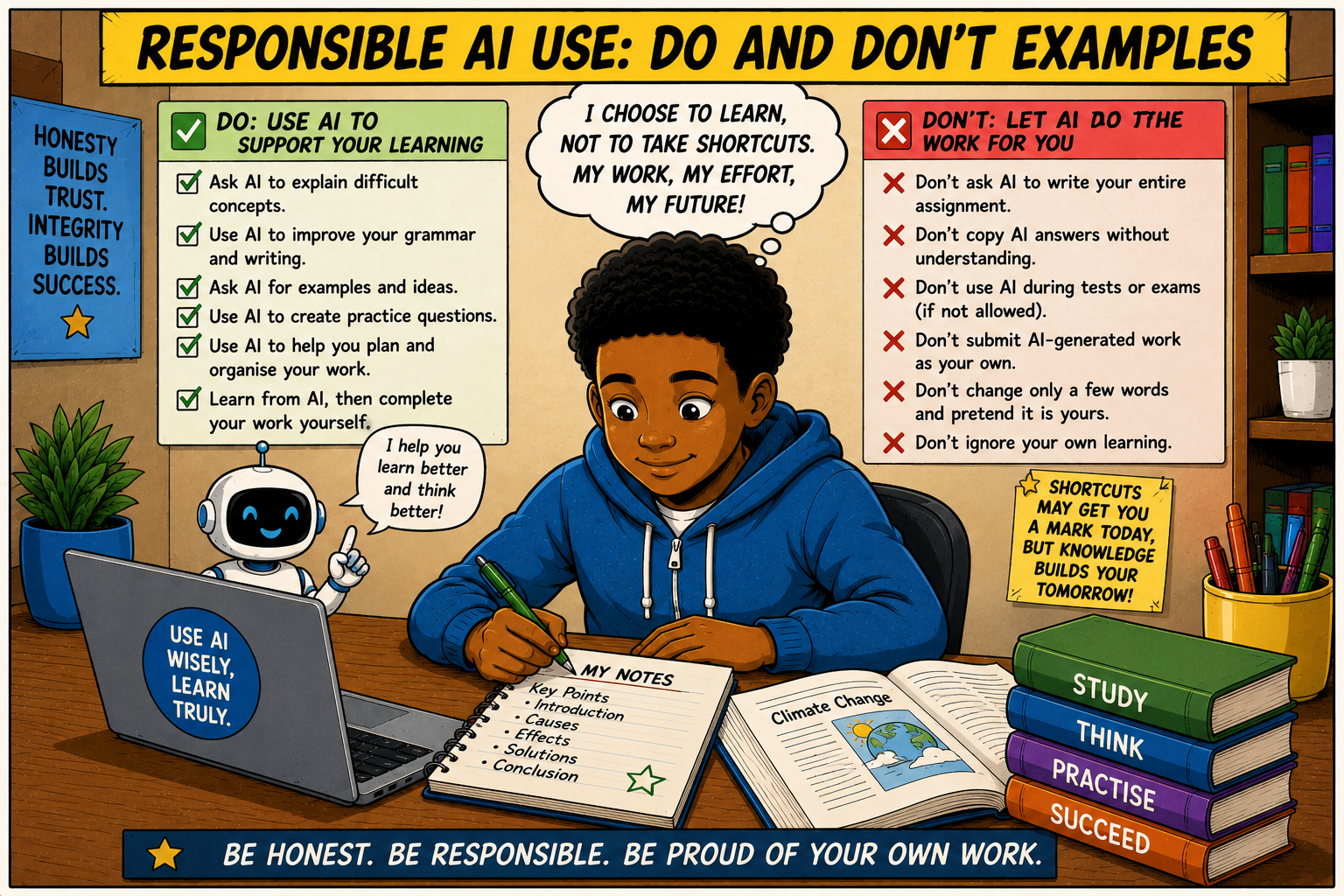
Examples Of Dishonest AI Use
Problems begin when learners stop thinking for themselves.
Examples include:
Asking AI to write your entire assignment.
Copying AI answers without reading them.
Submitting AI-generated essays as your own work.
Using AI during a test when it is not allowed.
Changing only a few words before submitting AI-generated work.
Pretending AI's ideas are your own.
These actions may be treated as cheating because they misrepresent your own knowledge and effort.
Ask Yourself One Simple Question
Whenever you use AI, ask yourself:
"Is AI helping me learn, or is it doing my learning for me?"
If AI helps you understand something better, you are probably using it responsibly.
If AI replaces your thinking completely, you have crossed an important line.
This simple question can guide many of your decisions.
Why Copying AI Can Hurt You
Some learners think: "If I get good marks, does it really matter?" Yes, it does.
Imagine AI writes your Accounting assignment. You receive a high mark.
A few weeks later, you write a class test without AI. Suddenly, you cannot answer the questions because you never truly understood the topic.
The assignment looked successful.
Your learning was not.
Copying AI may help you today, but it often creates bigger problems later.
AI Can Make Mistakes
Another reason not to copy AI is that it is not always correct.
AI sometimes:
invents facts
gives incorrect dates
misquotes sources
misunderstands questions
provides outdated information
If you copy AI without checking the facts, you may submit incorrect work.
Always verify important information using:
your textbook
class notes
trusted educational websites
reliable reference materials
Responsible learners check information before using it.
Every School May Have Different Rules
Schools are still developing policies about AI. Some schools may allow certain types of AI assistance. Others may restrict its use for particular assignments. Some teachers may ask learners to explain how AI was used during the assignment.
Always follow your teacher's instructions. If you are unsure whether AI is allowed, ask.
It is always better to clarify beforehand than to face problems later.
AI Should Improve Your Skills
A good question to ask is: "After using AI, am I becoming better at this subject?"
If the answer is yes, AI is helping you learn.
Perhaps your grammar has improved.
Maybe your essay planning has become stronger.
Perhaps you understand Mathematics more clearly.
These are signs that AI is supporting your education.
If, however, you cannot complete similar work without AI, it may be time to change how you are using it.
Build Confidence In Your Own Thinking
One of the greatest dangers of AI is becoming too dependent on it. Some learners begin asking AI every question before trying to think for themselves.
This weakens important skills such as:
critical thinking
creativity
problem-solving
decision-making
independent learning
Instead, try this approach:
Think first.
Write your own answer.
Then ask AI to help you improve it.
This allows your own brain to do the important work before receiving assistance.
Use AI To Learn From Mistakes
Mistakes are one of the best ways to learn.
Instead of asking AI for answers, ask questions such as:
Why is my answer incorrect?
How could I improve this paragraph?
What grammar mistake did I make?
Can you explain this calculation step by step?
These questions help you grow as a learner. Remember, learning happens when you understand your mistakes.
How Teachers Can Often Recognise AI-Generated Work
Many learners believe teachers cannot tell when AI has written an assignment.
In reality, teachers know their learners very well.
They may notice:
vocabulary that is unusually advanced
writing style that suddenly changes
perfect grammar that does not match previous work
explanations the learner cannot discuss later
answers that sound generic rather than personal
Some schools also use software that helps identify AI-generated writing.
Even if technology cannot detect every case, teachers often recognise when work does not reflect a learner's usual ability.
AI And Group Projects
Group projects introduce another challenge. Suppose one learner asks AI to write the entire project. Everyone submits it. Who is responsible?
Usually, the whole group shares responsibility.
Instead, use AI together to:
brainstorm ideas
organise tasks
improve grammar
generate discussion questions
The actual project should still reflect the group's own research and understanding.
Helpful AI Prompts That Encourage Honest Learning
Here are some examples of responsible prompts.
Understanding: "Explain this concept in simple English."
Improving My Writing: "Please improve my grammar but keep my original ideas."
Practising: "Create ten practice questions without giving me the answers immediately."
Checking My Work: "Can you review my answer and tell me what I could improve?"
Planning: "Help me organise my ideas into an essay plan."
Notice that none of these prompts ask AI to complete the assignment.
Instead, they help you become a better learner.
Warning Signs That You May Be Relying Too Much On AI
Ask yourself these questions honestly:
Can I explain my assignment without looking at AI?
Could I answer similar questions in a test?
Do I understand every paragraph I submitted?
Did I check the facts?
Did I write most of the work myself?
If the answer to several of these questions is "no," you may be relying too heavily on AI.
Building Digital Responsibility
AI is only one part of becoming a responsible digital citizen.
Responsible learners:
think critically
question information
respect copyright
avoid plagiarism
use technology ethically
protect their personal information
continue developing their own skills
These habits will become increasingly important as AI becomes more common in education and the workplace.
Learning how to use technology responsibly is just as important as learning how the technology works.
Preparing For The Future
Artificial Intelligence will continue to become part of everyday life. Universities, businesses, hospitals, engineering firms, banks, government departments, and many other organisations are already using AI to improve productivity and solve problems. This means that learning how to use AI responsibly is becoming an important life skill.
However, the people who will benefit most from AI are not those who allow it to think for them. They are the people who combine AI with their own knowledge, creativity, judgement, and problem-solving ability. Employers will always value people who can ask good questions, evaluate information carefully, communicate clearly, and make responsible decisions.
By developing these skills now, you are preparing yourself not only for school but also for life after school.
Use AI With Integrity And Confidence
Artificial Intelligence is one of the most powerful learning tools available to today's learners. It can explain difficult ideas, improve your writing, organise your thoughts, create practice questions, and support your learning in many positive ways.
The key is remembering that AI is a learning partner — not a replacement for your own effort.
Every assignment is an opportunity to grow your knowledge and skills. When you use AI to understand concepts, improve your work, and learn from your mistakes, you become a stronger and more confident learner. When you allow AI to do your thinking for you, you miss the very learning opportunities that school is designed to provide.
As you continue your education, choose honesty over shortcuts, curiosity over copying, and learning over simply collecting marks. Your integrity, your knowledge, and your ability to think independently will always be more valuable than any technology.
Use AI wisely, learn continuously, and take pride in producing work that truly reflects your own abilities.
Additional Articles in the AI for Writing, Assignments, and School Projects Series
How to Use AI to Improve Your English in School Assignments
Using AI to Plan Essays Before You Start Writing
How to Use AI to Improve School Project Research
Using AI to Simplify Difficult Concepts for Learners
What Counts as Cheating When You Use AI for Schoolwork?
Disclaimer
AI Tools were used to assist with research. Remember to always cross-check everything that you read.