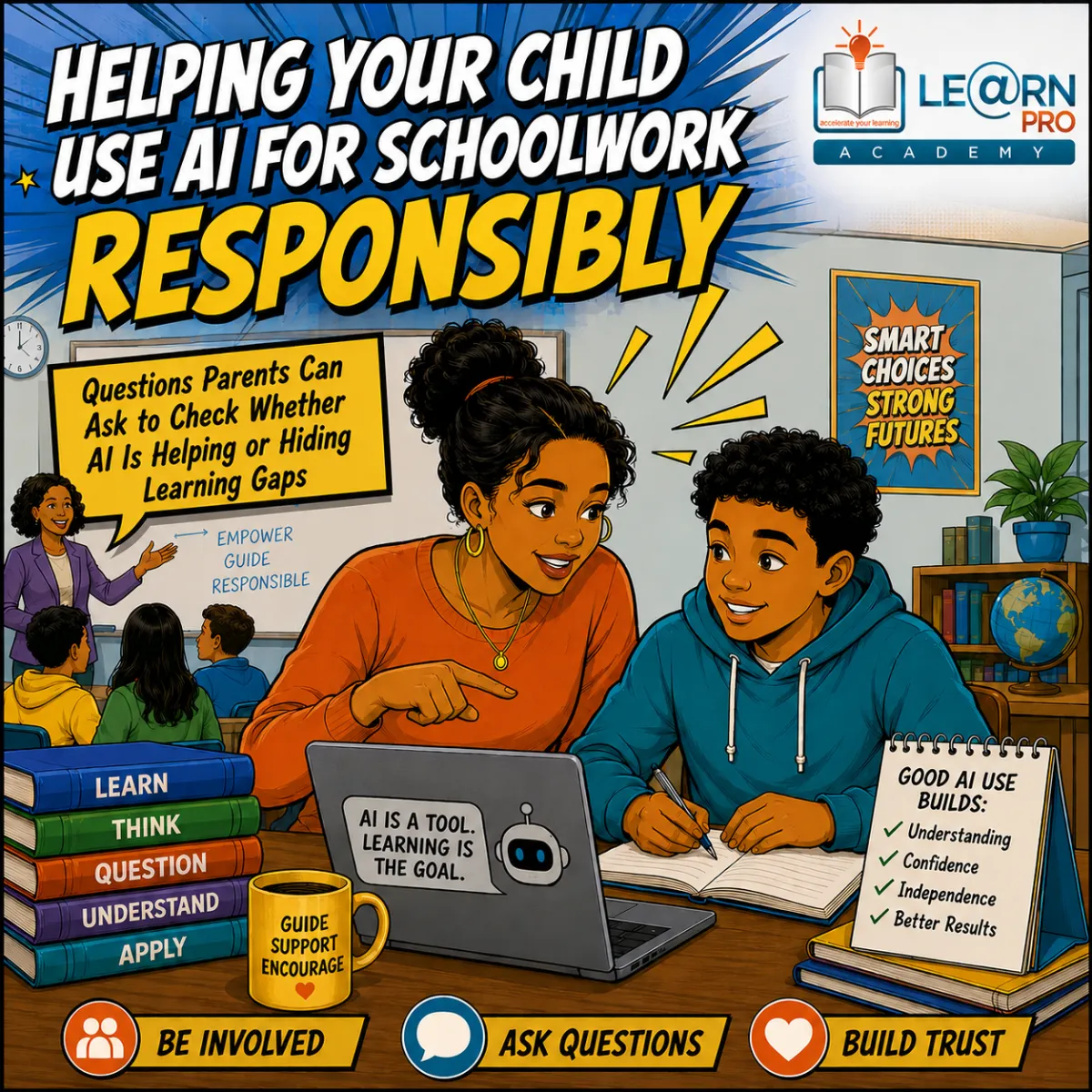
Questions Parents Can Ask to Check Whether AI Is Helping or Hiding Learning Gaps
This is article #5 of 5 in the Helping Your Child Use AI for Schoolwork Responsibly Series
Introduction
Artificial intelligence (AI) is changing the way many learners complete homework, prepare for tests, and work on school assignments. AI can explain difficult concepts, create practice questions, improve writing, and organise revision plans. Used responsibly, it can become a valuable learning partner that helps learners build confidence and understanding.
However, AI also creates a new challenge for parents. Homework may look neat, essays may sound impressive, and assignments may be completed quickly, but appearances can be misleading. A learner may have produced excellent-looking work without fully understanding the topic.
This means that parents should not judge learning only by the final product. Instead, they should become interested in the learning process.
The good news is that parents do not need to know every school subject to find out whether learning has taken place. Simple, thoughtful questions often reveal far more than reading the completed homework.
This article provides practical questions parents can use to discover whether AI is helping their child learn or simply hiding areas of confusion.
Looking Beyond Correct Answers
Many parents naturally feel pleased when homework is completed correctly. Good marks are encouraging.
However, correct answers do not always mean genuine understanding.
Sometimes learners:
Copy AI responses.
Memorise explanations.
Rewrite AI answers without understanding them.
Depend on AI for every difficult question.
The work looks excellent. The learning may not be.
Parents should therefore become interested in how the answer was reached rather than only what the answer is.
Learning Is About Thinking
School is not simply about collecting correct answers.
Learners develop important skills by:
Solving problems.
Making mistakes.
Asking questions.
Explaining ideas.
Connecting concepts.
Thinking independently.
If AI does all the thinking, these skills do not develop.
Parents can help protect independent thinking by asking questions that encourage explanation rather than memorisation.
Start With Curiosity
Children are more willing to talk when parents sound interested rather than suspicious.
Instead of saying: "Did AI do this for you?"
Try asking: "Tell me how you worked through this."
This creates a conversation instead of an interrogation. Children become more comfortable discussing how they use AI.
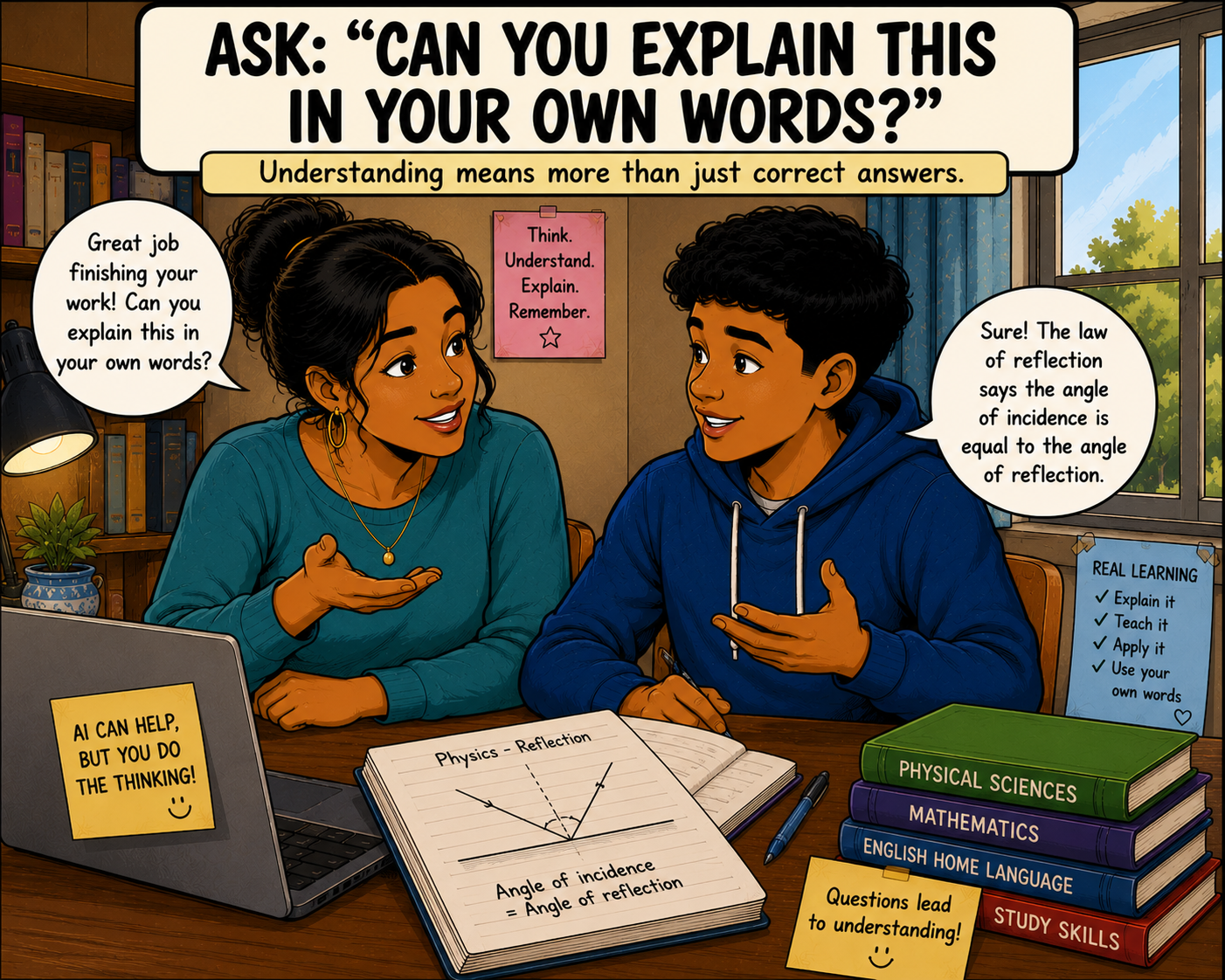
Ask: "Can You Explain This In Your Own Words?"
This is one of the most useful questions parents can ask. If learners truly understand a topic, they should usually be able to explain it using their own words. The explanation does not need to be perfect. It simply needs to show understanding.
If they repeat complicated AI wording without being able to simplify it, they may not fully understand the concept.
Ask: "How Did You Get This Answer?"
Understanding the process matters.
Encourage learners to describe:
Their thinking.
Their method.
Their reasoning.
Their calculations.
Their decisions.
A learner who understands the work can usually explain how they reached the answer.
Ask: "What Did AI Help You With?"
This question encourages honesty.
Children may answer:
"It explained the difficult part."
"It helped me organise my ideas."
"It gave another example."
"It checked my grammar."
These responses suggest AI supported learning. If they struggle to explain how AI helped, more discussion may be needed.
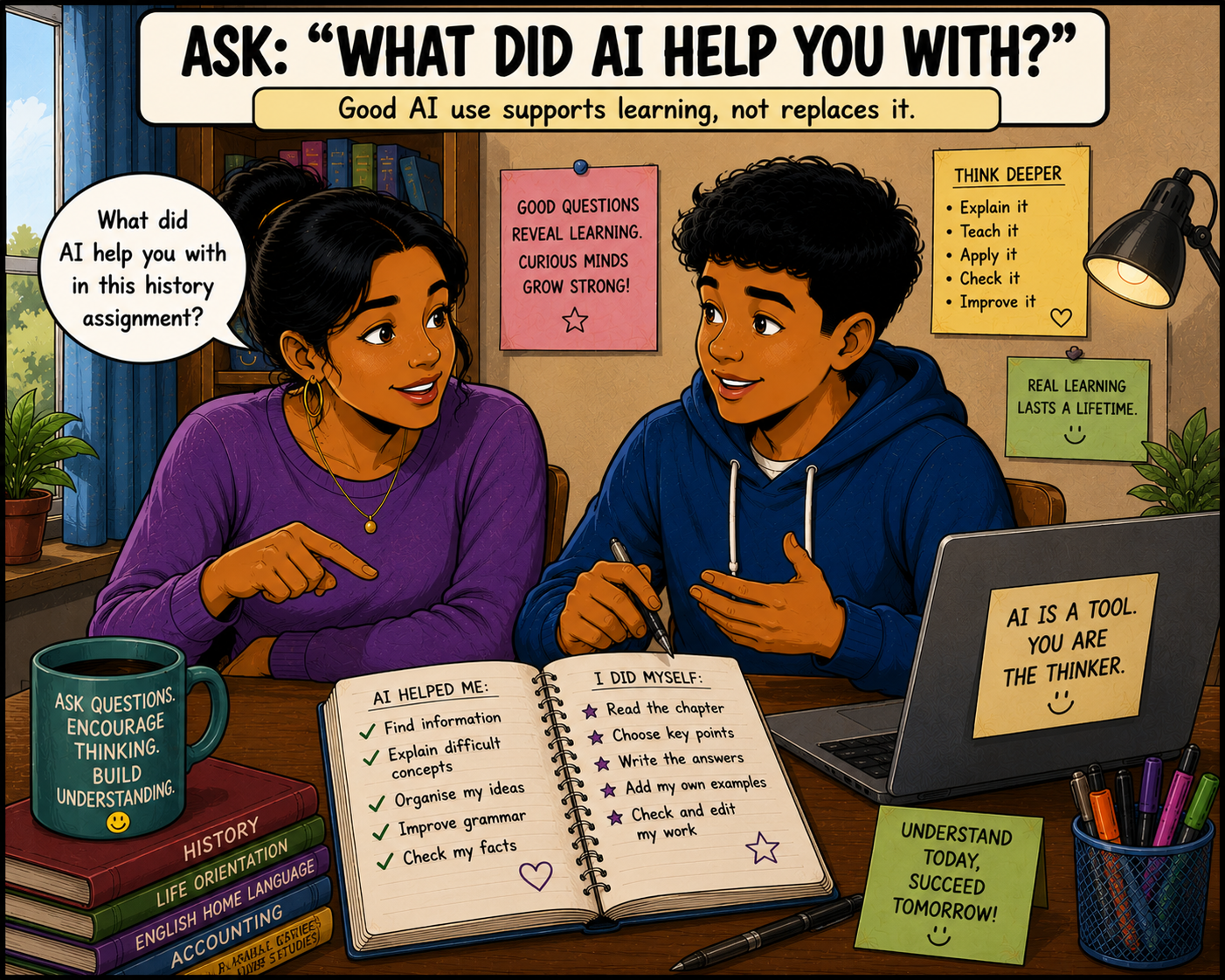
Ask: "What Did You Do Yourself?"
This question helps learners reflect on their own contribution.
Examples include:
Reading the chapter.
Solving calculations.
Researching information.
Planning the essay.
Writing the final draft.
Correcting mistakes.
Parents reinforce the idea that learning requires active participation.
Ask: "What Was The Most Difficult Part?"
This question reveals whether the learner recognised their own challenges. Children who know where they struggled are often better prepared to improve. Parents can then encourage extra practice in those specific areas.
Ask: "Can You Solve Another Similar Question?"
Understanding is easier to recognise when learners apply knowledge to a new example.
For example:
After completing one Mathematics problem, ask them to solve a similar one.
After studying a History topic, ask them to explain a related event.
This tests understanding instead of memory.
Ask: "What Would Happen If...?"
"What would happen if...?" questions encourage deeper thinking.
Examples include:
What would happen if interest rates increased?
What would happen if there was no photosynthesis?
What would happen if this formula changed?
These questions help learners apply knowledge rather than simply repeat facts.
Ask: "Could You Teach This To Someone Else?"
Teaching is one of the best ways to test understanding.
Parents can say: "Pretend I'm your classmate."
Or: "Teach this topic to me."
If learners can explain ideas clearly, understanding is usually growing.
Ask: "Does This Answer Make Sense?"
AI occasionally produces incorrect or confusing information.
Parents should encourage learners to think critically.
Questions include:
Does this seem logical?
Does it match your textbook?
Does it agree with your teacher's notes?
Can you verify it somewhere else?
Critical thinking is one of the most important AI skills learners can develop.
Ask: "Could You Do This Without AI?"
The goal is not to stop learners from using AI. Instead, parents should ask: "If AI disappeared tomorrow, could you still do this?"
The answer helps reveal whether AI is supporting learning or replacing it.
Listen To The Confidence In Their Answers
Parents should pay attention not only to what learners say but also how they say it.
Learners who understand often:
Explain confidently.
Give examples.
Admit uncertainty honestly.
Ask thoughtful questions.
Learners who relied heavily on copying may:
Avoid eye contact.
Change the subject.
Repeat memorised phrases.
Become frustrated by simple follow-up questions.
These observations should lead to supportive conversations, not immediate accusations.
Avoid Turning Every Homework Session Into A Test
Parents should remember that these questions are meant to encourage conversation.
The goal is not to examine children every evening.
Instead:
Stay relaxed.
Choose one or two questions.
Show genuine interest.
Celebrate progress.
Children who enjoy talking about learning become more confident learners.
The South African School Context
South African learners experience very different learning environments. Some attend schools with excellent technology access. Others rely on shared devices, mobile phones, or limited internet connections.
Regardless of resources, every learner benefits from conversations about understanding rather than simply completing work.
Parents should also encourage learners to compare AI explanations with the Curriculum and Assessment Policy Statement (CAPS), their textbooks, class notes, and teacher guidance. AI should strengthen classroom learning, not replace it.
Build A Habit Of Reflection
Reflection helps learners become independent thinkers.
After homework, parents can ask:
What did you learn today?
What was easier than yesterday?
What still feels confusing?
What would you like more practice with?
How did AI help your understanding?
Reflection builds self-awareness. Learners begin recognising their own strengths and weaknesses.
Encourage Honest Answers
Children should never feel they must pretend to understand something. Parents can reassure them by saying: "It's okay not to understand everything yet."
This encourages honesty. Honest learners are much easier to support than learners who feel they must hide confusion.
Help Children See AI As A Learning Partner
Parents can remind learners:
AI should:
Explain.
Guide.
Encourage.
Demonstrate.
Provide practice.
AI should not:
Replace thinking.
Complete assignments.
Hide confusion.
Remove effort.
Keeping this distinction clear helps learners make responsible decisions.
Preparing Children For Lifelong Learning
The questions parents ask today build habits that will benefit children throughout life.
Young people who regularly explain ideas, reflect on their learning, evaluate information, and think independently become stronger learners long after school ends.
Whether they continue to university, technical training, or employment, these skills remain valuable.
Technology will continue changing. Independent thinking will always matter.
Practical Questions Parents Can Keep Handy
Parents do not need a long checklist every evening. A few simple questions are enough.
Some of the best include:
Can you explain this in your own words?
What did AI help you understand?
What did you do yourself?
What was the hardest part?
Could you teach this to me?
How did you reach this answer?
Does this answer make sense?
Could you solve another similar problem?
Would you still understand this without AI?
What did you learn today?
These questions keep the focus where it belongs—on learning.
Conclusion
AI can produce impressive-looking homework, but parents should remember that neat assignments and correct answers do not always reflect genuine understanding. By asking thoughtful follow-up questions, encouraging learners to explain concepts in their own words, and focusing on the learning process rather than only the final result, parents can quickly identify whether AI is strengthening understanding or hiding learning gaps.
The most valuable conversations are not about catching children using AI but about helping them become confident, independent learners. When parents create a home environment where curiosity, honesty, and reflection are encouraged, AI becomes a powerful learning partner instead of a shortcut. The questions asked today can help develop the thinking skills, responsibility, and confidence that learners will carry with them throughout school and into adult life.
Additional Articles in the Helping Your Child Use AI for Schoolwork Responsibly Series
How Parents Can Support Responsible AI Use for Homework
When AI Helps Learning — and When It Becomes a Shortcut
Helping Your Child Use AI to Understand Difficult Subjects
How to Talk to Your Child About AI and School Assignments
Questions Parents Can Ask to Check Whether AI Is Helping or Hiding Learning Gaps
Disclaimer
AI Tools were used to assist with research. Remember to always cross-check everything that you read.