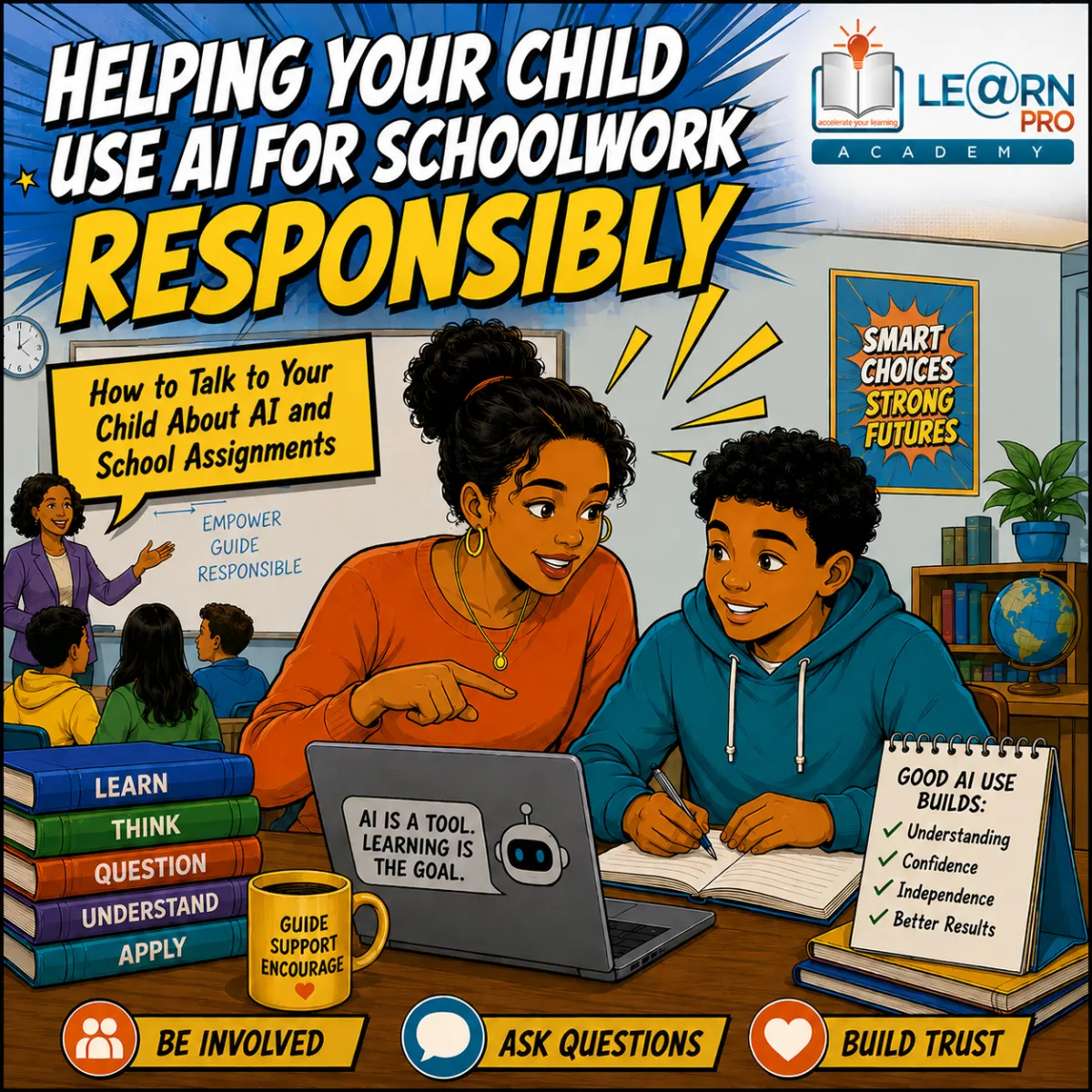
How to Talk to Your Child About AI and School Assignments
This is article #4 of 5 in the Helping Your Child Use AI for Schoolwork Responsibly Series
Introduction
Artificial intelligence (AI) is changing the way many learners complete school assignments, projects, essays, and research tasks. Some learners use AI to explain difficult concepts, organise ideas, improve grammar, or check their understanding. Others may use it to generate complete answers without doing much of the thinking themselves.
For many parents, this creates uncertainty. If you discover that your child has used AI for a school assignment, how should you respond? Should you immediately assume they have cheated? Should AI be completely banned at home? Or is there a better way to guide responsible use?
The answer is rarely as simple as "AI is good" or "AI is bad." What matters most is how it was used and whether genuine learning still took place.
Children are more likely to make responsible choices when they can talk openly with their parents. If every conversation about AI ends in anger or punishment, learners may simply become better at hiding their use of AI. However, if parents respond with curiosity, calm questions, and clear expectations, they can help their children develop honesty, responsibility, and good learning habits.
This article explores practical ways to have positive conversations about AI and school assignments while keeping learning at the centre of every discussion.
Why Conversations Matter More Than Rules
Many parents feel they need to create strict rules about AI. Rules certainly have a place. However, conversations are often even more important. Technology changes quickly. The AI tools available today will not be exactly the same in a few years.
Children therefore need more than rules. They need judgement.
Regular conversations help learners understand:
Why honesty matters.
Why independent thinking is valuable.
How AI should support learning.
When AI use becomes inappropriate.
Parents who talk regularly about technology help children make better decisions even when adults are not watching.
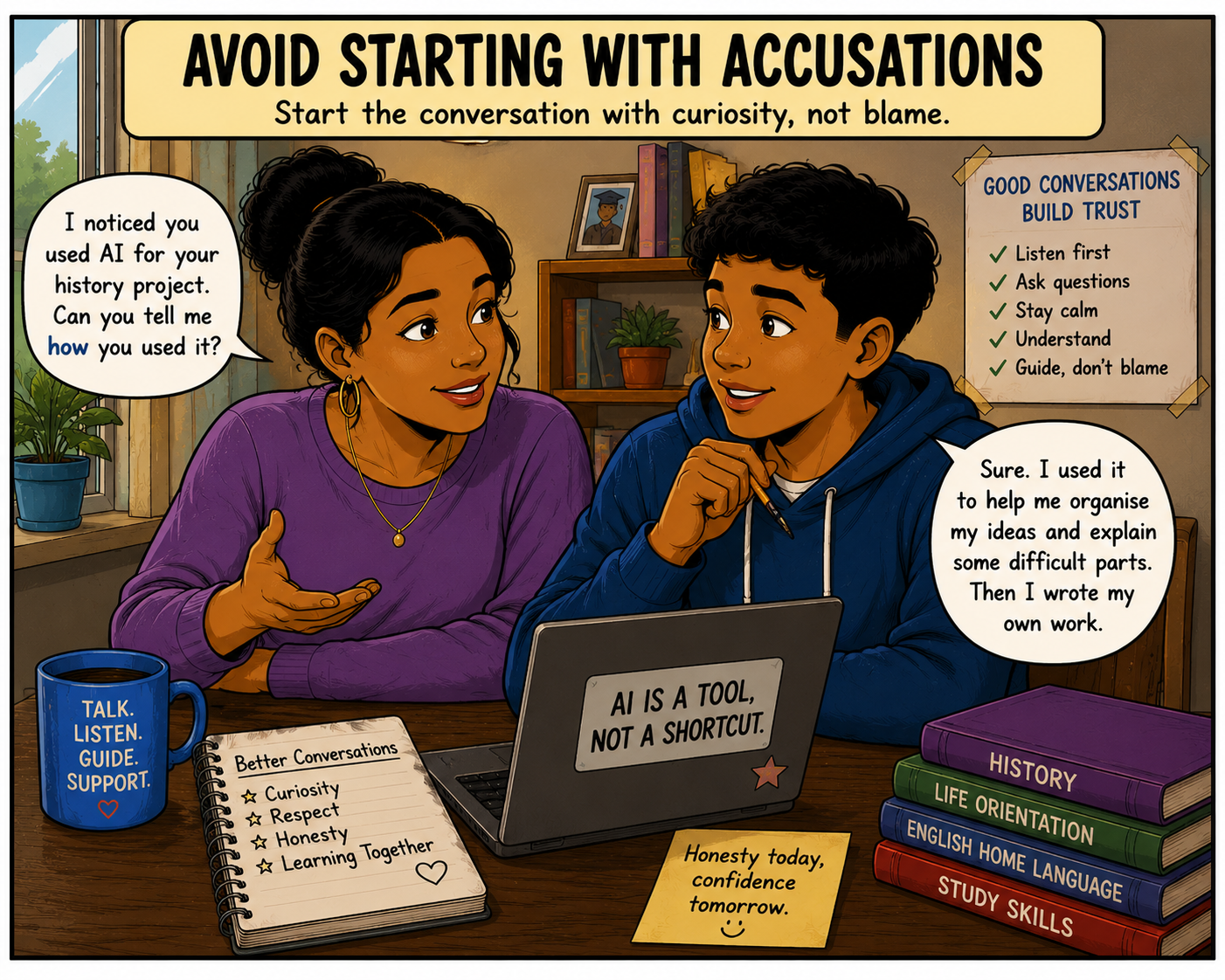
Avoid Starting With Accusations
Imagine discovering that your child used AI for an English essay. Your first reaction may be frustration. However, beginning the conversation with accusations often causes children to become defensive.
Instead of saying: "You cheated!"
Try saying: "I noticed you used AI. Tell me how you used it."
This simple change encourages honesty instead of fear. Children are far more likely to explain what happened when they feel heard.
Understand Why They Used AI
Different learners use AI for different reasons. Some reasons are positive. Others suggest deeper learning problems.
Ask questions such as:
What were you trying to do?
Which part was difficult?
How did AI help?
What did you do yourself?
What did you learn?
Their answers often reveal far more than the assignment itself.
AI Can Be Helpful During Assignments
Parents sometimes assume that any AI use during an assignment is automatically wrong. In many cases, AI can provide valuable support.
Examples include:
Brainstorming ideas.
Explaining difficult concepts.
Improving grammar.
Checking spelling.
Creating study notes.
Clarifying instructions.
Generating practice questions.
These uses still require learners to think independently. The learner remains responsible for the final work.
When AI Crosses The Line
Problems begin when AI replaces the learner's own thinking.
Examples include:
Copying complete essays.
Submitting AI-generated projects.
Presenting AI work as personal work.
Avoiding research completely.
Letting AI answer every question.
In these situations, learning becomes secondary to finishing the assignment.
Parents should explain that honesty matters even when technology makes shortcuts easy.
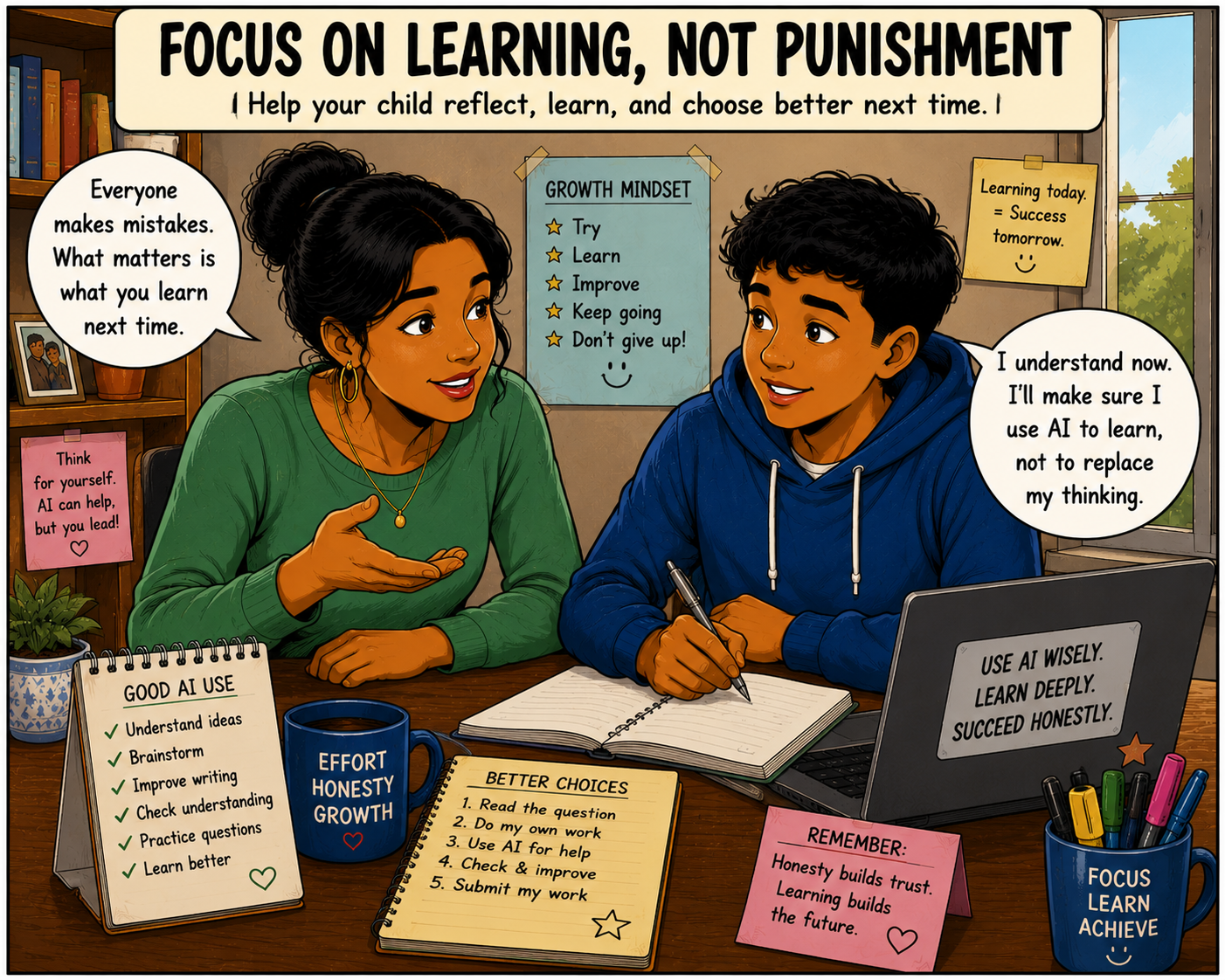
Focus On Learning Rather Than Punishment
If your child admits using AI poorly, the conversation should not end with punishment alone. Instead, ask: "What could you do differently next time?"
This encourages reflection. The goal is to build better habits rather than simply expressing disappointment.
Children learn more when they understand the reason behind expectations.
Encourage Honesty About AI Use
Learners should never feel that they need to hide responsible AI use. Parents can say: "If AI helped you understand something, that's fine. I just want you to be honest about how you used it."
Honesty creates trust. Trust creates better conversations. Better conversations lead to wiser decisions.
Teach The Difference Between Help And Copying
One useful discussion is explaining the difference between receiving help and copying.
Getting help means:
Understanding ideas.
Receiving explanations.
Improving work.
Learning new skills.
Copying means:
Taking someone else's work.
Avoiding effort.
Pretending work is your own.
Parents can ask: "Could you still complete this assignment without copying the AI answer?"
If the answer is yes, AI probably supported learning. If not, it may have replaced it.
Ask Questions That Reveal Understanding
Instead of only reading the finished assignment, ask your child questions.
For example:
Can you explain this idea?
Why did you choose this answer?
What was the hardest part?
What did AI explain?
Which part did you write yourself?
These conversations quickly reveal whether real learning has taken place.
Praise Effort, Not Just Marks
Children often believe that high marks matter more than learning. Parents can change this message.
Praise:
Effort.
Improvement.
Persistence.
Curiosity.
Honest work.
When effort becomes the focus, learners are less likely to search for shortcuts.
Keep Conversations Calm
Some children become nervous whenever schoolwork is discussed. A calm conversation is usually far more productive than an angry lecture.
Parents can:
Listen carefully.
Avoid interrupting.
Stay curious.
Ask follow-up questions.
Explain expectations clearly.
A respectful conversation encourages honesty in future discussions.
Help Children Think About Consequences
Many teenagers focus on finishing today's assignment. Parents can help them think further ahead.
Ask questions like:
What happens if you never learn this topic?
How will this affect your exams?
What if university expects you to do this independently?
Will copying today help you tomorrow?
These questions encourage long-term thinking.
AI Should Build Skills
Every assignment develops certain skills. For example:
An essay develops:
Research.
Planning.
Writing.
Critical thinking.
A Mathematics task develops:
Problem-solving.
Logical reasoning.
Accuracy.
A History assignment develops:
Analysis.
Interpretation.
Evidence evaluation.
Parents can ask: "Did AI help you build these skills, or did it replace them?"
Discuss School Expectations
Different schools may have different rules about AI. Some teachers encourage limited AI use. Others may restrict it for certain assignments.
Parents should encourage learners to:
Read assignment instructions carefully.
Ask teachers when unsure.
Follow school policies.
Be honest about AI assistance.
Learning to follow expectations is an important life skill.
The South African School Context
South African schools differ widely in their access to technology and their approach to AI. Some schools have begun discussing responsible AI use with learners. Others are still developing policies.
Parents should encourage children to use AI responsibly regardless of whether formal rules already exist.
They should also remind learners that the Curriculum and Assessment Policy Statement (CAPS) remains the foundation of classroom learning. AI can support understanding, but it should never replace the knowledge, skills, and assessment standards expected by teachers.
Build Trust Instead Of Fear
Children who fear punishment often become secretive. Children who trust their parents are more likely to ask questions before making poor decisions.
Parents can say: "If you're ever unsure whether it's okay to use AI, come and ask me first."
This keeps communication open.
Help Children Develop Digital Integrity
Integrity means doing the right thing even when nobody is watching. AI makes this especially important.
Children should understand that:
Technology cannot replace honesty.
Good character matters.
Learning has long-term value.
Trust is earned through responsible choices.
These lessons extend far beyond school.
Preparing Children For An AI Future
AI will almost certainly remain part of higher education and many workplaces. The goal is therefore not to teach children to avoid AI. Instead, parents should teach them to use it wisely.
Responsible learners know how to:
Think independently.
Ask thoughtful questions.
Check information.
Improve their own work.
Stay honest.
Continue learning.
These qualities will remain valuable no matter how technology develops.
Practical Conversation Starters
If you are unsure how to begin talking about AI, try questions like these:
How did AI help you today?
What part did you do by yourself?
What new idea did you learn?
Could you explain that topic without AI?
Did AI make anything confusing?
How do you know the answer is correct?
What would your teacher expect you to do yourself?
Simple questions encourage meaningful conversations without creating conflict.
Conclusion
Talking to your child about AI and school assignments does not need to become a battle. The most productive conversations focus on understanding rather than accusations, learning rather than punishment, and honesty rather than secrecy. When parents ask thoughtful questions and show genuine interest in how AI was used, they help children develop the judgement needed to use technology responsibly.
AI will continue to become part of education, but the qualities that matter most remain unchanged. Curiosity, integrity, independent thinking, and a willingness to learn are still the foundations of academic success. By keeping communication open and encouraging responsible choices, parents can help their children use AI as a valuable learning tool while ensuring that real understanding always comes first.
Additional Articles in the Helping Your Child Use AI for Schoolwork Responsibly Series
How Parents Can Support Responsible AI Use for Homework
When AI Helps Learning — and When It Becomes a Shortcut
Helping Your Child Use AI to Understand Difficult Subjects
How to Talk to Your Child About AI and School Assignments
Questions Parents Can Ask to Check Whether AI Is Helping or Hiding Learning Gaps
Disclaimer
AI Tools were used to assist with research. Remember to always cross-check everything that you read.