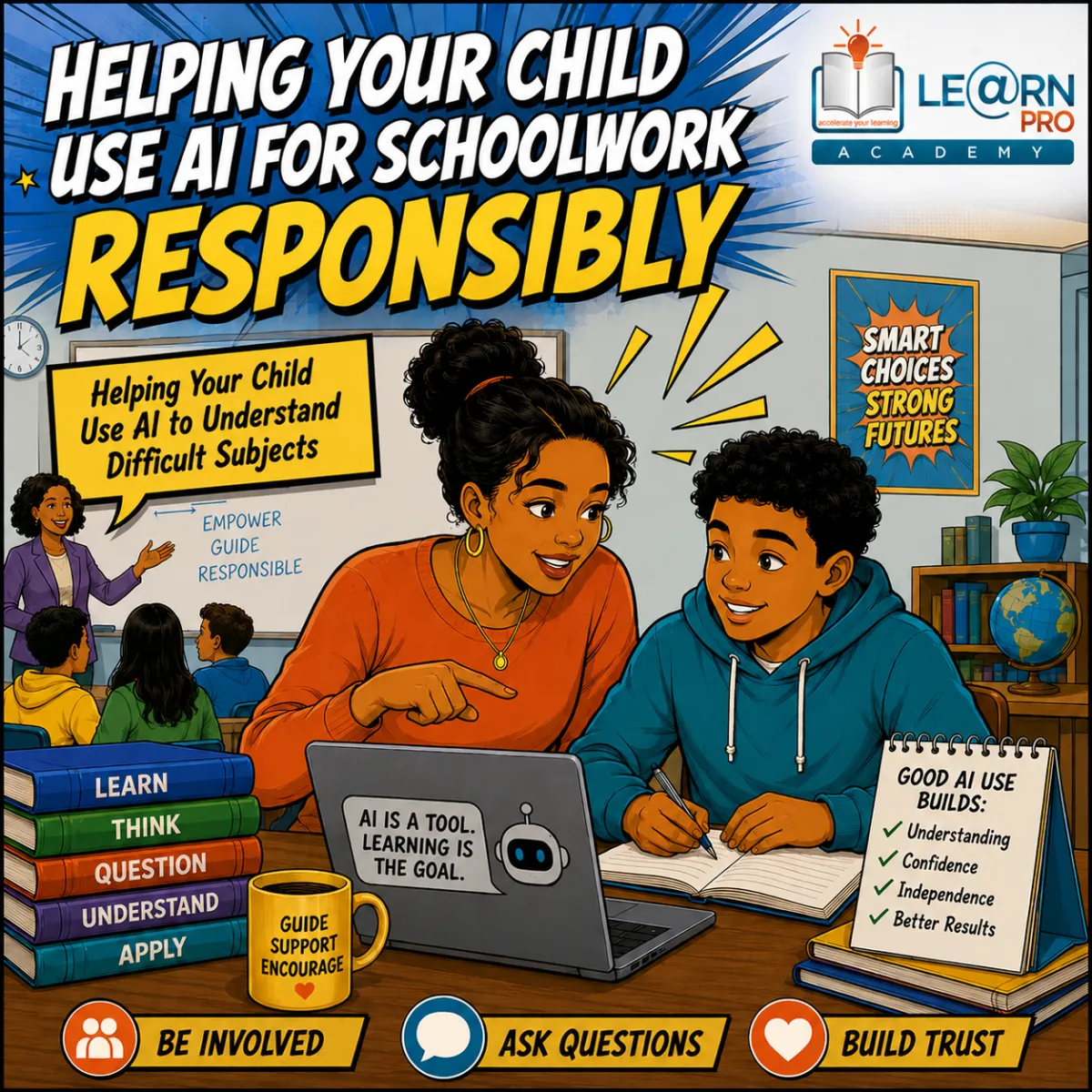
Helping Your Child Use AI to Understand Difficult Subjects
This is article #3 of 5 in the Helping Your Child Use AI for Schoolwork Responsibly Series
Introduction
Every learner reaches a point where schoolwork feels confusing. It might be a complicated Mathematics equation, a difficult Physical Sciences concept, an unfamiliar English literature question, or a challenging Accounting principle. Some learners immediately ask for help, while others stay quiet because they feel embarrassed, worried about looking "slow," or afraid of asking what they think is a silly question.
Artificial intelligence (AI) is changing the way learners can access support. Instead of waiting until the next lesson or struggling alone for hours, learners can ask AI to explain a topic in different ways, use simpler language, provide more examples, or guide them through a problem step by step. When used responsibly, AI can become a patient tutor that is available whenever help is needed.
However, parents also need to understand that AI should explain learning, not replace it. If learners use AI simply to produce answers without understanding the work, they may hide learning gaps that become much bigger before tests and examinations.
The good news is that parents do not need to be experts in every school subject to help. By encouraging the right habits and asking thoughtful questions, they can support their child in using AI to understand difficult topics while still developing independent thinking and confidence.
This article explains how parents can turn AI into a valuable learning partner rather than an easy shortcut.
Every Learner Finds Some Subjects Difficult
No learner finds every school subject equally easy. One learner may enjoy Mathematics but struggle with English. Another may excel in History but find Physical Sciences overwhelming.
Some learners understand concepts quickly, while others need more time and different explanations. This is completely normal.
Parents should avoid comparing brothers, sisters, classmates, or friends. Instead, they should help each child develop confidence in their own learning journey.
Why Learners Sometimes Stop Asking Questions
Many parents assume that if their child is confused, they will simply ask the teacher. Unfortunately, this does not always happen.
Learners may avoid asking questions because they:
Feel embarrassed.
Think everyone else understands.
Fear giving the wrong answer.
Worry about being laughed at.
Believe they should already know the work.
Feel rushed during class.
As a result, confusion grows quietly.
Small misunderstandings can eventually become major learning gaps.
How AI Can Make Asking Questions Easier
One advantage of AI is that learners can ask questions privately.
They can ask:
The same question several times.
For a simpler explanation.
For another example.
For step-by-step guidance.
For different ways of explaining the topic.
AI does not become impatient. It simply continues explaining.
For shy learners, this can build confidence before they ask teachers or classmates for additional help.
AI Can Explain Topics In Different Ways
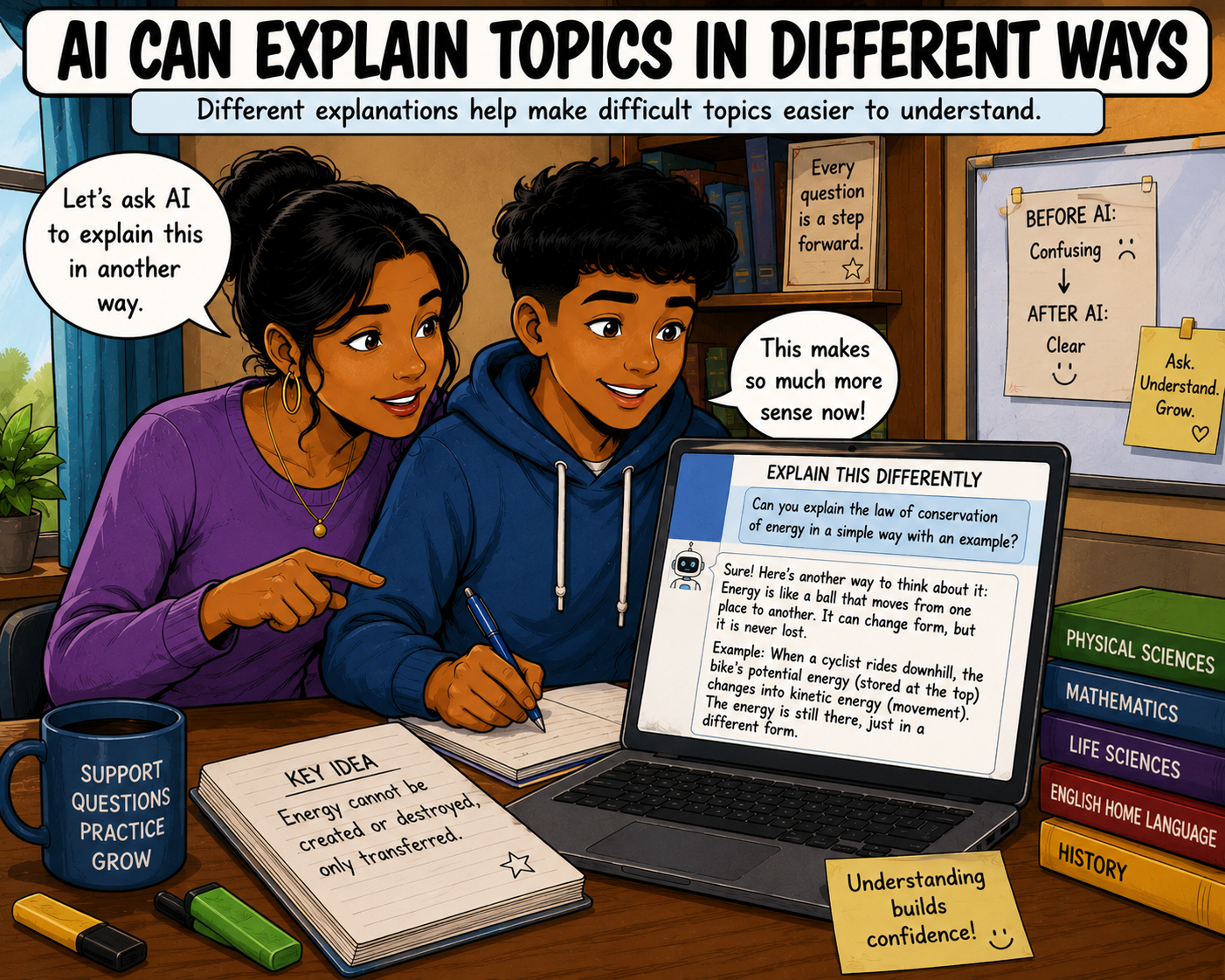
Not every learner understands the same explanation. A textbook may describe a concept using technical language. A teacher may explain it using classroom examples. AI can often explain the same idea differently.
For example, a learner might ask:
"Explain this like I'm in Grade 10."
"Use simple English."
"Give me an everyday example."
"Explain it step by step."
"Compare it to something I already know."
Sometimes hearing the same idea differently is all a learner needs.
Simpler Language Can Build Understanding
Many South African learners study in English even though it is not their first language. Sometimes the difficulty is not the concept itself. The difficulty is the language used to explain it. AI can simplify complex explanations without changing the main idea.
Parents should encourage learners to:
Read the textbook.
Listen in class.
Use AI to simplify confusing sections.
Return to the original material afterwards.
This approach builds both subject knowledge and English vocabulary.
Extra Examples Improve Confidence
One classroom example is often not enough.
AI can create:
More worked examples.
Practice questions.
Different scenarios.
Similar problems with new numbers.
Everyday applications.
The more learners practise, the more confident they become. Parents should encourage practice rather than simply reading explanations.
AI Works Best After The Learner Has Tried
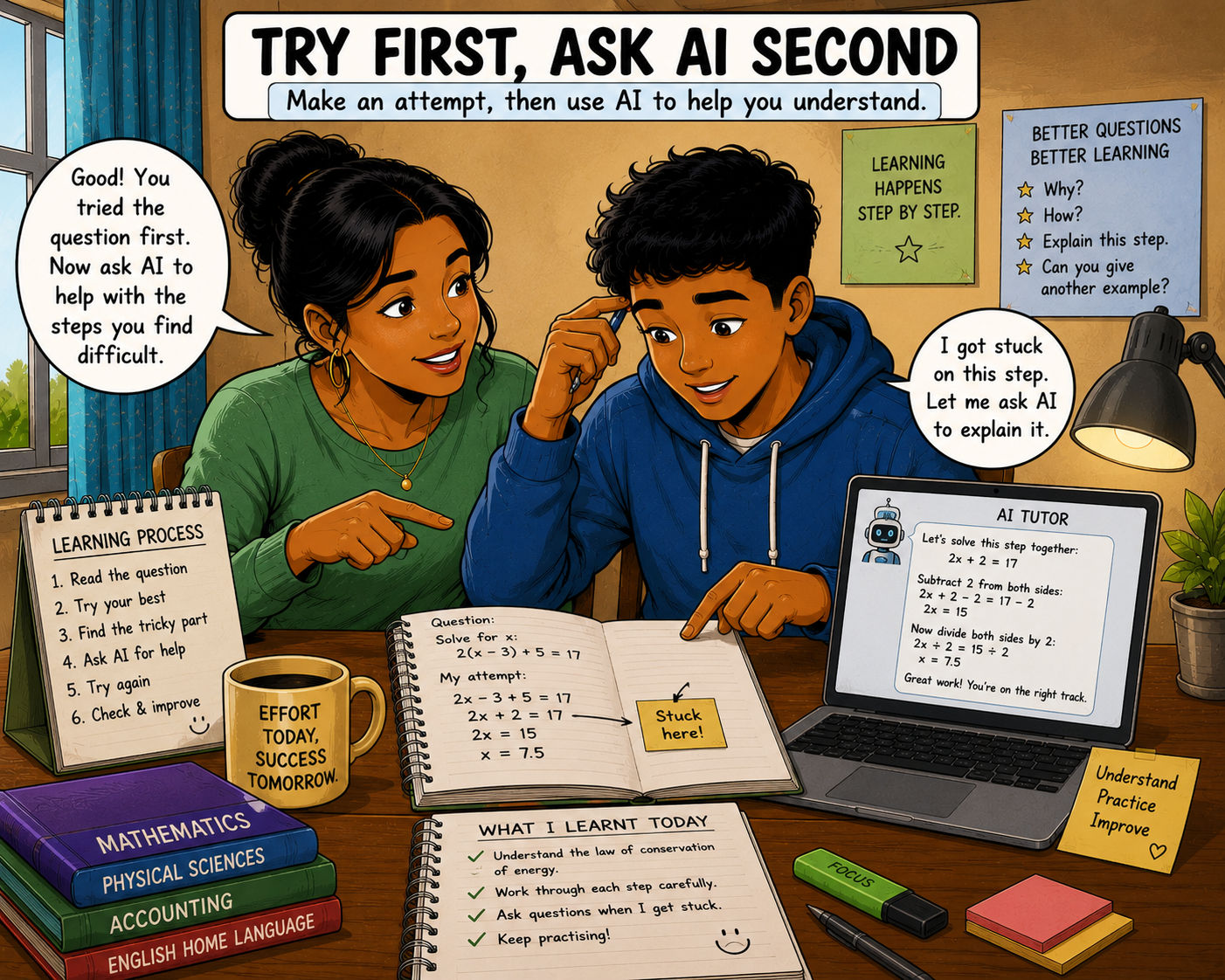
One of the healthiest habits parents can teach is: Try first. Ask AI second.
When learners attempt the work independently, they discover exactly where they become confused. This makes AI explanations much more meaningful.
For example:
Read the question.
Attempt the answer.
Identify the difficult step.
Ask AI to explain only that part.
Try again.
This keeps the learner actively involved.
Encourage Learners To Ask Better Questions
The quality of AI support depends on the quality of the question.
Instead of asking: "Give me the answer."
Encourage questions such as:
"Why does this formula work?"
"Explain this step."
"What mistake did I make?"
"Can you show another example?"
"Can you explain this differently?"
"What should I remember for the exam?"
These questions promote understanding rather than copying.
Different Subjects Need Different Types Of AI Support
Parents do not need detailed subject knowledge to understand how AI can help.
Mathematics
AI can:
Explain formulas.
Show worked examples.
Break calculations into smaller steps.
The learner should still complete the calculations independently.
Physical Sciences
AI can:
Explain scientific concepts.
Describe experiments.
Clarify scientific terms.
Learners should still understand the scientific reasoning behind the answers.
Life Sciences
AI can explain:
Biological processes.
Diagrams.
Human body systems.
Genetics.
Ecology.
Visual explanations and simple comparisons often improve understanding.
English Home Language And First Additional Language
AI can:
Explain vocabulary.
Simplify literature themes.
Improve grammar.
Clarify comprehension questions.
Learners should still write their own responses.
History
AI can:
Explain historical events.
Build timelines.
Compare different viewpoints.
Clarify causes and consequences.
The learner should still analyse information independently.
Geography
AI can simplify:
Climate systems.
Map work.
Population studies.
Geographical processes.
Practice remains essential.
Accounting
AI can:
Explain accounting principles.
Demonstrate calculations.
Clarify financial statements.
Learners should still complete exercises themselves.
Business Studies
AI can:
Explain business concepts.
Provide examples.
Compare theories.
Generate revision questions.
Understanding remains more important than memorising.
Parents Do Not Need To Know Every Answer
Many parents worry because they cannot remember school subjects themselves. Fortunately, they do not need to.
Instead of providing answers, parents can encourage learning by asking questions like:
What part is confusing?
What have you tried?
What did AI explain?
Can you explain it back to me?
Does that answer make sense?
Parents become learning partners rather than subject experts.
Check That Understanding Has Improved
After AI has explained a topic, parents can check whether learning has taken place.
Simple questions include:
Can you explain this without looking?
Can you solve another example?
Could you teach this to someone else?
What was confusing before?
What makes sense now?
If learners can explain ideas in their own words, real understanding is growing.
AI Should Build Confidence, Not Dependence
Confidence grows when learners realise: "I understand this now."
Dependence develops when learners think: "I cannot do anything without AI."
Parents should encourage children to gradually rely more on their own thinking. As confidence grows, learners should need AI less often for familiar topics.
The Importance Of Teachers
AI is helpful, but it does not replace teachers.
Teachers:
Understand the CAPS curriculum.
Know what learners have already studied.
Recognise common misconceptions.
Provide encouragement.
Assess understanding.
Answer follow-up questions.
Parents should encourage learners to continue asking teachers whenever AI explanations remain confusing.
AI works best alongside excellent teaching, not instead of it.
The South African School Context
South African schools vary greatly in resources, class sizes, and access to technology. Some learners receive individual attention. Others learn in busy classrooms where teachers have limited time to answer every question in detail.
In these situations, AI can provide valuable additional support outside school hours.
Parents should also remember that AI explanations may not always match the Curriculum and Assessment Policy Statement (CAPS) exactly. Encourage learners to compare AI responses with their textbooks, class notes, and teacher guidance to make sure they are studying the correct material.
Families who have limited internet access or rely on mobile data can still benefit by using AI selectively for the topics learners find most difficult rather than for every homework task.
Encourage Persistence
Understanding difficult subjects takes time.
Parents can encourage children by reminding them:
Nobody understands everything immediately.
Every expert was once a beginner.
Mistakes help learning.
Practice builds confidence.
Asking questions shows strength, not weakness.
A positive attitude towards learning often matters as much as natural ability.
Building Lifelong Learning Skills
Technology will continue changing long after today's learners leave school. The most successful young people will not simply know how to use AI.
They will know how to:
Ask thoughtful questions.
Solve problems.
Learn independently.
Evaluate information.
Think critically.
Keep improving.
These are lifelong learning skills. AI can help develop them when used responsibly.
Conclusion
AI has the potential to make difficult school subjects less intimidating by providing simpler explanations, additional examples, and patient guidance whenever learners need support. For many learners, especially those who feel shy about asking questions or who need concepts explained in different ways, AI can become a valuable learning companion that builds confidence and understanding.
Parents play an important role in making sure AI remains a tool for learning rather than a shortcut to completed homework. By encouraging children to attempt work first, ask thoughtful questions, explain concepts in their own words, and continue learning from their teachers, parents help build independent learners who are prepared for school, future studies, and a world where technology will remain an important part of everyday life.
Additional Articles in the Helping Your Child Use AI for Schoolwork Responsibly Series
How Parents Can Support Responsible AI Use for Homework
When AI Helps Learning — and When It Becomes a Shortcut
Helping Your Child Use AI to Understand Difficult Subjects
How to Talk to Your Child About AI and School Assignments
Questions Parents Can Ask to Check Whether AI Is Helping or Hiding Learning Gaps
Disclaimer
AI Tools were used to assist with research. Remember to always cross-check everything that you read.