

Signs Your Child May Be Overusing AI for Schoolwork
This is article #3 of 5 in the AI, Cheating, and Academic Honesty at Home Series
Introduction
Artificial intelligence (AI) has become a valuable learning tool for many high school learners. It can explain difficult concepts, create practice questions, improve writing, and help learners organise their study time. Used responsibly, AI can make learning more engaging and help learners become more confident.
However, like any tool, AI can also be overused.
Some learners begin using AI not just to support their learning, but to avoid thinking, writing, researching, or solving problems for themselves. At first, this may seem like a harmless shortcut. Over time, though, it can weaken important skills such as critical thinking, problem-solving, creativity, and independent learning.
Many parents worry about this possibility. They may wonder whether their child is relying too much on AI but feel unsure about what to look for.
The goal is not to become suspicious of every assignment or constantly monitor every online activity. Healthy family relationships are built on trust, not investigation. Instead, parents should learn to notice patterns that suggest AI may be replacing effort rather than supporting learning.
This article explains common warning signs, how to interpret them carefully, and practical ways to help your child develop healthy AI habits.
Remember That Using AI Is Not Automatically A Problem
Before discussing warning signs, it is important to remember that using AI itself is not wrong.
Many learners use AI responsibly by asking it to:
Explain difficult topics.
Check grammar.
Create revision quizzes.
Simplify complex ideas.
Generate study plans.
Review practice answers.
These uses encourage learning.
The concern begins when AI consistently replaces the learner's own thinking instead of supporting it.
Parents should focus on how AI is being used rather than whether it is being used.
Sudden Improvement That Seems Out Of Character
One possible sign is a sudden, dramatic improvement in written work.
For example, your child may suddenly begin producing:
Perfect essays.
Highly advanced vocabulary.
Exceptionally polished assignments.
Professional-looking reports.
Improvement is not automatically suspicious. Learners naturally develop over time, especially when they receive good teaching or work hard.
However, if the improvement happens almost overnight and seems very different from previous work, it may be worth having a gentle conversation.
Avoid making accusations.
Instead, ask: "What helped you improve so much?"
This allows your child to explain their learning process.
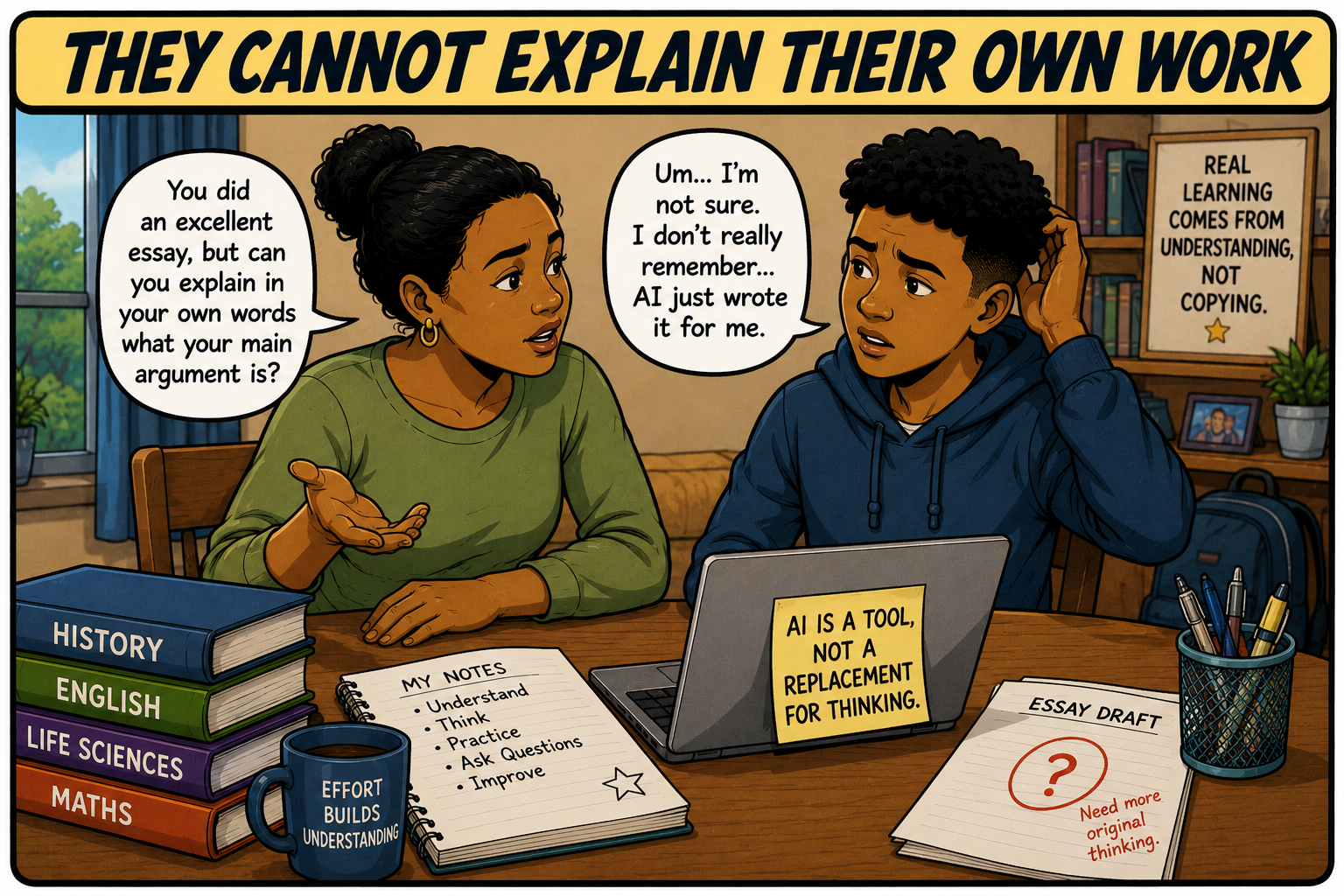
They Cannot Explain Their Own Work
One of the clearest warning signs is when a learner cannot explain what they submitted.
For example:
They cannot define words used in their assignment.
They struggle to explain their conclusions.
They forget how they solved a problem.
They cannot answer simple follow-up questions.
If learners genuinely completed the work themselves, they should usually understand the main ideas.
Parents do not need to test their children.
Simple curiosity is often enough.
Ask: "Can you tell me how you reached this answer?"
or: "What part of this topic did you find most interesting?"
Their response often reveals how much they actually understand.
Strong Homework But Weak Test Results
Sometimes parents notice a puzzling pattern. Homework looks excellent. Tests and examinations do not.
Many reasons can explain this difference, including:
Exam anxiety.
Poor time management.
Stress.
Lack of confidence.
However, another possibility is that homework relied too heavily on AI while tests required independent thinking.
This pattern should encourage conversation rather than immediate conclusions.
Ask your child how they prepared for both situations.
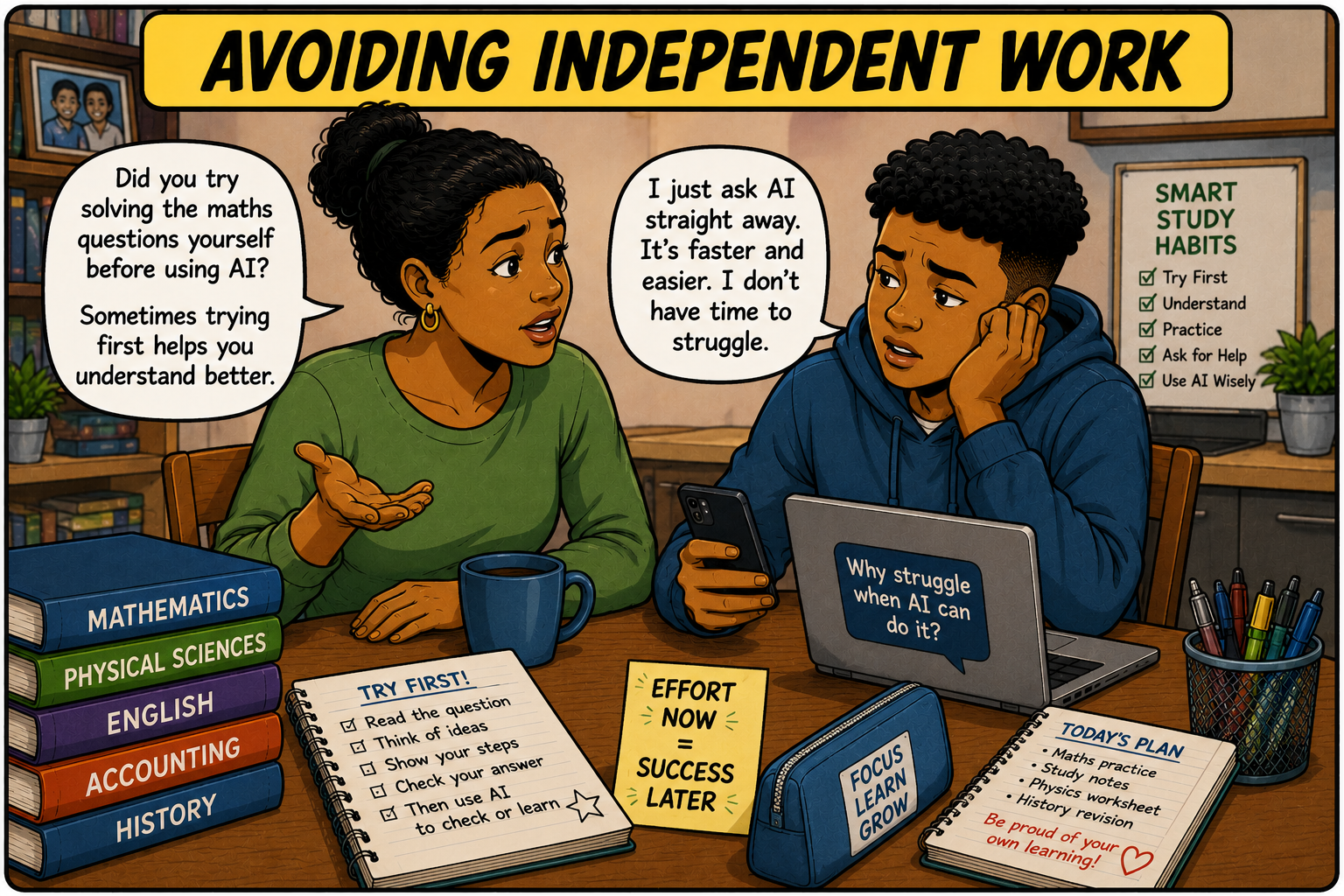
Avoiding Independent Work
Learners who overuse AI sometimes become uncomfortable working without it.
They may:
Delay starting homework until AI is available.
Refuse to attempt questions independently.
Become frustrated quickly.
Give up after only a few minutes.
Immediately ask AI instead of trying first.
Healthy learners usually attempt difficult work before seeking assistance.
Encourage your child to spend some time thinking independently before turning to AI.
Copying Instead Of Learning
AI should encourage understanding. Overuse often looks different.
Some learners simply:
Copy.
Paste.
Submit.
Without:
Reading carefully.
Checking facts.
Making changes.
Understanding the content.
Parents can encourage better habits by asking: "What did AI explain that helped you understand this topic?"
instead of: "Did AI write this?"
This shifts attention toward learning.
Less Interest In Problem Solving
Learning often requires persistence. Children naturally encounter questions they cannot answer immediately. Learners who overuse AI may become less willing to work through challenges.
They may say:
"It's too difficult."
"AI can do it."
"I'll just ask AI."
Problem-solving skills grow through practice.
Parents should encourage children to spend time thinking before looking for immediate answers.
Reduced Confidence Without AI
Surprisingly, overusing AI can reduce confidence. Learners may begin believing they cannot complete work without assistance. They become dependent on AI rather than trusting their own ability.
You may hear comments such as:
"I can't do this without AI."
"I don't know where to start."
"I need AI to help with everything."
Parents can gently remind children of previous successes they achieved independently.
Confidence grows through doing, not watching.
Spending Less Time Reading
AI summaries are useful. However, they should not completely replace reading.
Learners who overuse AI may stop:
Reading textbooks.
Reviewing teacher notes.
Using study guides.
Researching multiple sources.
Instead, they rely only on short AI summaries. This often limits deeper understanding.
Encourage your child to use AI as one resource among many.
Rushing Through Homework
Homework that once took an hour suddenly takes ten minutes. Sometimes this simply means learners have become more efficient. Other times, AI may be completing most of the work.
Rather than assuming the worst, ask questions such as: "What helped you finish so quickly today?"
This encourages honest conversation without creating conflict.
Less Pride In Their Own Work
Children who genuinely create something often enjoy discussing it. Learners who relied heavily on AI sometimes show less interest in talking about their assignments.
They may:
Avoid questions.
Change the subject.
Show little enthusiasm.
Treat assignments as tasks to finish rather than opportunities to learn.
Parents can encourage reflection by asking what they enjoyed or found challenging.
Difficulty Thinking Critically
AI often provides immediate answers. Over time, excessive dependence may reduce independent thinking.
Learners may struggle to:
Compare ideas.
Evaluate evidence.
Form personal opinions.
Explain reasoning.
Question information.
Parents can strengthen critical thinking by asking:
"What do you think?"
"Do you agree with this answer?"
"Why?"
These conversations help children practise reasoning.
Becoming Frustrated When AI Is Unavailable
Technology does not always work. Internet connections fail. Devices run out of battery. AI services may become unavailable.
Learners who depend heavily on AI sometimes become unusually anxious when they cannot access it.
Healthy learners can continue working independently while using AI only when appropriate.
Using AI For Every Subject
Different subjects require different learning approaches.
AI can support:
Mathematics.
Science.
Languages.
History.
Business Studies.
But learners should not automatically use AI for every task.
Sometimes:
Reading.
Practising.
Memorising.
Discussing.
Experimenting.
are more effective.
Encourage your child to think about when AI genuinely adds value.
Declining Writing Skills
One surprising consequence of AI overuse is weaker writing.
If AI always creates:
Introductions.
Conclusions.
Paragraphs.
Summaries.
the learner loses opportunities to practise these skills.
Watch for situations where your child becomes reluctant to write anything without AI support.
Writing improves through regular practice.
Always Choosing The Quickest Answer
Technology often encourages speed. Learning requires patience. Children who overuse AI sometimes focus only on finishing work quickly.
Parents can encourage a different mindset by asking: "What did you learn?"
instead of: "Have you finished?"
Learning should remain more important than speed.
More Concern About Marks Than Learning
Overreliance on AI often shifts attention toward results.
Learners become focused on:
High marks.
Perfect assignments.
Fast completion.
rather than:
Understanding.
Improvement.
Growth.
Curiosity.
Parents can help restore balance by celebrating effort, persistence, and progress.
Ignoring Teacher Feedback
Learners who depend heavily on AI sometimes pay less attention to teacher comments. They assume AI already produced the "best" answer.
However, teachers provide valuable guidance that AI cannot always replace.
Encourage your child to:
Read teacher feedback.
Correct mistakes.
Ask questions.
Reflect on improvements.
This builds genuine learning.
Healthy AI Use Looks Different
Responsible AI users usually:
Attempt work independently first.
Ask AI to explain difficult concepts.
Check information carefully.
Rewrite ideas using their own words.
Continue reading textbooks.
Ask teachers for help when needed.
Reflect on what they have learned.
These habits strengthen learning rather than replacing it.
What Parents Should Avoid
If you suspect your child may be relying too heavily on AI, avoid becoming a detective.
Avoid:
Secretly checking every assignment.
Constantly accusing your child.
Assuming every good mark came from AI.
Creating fear around technology.
Instead, build trust through open conversations.
Most learners respond better to curiosity than criticism.
How To Start The Conversation
A calm discussion is often more effective than an interrogation.
You could ask:
How do you normally use AI?
What subjects does it help you most with?
Which tasks do you still complete on your own?
Do you think AI ever makes learning too easy?
What would happen if you had to complete this work without AI?
These questions encourage honesty while helping children reflect on their own habits.
Helping Your Child Build Better AI Habits
Parents can encourage simple routines that reduce overdependence.
For example:
Attempt every question before asking AI.
Spend at least fifteen minutes thinking independently.
Use AI to explain, not replace.
Check AI answers using textbooks.
Rewrite information in your own words.
Review mistakes carefully.
Ask teachers for help when necessary.
Small habits create long-term independence.
Building Confidence Instead Of Dependence
Ultimately, parents want children who believe:
"I can solve difficult problems."
"I can learn new things."
"I can improve with practice."
AI should strengthen these beliefs — not replace them.
Children who trust their own ability will use AI wisely because they see it as a helpful assistant rather than the source of every answer.
Conclusion
Most learners who use AI are not trying to avoid learning. They are often looking for support, saving time, or trying to cope with busy school schedules. However, when AI begins replacing independent thinking, writing, and problem-solving, it can slow the development of important lifelong skills.
Parents do not need to become detectives or ban AI completely. Instead, they can watch for patterns, ask thoughtful questions, and encourage habits that keep learning at the centre of every assignment. By focusing on understanding rather than suspicion, and on growth rather than perfection, families can help learners enjoy the benefits of AI while continuing to build confidence, resilience, honesty, and independent thinking — qualities that will remain valuable long after today's AI tools have evolved.
Additional Articles in the AI, Cheating, and Academic Honesty at Home Series
What Counts as Cheating When Your Child Uses AI?
How to Talk About Honesty When AI Can Do the Work So Easily
Signs Your Child May Be Overusing AI for Schoolwork
How to Respond If You Discover Your Child Used AI Dishonestly
Building a Home Culture of Effort, Not Shortcuts
Disclaimer
AI Tools were used to assist with research. Remember to always cross-check everything that you read.