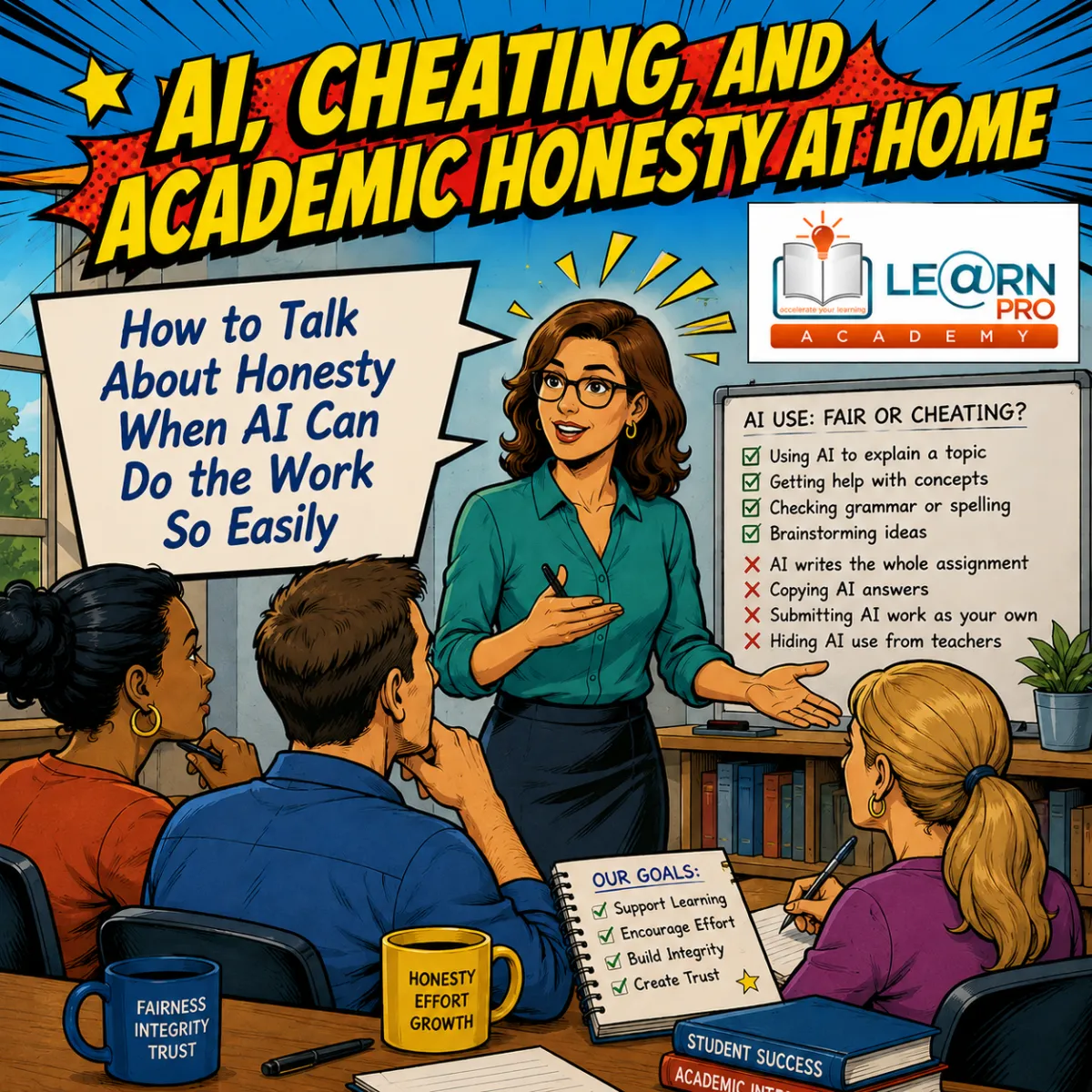
How to Talk About Honesty When AI Can Do the Work So Easily
This is article #2 of 5 in the AI, Cheating, and Academic Honesty at Home Series
Introduction
Artificial intelligence (AI) has changed the way many learners approach schoolwork. With only a few words typed into an AI tool, they can receive essays, summaries, explanations, speeches, project ideas, or even complete homework answers in seconds. For many parents, this creates a difficult question: How do you teach honesty when technology makes shortcuts so easy?
It is natural to worry. Parents want their children to succeed, but they also want them to grow into trustworthy, responsible adults. Simply telling a learner, "Don't cheat," is no longer enough. Young people need to understand why honesty matters, even when nobody is watching and even when technology makes dishonest choices seem easy.
The goal is not to make children afraid of AI. Instead, parents should help them understand that AI is a powerful learning tool when used responsibly, but it should never replace effort, personal responsibility, or genuine learning.
This article explores practical ways parents can talk about honesty, build trust, and help their children develop strong values in a world where AI can often do the work for them.
Why Honesty Still Matters In The Age Of AI
Some learners wonder why they should complete work themselves when AI can produce good answers almost instantly.
This is an understandable question. The answer is simple. School is not only about producing assignments. It is about developing knowledge, skills, habits, and character.
Every assignment helps learners practise:
Thinking independently
Solving problems
Communicating clearly
Managing time
Learning from mistakes
Developing perseverance
If AI completes all the work, those important skills are never fully developed.
Parents can remind their children that the purpose of education is not simply earning marks. It is becoming capable, confident, and prepared for adult life.
Understand Why Learners Feel Tempted
Before discussing honesty, it helps to understand why learners sometimes make poor choices. The temptation to misuse AI is often driven by pressure rather than laziness.
Some common reasons include:
Fear of failing
Heavy homework loads
Pressure to achieve high marks
Lack of confidence
Poor time management
Feeling overwhelmed
Comparing themselves to classmates
Wanting quick results
When parents understand these pressures, conversations become more supportive instead of judgmental.
Rather than asking, "Why did you cheat?" consider asking, "What made this assignment feel so difficult?"
This opens the door to honest discussion.
Move Beyond "Don't Cheat"
Many parents focus only on the rule:
"Don't cheat."
While this is important, children also need to understand the reason behind the rule.
Try explaining ideas such as:
Honesty builds trust.
Learning requires effort.
Mistakes help people improve.
Shortcuts often create bigger problems later.
Real success comes from genuine ability.
When children understand the purpose behind honesty, they are more likely to choose it even when no one is supervising them.
Explain That AI Is A Tool, Not A Worker
One of the simplest ways to explain responsible AI use is to compare it with other tools.
You might say:
"A calculator helps you calculate, but you still need to understand mathematics."
"A dictionary explains words, but it does not write your essay."
"AI should help you learn, not do your learning for you."
This simple comparison helps learners understand where the line between support and dishonesty often lies.
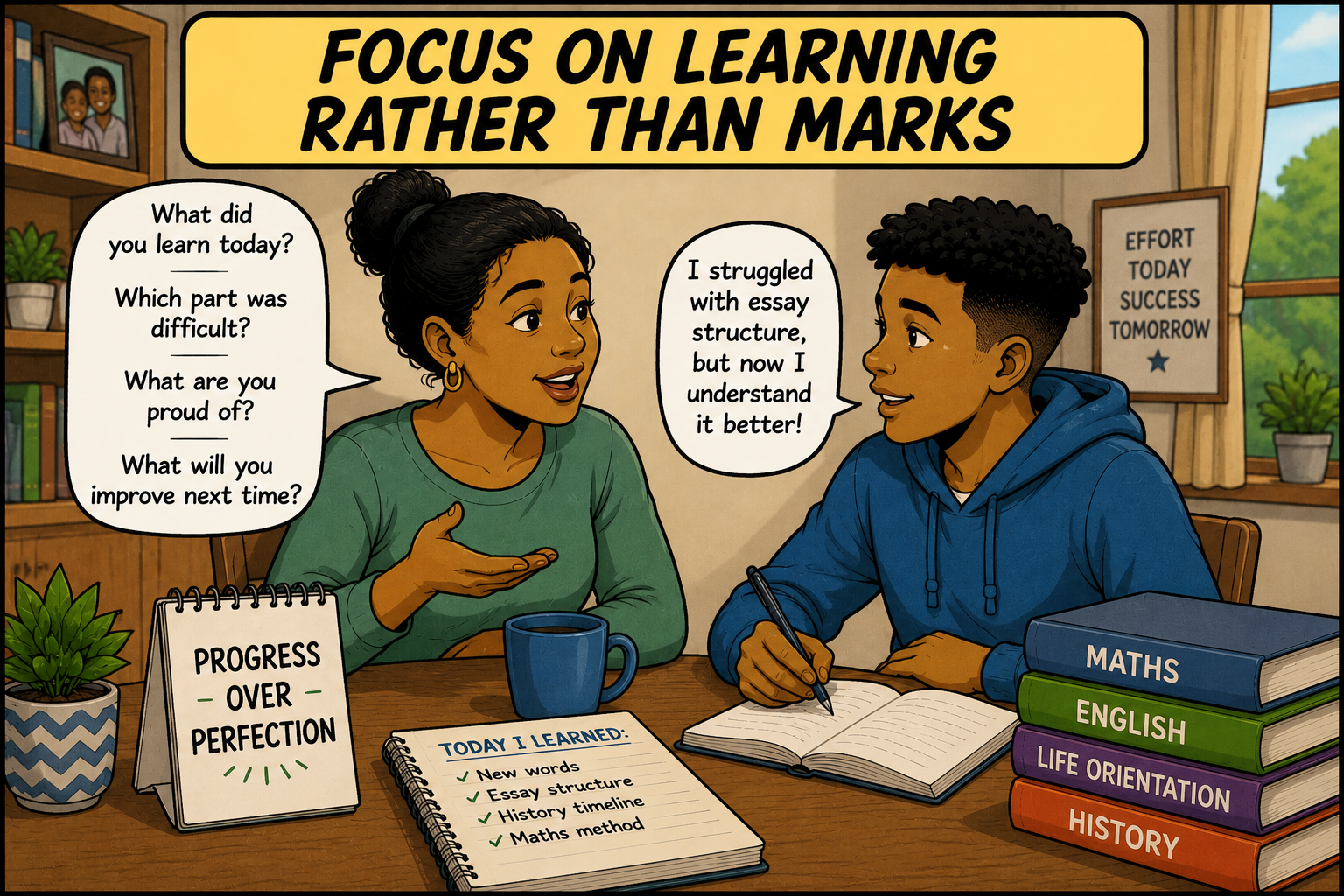
Focus On Learning Rather Than Marks
Many children believe high marks are the most important measure of success.
Parents sometimes unintentionally reinforce this idea.
Questions like:
"What mark did you get?"
can be balanced with questions such as:
What did you learn?
Which part was difficult?
What are you proud of?
What would you improve next time?
What did you discover that you did not know before?
When learning becomes the main focus, learners feel less pressure to find shortcuts.
Teach That Everyone Learns Through Struggle
One of AI's greatest attractions is that it removes struggle. Unfortunately, struggle is often where real learning happens.
Think about learning to:
Ride a bicycle
Drive a car
Swim
Play a musical instrument
Speak another language
Nobody masters these skills without making mistakes. School is no different.
When learners work through difficult questions themselves, their brains build stronger understanding.
Parents can reassure children that finding work difficult does not mean they are failing.
It means they are learning.
Praise Effort As Much As Results
Children naturally repeat behaviours that receive positive attention.
If parents only celebrate excellent marks, learners may feel pressure to achieve those marks at any cost.
Instead, praise qualities such as:
Persistence
Improvement
Hard work
Responsibility
Curiosity
Honesty
Careful preparation
For example: "I'm proud that you kept trying even when the maths questions were difficult."
or "I like that you rewrote your assignment after getting feedback."
This teaches children that effort has value, even before perfect results appear.
Help Your Child Build Confidence
Sometimes learners misuse AI because they doubt their own ability.
They may believe:
"My writing is not good enough."
"I'll never understand this."
"Everyone else is smarter."
Parents can help by reminding children that ability grows through practice. Encourage them to see mistakes as opportunities to improve rather than signs of failure.
Confident learners are usually less dependent on shortcuts.
Discuss Real-Life Consequences
Children sometimes think cheating only affects school marks.
Parents can explain that honesty matters throughout life.
Imagine:
An accountant who never learned accounting properly.
A nurse who copied all their assignments.
An engineer who never understood mathematics.
An electrician who skipped learning safety procedures.
In every profession, people depend on genuine knowledge. School prepares learners for those future responsibilities.
Honesty today protects competence tomorrow.
Encourage Questions Instead Of Secret AI Use
Some learners hide their AI use because they expect punishment. Parents can create a safer environment by encouraging openness.
Try saying: "If you use AI, tell me how you used it."
or: "If you are unsure whether something is acceptable, let's discuss it together."
This shifts the conversation from secrecy to responsible decision-making.
Teach Children To Ask Better AI Questions
Rather than banning AI, show learners how to use it wisely.
Instead of asking: "Write my essay."
Encourage prompts like:
Explain this concept in simpler language.
Give me three examples.
Help me understand where I made a mistake.
Test me with quiz questions.
Suggest ways to improve my introduction.
These prompts encourage learning instead of replacing it.
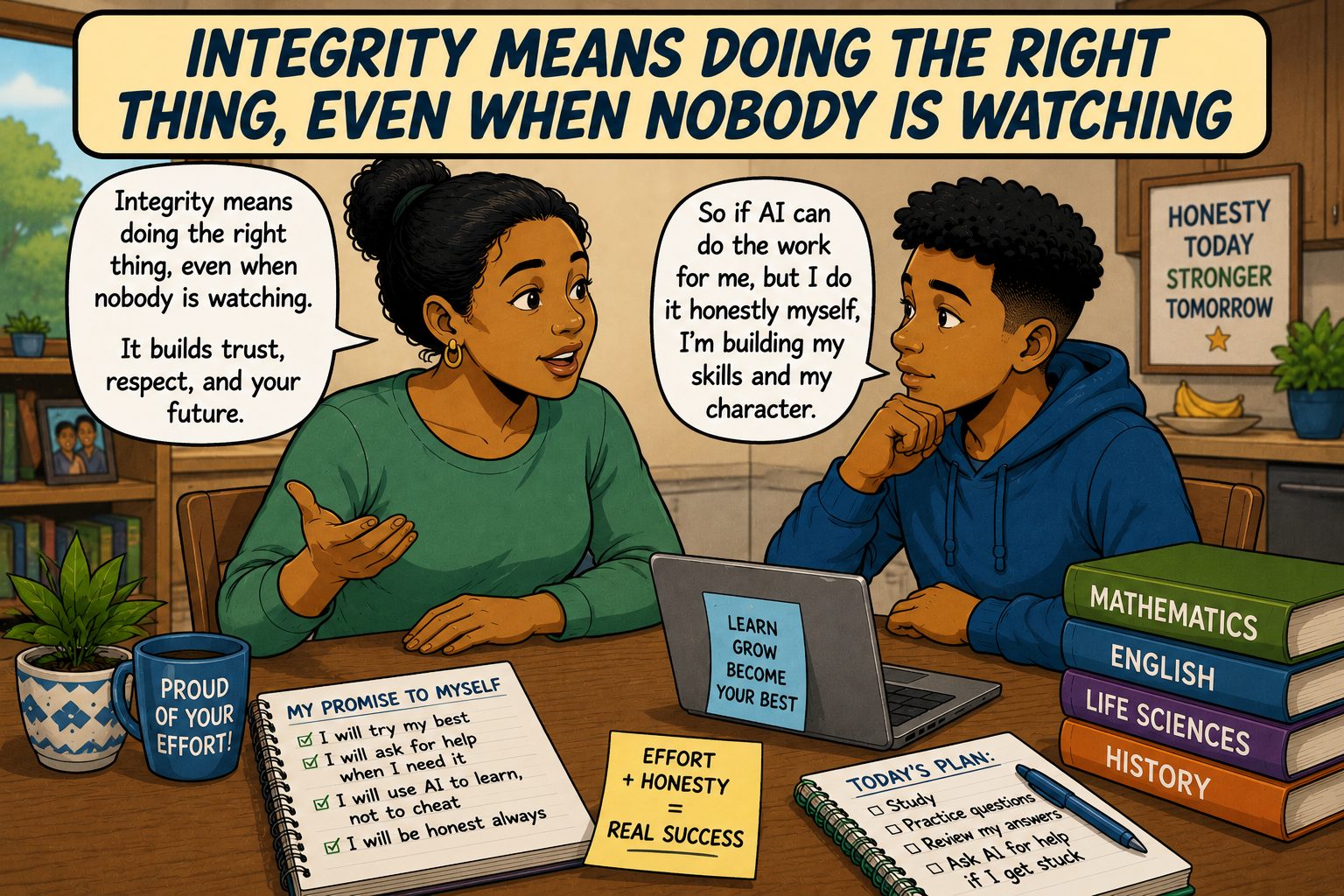
Explain That Integrity Means Doing The Right Thing
Integrity is a word many learners hear but do not always understand. Parents can explain it simply.
Integrity means choosing to do the right thing even when:
Nobody is watching.
It would be easier not to.
You might get away with dishonest behaviour.
Others are making poor choices.
Integrity becomes part of a person's character.
It is built through many small decisions made every day.
Talk About Trust
Trust is one of the most valuable things parents and children share.
When learners complete work honestly:
Teachers trust them.
Parents trust them.
Friends trust them.
Future employers will trust them.
Dishonesty may produce short-term success, but it often damages long-term trust. Parents can explain that trust takes years to build and only moments to lose.
Show That Mistakes Are Acceptable
Many learners cheat because they fear making mistakes. Parents can change this by making mistakes feel safe.
Instead of reacting with disappointment when marks are low, ask:
What made this difficult?
What could we do differently?
What support would help next time?
Which topic needs more practice?
Children who know mistakes are acceptable are more likely to ask for help instead of looking for shortcuts.
Avoid Turning AI Into The Enemy
It can be tempting to blame AI itself. However, AI is simply a tool. The real issue is how people choose to use it.
If parents describe AI as something dangerous or forbidden, children may become secretive instead of responsible.
Instead, explain that every powerful tool requires good judgment.
Just as people learn to use the internet safely, they must also learn to use AI responsibly.
Set Clear Family Expectations
Children benefit from knowing what is expected.
Families can agree on simple guidelines such as:
Attempt homework before using AI.
Use AI to understand difficult topics.
Never copy AI answers directly.
Always read and check AI responses.
Follow school rules regarding AI.
Be honest about when AI has been used.
Having clear expectations removes uncertainty.
Lead By Example
Children notice how adults use technology. If parents use AI, they can explain their own choices.
For example: "I asked AI to help me organise my ideas, but I still wrote the report myself."
or: "I used AI to check my grammar before sending the email."
These examples show that adults also use AI responsibly.
Children often learn more from what parents do than from what they say.
Encourage Independent Thinking
One of the greatest gifts parents can give their children is confidence in their own thinking.
Ask open-ended questions such as:
What do you think?
Why do you agree?
Can you explain that idea?
What evidence supports your answer?
Is there another solution?
These conversations teach learners that their own ideas matter.
They become less likely to depend entirely on AI for answers.
Build Long-Term Character Instead Of Short-Term Success
Parents naturally want their children to achieve good marks. However, character lasts much longer than any school report.
Qualities such as:
Honesty
Responsibility
Perseverance
Self-discipline
Respect
Curiosity
will continue to benefit learners throughout university, work, relationships, and adult life. AI technology will continue to change.
Strong character will always remain valuable.
Keep Communication Open
Conversations about honesty should not happen only after something goes wrong.
Talk regularly about:
School experiences
New technology
Difficult assignments
Peer pressure
Responsible AI use
Personal responsibility
When communication is open, children feel comfortable asking questions before making poor decisions.
Parents become trusted guides rather than only rule enforcers.
Helping Your Child Prepare For An AI Future
AI will almost certainly become part of nearly every profession. Your child needs more than technical skills. They also need judgment.
Responsible learners understand:
When AI is appropriate.
When independent work is expected.
How to verify information.
How to think critically.
Why honesty matters.
These habits will prepare them not only for school but also for university, future careers, and lifelong learning.
The goal is not to raise children who avoid AI.
The goal is to raise children who know how to use AI wisely, ethically, and responsibly.
Conclusion
Talking about honesty in the age of AI requires more than warning children not to cheat. Parents have an opportunity to help their learners understand the deeper values of integrity, effort, responsibility, and genuine learning.
By focusing on character rather than simply marks, praising persistence as much as achievement, and keeping conversations open and supportive, parents can help their children make wise choices even when shortcuts are easy. AI may continue to become more powerful, but honesty, critical thinking, and personal responsibility will always be among the most valuable skills a young person can develop.
Additional Articles in the AI, Cheating, and Academic Honesty at Home Series
What Counts as Cheating When Your Child Uses AI?
How to Talk About Honesty When AI Can Do the Work So Easily
Signs Your Child May Be Overusing AI for Schoolwork
How to Respond If You Discover Your Child Used AI Dishonestly
Building a Home Culture of Effort, Not Shortcuts
Disclaimer
AI Tools were used to assist with research. Remember to always cross-check everything that you read.