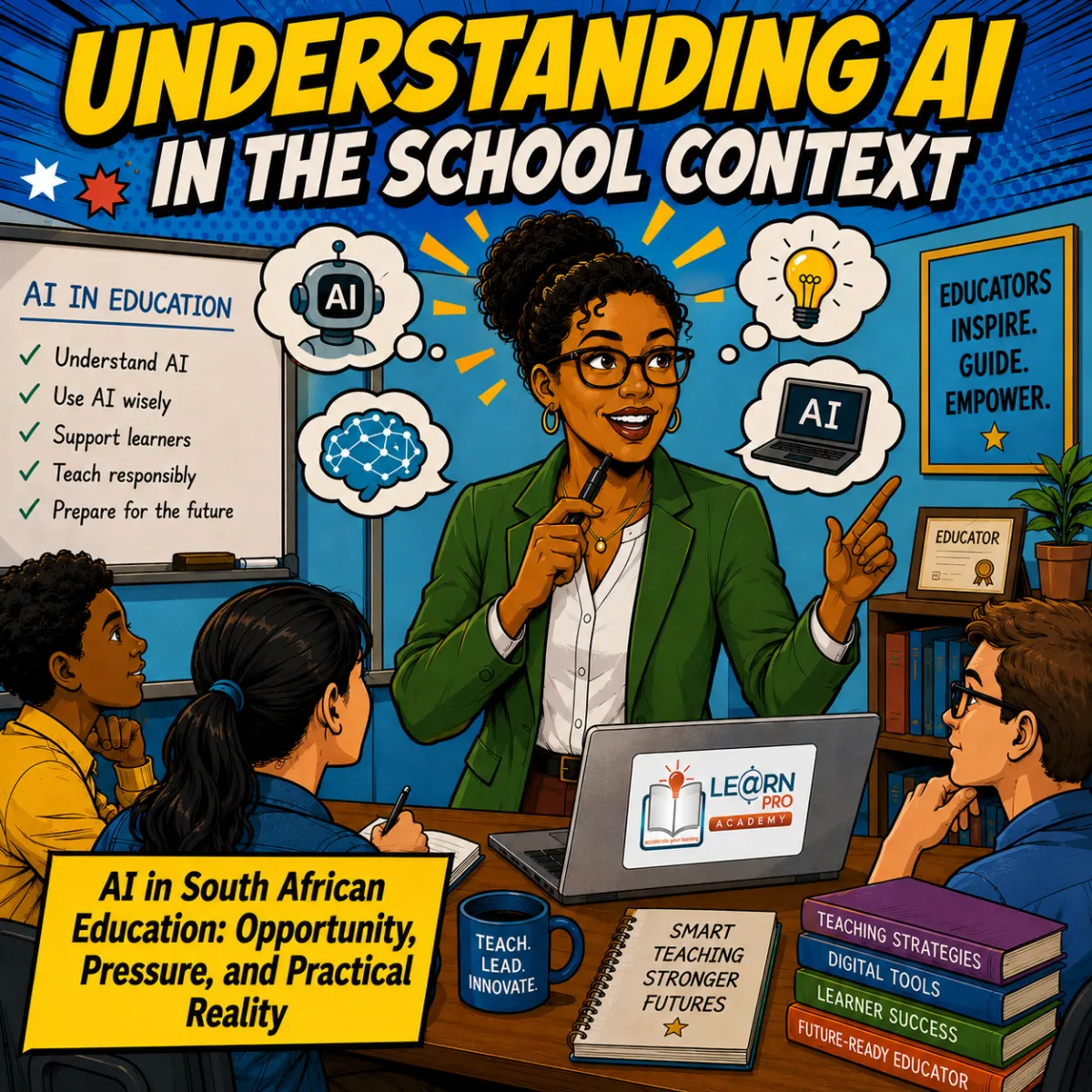
AI in South African Education: Opportunity, Pressure, and Practical Reality
This is article #5 of 5 in the Understanding AI in the School Context Series
Introduction
Artificial Intelligence (AI) is transforming education across the world, but it is important to remember that education does not look the same in every country — or even in every school. South Africa has one of the most diverse education systems in the world. Some schools have modern computer laboratories, reliable internet access, and learners with personal devices, while others continue to face challenges such as limited connectivity, shared resources, large class sizes, and frequent interruptions to teaching.
Because of these differences, AI cannot be viewed as a one-size-fits-all solution. While it offers exciting opportunities to improve teaching, reduce administrative workload, personalise learning, and support learners, it also raises practical questions about access, fairness, academic integrity, and educator readiness.
For South African educators, the goal is not to adopt every new AI tool immediately. Instead, it is to understand where AI genuinely adds value, recognise its limitations, and use it in ways that support learners within the realities of their own school environment.
This article explores both the opportunities and the challenges of AI in South African education and provides practical guidance for educators who want to approach this rapidly changing technology with confidence and balance.
Every South African School Is Different
One of the first realities educators must recognise is that there is no single "South African classroom."
Schools differ significantly in terms of:
Internet connectivity
Electricity reliability
Learner access to smartphones
Computer facilities
Teacher workloads
School budgets
Class sizes
Language diversity
Community resources
A strategy that works well in one school may not be practical in another.
AI should therefore be viewed as a flexible tool rather than a universal solution.
The Opportunity: Better Access To Learning Support
One of AI's greatest strengths is its ability to provide additional learning support outside normal classroom hours.
Learners can ask AI to:
Explain difficult concepts.
Generate revision questions.
Create summaries.
Improve writing.
Practise mathematics.
Translate vocabulary.
Build study plans.
For learners who are motivated and have access to suitable technology, AI can become an additional source of academic support.
Importantly, this support does not replace teachers.
It supplements classroom learning.
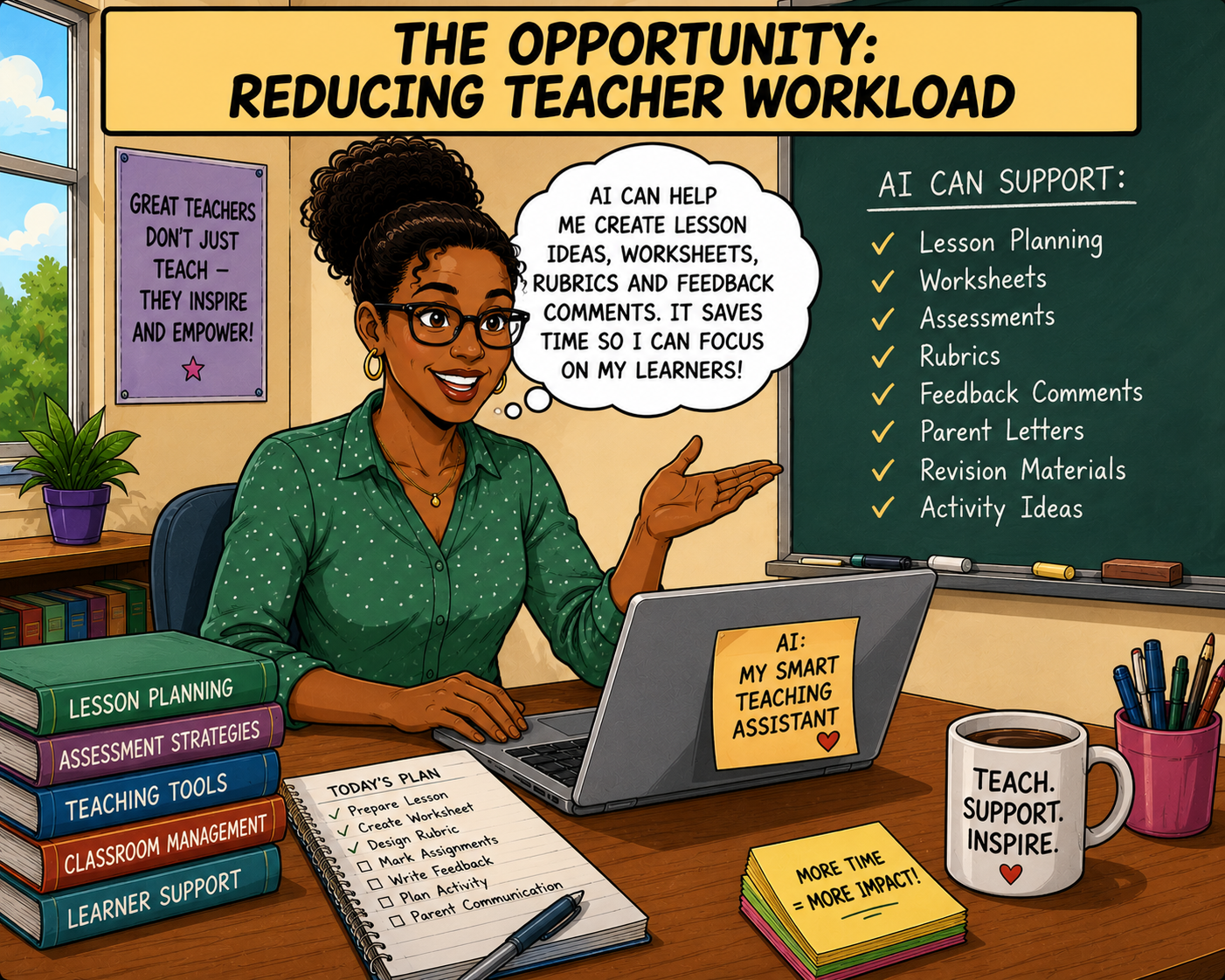
The Opportunity: Reducing Teacher Workload
South African educators often carry heavy responsibilities.
Many teachers spend hours every week:
Planning lessons
Creating worksheets
Preparing assessments
Marking assignments
Writing reports
Communicating with parents
Completing administrative tasks
AI can assist by producing first drafts of:
Lesson plans
Rubrics
Classroom activities
Revision materials
Parent letters
Feedback comments
Discussion questions
Teachers still review and improve these materials, but AI can significantly reduce the time needed to start from a blank page.
The Opportunity: Supporting Large Classes
Large class sizes remain a challenge in many South African schools.
Providing individual attention to every learner can be difficult.
AI can help educators prepare:
Additional practice questions
Extension work
Simplified explanations
Vocabulary support
Revision activities
Homework variations
Although AI cannot provide individual teacher attention, it can help create more learning resources in less time.
The Opportunity: Supporting English First Additional Language Learners
Many South African learners study in English even though it is not their home language.
This can make understanding textbooks and examination questions more difficult.
AI can assist educators by:
Simplifying language.
Explaining difficult vocabulary.
Rewriting complex passages.
Creating reading support.
Generating examples.
These resources can help learners focus on understanding subject content rather than struggling with language alone.
The Opportunity: Encouraging Independent Learning
AI gives learners opportunities to learn beyond the classroom.
Instead of waiting until the next lesson, learners can ask questions whenever they encounter difficulties.
This encourages:
Curiosity
Independent revision
Additional practice
Self-directed learning
Teachers remain responsible for guiding learners in using AI responsibly and critically.
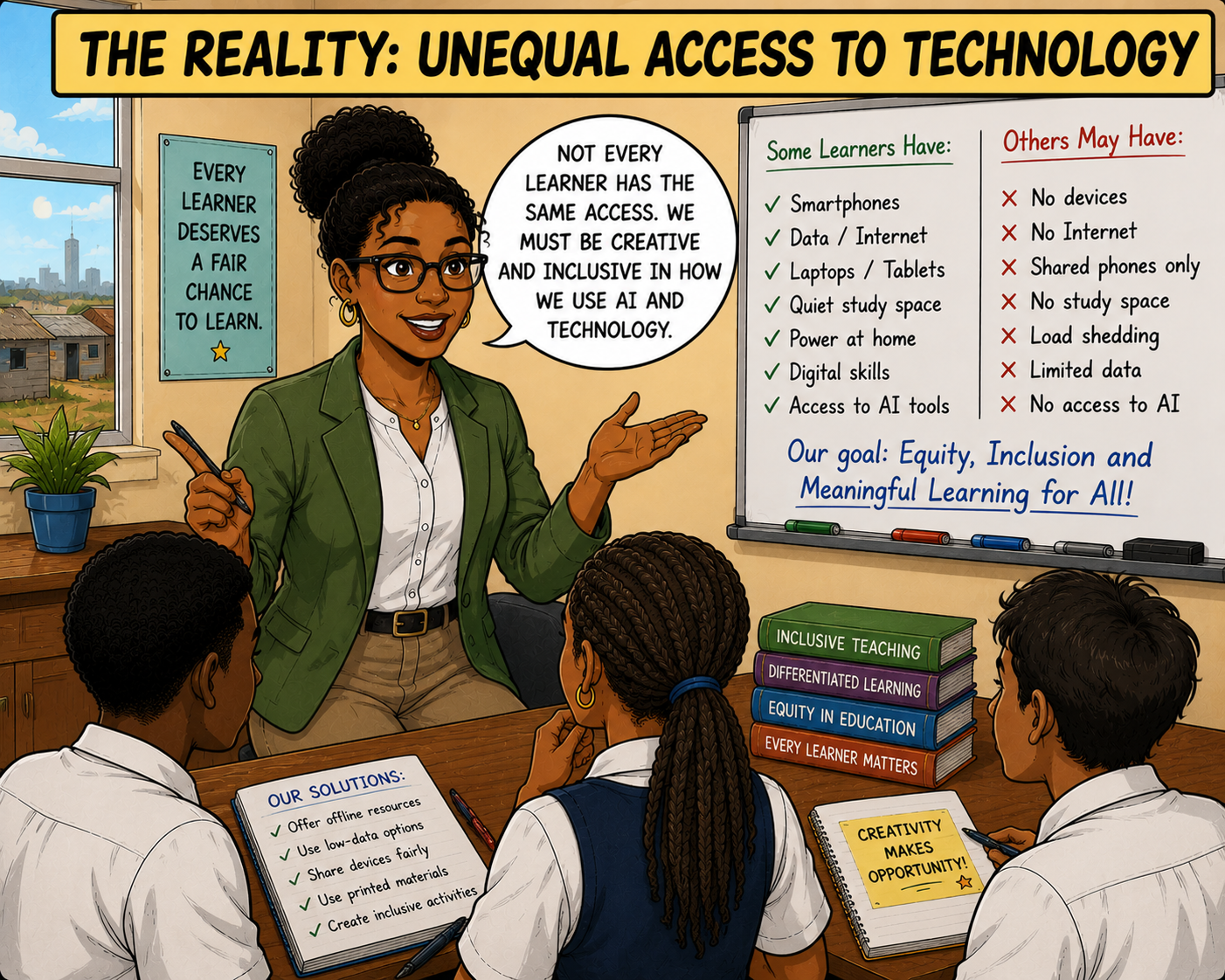
The Reality: Unequal Access To Technology
One of the biggest challenges in South Africa is unequal access.
Not every learner has:
A smartphone
Reliable internet
Mobile data
A computer
Electricity at home
Some learners may have excellent AI access.
Others may have almost none.
Educators should avoid designing compulsory learning activities that assume equal access unless this is genuinely the case in their school.
Equity must remain an important consideration.
The Reality: The Cost Of Connectivity
Although AI tools are becoming more accessible, internet access still costs money.
Many South African families carefully manage their monthly data budgets.
Large AI-generated images, videos, or extensive online activities may not always be practical.
Teachers should remember that simple, low-data learning resources often remain highly valuable.
Technology should support inclusion rather than increase inequality.
The Reality: Load Shedding And Infrastructure Challenges
While electricity supply has improved in recent years, interruptions and infrastructure challenges can still affect some communities.
Technology-dependent lessons should always include contingency plans.
Good teaching remains adaptable.
AI should enhance learning—not create unnecessary dependence on technology that may not always be available.
The Reality: Teachers Already Have Heavy Workloads
Some educators worry that AI will create additional expectations rather than reduce workload.
This concern is understandable.
Teachers already balance:
Teaching
Assessment
Administration
Extramural activities
Parent communication
Professional development
Schools should introduce AI gradually and realistically.
The goal should be to simplify work—not add unnecessary complexity.
AI Does Not Solve Every Educational Problem
AI is a powerful tool.
It is not a miracle solution.
AI cannot solve challenges such as:
Poverty
Poor attendance
Lack of motivation
Classroom discipline
Emotional wellbeing
School infrastructure
Funding shortages
These issues still require human leadership, policy decisions, and community support.
AI works best when applied to problems it is genuinely suited to solving.
CAPS Still Remains The Curriculum
South African educators teach according to the Curriculum and Assessment Policy Statement (CAPS).
AI does not replace curriculum requirements.
Instead, teachers should ask:
Does this support CAPS outcomes?
Is the information accurate?
Is it age appropriate?
Does it improve understanding?
Will it save meaningful time?
Curriculum remains the foundation.
AI simply becomes another teaching tool.
Academic Integrity Still Matters
One concern shared by many educators is that learners may use AI to complete assignments dishonestly.
This concern should not be ignored.
Schools should develop clear expectations regarding:
Acceptable AI use.
Original work.
Proper acknowledgement.
Responsible learning.
Academic honesty.
Rather than banning AI completely, schools should teach learners how to use it ethically.
Professional Judgement Becomes Even More Important
AI produces suggestions.
Teachers make decisions.
Professional educators decide:
Which explanations are accurate.
Which activities suit learners.
Which examples fit local contexts.
Which assessments measure genuine understanding.
AI cannot replace educational judgement.
Professional expertise becomes even more valuable.
AI Can Support Inclusive Education
South African classrooms are diverse.
Learners differ in:
Language
Ability
Confidence
Learning needs
Educational backgrounds
AI can help teachers produce differentiated learning materials more efficiently.
For example:
Easier reading passages
Extension activities
Vocabulary support
Practice exercises
Alternative explanations
Teachers still determine which learners need which resources.
Schools Will Adopt AI At Different Speeds
Some schools are already experimenting with AI.
Others are taking a cautious approach.
Both responses are understandable.
Successful implementation depends on factors such as:
Infrastructure
Leadership
Teacher confidence
Community support
Available resources
There is no requirement for every school to move at the same pace.
Thoughtful adoption is better than rushed implementation.
Practical Ways To Start
Educators interested in AI do not need expensive equipment or complicated software.
Simple first steps include:
Explore One Reliable AI Tool
Become comfortable with one platform before trying many others.
Use AI For Planning
Generate lesson ideas and improve them.
Create Revision Questions
Check accuracy before using them.
Simplify Reading Material
Support learners who need additional language assistance.
Discuss AI Openly
Help learners understand both opportunities and risks.
Small improvements often create the greatest long-term benefits.
Working Together As A School
AI should not become the responsibility of individual teachers alone.
Schools benefit when staff collaborate.
Possible initiatives include:
Staff workshops
Shared lesson ideas
Department discussions
AI policy development
Assessment reviews
Professional learning communities
Collaboration reduces uncertainty and builds confidence.
Preparing Learners For South Africa's Future Economy
Many industries in South Africa are beginning to integrate AI.
Examples include:
Healthcare
Banking
Agriculture
Manufacturing
Retail
Mining
Engineering
Marketing
Customer service
Today's learners will likely encounter AI in many future careers.
Schools therefore have a responsibility to prepare learners not only academically but also technologically and ethically.
Maintaining A Balanced Perspective
Successful educators avoid two extremes.
One extreme says:
"AI will solve everything."
The other says:
"AI has no place in education."
Neither view reflects reality.
A balanced perspective recognises that:
AI creates opportunities.
AI introduces challenges.
Human teachers remain essential.
Professional judgement is irreplaceable.
Continuous learning is necessary.
Balance leads to wise educational decisions.
Looking Ahead
The role of AI in South African education will continue to grow.
More educational software will include AI.
Assessment methods will continue evolving.
Professional development opportunities will increase.
Schools will gradually develop policies and best practices.
Educators who remain curious, adaptable, and reflective will be well prepared for these changes.
The future belongs not to those who know every AI tool, but to those who continue learning throughout their careers.
Practical Questions Every Educator Should Ask
Before introducing any AI tool into classroom practice, consider asking yourself:
Does this improve learning?
Does it save meaningful time?
Is it suitable for my learners?
Does it support CAPS outcomes?
Can all learners access it fairly?
Have I checked the accuracy of the information?
Does it encourage independent thinking?
Does it protect learner privacy?
Am I still using my professional judgement?
These questions help ensure that technology serves education—not the other way around.
Key Takeaways
Artificial Intelligence presents both exciting opportunities and genuine challenges for South African education. It has the potential to reduce teacher workload, support differentiated instruction, improve learner revision, and provide additional educational resources. At the same time, unequal access to technology, connectivity costs, academic integrity, infrastructure differences, and varying school contexts mean that AI cannot be adopted in exactly the same way everywhere.
The most successful approach is a practical and balanced one. South African educators do not need to rush into every new AI tool, nor should they ignore the technology altogether. Instead, they should focus on understanding AI, using it where it genuinely benefits teaching and learning, and ensuring that every decision remains guided by professional judgement, curriculum requirements, and the needs of their learners.
As AI becomes increasingly common in workplaces and higher education, schools have an important role in preparing learners for this future. By embracing thoughtful innovation while maintaining the human relationships, ethical values, and educational expertise that define excellent teaching, South African educators can help ensure that AI becomes a tool for opportunity rather than a source of division.
Additional Articles in the Understanding AI in the School Context Series
What High School Educators Need to Know About AI
How AI Is Changing Teaching, Learning, and Assessment
Common Myths and Fears About AI in Education
Why AI Literacy Is Becoming Part of Good Teaching
AI in South African Education: Opportunity, Pressure, and Practical Reality
Disclaimer
AI Tools were used to assist with research. Remember to always cross-check everything that you read.