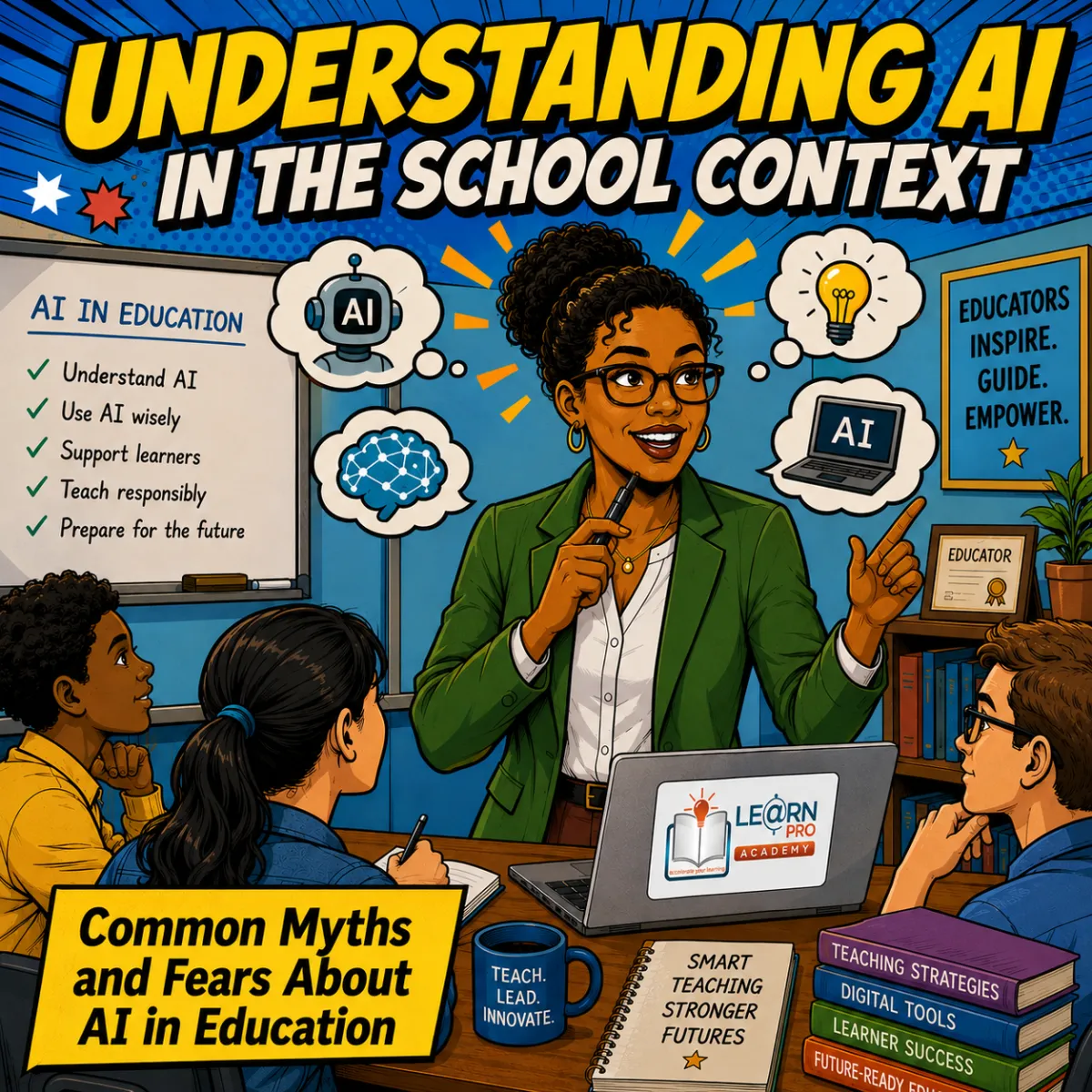
Common Myths and Fears About AI in Education
This is article #3 of 5 in the Understanding AI in the School Context Series
Introduction
Artificial Intelligence (AI) has quickly become one of the most discussed topics in education. News headlines often make bold claims about AI replacing teachers, increasing cheating, or changing schools forever. At the same time, learners are discovering AI tools independently, while many educators are still deciding whether these technologies belong in the classroom.
It is understandable that many teachers feel uncertain. Every major technological change has created questions, concerns, and even fear before people understood how it could be used effectively. The arrival of computers, the internet, smartphones, calculators, and online learning platforms all prompted similar debates. AI is simply the latest development, but because it can generate human-like text, images, and explanations, it often feels more personal and more disruptive than previous technologies.
The challenge for educators is to separate myths from reality. Some concerns about AI are genuine and deserve careful attention, while others are based on misunderstandings or unrealistic expectations. By understanding what AI can and cannot do, teachers can make informed decisions that protect educational quality while embracing useful innovation.
This article explores some of the most common myths and fears about AI in education and explains what every South African high school educator should know.
Why New Technology Often Creates Fear
Throughout history, new technology has often been met with uncertainty.
People once worried that:
Calculators would destroy mathematical ability.
Computers would replace office workers.
The internet would make libraries unnecessary.
Smartphones would prevent meaningful learning.
Online education would replace schools completely.
Although each technology changed the way people worked and learned, none completely replaced the human expertise that professionals bring to their roles.
AI should be viewed in the same way.
It represents a significant change, but it does not eliminate the need for skilled educators.
Understanding the technology reduces fear and allows teachers to focus on practical solutions rather than worst-case scenarios.
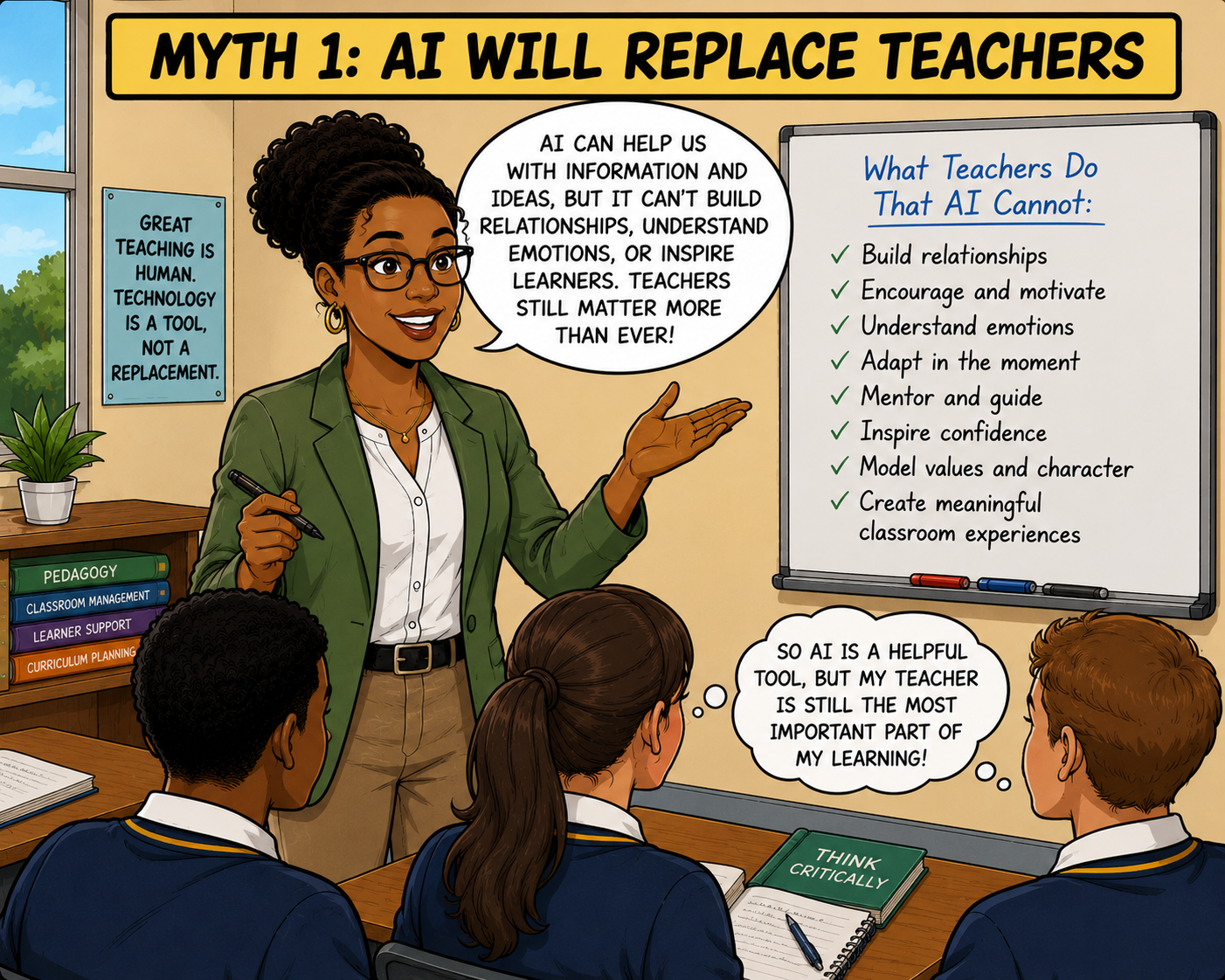
Myth 1: AI Will Replace Teachers
This is probably the most common fear surrounding AI.
Some people imagine classrooms where learners interact only with computers while teachers become unnecessary.
The reality is very different.
Teaching involves much more than delivering information.
Educators:
Build relationships.
Understand learner emotions.
Encourage confidence.
Manage classroom behaviour.
Adapt lessons instantly.
Support struggling learners.
Recognise individual strengths.
Inspire curiosity.
Model values and professionalism.
AI cannot genuinely understand human emotions.
It cannot build trust.
It cannot mentor learners.
It cannot replace the relationships that are at the heart of successful education.
Instead, AI is better viewed as a professional assistant that helps teachers perform some tasks more efficiently.
Myth 2: AI Knows Everything
Many people assume that AI always provides correct answers.
Unfortunately, this is not true.
AI sometimes:
Makes factual mistakes.
Invents references.
Misquotes sources.
Provides outdated information.
Misunderstands questions.
Gives incomplete explanations.
One of the most important lessons educators can teach is that AI should never be accepted without verification.
Professional judgement remains essential.
Teachers should model critical evaluation by checking AI-generated content before using it in lessons or assessments.
Myth 3: AI Is Always Objective
Because AI is a computer system, some people assume it is completely unbiased.
In reality, AI learns from enormous collections of human-created information.
Human information often contains:
Cultural bias
Historical bias
Language bias
Social assumptions
Incomplete perspectives
As a result, AI may unintentionally reflect these biases.
Educators should encourage learners to compare different viewpoints, verify information, and recognise that no single source should automatically be treated as the complete truth.
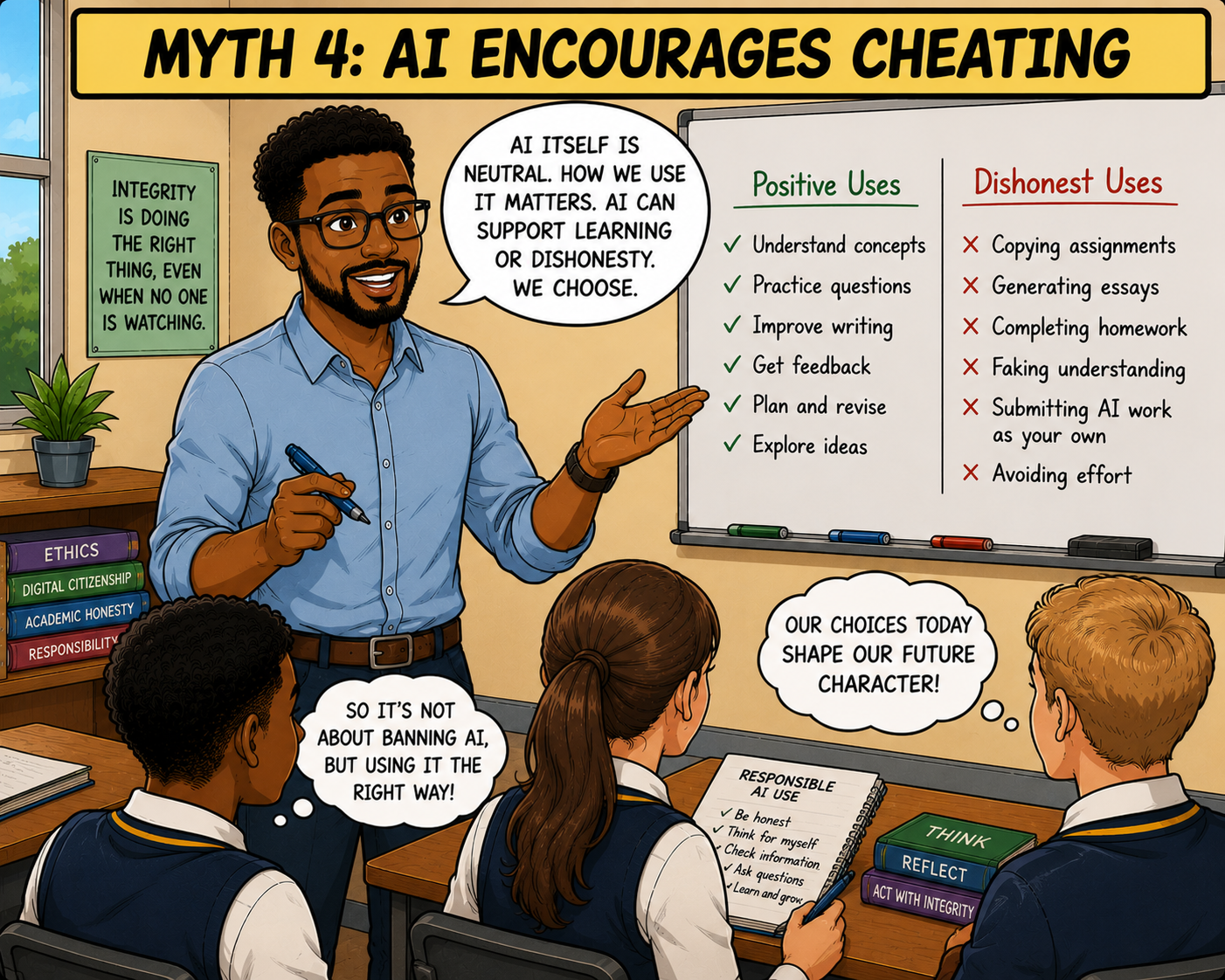
Myth 4: AI Encourages Cheating
Many educators worry that AI exists mainly to help learners cheat.
There is some truth behind this concern.
Learners can misuse AI by:
Generating essays.
Completing homework.
Producing assignments.
Copying explanations without understanding them.
However, the problem is not AI itself.
The problem is how learners choose to use it.
The same technology can also help learners:
Understand difficult concepts.
Practise revision.
Improve writing.
Generate quiz questions.
Organise study plans.
Receive additional explanations.
Responsible use supports learning.
Dishonest use undermines learning.
The educator's role is to teach the difference.
Myth 5: Every Teacher Must Become An AI Expert
Some educators feel overwhelmed because they believe they need to understand every AI platform available.
Fortunately, this is unnecessary.
Teachers do not need to become software developers or technology specialists.
Instead, they should develop:
Basic AI awareness.
Critical thinking.
Ethical understanding.
Confidence in evaluating AI outputs.
Practical classroom strategies.
The goal is informed professional judgement, not technical mastery.
Myth 6: AI Makes Teaching Less Meaningful
Some teachers worry that AI will remove creativity and human interaction from education.
In practice, AI often reduces routine administrative work rather than meaningful teaching.
AI can assist with:
Draft lesson plans.
Revision questions.
Worksheets.
Rubrics.
Parent communication.
Administrative tasks.
This may actually allow educators to spend more time on:
Classroom discussion.
Learner support.
Individual guidance.
Creative teaching.
Building relationships.
The meaningful parts of teaching remain firmly in human hands.
Myth 7: Learners Will Stop Thinking
Some educators fear that learners will simply ask AI for every answer.
This is a genuine risk if AI is used poorly.
However, good teaching can prevent this.
Teachers can design learning activities that require learners to:
Explain reasoning.
Defend opinions.
Compare viewpoints.
Evaluate evidence.
Reflect on learning.
Apply knowledge.
Solve unfamiliar problems.
These activities encourage independent thinking even when AI is available.
Myth 8: AI Is Only For Technology Subjects
Some teachers assume AI only affects Computer Studies or Information Technology.
In reality, AI can support almost every subject.
Examples include:
Mathematics
Generating practice questions and explaining methods.
English
Improving grammar, analysing literature, and developing writing ideas.
History
Summarising historical events and comparing perspectives.
Geography
Explaining environmental concepts and creating revision questions.
Physical Sciences
Breaking down difficult scientific principles.
Life Sciences
Generating revision activities and vocabulary support.
Business Studies
Explaining financial concepts and creating case-study questions.
Accounting
Providing additional examples for calculations and terminology.
AI is becoming a cross-curricular tool rather than a subject-specific technology.
Myth 9: AI Is Only For Wealthy Schools
Some educators worry that AI will only benefit well-resourced schools.
There are genuine concerns about unequal access.
South African schools differ significantly in terms of:
Internet connectivity.
Device availability.
Budgets.
Digital infrastructure.
However, many AI tools are becoming more affordable and accessible over time.
Even where resources are limited, educators can still begin learning about AI and prepare for gradual adoption.
Professional understanding does not depend entirely on expensive technology.
Myth 10: AI Will Replace Critical Thinking
AI can generate answers quickly.
This sometimes creates the impression that learners no longer need to think for themselves.
In reality, AI increases the importance of critical thinking.
Learners need to ask:
Is this answer accurate?
Is it complete?
Is there another perspective?
What evidence supports this?
Can I explain this in my own words?
Critical thinking becomes more valuable—not less.
Real Concerns Educators Should Take Seriously
While many fears are exaggerated, some concerns deserve careful attention.
These include:
Academic Integrity
Schools need clear policies about acceptable AI use.
Accuracy
Teachers should always verify AI-generated material.
Privacy
Personal learner information should never be entered into AI systems without following school policies.
Equity
Schools should consider differences in learner access to technology.
Overdependence
Learners should continue developing independent thinking and problem-solving skills.
These concerns are manageable when educators approach AI thoughtfully.
Why Some Teachers Feel Pressured
Many educators experience anxiety because AI appears to be advancing very quickly.
Some common thoughts include:
"My learners know more about AI than I do."
"I'm too late to catch up."
"There are too many AI tools."
"Everyone else seems to understand this better."
These feelings are perfectly normal.
Remember:
Technology changes continuously.
No educator knows everything.
Professional growth happens one step at a time.
Building Confidence With AI
Confidence grows through experience.
Educators can begin by experimenting with simple activities.
For example:
Ask AI to explain a CAPS topic.
Generate a short quiz.
Create discussion questions.
Draft a lesson introduction.
Rewrite difficult text into simpler English.
Review the output carefully.
Ask yourself:
Is it accurate?
Would I use it?
How would I improve it?
Small experiments build confidence without feeling overwhelming.
Talking Openly With Learners
Rather than pretending AI does not exist, educators should discuss it openly.
Classroom conversations might include:
When is AI helpful?
When does AI become dishonest?
How do we verify AI answers?
Why does original thinking matter?
What are responsible ways to use AI?
These discussions help create a culture of honesty rather than secrecy.
Professional Development Matters
Schools should encourage ongoing AI learning.
Professional development may include:
Staff workshops.
Peer learning sessions.
Demonstrations.
Online courses.
Department meetings.
Shared classroom experiences.
Teachers learn best when they collaborate.
No educator should feel that they must learn everything alone.
The South African Context
South African educators face unique realities.
Many teachers already manage:
Large classes.
Heavy marking loads.
Administrative responsibilities.
Curriculum pressures.
Limited preparation time.
Unequal learner access to technology.
These realities mean AI should be introduced carefully and practically.
Educators should ask:
Will this genuinely save time?
Does it improve learner understanding?
Is it accessible to my learners?
Does it align with curriculum requirements?
Technology should solve problems—not create unnecessary complexity.
Developing A Balanced Perspective
Healthy scepticism is valuable.
Blind enthusiasm is not.
Blind fear is not.
The most effective educators adopt a balanced perspective.
They recognise that:
AI has strengths.
AI has limitations.
AI requires human oversight.
AI works best alongside professional teaching.
AI should always support learning rather than replace it.
Balance leads to better educational decisions.
Looking Ahead
AI will continue improving over the coming years.
New tools will appear.
Existing platforms will become more capable.
Educational policies will evolve.
The educators who will benefit most are not necessarily those who become technology experts.
They are the teachers who remain:
Curious.
Adaptable.
Reflective.
Ethical.
Willing to learn.
These qualities have always defined excellent teaching.
AI simply provides another opportunity to apply them.
Key Takeaways
Many of the fears surrounding AI in education are based on understandable uncertainty rather than reality. AI will not replace teachers, eliminate meaningful learning, or remove the need for professional judgement. Instead, it is a powerful tool that can assist educators with planning, administration, learner support, and resource development while leaving the essential human aspects of teaching firmly in the hands of skilled professionals.
At the same time, educators should not ignore the genuine challenges that AI presents. Issues such as academic integrity, information accuracy, learner privacy, equitable access, and responsible classroom use require thoughtful policies and ongoing discussion. By understanding both the opportunities and the limitations of AI, teachers can make balanced decisions that benefit learners without compromising educational standards.
For South African educators, the goal is not to fear AI or embrace it without question. It is to become confident enough to use the technology wisely, guide learners responsibly, and continue providing the human connection, encouragement, and professional expertise that no artificial intelligence can replace.
Additional Articles in the Understanding AI in the School Context Series
What High School Educators Need to Know About AI
How AI Is Changing Teaching, Learning, and Assessment
Common Myths and Fears About AI in Education
Why AI Literacy Is Becoming Part of Good Teaching
AI in South African Education: Opportunity, Pressure, and Practical Reality
Disclaimer
AI Tools were used to assist with research. Remember to always cross-check everything that you read.