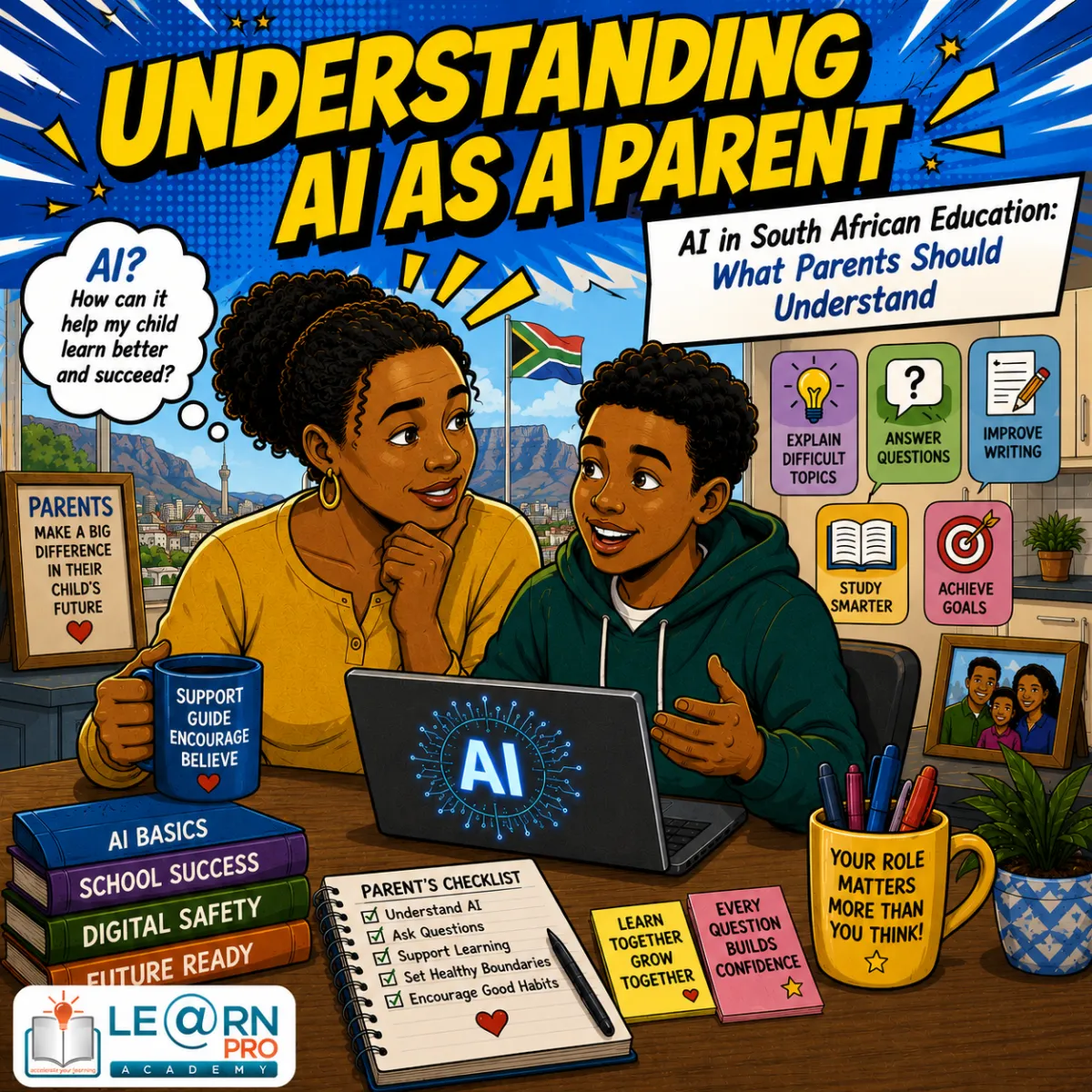
AI in South African Education: What Parents Should Understand
This is article #4 of 5 in the Understanding AI as a Parent Series
Introduction
Artificial intelligence (AI) is becoming part of education around the world, including South Africa. Many high school learners are already using AI to explain difficult concepts, revise for examinations, improve assignments, and organise their studies. At the same time, schools are beginning to discuss how AI should be used responsibly and ethically.
For many parents, however, AI raises important questions. Will every school use it? Will learners without laptops be left behind? Does AI fit into the South African curriculum? How can parents support their children if they do not fully understand the technology themselves?
These are sensible questions because South Africa is a country with very different educational environments. Some schools have computer laboratories, high-speed internet, and digital classrooms, while others continue to face challenges such as limited devices, unreliable internet access, and large class sizes.
The good news is that AI does not have to be available everywhere to be useful. Even where access is limited, parents and learners can still develop the habits and thinking skills that matter most.
This article explores what AI looks like in the South African education system, explains both the opportunities and the challenges, and helps parents understand how they can support responsible AI learning regardless of their family's circumstances.
South African Schools Are Very Different
One of the most important things parents should understand is that there is no single South African school experience.
Schools differ greatly in areas such as:
access to computers
internet connectivity
digital learning resources
teacher training
school budgets
learner-to-teacher ratios
Some learners have daily access to laptops and online learning platforms.
Others may only use computers occasionally or rely almost entirely on printed textbooks.
This means AI will not become part of education in exactly the same way for every learner.
Parents should avoid comparing their child's school with others.
Instead, focus on helping your child make the best use of the opportunities available to them.
AI Is Already Part Of Everyday Life
Many parents think AI is something completely new.
In reality, many South Africans already use AI every day without realising it.
Examples include:
navigation apps suggesting faster routes
email spam filters
online shopping recommendations
banking fraud detection
voice assistants
language translation tools
customer service chatbots
As learners become familiar with these technologies, it makes sense that AI is also becoming part of education.
Learning how to use AI responsibly is becoming another digital skill, much like learning to use the internet safely.
Why Schools Are Talking About AI
Schools are discussing AI because education should prepare learners for the world they will enter after school.
Many industries now use AI, including:
healthcare
finance
agriculture
engineering
marketing
accounting
law
journalism
manufacturing
customer service
Today's Grade 10 learner may work in a career where AI is a normal part of everyday tasks.
Schools therefore have a responsibility to help learners understand both the opportunities and the responsibilities that come with AI.
AI Does Not Replace The CAPS Curriculum
Some parents worry that AI will replace the curriculum.
This is not the case.
South African schools continue to teach according to the Curriculum and Assessment Policy Statement (CAPS).
AI is simply another tool that learners can use while studying the existing curriculum.
For example, learners may use AI to:
explain Mathematics concepts
summarise History chapters
practise English comprehension
revise Accounting terminology
prepare Physical Sciences questions
The curriculum remains the same.
AI simply offers another way to support learning.
AI Can Support Different Subjects
AI is useful across many high school subjects.
Examples include:
Mathematics
Learners can ask for step-by-step explanations of calculations and receive additional practice questions.
Physical Sciences
AI can explain scientific concepts using simpler language and provide everyday examples.
Accounting
Learners can practise calculations and better understand accounting principles.
History
AI can summarise historical events, compare different perspectives, and help learners revise important dates.
English Home Language And First Additional Language
Learners can improve grammar, vocabulary, essay planning, and comprehension skills.
Business Studies And Economics
AI can explain business concepts using practical South African examples.
Parents should remember that AI supports understanding—it should never replace reading textbooks or attending class.
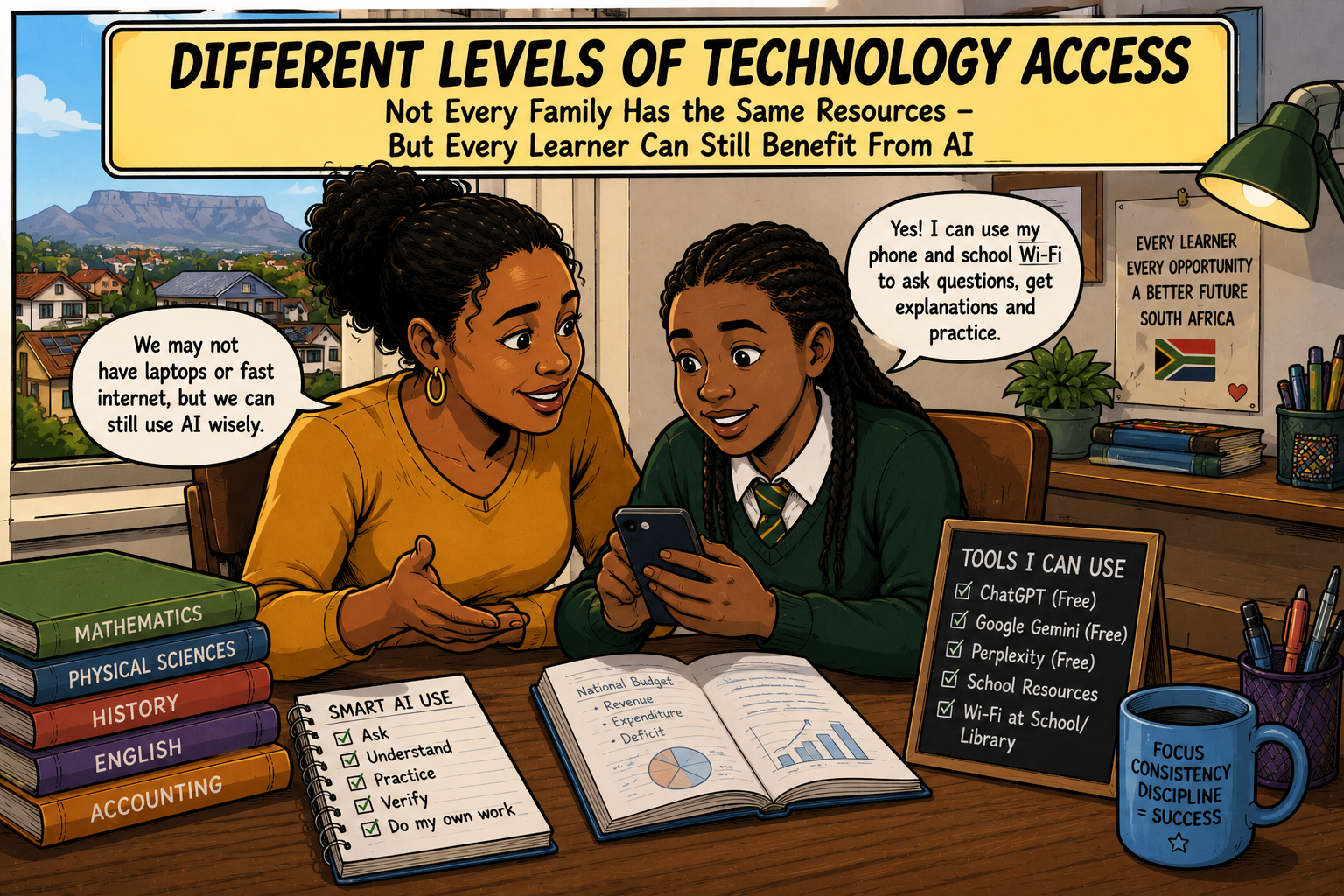
Different Levels Of Technology Access
Not every family has:
fibre internet
laptops
tablets
unlimited mobile data
Many South African learners rely on:
shared smartphones
prepaid data
public Wi-Fi
school computer laboratories
This reality is important.
Parents should never feel that expensive technology determines educational success.
Good learning habits remain far more important.
Even limited AI access can still be valuable if used thoughtfully.
Data Costs Still Matter
South African families often manage limited mobile data budgets.
Parents may understandably worry about the cost of online learning.
Where possible, learners should:
download study material while connected to Wi-Fi
avoid unnecessary video streaming
use educational resources purposefully
plan AI study sessions instead of browsing aimlessly
Using AI wisely often reduces wasted data.
Quality matters more than quantity.
AI Cannot Replace Teachers
South African teachers already manage many responsibilities.
Large classes, administrative work, and curriculum demands require enormous commitment.
AI cannot replace:
classroom teaching
learner encouragement
assessment
discipline
emotional support
mentoring
personal relationships
Instead, many educators are beginning to use AI themselves to prepare lessons, generate ideas, and create revision activities.
Teachers remain at the centre of education.
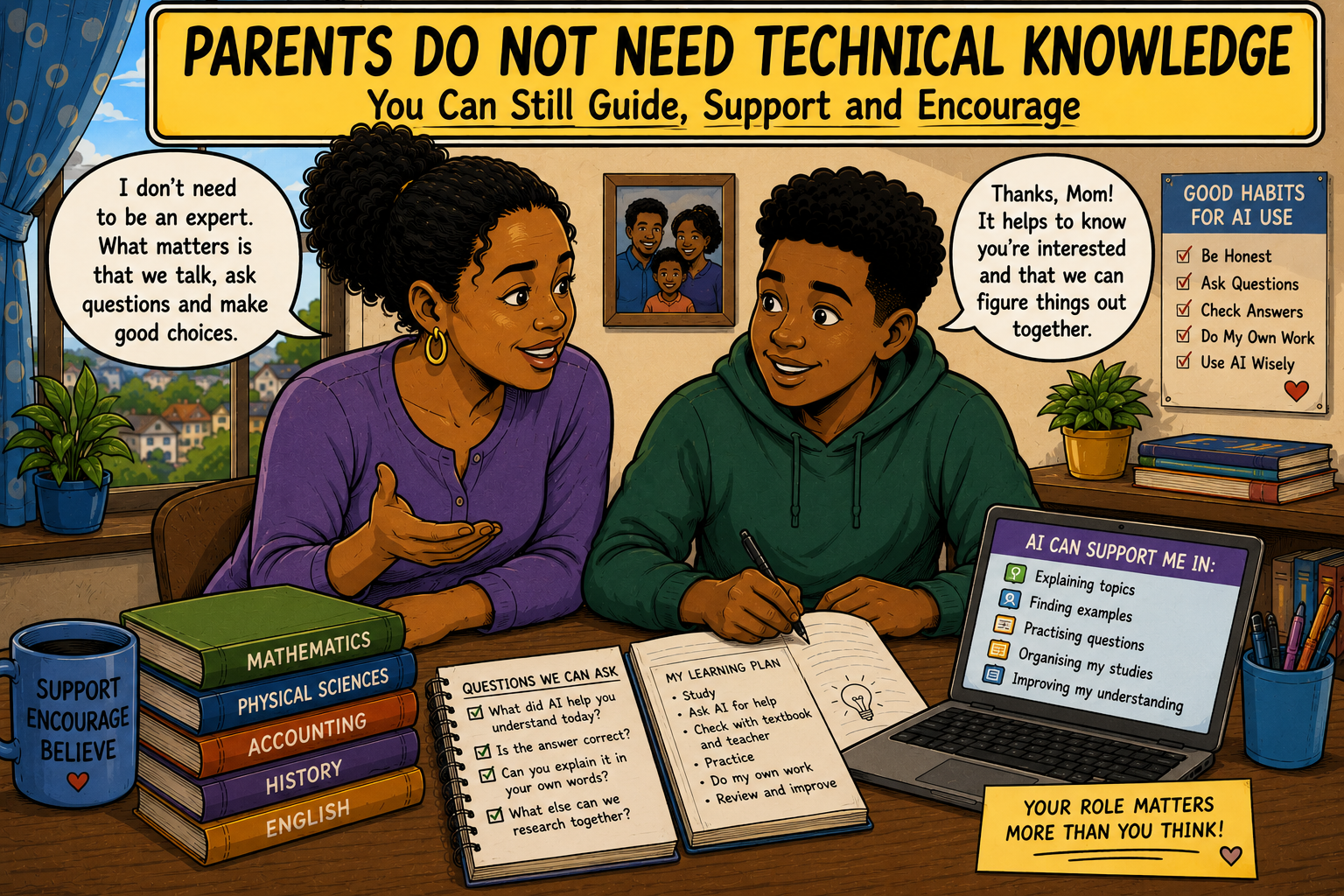
Parents Do Not Need Technical Knowledge
Many parents worry that they know less about technology than their children.
Fortunately, helping a learner does not require advanced digital skills.
Parents can still:
ask questions
encourage honesty
monitor study habits
discuss responsible technology use
reinforce school expectations
Good parenting remains more important than technical expertise.
AI Can Help Learners Become More Independent
One important goal of high school education is preparing learners for adulthood.
AI can encourage learners to:
ask questions
explore ideas
identify weak areas
organise revision
develop study plans
practise independently
These are valuable lifelong learning skills.
Parents should encourage children to use AI to become more capable—not more dependent.
AI Also Has Risks
Like every technology, AI should be used responsibly.
Parents should understand some important risks.
These include:
Incorrect Information
AI occasionally provides inaccurate answers.
Learners should always compare important information with:
textbooks
class notes
teachers
trusted educational resources
Overdependence
Learners should not rely on AI to think for them.
Real understanding still requires effort and practice.
Academic Dishonesty
AI should never complete schoolwork that learners are expected to do independently.
Schools increasingly have policies explaining acceptable AI use.
Parents should reinforce these expectations.
Excessive Screen Time
Educational screen time differs from entertainment, but balance remains important.
Healthy routines still include:
exercise
sleep
family time
reading
outdoor activities
Preparing Learners For Future Careers
The workplace is changing rapidly.
Future employers will increasingly expect people to understand AI.
However, technical knowledge alone will never be enough.
Employers also value:
communication
teamwork
honesty
adaptability
creativity
leadership
problem-solving
Parents play a vital role in helping children develop these human qualities alongside digital skills.
Supporting Learners At Home
Parents can make a significant difference by creating a positive learning environment.
Simple actions include:
Show Interest
Ask your child how they use AI.
Many learners enjoy explaining new technology.
Ask Good Questions
Instead of asking:
"Did AI do your homework?"
Try asking:
What did AI help you understand?
What questions did you ask?
Could you explain it to me now?
Encourage Verification
Teach children to check AI answers before accepting them.
This develops critical thinking.
Praise Effort
Celebrate persistence rather than perfect marks.
Children who value effort become stronger learners.
Maintain Balance
Technology should support learning—not replace healthy daily routines.
Working Together With Schools
Parents and schools achieve the best results when they work together.
As more schools develop AI guidelines, parents should:
understand school policies
encourage responsible AI use
communicate with teachers
support academic honesty
discuss concerns openly
A consistent message at home and at school helps learners make better decisions.
There Is No "Perfect" Way To Use AI
Every family is different.
Every school is different.
Every learner is different.
Some learners will use AI every day.
Others may only use it occasionally.
Neither approach is automatically better.
The important question is whether AI is helping the learner:
understand more deeply
think independently
work honestly
become more confident
Responsible use matters far more than frequent use.
Looking Ahead
South African education will continue evolving as technology develops.
Over the next few years, AI will likely become more common in classrooms, universities, and workplaces.
Parents do not need to predict every future change.
Instead, they can prepare children by encouraging qualities that never go out of date.
These include:
curiosity
responsibility
resilience
honesty
critical thinking
adaptability
respect for others
lifelong learning
These skills will remain valuable regardless of how technology changes.
Conclusion
Artificial intelligence is becoming part of South African education, but it is not arriving in exactly the same way for every family or every school. Differences in internet access, devices, school resources, and digital confidence mean that learners will have different experiences with AI. This is completely normal and should not discourage parents.
The most important role of AI is not to replace teachers, textbooks, or hard work. Instead, it can become another valuable learning tool that helps learners understand difficult concepts, practise more effectively, organise their studies, and prepare for the future. Used responsibly, AI can support education while still encouraging independent thinking and genuine learning.
Parents do not need to become technology experts to guide their children. By staying curious, asking thoughtful questions, encouraging honesty, and working together with schools, families can help learners develop healthy AI habits that will benefit them both in school and beyond.
Ultimately, success in the South African education system will continue to depend not only on technology, but also on determination, good study habits, strong values, and the support learners receive from the adults who care about their future.
Additional Articles in the Understanding AI as a Parent Series
What Parents of High School Learners Need to Know About AI
Why AI Is Becoming Part of High School Learning
Common Fears Parents Have About AI — and What Is Actually True
AI in South African Education: What Parents Should Understand
Why Parents Do Not Need to Be “Tech Experts” to Support AI Learning
Disclaimer
AI Tools were used to assist with research. Remember to always cross-check everything that you read.