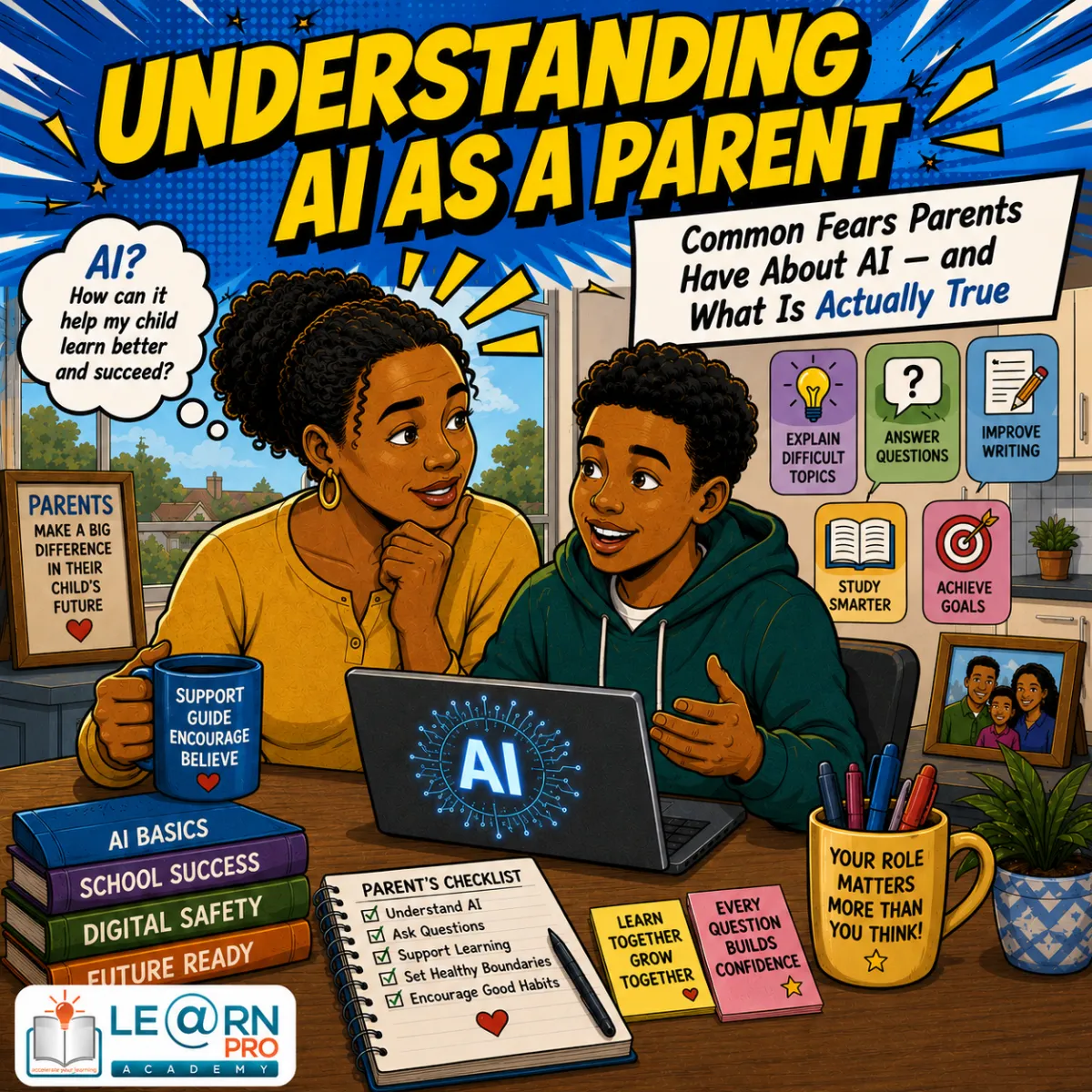
Common Fears Parents Have About AI — and What Is Actually True
This is article #3 of 5 in the Understanding AI as a Parent Series
Introduction
Artificial intelligence (AI) has quickly become one of the most talked-about technologies in education. News headlines often make bold claims, with some people describing AI as the future of learning while others warn that it will destroy education, replace jobs, and encourage cheating. It is no surprise that many parents feel uncertain about what to believe.
If your child is in high school, you may already have heard them mention AI tools such as ChatGPT or other learning assistants. Perhaps they use AI to explain difficult Mathematics problems, summarise a chapter for revision, or improve the grammar in an English assignment. While some parents see these tools as exciting opportunities, others worry that learners will stop thinking for themselves or become too dependent on technology.
The truth usually lies somewhere between the extremes.
AI offers genuine opportunities to improve learning, but it also comes with real risks that families need to understand. Like calculators, the internet, and smartphones before it, AI can be used wisely or poorly. The outcome depends largely on how learners use it and how adults guide them.
This article explores some of the most common fears parents have about AI, explains which concerns are justified, and helps separate myths from reality. By understanding the facts, parents can feel more confident supporting their children in an AI-enabled world.
Why AI Creates Strong Reactions
Whenever a major new technology appears, people often react with excitement and fear at the same time.
History provides many examples.
When calculators first became common in schools, some believed learners would never learn Mathematics properly again.
When the internet became widely available, many feared that books and libraries would disappear.
When smartphones became popular, concerns grew about distraction, addiction, and reduced face-to-face communication.
Many of these concerns had some truth, but society also learned how to use these technologies responsibly.
AI is following a similar pattern.
It is powerful, useful, and sometimes misunderstood.
The goal is not to fear AI or blindly trust it, but to understand it well enough to use it wisely.
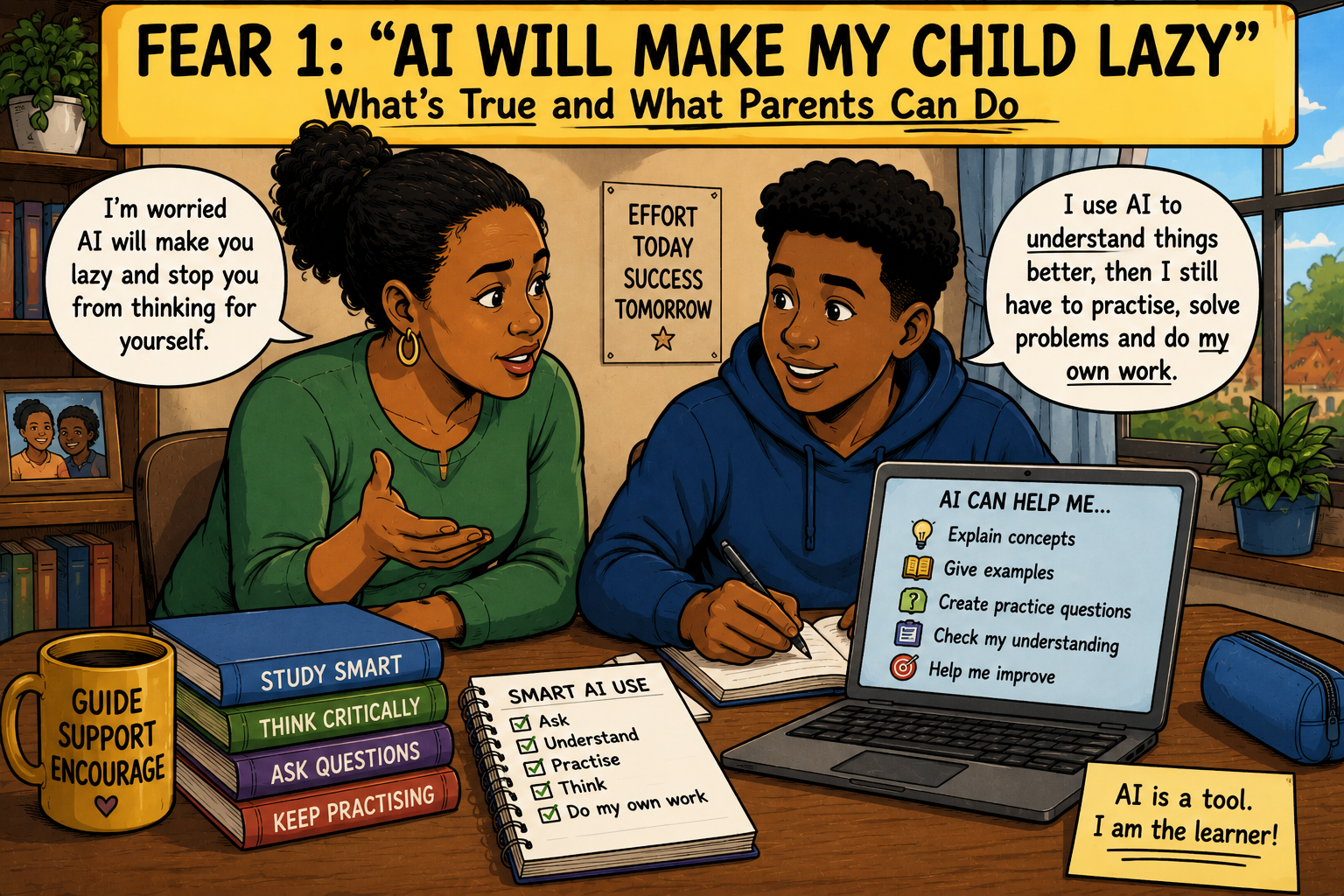
Fear 1: "AI Will Make My Child Lazy"
This is probably the most common concern.
Many parents worry that if AI can answer questions quickly, learners will stop thinking and working hard.
What Is True?
AI can become a shortcut if learners misuse it.
For example, asking AI to complete an assignment and submitting it without understanding the work does not promote learning.
However, AI does not automatically make learners lazy.
Many learners use AI to:
explain difficult concepts
create practice questions
organise study plans
revise for tests
improve understanding
In these situations, AI supports learning rather than replacing it.
What Parents Can Do
Encourage your child to use AI to understand the work—not to avoid doing it.
Ask questions such as:
Can you explain this topic to me yourself?
What did AI help you understand?
Could you solve this problem without AI now?
These conversations help ensure genuine learning.
Fear 2: "AI Encourages Cheating"
Many parents worry that learners will use AI to complete homework or write assignments they did not produce themselves.
What Is True?
This concern is real.
AI can be misused for cheating.
However, the technology itself is not dishonest.
Just as learners can misuse the internet by copying information, they can misuse AI.
The problem is not AI—it is how it is used.
Many schools are now creating clear policies explaining when AI is acceptable and when it is not.
What Parents Can Do
Discuss academic honesty regularly.
Help your child understand that AI should:
explain
guide
support
provide practice
It should never replace their own effort.
Honesty remains more valuable than high marks earned dishonestly.
Fear 3: "My Child Will Stop Thinking Independently"
Some parents worry that learners will simply accept every AI answer without thinking critically.
What Is True?
This can happen if learners become overly dependent on AI.
However, responsible AI use actually encourages questioning.
Good learners often ask AI:
Why?
Can you explain differently?
Is there another method?
Can you compare these ideas?
These follow-up questions deepen understanding.
What Parents Can Do
Encourage children to question AI just as they would question any information source.
Teach them to ask:
Does this make sense?
Does it match my textbook?
Can I explain it myself?
Would my teacher agree?
Critical thinking remains essential.
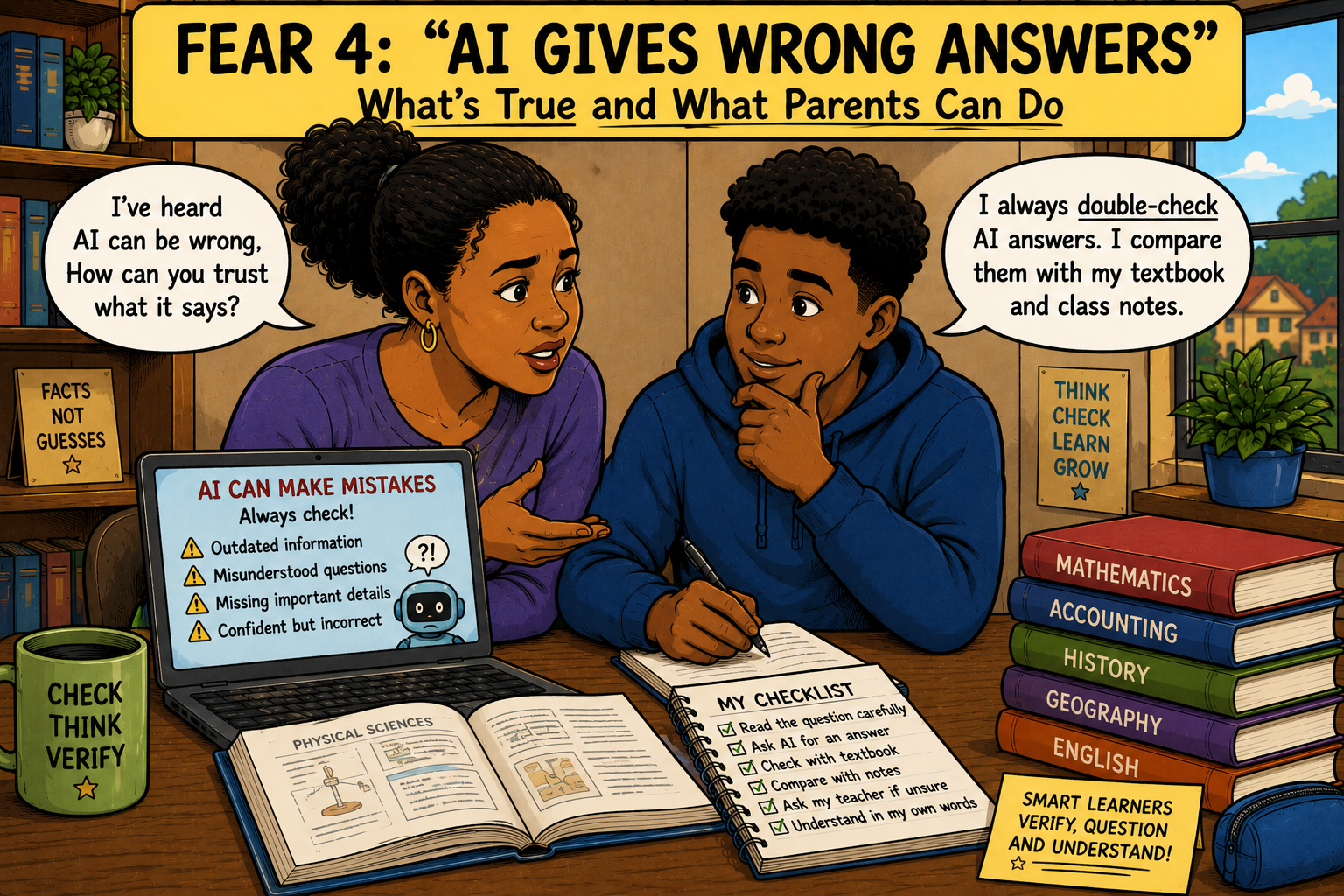
Fear 4: "AI Gives Wrong Answers"
Parents often hear stories about AI making mistakes.
What Is True?
This concern is absolutely valid.
AI is not always correct.
It sometimes:
invents information
misunderstands questions
provides outdated facts
gives incomplete explanations
Even when AI sounds confident, it can still be wrong.
What Parents Can Do
Teach learners to verify important information using:
textbooks
teacher notes
trusted educational websites
classroom discussions
AI should be treated as a helpful assistant—not the final authority.
Fear 5: "My Child Will Spend Even More Time On Screens"
Many parents already struggle to manage screen time.
AI appears to add another reason for children to spend hours on phones and computers.
What Is True?
AI does increase digital learning opportunities.
However, not all screen time is the same.
There is an important difference between:
scrolling endlessly on social media
watching entertainment for hours
completing productive schoolwork
Educational screen time can have real value.
What Parents Can Do
Focus on balance rather than simply counting hours.
Encourage:
regular breaks
physical exercise
family meals without devices
enough sleep
outdoor activities
hobbies away from screens
Healthy routines remain important regardless of technology.
Fear 6: "Teachers Will Become Unnecessary"
Some parents wonder whether AI will eventually replace teachers.
What Is True?
This is highly unlikely.
Teachers do far more than explain information.
They:
motivate learners
manage classrooms
provide encouragement
assess understanding
identify learning difficulties
teach communication
build confidence
model good values
AI cannot replace these human relationships.
Many teachers are actually using AI themselves to improve lesson planning and create learning materials.
Teachers remain central to education.
Fear 7: "AI Will Replace Every Job"
This is one of the biggest fears surrounding AI.
Parents naturally worry about their children's future careers.
What Is True?
AI will change many jobs.
Some routine tasks may become automated.
However, history shows that technology also creates new careers.
Today's learners may work in jobs that do not yet exist.
Future employers will increasingly value people who know how to work alongside AI.
What Parents Can Do
Encourage your child to develop skills that technology cannot easily replace.
These include:
communication
teamwork
creativity
ethical judgement
leadership
empathy
adaptability
problem-solving
These skills remain valuable across almost every profession.
Fear 8: "Only Wealthy Families Can Benefit From AI"
In South Africa, access to technology differs greatly.
Some learners have laptops and fibre internet.
Others rely on shared smartphones or prepaid mobile data.
What Is True?
Access does vary.
Not every learner has the same opportunities.
However, responsible learning habits matter more than expensive devices.
Many AI tools work on smartphones, and schools are gradually increasing digital access.
What Parents Can Do
Focus on making the best use of the resources your family has.
Encourage thoughtful learning rather than comparing your situation with others.
Fear 9: "I Don't Understand AI, So I Can't Help My Child"
Many parents feel left behind by rapidly changing technology.
What Is True?
You do not need to become an AI expert.
Children benefit most from parents who:
show interest
ask questions
encourage honesty
support learning
set healthy boundaries
Your role is to guide behaviour, not master every new app.
What Parents Can Do
Ask your child to show you how they use AI.
Learning together often strengthens communication.
Curiosity is far more valuable than pretending to know everything.
Fear 10: "AI Will Replace Real Learning"
Some parents believe learners may stop reading, writing, solving problems, or thinking independently.
What Is True?
This depends entirely on how AI is used.
If learners rely on AI to do everything, learning suffers.
If they use AI to:
practise
understand
organise
revise
explore ideas
learning often improves.
The learner still needs to:
attend class
complete assignments
write exams
think critically
practise regularly
AI cannot replace these responsibilities.
How Parents Can Encourage Responsible AI Use
Rather than banning AI completely, most families will benefit from establishing healthy expectations.
Encourage your child to:
use AI for learning, not shortcuts
verify important information
ask thoughtful questions
complete their own assignments
respect school AI policies
discuss confusing topics with teachers
Responsible habits matter far more than the technology itself.
Questions Parents Can Ask At Home
Regular conversations help children develop responsible digital habits.
Useful questions include:
What did AI help you understand today?
What questions did you ask?
Did you check whether the answer was correct?
Could you explain the topic without AI now?
What did your teacher say about using AI?
These discussions encourage reflection rather than simply monitoring behaviour.
Working Together With Schools
Schools and parents share the same goal: helping learners succeed.
As AI becomes more common, schools may introduce guidelines about:
homework
projects
assessments
acceptable AI use
academic honesty
Parents should support these expectations at home.
If you are unsure about your school's policy, ask teachers for clarification.
Strong communication between home and school benefits everyone.
Looking Ahead
AI will continue changing over the coming years.
New tools will appear, and schools will continue adapting.
Instead of focusing only on technology, parents should help children build lifelong qualities such as:
integrity
curiosity
resilience
responsibility
adaptability
critical thinking
respect for others
willingness to keep learning
These qualities will remain valuable regardless of how technology evolves.
Conclusion
It is completely understandable that parents have questions and concerns about artificial intelligence. AI is developing quickly, and the messages people hear in the media are often dramatic or confusing. While some fears are based on genuine risks, many others become less worrying once we understand how AI actually works.
AI can be misused for cheating, overdependence, or avoiding effort, but it can also become a powerful learning tool that helps learners understand difficult concepts, revise more effectively, organise their studies, and build confidence. Like any educational resource, its value depends on how it is used.
Parents do not need to fear AI, nor should they ignore it. The best approach is to stay informed, maintain open conversations, encourage honesty, and remind children that genuine learning still requires effort, curiosity, and independent thinking.
In South Africa and around the world, AI is becoming part of education because it reflects the changing world learners will enter after school. By helping young people use these tools responsibly while continuing to value integrity, critical thinking, and perseverance, parents can prepare them not only for examinations, but for lifelong success in an increasingly digital future.
Additional Articles in the Understanding AI as a Parent Series
What Parents of High School Learners Need to Know About AI
Why AI Is Becoming Part of High School Learning
Common Fears Parents Have About AI — and What Is Actually True
AI in South African Education: What Parents Should Understand
Why Parents Do Not Need to Be “Tech Experts” to Support AI Learning
Disclaimer
AI Tools were used to assist with research. Remember to always cross-check everything that you read.