Why Parents Do Not Need to Be “Tech Experts” to Support AI Learning
This is article #5 of 5 in the Understanding AI as a Parent Series
Introduction
Artificial intelligence (AI) is becoming a regular part of education. Many high school learners now use AI tools to explain difficult concepts, revise for tests, improve their writing, and organise their studies. As this technology becomes more common, many parents begin asking themselves an important question:
"How can I help my child if I don't understand AI?"
This is a very common concern. Many parents did not grow up with smartphones, online learning, or AI assistants. Their children often seem far more confident using technology, which can make parents feel left behind. Some even believe they have nothing useful to contribute because they cannot explain how AI works.
Fortunately, this simply is not true.
Supporting your child's education has never depended on being the smartest person in the room or understanding every new technology. Good parenting is built on communication, encouragement, guidance, and values. Those qualities remain just as important in the age of AI as they were before computers existed.
The role of a parent is not to become an AI expert. Instead, it is to help children develop good habits, make wise decisions, think critically, and use technology responsibly.
This article explains why parents can confidently support AI learning even without advanced technical knowledge. It also provides practical ways to stay involved in your child's education while helping them prepare for an increasingly digital future.
You Do Not Need To Know Everything
Many parents believe they should have all the answers.
In reality, no parent knows everything.
Children often learn about:
new technology
social media
digital tools
mobile apps
before adults do.
This has happened throughout history.
Parents once learned alongside their children about:
computers
the internet
email
smartphones
online banking
AI is simply the next technology families are learning together.
Your willingness to learn is far more valuable than pretending to know everything.
Parenting Is About Guidance, Not Technical Expertise
Think about other areas of parenting.
You do not need to be:
a professional athlete to encourage exercise
a nutritionist to promote healthy eating
an accountant to teach honesty about money
a teacher to value education
Similarly, you do not need to be an AI specialist to encourage responsible technology use.
Your child benefits most from your guidance, interest, and support.
These qualities remain far more important than technical knowledge.
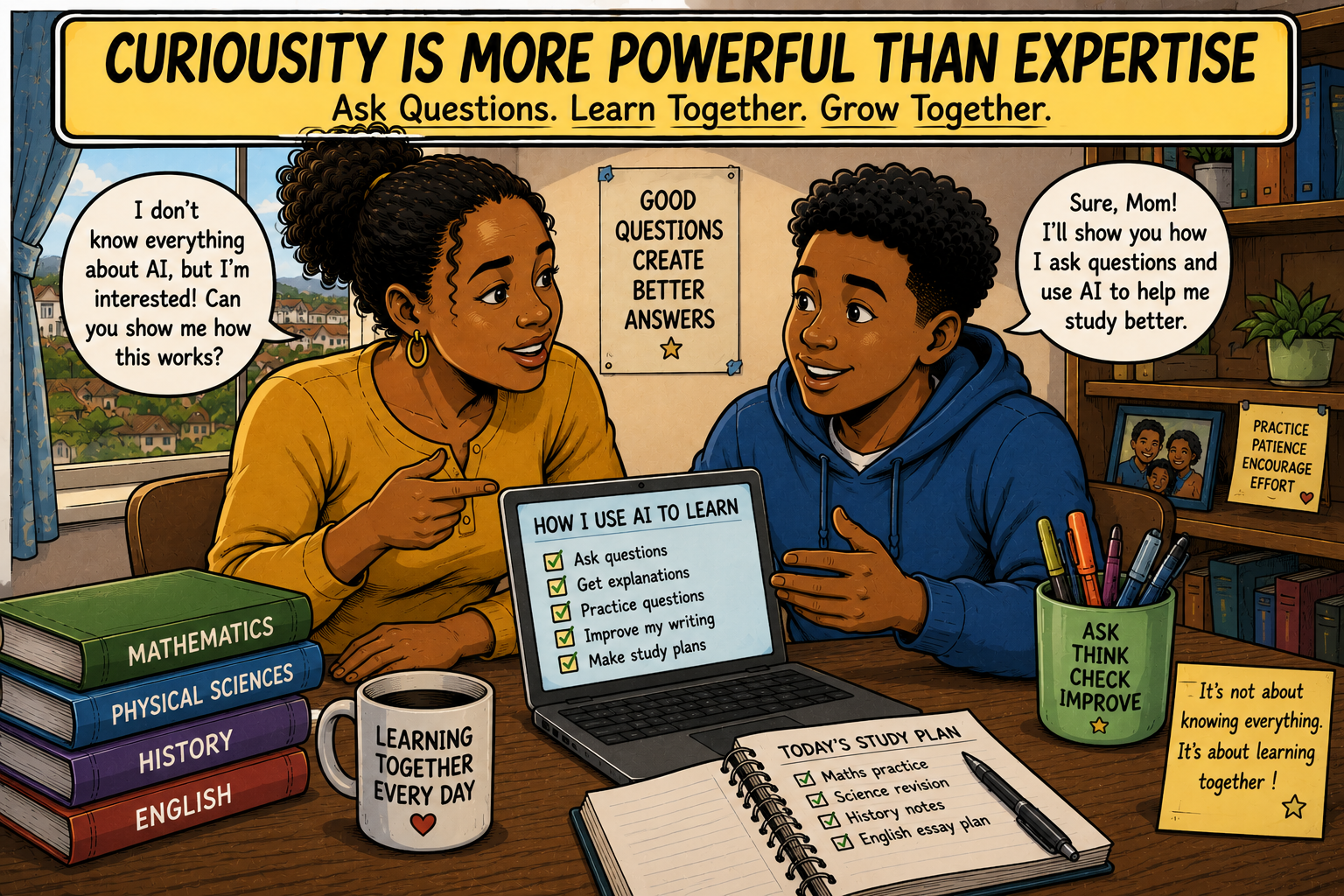
Curiosity Is More Powerful Than Expertise
Children appreciate adults who are interested in what they are learning.
Instead of feeling embarrassed about not understanding AI, become curious.
Try asking:
Can you show me how this works?
Why do you like using this tool?
How does it help you study?
What did you learn from it?
What happens if the answer is wrong?
These conversations build trust while helping you learn alongside your child.
Many teenagers enjoy teaching adults something new.
You Already Teach Important Life Skills
Parents sometimes underestimate how much they already contribute.
Every day, you help your child develop qualities such as:
honesty
responsibility
perseverance
respect
patience
kindness
resilience
These qualities remain essential when using AI.
Technology changes.
Good character does not.
If learners use AI honestly and responsibly, they will benefit far more than learners who simply know how to operate the latest software.
AI Does Not Replace Parenting
Some parents worry that technology is becoming more influential than families.
Fortunately, this is not the case.
AI cannot replace:
encouragement
emotional support
family values
life experience
wisdom
love
trust
guidance
Your child still needs someone to help them:
make decisions
manage disappointment
build confidence
stay motivated
develop self-discipline
These are human responsibilities.
No technology can replace them.
Ask Questions Instead Of Giving Answers
One of the simplest ways parents can support learning is by asking thoughtful questions.
For example:
Instead of asking:
"Did AI do your homework?"
Try asking:
What did AI help you understand?
Could you explain it to me?
Did you check whether it was correct?
Which part was still confusing?
How would your teacher explain it?
These questions encourage reflection.
Children learn more when they explain ideas in their own words.
Encourage Independent Thinking
AI should never replace thinking.
Parents can help children develop good habits by encouraging them to ask:
Does this answer make sense?
Can I explain this myself?
Have I checked another source?
Would my teacher agree?
Can I solve this without AI now?
These questions develop critical thinking.
This is one of the most valuable skills learners will ever acquire.
Help Children Use AI Responsibly
Parents do not need technical knowledge to recognise responsible behaviour.
Healthy AI use includes:
asking questions
improving understanding
practising difficult topics
organising revision
planning assignments
Unhealthy AI use includes:
copying answers
submitting AI work as your own
avoiding effort
relying on AI for everything
The difference is often easy to recognise.
Focus on behaviour rather than technology.
Support Good Study Habits
Children succeed because of consistent habits—not because of one particular app.
Parents can encourage:
regular study times
organised notes
realistic revision plans
enough sleep
healthy meals
exercise
regular breaks
AI works best when it supports good routines rather than replacing them.
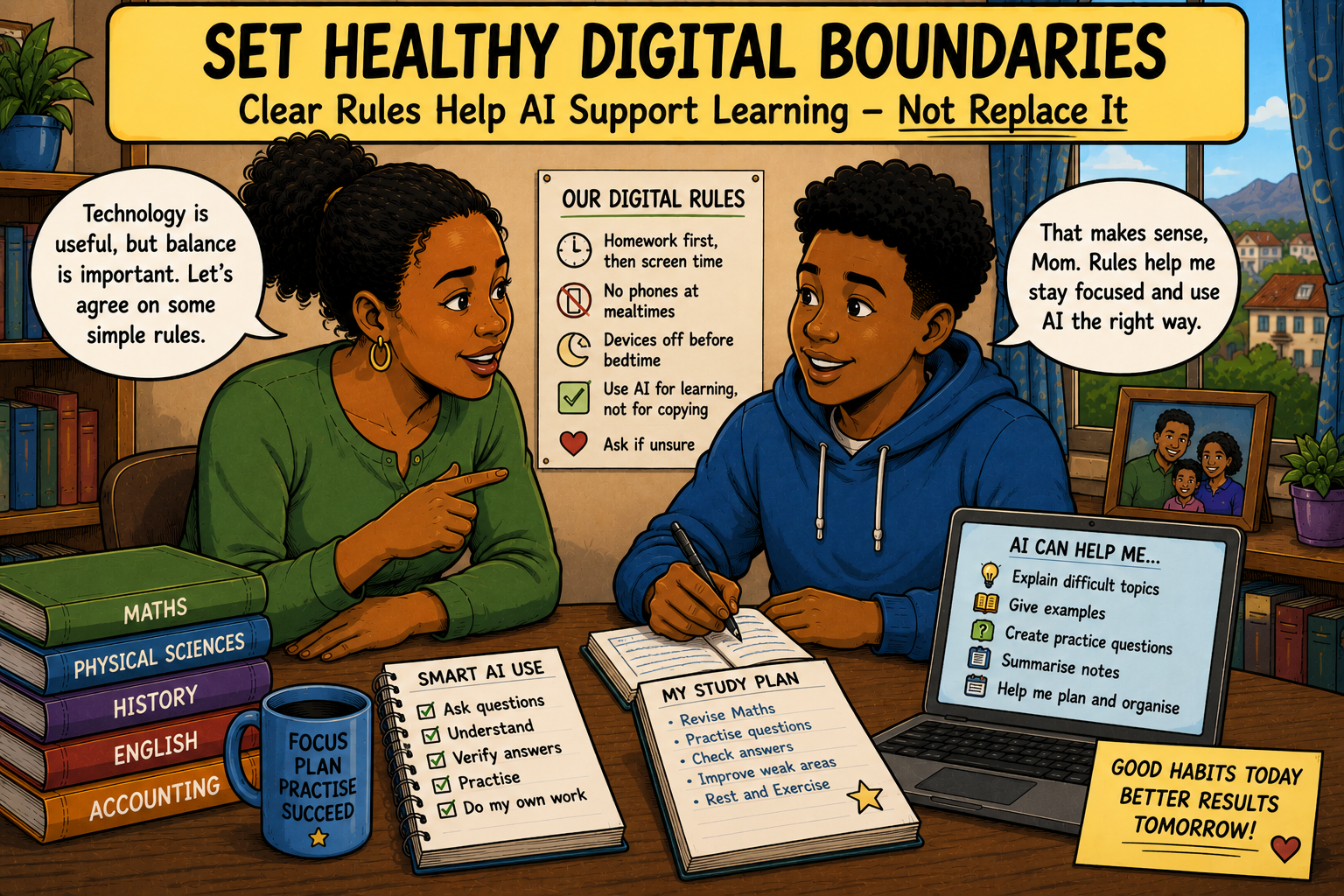
Set Healthy Digital Boundaries
Technology should have sensible limits.
Families can agree on simple expectations.
Examples include:
No phones during family meals.
Homework before entertainment.
Regular screen breaks.
Devices switched off before bedtime.
AI used for learning—not endless browsing.
Clear boundaries help children develop healthy digital habits.
Learn Together
You do not need to study AI alone.
Learning together strengthens family relationships.
Ask your child to show you:
how they ask AI questions
how they check answers
how they prepare for exams
how they improve assignments
You may discover useful study methods while your child develops confidence by explaining them.
Learning together creates partnership instead of conflict.
Every Family Will Look Different
South African families have different circumstances.
Some households have:
laptops
fibre internet
several digital devices
Others rely on:
shared smartphones
prepaid data
public Wi-Fi
school computer laboratories
Parents should not compare themselves with others.
The quality of support matters far more than the quantity of technology.
A supportive conversation costs nothing.
Work Together With Teachers
Teachers appreciate parents who remain involved.
If you are unsure about AI, ask your child's teachers questions such as:
How may learners use AI?
What does the school allow?
What counts as cheating?
How can parents help at home?
Schools and families achieve the best results when they work together.
Encourage Honesty Above High Marks
Children sometimes feel pressure to achieve excellent results.
Parents can reduce this pressure by valuing:
effort
improvement
persistence
honesty
more than perfect marks.
A learner who genuinely understands the work has achieved far more than someone who simply copied AI answers.
Character matters more than shortcuts.
Mistakes Are Part Of Learning
Parents sometimes worry when children make mistakes.
However, mistakes help learning happen.
If AI gives the wrong answer or your child misunderstands something, use it as a learning opportunity.
Ask:
What happened?
How did you discover the mistake?
What did you learn?
How could you check next time?
These conversations develop resilience and problem-solving.
Preparing Children For The Future
The world your child enters after school will continue changing.
New technology will appear throughout their career.
Rather than trying to prepare them for every new tool, prepare them to become lifelong learners.
Encourage qualities such as:
curiosity
adaptability
communication
integrity
resilience
critical thinking
responsibility
These skills remain valuable regardless of future technology.
Practical Things Parents Can Do This Week
Supporting AI learning does not require major changes.
You could:
Ask your child to show you one AI tool they use.
Spend ten minutes discussing how it helps them learn.
Ask them to explain a school topic in their own words.
Encourage them to verify important information.
Read your school's AI policy if one exists.
Praise effort rather than only results.
Keep communication open.
Small actions often have lasting impact.
Remember What Matters Most
When children look back on their education, they are unlikely to remember every technology they used.
They are far more likely to remember:
parents who encouraged them
adults who listened
conversations that built confidence
support during difficult times
people who believed in them
Technology supports learning.
Relationships inspire learning.
Parents remain one of the strongest influences on a young person's education.
Conclusion
Many parents worry that they cannot support AI learning because they are not technology experts. Fortunately, nothing could be further from the truth. Children do not need parents who understand every digital tool—they need parents who are interested, supportive, and willing to learn alongside them.
The most valuable contributions parents make have very little to do with technology. Encouraging honesty, asking thoughtful questions, setting healthy boundaries, supporting good study habits, and helping children think independently are all far more important than knowing how every AI application works.
In South Africa, where families have different levels of access to technology and digital resources, every parent can still make a meaningful difference. Whether your child studies using a laptop, a shared smartphone, or school resources, your encouragement, curiosity, and involvement remain powerful influences on their success.
Artificial intelligence will continue to evolve, but the qualities that make children successful learners will remain the same. Curiosity, integrity, resilience, responsibility, and a willingness to keep learning are timeless strengths. By focusing on these values instead of fearing new technology, parents can confidently guide their children through the changing world of education and prepare them for the opportunities that lie ahead.
Additional Articles in the Understanding AI as a Parent Series
What Parents of High School Learners Need to Know About AI
Why AI Is Becoming Part of High School Learning
Common Fears Parents Have About AI — and What Is Actually True
AI in South African Education: What Parents Should Understand
Why Parents Do Not Need to Be “Tech Experts” to Support AI Learning
Disclaimer
AI Tools were used to assist with research. Remember to always cross-check everything that you read.