

Parental Involvement & Boundaries: Supporting Learners Without Micromanaging
This is article #5 of 5 in the Parental Involvement & Boundaries Series
Introduction
High school learners in Grades 10–12 face more pressure, more subjects, and higher expectations than ever before. As a parent, it is natural to want to make sure your child is doing everything correctly and on time.
However, there is a fine line between supporting your child and micromanaging their school life.
Micromanaging happens when a parent becomes too involved in every small detail of schoolwork, study time, and decision-making. While it often comes from care and concern, it can lead to stress, frustration, and reduced independence in learners.
This article will help you understand how to support your child effectively while giving them the space they need to grow.
What Is Micromanaging?
Micromanaging is when a parent tries to control or monitor every small part of their child’s academic life, such as:
Constantly checking homework in detail
Controlling exactly when and how they study
Re-doing or correcting assignments too much
Sitting with them for every study session
Making all academic decisions for them
Instead of building independence, this can create dependence and anxiety.
Why Micromanaging Can Be Harmful
Even though it may feel like you are helping, micromanaging can have negative effects:
1. It Reduces Confidence
Learners may start to believe they cannot do anything on their own.
2. It Creates Dependence
Instead of thinking for themselves, they wait for instructions.
3. It Increases Stress
Constant supervision can make learners feel pressured and overwhelmed.
4. It Limits Problem-Solving Skills
If every mistake is corrected immediately, learners do not learn how to solve problems independently.
Signs You May Be Micromanaging
It is not always easy to notice. Here are common signs:
You check every detail of homework before it is submitted
You constantly remind your child about every task
You sit with them for most or all study sessions
You make decisions about their study methods for them
You feel anxious when you are not involved in their schoolwork
Your child relies on you for every academic step
If several of these apply, it may be time to step back slightly.
What Healthy Support Looks Like
Supporting your child does NOT mean controlling everything. Healthy support looks like:
Encouraging without taking over
Guiding instead of instructing every step
Checking progress, not controlling every action
Being available when needed
Trusting your child to take responsibility
Support should build independence, not replace it.
The Difference Between Support and Micromanaging
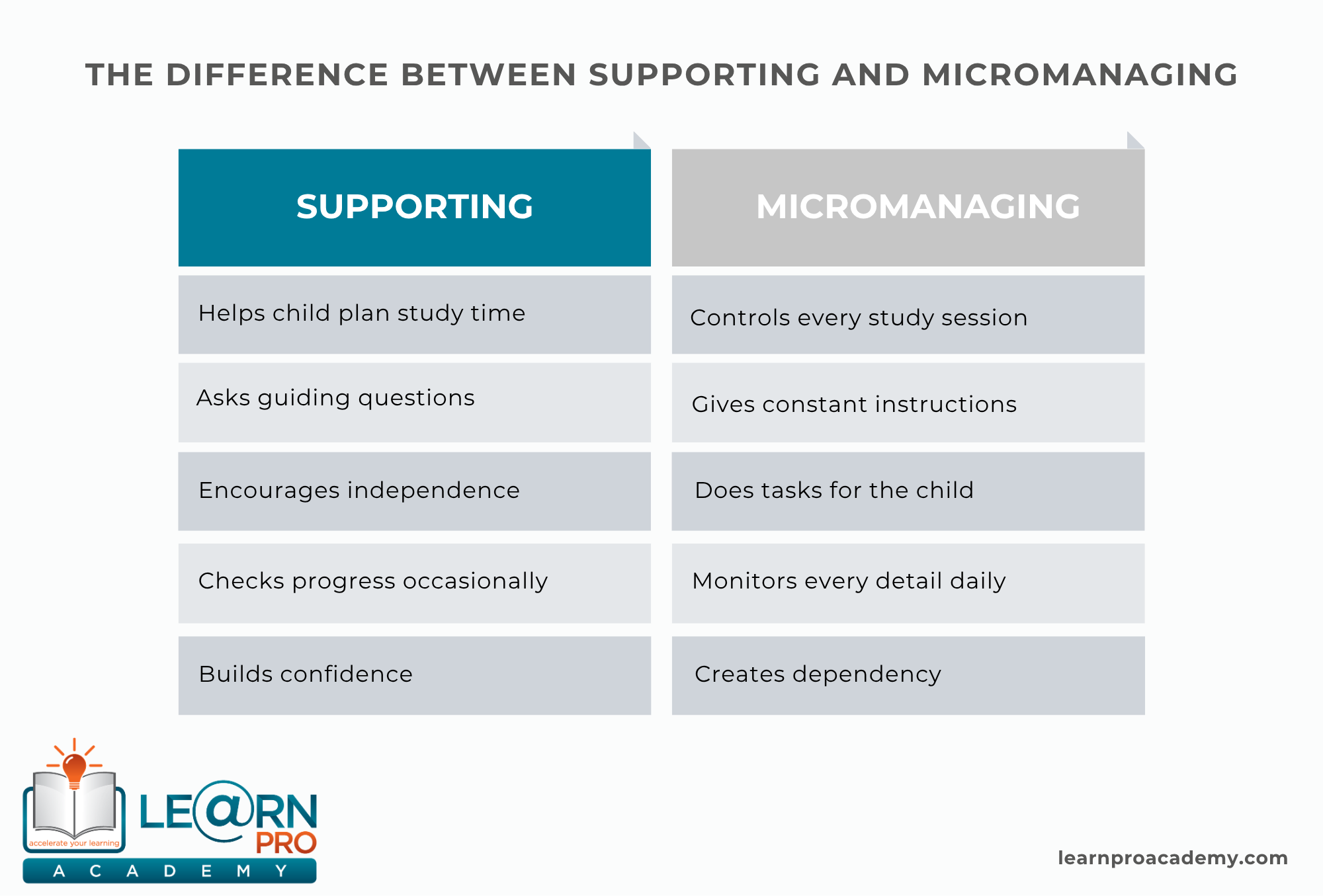
How to Support Without Micromanaging
Here are practical ways to stay involved without taking control:
1. Set Clear Expectations, Then Step Back
Help your child understand:
What needs to be done
When it needs to be completed
Why it is important
Then allow them to manage the process.
2. Use Check-Ins Instead of Constant Supervision
Instead of watching every study session, check in at agreed times:
“How is your revision going?”
“Do you need help with anything?”
This gives structure without pressure.
3. Ask Questions Instead of Giving Instructions
Encourage thinking by asking:
“What is your plan for this assignment?”
“How will you prepare for the test?”
“What is your biggest challenge right now?”
This helps learners develop decision-making skills.
4. Allow Small Mistakes
Mistakes are part of learning. Instead of fixing everything:
Let your child experience the result
Discuss what they learned
Help them improve next time
5. Encourage Ownership of Schoolwork
Let your child take responsibility for:
Homework tracking
Study planning
Communicating with teachers when appropriate
Building Trust With Your Child
Trust is essential in reducing micromanagement. When your child feels trusted, they are more likely to take responsibility.
You build trust by:
Showing confidence in their ability
Avoiding unnecessary criticism
Listening without immediately correcting
Respecting their study choices
Trust reduces conflict and improves cooperation.
Managing Parental Anxiety
Many parents micromanage because they are worried about results. This is understandable, but it can create pressure for both parent and child.
To manage anxiety:
Focus on progress, not perfection
Accept that mistakes are part of learning
Remember that independence is part of success
Avoid comparing your child to others
Trust the school system and teachers
A calmer parent often leads to a more confident learner.
Finding the Right Balance
The goal is not to stop caring. The goal is to move from control to guidance.
A healthy balance includes:
Staying informed about progress
Offering help when needed
Allowing independence in daily tasks
Stepping in only when necessary
This balance prepares learners for real-world responsibility.
Long-Term Benefits of Avoiding Micromanagement
When parents step back appropriately, learners develop:
Stronger independence
Better time management
Improved confidence
Problem-solving skills
Emotional resilience
These skills are essential not only for school success but also for life after school.
Checklist: Supporting Without Micromanaging
I set clear expectations but allow my child to manage their work
I avoid checking every detail of homework or study sessions
I use check-ins instead of constant supervision
I ask questions instead of giving direct instructions
I allow my child to make small mistakes and learn from them
I encourage my child to take responsibility for school tasks
I trust my child to manage their own study time
I focus on progress rather than perfection
I avoid comparing my child to others
I reflect regularly on whether I am over-involved
Conclusion
Supporting your child without micromanaging is one of the most valuable skills a parent can develop during high school years.
Your child does not need you to control every step. They need:
Guidance when they are unsure
Support when they struggle
Space to grow and learn independently
When parents find this balance, learners become more confident, responsible, and capable of handling academic challenges on their own.
Related Articles in the Parental Involvement & Boundaries Series
Finding the Right Balance Between Support and Independence
When to Get Extra Academic Support
Working with Teachers and Schools Effectively
Understanding Your Role in Your Child’s Education
Supporting Learners Without Micromanaging
Disclaimer
AI Tools were used to assist with research. Remember to always cross-check everything that you read.