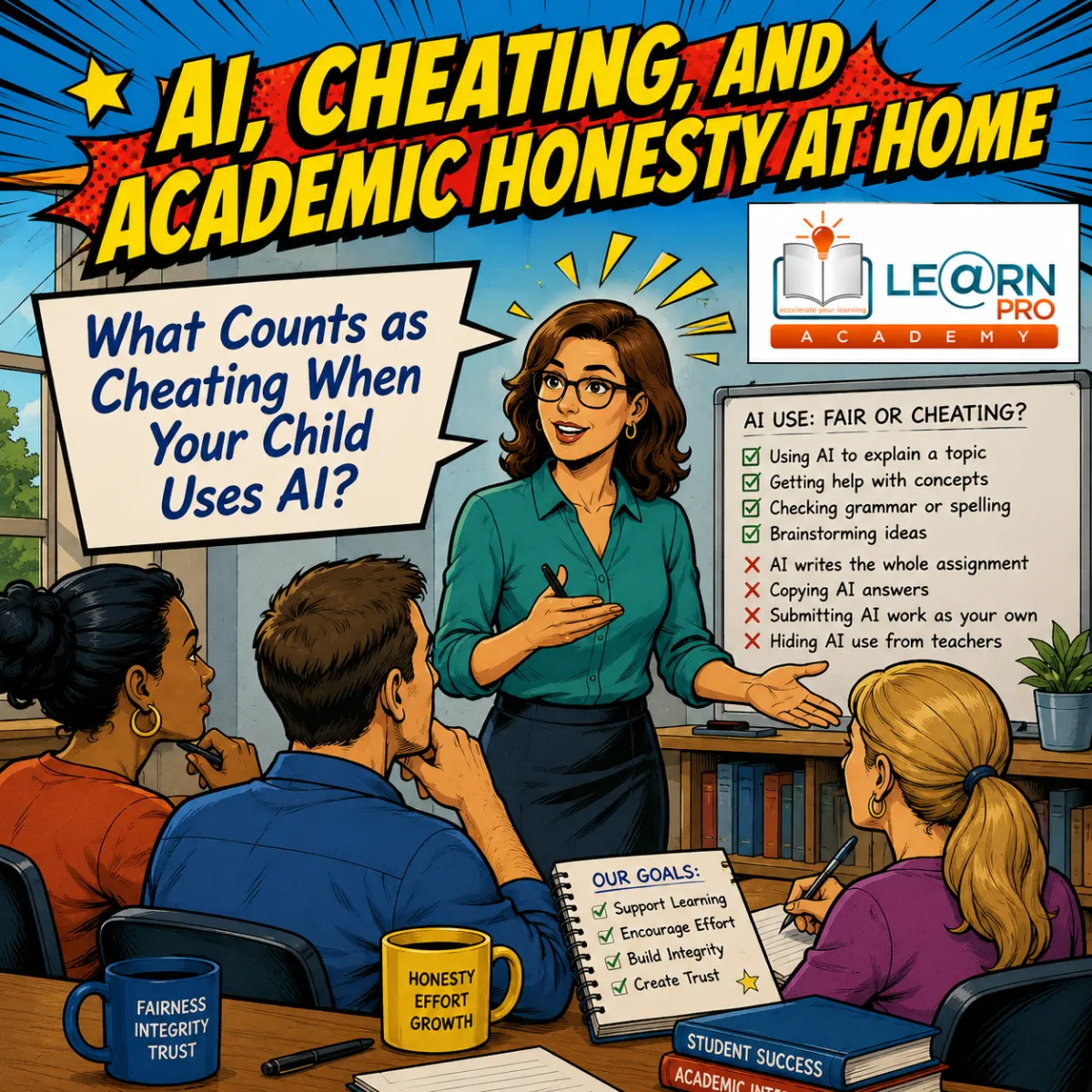
What Counts as Cheating When Your Child Uses AI?
This is article #1 of 5 in the AI, Cheating, and Academic Honesty at Home Series
Introduction
Artificial intelligence (AI) is becoming a normal part of school life. Many high school learners already use AI to explain difficult topics, check grammar, summarise notes, or help them prepare for tests. As more schools discuss AI in education, many parents are asking an important question: When does using AI become cheating?
The answer is not always simple. Using AI is not automatically dishonest. In fact, many teachers encourage learners to use AI in responsible ways because it can improve understanding and support independent learning. The problem begins when AI replaces the learner's own thinking, effort, or original work.
Parents do not need to become AI experts to guide their children well. They simply need to understand the difference between using AI as a learning assistant and using it as a shortcut to avoid learning.
This article explains where that line usually lies, why honesty still matters in an AI-rich world, and how parents can help their child use AI responsibly while continuing to develop real knowledge and skills.
Why This Question Matters More Than Ever
For many years, cheating usually meant copying another learner's work or looking at answers during a test. Today, AI has introduced a new challenge.
A learner can type a question into an AI tool and receive an essay, project outline, speech, or explanation within seconds. Sometimes the work looks so polished that it appears to have been written by an experienced adult.
This creates confusion for parents. Some wonder whether using AI at all is cheating. Others believe AI is simply another educational tool like a calculator or dictionary.
The truth lies somewhere between these two views.
Like any tool, AI can be used responsibly or irresponsibly. What matters most is how it is used.
Understanding this difference helps parents support learning without encouraging dishonest behaviour.
AI Is A Tool, Not A Replacement For Learning
Think about other tools learners already use.
They use:
Dictionaries to understand words.
Calculators to solve complex calculations.
Atlases to study geography.
Search engines to find information.
Spell checkers to improve writing.
None of these tools are considered cheating when they are used appropriately.
AI is similar.
It becomes a problem only when the learner allows it to do the thinking instead of helping them think better.
A useful question for parents is:
"Is AI helping my child learn, or is it replacing their learning?"
The answer usually makes the difference clear.
Examples Of Responsible AI Use
There are many ways AI can genuinely support learning.
Responsible AI use often includes asking AI to:
Explain difficult concepts in simpler language.
Provide examples of mathematical methods.
Summarise long textbook chapters.
Create practice quizzes.
Generate revision questions.
Explain unfamiliar vocabulary.
Suggest ways to improve grammar.
Give feedback on writing.
Help organise study schedules.
Explain mistakes after completing homework independently.
In all these situations, the learner remains actively involved.
They still need to:
Read.
Think.
Practise.
Understand.
Make decisions.
Complete their own work.
AI acts like an extra tutor rather than a replacement learner.
Examples Of AI Use That Crosses The Line
Problems begin when AI produces work that the learner submits as though it were entirely their own.
Examples include:
Asking AI to write an entire essay.
Generating complete homework answers without attempting the questions first.
Copying AI responses directly into assignments.
Using AI to complete projects with little or no personal contribution.
Creating speeches that the learner has never practised or understood.
Submitting AI-generated reports without checking facts or making changes.
Using AI secretly when school rules prohibit it.
In these cases, the learner receives credit for work they did not actually complete.
That is dishonest because the assignment is supposed to measure the learner's own understanding.
Every School May Have Different Rules
Parents should remember that schools are still developing AI policies.
Some schools:
Encourage responsible AI use.
Allow AI for brainstorming.
Permit grammar checking.
Allow AI for research support.
Require learners to declare when AI has been used.
Restrict AI during certain assignments.
Ban AI entirely for specific assessments.
Because policies differ, learners should always understand their school's expectations. Encourage your child to ask their teacher if they are unsure.
Learning to clarify expectations is a valuable life skill.
Why Learning Matters More Than Marks
Many learners become tempted by AI because they want higher marks. Parents naturally want their children to succeed too. However, marks only tell part of the story.
The real purpose of school is to build knowledge and skills that learners will use long after they leave the classroom.
When AI completes the work:
Writing skills do not improve.
Critical thinking becomes weaker.
Problem-solving skills develop more slowly.
Learners struggle during tests.
Confidence decreases because they know they cannot work independently.
A high mark earned dishonestly may look impressive today but creates bigger problems tomorrow.
Real learning lasts much longer than a report card.
Why Tests Often Reveal The Truth
Some learners believe they can use AI for every assignment without consequences. Unfortunately, classroom tests often reveal the gaps.
A learner may submit excellent homework but then:
Forget key concepts.
Struggle to explain ideas.
Perform poorly during exams.
Fail oral presentations.
Find independent writing difficult.
Teachers usually notice these differences.
Parents may notice them too.
This does not always mean the learner cheated, but sudden differences between homework quality and independent performance deserve gentle conversation.
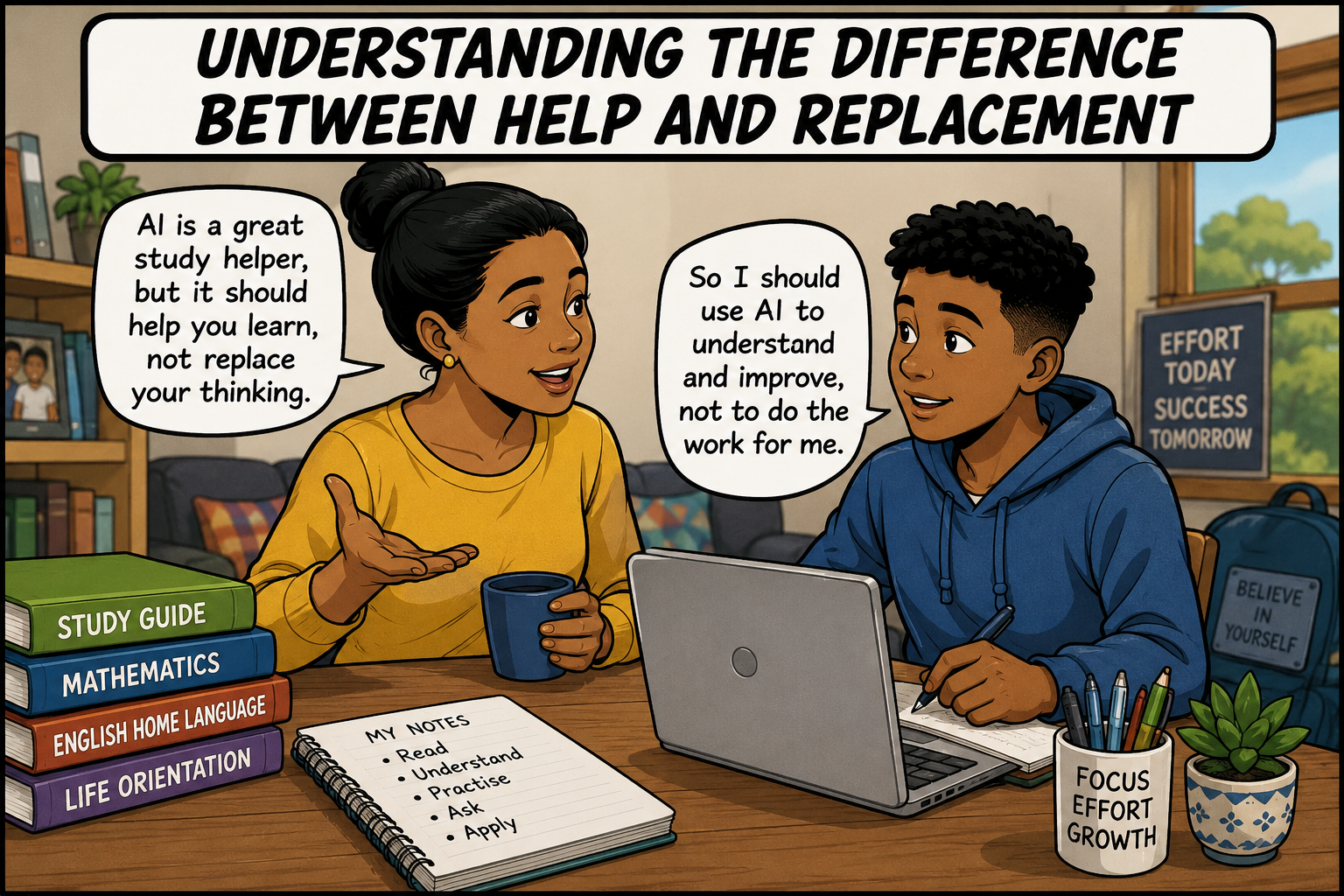
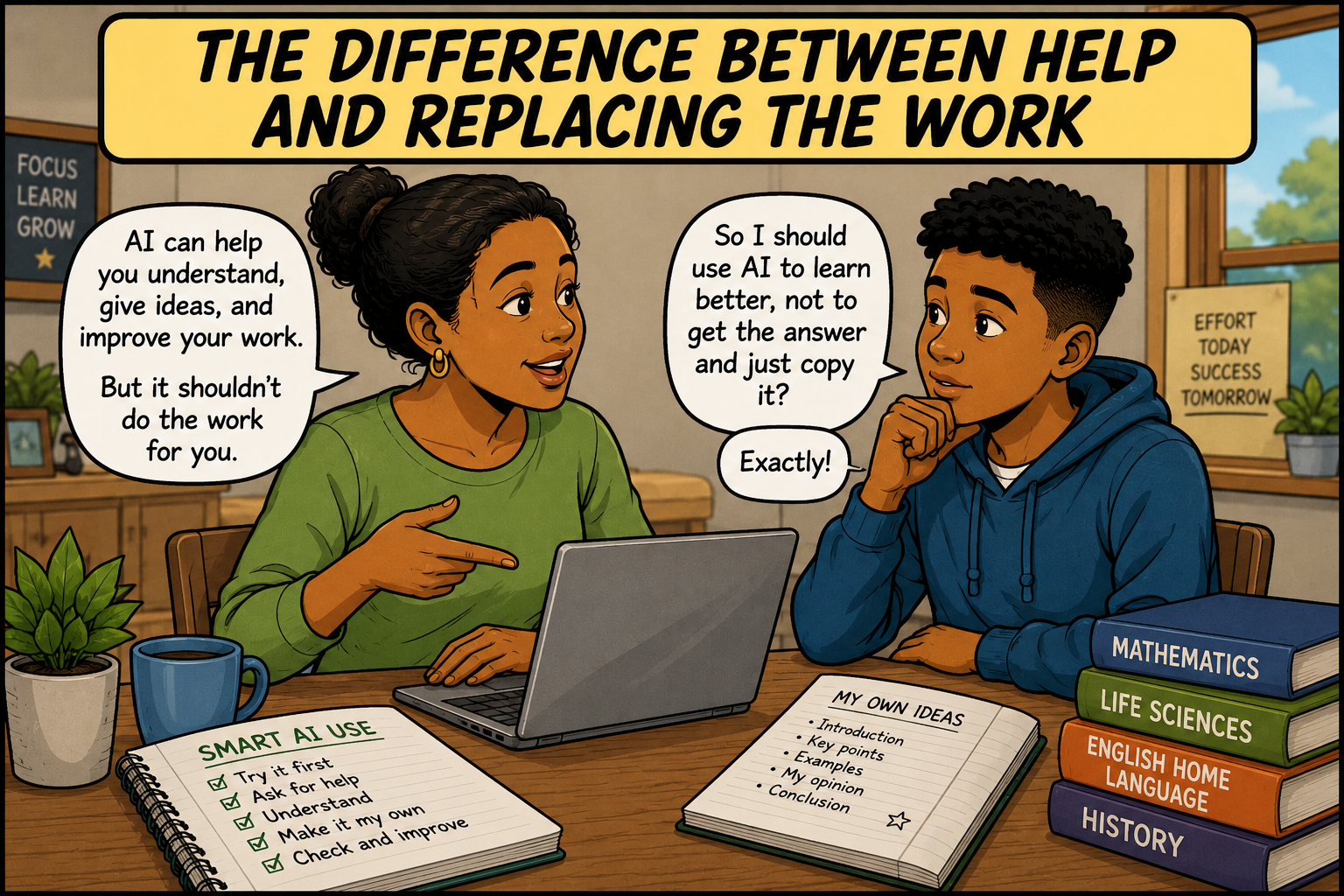
Understanding The Difference Between Help And Replacement
One useful way to judge AI use is to ask a few simple questions.
Did the learner:
Try the work first?
Read and understand the AI explanation?
Change the work into their own words?
Learn something new?
Improve their own understanding?
Or did they simply:
Copy.
Paste.
Submit.
Move on.
The first approach supports learning.
The second avoids learning.
AI Should Start A Conversation, Not End One
Many parents worry when they hear their child using AI.
Instead of immediately saying, "You are cheating," try asking questions.
For example:
"What did AI help you understand?"
"Can you explain this answer to me?"
"Which part did you write yourself?"
"What was difficult before you used AI?"
"Would you be able to answer this question without AI now?"
These questions encourage thinking rather than defensiveness.
They also help parents understand whether genuine learning has taken place.
The Importance Of Original Thinking
Every learner has their own voice.
Teachers want to see:
Personal ideas.
Individual reasoning.
Creative thinking.
Problem-solving ability.
Independent opinions.
AI cannot replace these qualities.
If every learner submits similar AI-generated work, teachers cannot accurately assess what each learner actually understands.
Encourage your child to use AI for ideas — not finished answers.
Their own thinking remains the most valuable part of any assignment.
Grammar Help Is Different From Writing The Whole Assignment
Many learners worry about spelling and grammar, especially if English is not their first language.
Using AI to improve grammar is generally very different from asking AI to write the assignment.
Imagine a learner writes an essay independently and then asks AI to:
Correct spelling.
Improve punctuation.
Suggest clearer sentences.
The learner still created the ideas.
They simply improved how those ideas are communicated.
This is similar to asking a teacher, tutor, or parent to review writing before submission.
However, asking AI to generate the essay from the beginning removes much of the learner's own work.
Research Support Is Not The Same As Copying
AI can help learners begin research.
For example, AI can:
Explain background information.
Suggest topics to investigate.
Recommend questions to explore.
Summarise general concepts.
This can save time.
However, learners should still:
Read textbooks.
Use reliable sources.
Verify information.
Compare different viewpoints.
Write conclusions in their own words.
Research is about understanding information—not simply collecting it.
AI Can Sometimes Be Wrong
Parents should also know that AI does not always produce correct answers.
Sometimes AI:
Makes factual mistakes.
Gives outdated information.
Invents references.
Misunderstands questions.
Provides oversimplified explanations.
If learners copy AI without checking, they may submit inaccurate work.
Responsible AI use always includes checking information against trusted sources such as textbooks, teacher notes, and reputable educational websites.
Encourage Transparency Instead Of Secrecy
Some learners hide their AI use because they fear punishment.
Parents can encourage honesty instead.
If your child uses AI appropriately, they should feel comfortable saying:
"I used AI to help me understand this chapter."
or
"I asked AI to explain this Maths method."
This openness creates trust.
If AI use must always be hidden, it may indicate that the learner already knows they have crossed a line.
Building Good Habits Early
Healthy AI habits develop over time.
Parents can encourage simple routines such as:
Attempt homework before opening AI.
Use AI only after becoming stuck.
Compare AI explanations with textbooks.
Rewrite answers using personal understanding.
Review mistakes carefully.
Discuss difficult topics with teachers when necessary.
These habits build independence instead of dependence.
Helping Your Child Think About Consequences
Rather than focusing only on punishment, help your child think ahead.
Ask questions like:
"What will happen during exams if AI always does your homework?"
"Will this help you in university?"
"Would you trust a doctor who never learned the work properly?"
"How will employers know what you can really do?"
These conversations connect honesty to future success rather than simply avoiding punishment.
Creating Family Expectations Around AI
Every family can decide what responsible AI use looks like at home.
You might agree on expectations such as:
Homework should always begin with independent effort.
AI should explain rather than replace.
Finished assignments should reflect the learner's own understanding.
AI-generated text should never simply be copied and submitted.
School rules about AI should always be followed.
Parents can ask questions about how AI was used.
Simple expectations provide clear guidance without making AI seem forbidden.
Remember That Mistakes Can Become Learning Opportunities
Some learners will make poor choices.
If your child copies AI work once, avoid assuming they are dishonest by nature.
Instead, ask:
Why did this happen?
Were they overwhelmed?
Were they worried about marks?
Did they misunderstand the school's rules?
Did they panic because of deadlines?
Understanding the reason makes it easier to teach better decision-making in future.
Accountability remains important, but so does helping learners grow from mistakes.
Preparing Your Child For An AI Future
AI will almost certainly remain part of education and many future careers.
The goal is not to prevent children from ever using AI.
The goal is to teach them to use it wisely.
Learners who understand when AI supports learning — and when it replaces learning — will be better prepared for university, the workplace, and lifelong learning.
Honesty, curiosity, critical thinking, and responsibility will remain valuable long after today's AI tools have changed.
Conclusion
Parents do not need to fear AI, but they do need to understand it. The difference between responsible AI use and cheating is usually quite simple: responsible use helps the learner think, while dishonest use allows AI to do the thinking for them.
Encourage your child to use AI as a tutor, coach, and study partner — not as someone who completes their work. Celebrate effort as much as achievement, ask thoughtful questions about how AI was used, and keep communication open. When children understand that the real goal of school is learning rather than simply collecting marks, they are far more likely to use AI with honesty, confidence, and integrity.
Additional Articles in the AI, Cheating, and Academic Honesty at Home Series
What Counts as Cheating When Your Child Uses AI?
How to Talk About Honesty When AI Can Do the Work So Easily
Signs Your Child May Be Overusing AI for Schoolwork
How to Respond If You Discover Your Child Used AI Dishonestly
Building a Home Culture of Effort, Not Shortcuts
Disclaimer
AI Tools were used to assist with research. Remember to always cross-check everything that you read.