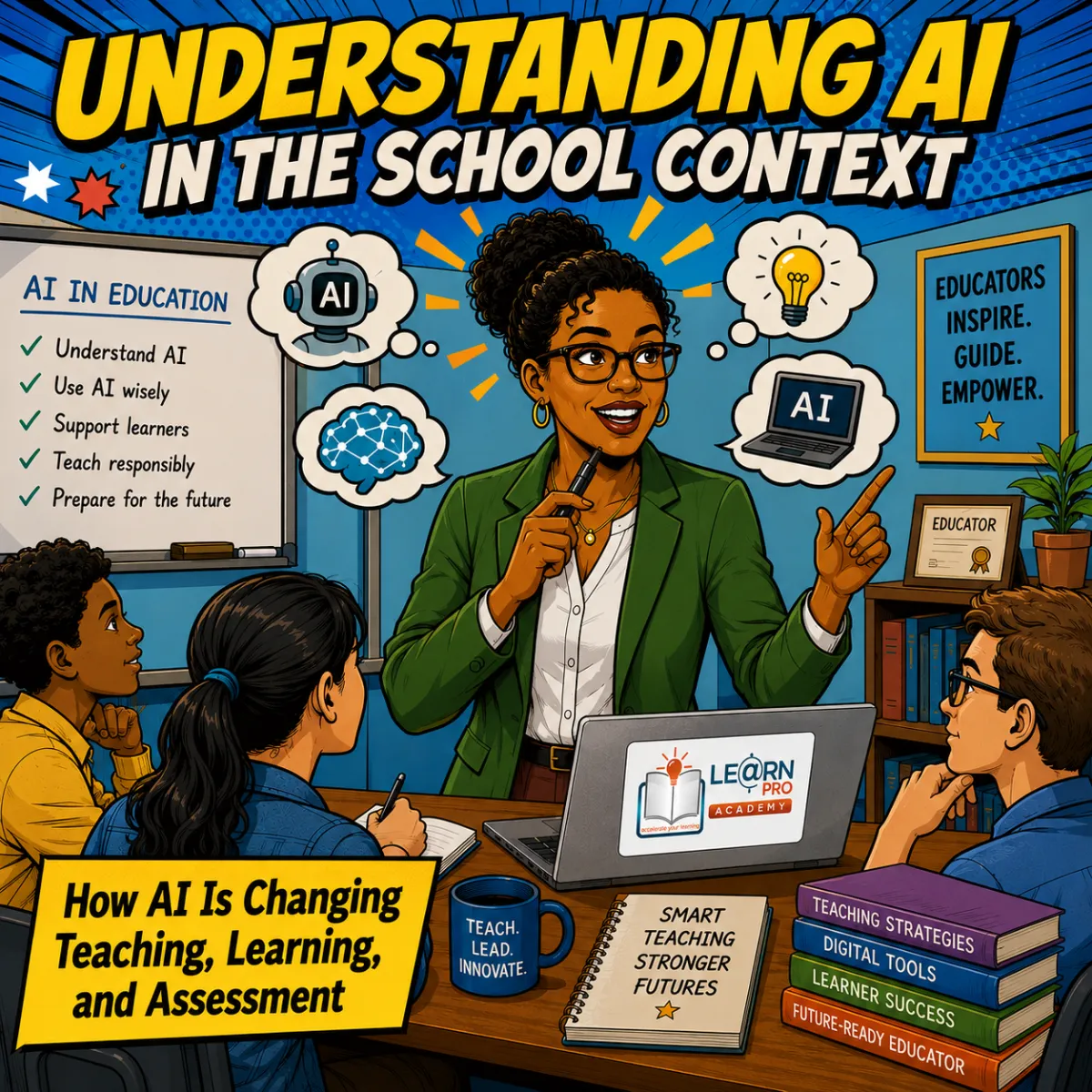
How AI Is Changing Teaching, Learning, and Assessment
This is article #2 of 5 in the Understanding AI in the School Context Series
Introduction
Artificial Intelligence (AI) is no longer something educators need to prepare for in the distant future — it is already influencing classrooms across South Africa and around the world. Many learners are using AI to explain difficult concepts, summarise notes, generate practice questions, improve their writing, and prepare for tests and examinations. Some educators are experimenting with AI to reduce administrative tasks, while others remain uncertain about its role in education.
These changes raise important questions. How should teachers respond when learners use AI? Will traditional assessment methods still be effective? Can AI genuinely improve teaching, or will it simply create new challenges?
The reality is that AI is changing education in much the same way that the internet, smartphones, and online learning platforms did. It is creating new opportunities while also requiring educators to rethink some long-established classroom practices. Rather than replacing teachers, AI is changing the way teachers work, how learners access information, and how schools think about learning and assessment.
This article explores how AI is reshaping teaching, learning, and assessment in practical terms. It also explains how South African educators can adapt thoughtfully while keeping quality teaching, critical thinking, and learner development at the centre of education.
Education Has Always Evolved
Education has never remained the same.
Over the years, schools have adapted to many technological developments, including:
Overhead projectors
Computers
The internet
Interactive whiteboards
Smartphones
Online learning platforms
Digital textbooks
Learning management systems
Each new technology initially created uncertainty.
Teachers asked:
Will this make teaching harder?
Will learners become too dependent on technology?
Is this just another passing trend?
Although each innovation changed classroom practice, none replaced the educator.
Instead, teachers adapted their methods while continuing to provide guidance, structure, encouragement, and professional judgement.
AI represents the next stage in this ongoing evolution.
AI Is Changing How Learners Access Information
One of the biggest changes AI has introduced is the speed at which learners can obtain information.
Previously, learners might:
Search through textbooks
Visit the library
Browse websites
Watch educational videos
Ask teachers for clarification
Today, many learners begin by asking an AI assistant.
Instead of searching through multiple sources, they may ask:
"Explain photosynthesis for Grade 10."
Or:
"Summarise the causes of World War I."
Within seconds, AI produces a personalised explanation.
This speed is useful, but it also changes the educator's role.
Teachers increasingly need to help learners evaluate information rather than simply find it.
Information Is No Longer The Challenge
In previous generations, access to information was often limited.
Today, the challenge is different.
Learners have access to enormous amounts of information, including AI-generated responses.
The real question is:
Can learners recognise whether the information is accurate, balanced, complete, and trustworthy?
This makes information literacy and critical thinking even more important.
Educators are becoming guides who help learners:
Question information
Compare sources
Verify facts
Identify bias
Think independently
These skills will remain valuable regardless of future technological developments.
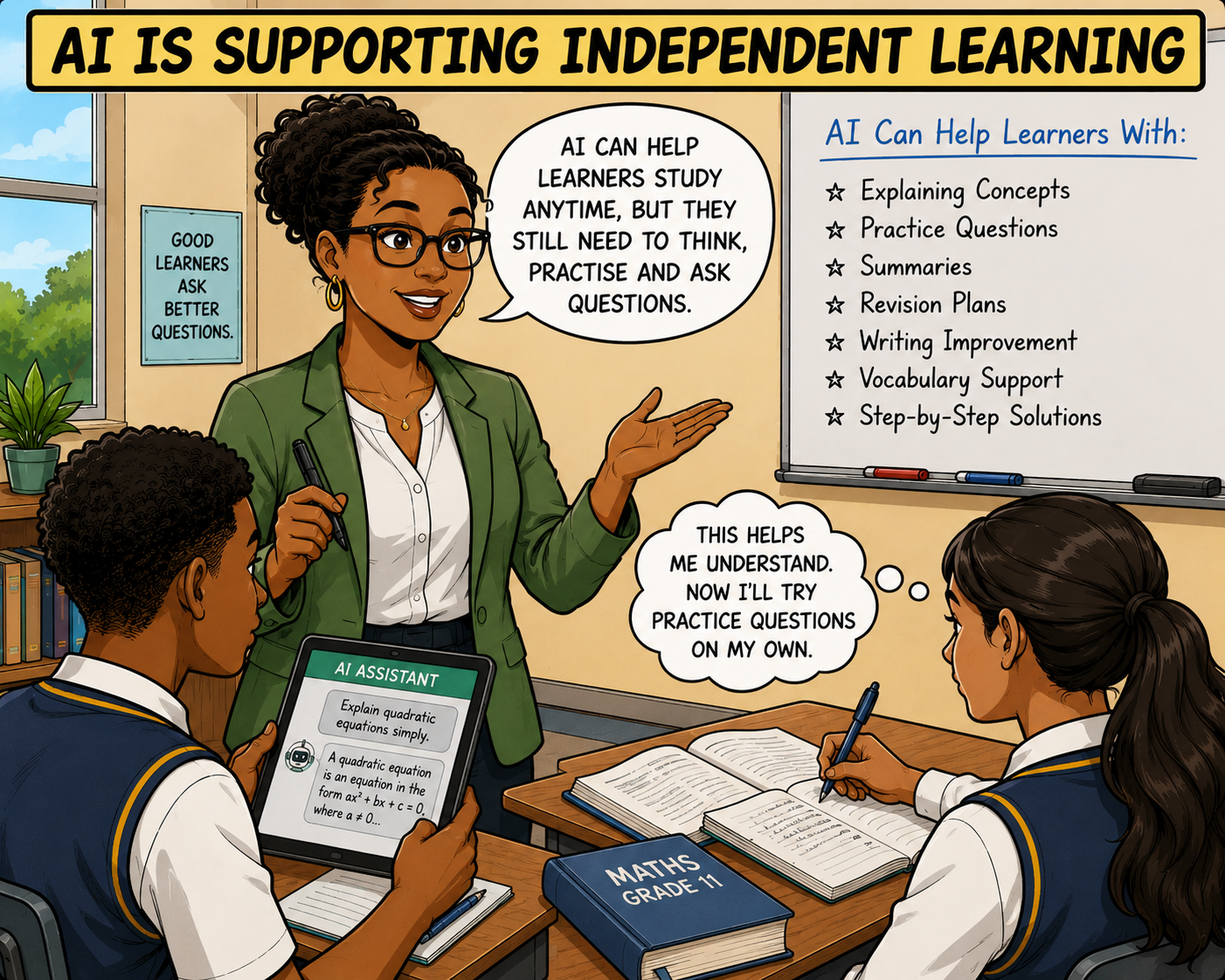
AI Is Supporting Independent Learning
Many learners already use AI outside school hours.
They ask AI to:
Explain difficult concepts
Create quizzes
Simplify textbook chapters
Generate revision plans
Practise essay questions
Translate difficult vocabulary
Check grammar
Solve mathematical problems step by step
For motivated learners, AI can provide additional academic support long after the school day has ended.
This creates opportunities for more independent learning.
However, independence does not mean learners should work without guidance.
Teachers remain responsible for helping learners use AI responsibly and effectively.
The Teacher's Role Is Becoming More Important
Some people worry that AI reduces the importance of educators.
The opposite is often true.
When learners have unlimited access to AI-generated information, they need skilled teachers to help them:
Understand concepts deeply
Ask better questions
Evaluate evidence
Recognise incorrect information
Develop reasoning skills
Build ethical judgement
Apply knowledge to real situations
AI can provide information.
Teachers develop understanding.
Those are very different responsibilities.
Classroom Discussions Become More Valuable
If AI can quickly answer factual questions, classroom time becomes even more valuable for activities that AI cannot easily replace.
These include:
Group discussions
Debates
Practical investigations
Experiments
Problem-solving
Collaboration
Reflection
Oral presentations
These activities encourage learners to think, communicate, and justify their ideas rather than simply recall information.
AI should support these learning experiences—not replace them.
Lesson Planning Is Becoming Faster
Many educators spend several hours each week preparing lessons.
AI can assist by generating first drafts of:
Lesson outlines
Learning objectives
Classroom activities
Revision exercises
Homework ideas
Discussion questions
Extension activities
Differentiated tasks
Importantly, AI should not replace professional lesson planning.
Instead, it provides a starting point.
Educators still decide:
What to teach
How to teach it
Which examples suit their learners
Which activities align with CAPS requirements
Which adjustments are needed for their particular classes
Professional judgement remains essential.
Supporting Diverse Learners
South African classrooms often include learners with different:
Language backgrounds
Academic abilities
Learning speeds
Educational needs
Confidence levels
Preparing different resources for every learner has traditionally required significant time.
AI can assist educators by creating:
Simplified explanations
Additional examples
Vocabulary lists
Reading passages
Practice exercises
Extension work for advanced learners
This makes differentiated instruction more achievable.
However, teachers remain responsible for ensuring that the materials are accurate, appropriate, and aligned with curriculum outcomes.
AI Is Helping Learners Revise More Effectively
Revision has become one of the most common educational uses of AI.
Learners can ask AI to:
Generate flashcards
Create multiple-choice questions
Explain mistakes
Test understanding
Summarise chapters
Produce revision timetables
This allows learners to receive immediate feedback without waiting for classroom time.
Teachers can encourage these positive uses while reminding learners that AI should support revision—not replace genuine study.
AI Is Changing Homework
Homework has traditionally allowed educators to assess individual understanding.
AI changes this considerably.
A learner can now ask AI to:
Write an essay
Solve mathematics questions
Complete research tasks
Generate project ideas
Improve written English
This creates new challenges.
Teachers can no longer assume that every homework submission reflects only the learner's own thinking.
Rather than abandoning homework altogether, educators may need to redesign homework tasks.
Authentic Learning Matters More Than Ever
One response to AI is to focus more on authentic learning.
Authentic learning asks learners to:
Explain their thinking
Apply knowledge
Solve unfamiliar problems
Reflect on their learning
Connect ideas
Work collaboratively
These tasks are much harder to complete dishonestly using AI alone.
Authentic learning also develops skills that employers increasingly value.
Assessment Is Beginning To Change
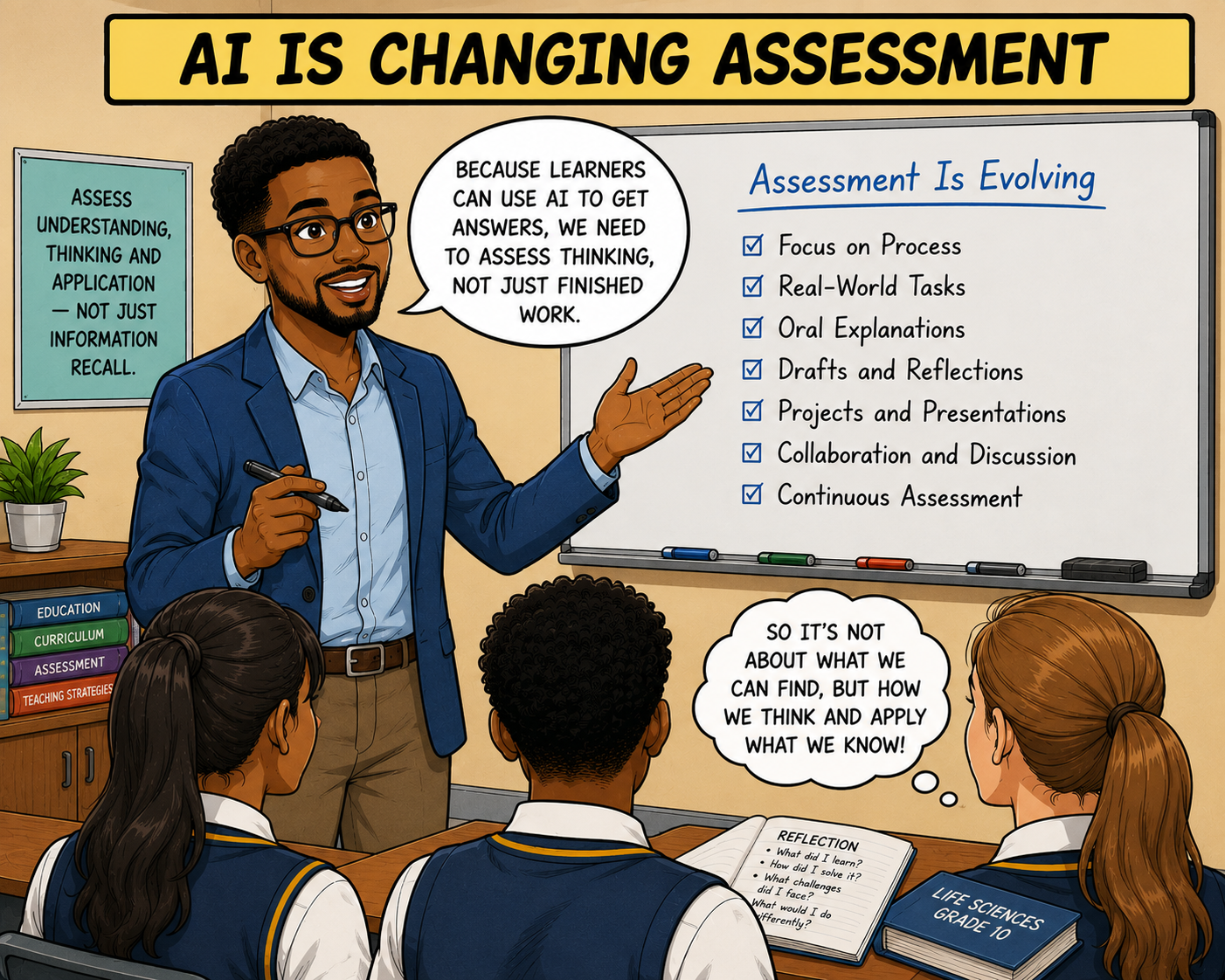
Perhaps the biggest educational impact of AI is on assessment.
Traditional assessment methods often focus on finished products.
AI makes it easier to generate those products.
As a result, schools may increasingly assess:
Thinking processes
Draft development
Oral explanations
Practical application
Reflection
Classroom participation
Collaboration
Real-world problem-solving
Assessment becomes more about demonstrating understanding than producing polished written work.
Continuous Assessment Becomes More Valuable
Instead of relying heavily on one assignment, educators may place greater emphasis on continuous assessment.
This allows teachers to observe learners over time through:
Classroom discussions
Practical tasks
Small quizzes
Presentations
Peer feedback
Group activities
Learning journals
These multiple pieces of evidence provide a more complete picture of learner progress.
Feedback Can Become More Personalised
Providing detailed feedback for every learner is challenging, especially in large classes.
AI can assist educators by generating first-draft feedback based on marking criteria.
Teachers can then personalise this feedback before sharing it with learners.
This saves time while maintaining the educator's professional oversight.
Learners benefit from more detailed guidance without increasing teacher workload significantly.
AI Can Improve Accessibility
Some learners experience barriers that make learning more difficult.
AI can support accessibility by helping educators create:
Simplified language versions
Reading support
Vocabulary explanations
Alternative examples
Structured revision material
These resources may particularly benefit:
English First Additional Language learners
Learners who missed school
Learners needing additional reinforcement
AI should be viewed as one support tool within inclusive education rather than a complete solution.
Developing Higher-Order Thinking Skills
Because AI can provide factual information quickly, classroom learning increasingly needs to emphasise higher-order thinking.
Learners should practise:
Analysing
Comparing
Evaluating
Creating
Reflecting
Justifying conclusions
Solving unfamiliar problems
These skills remain difficult for AI to perform independently because they depend on human reasoning, context, judgement, and creativity.
Teaching Learners How To Use AI Responsibly
Educators have an important role in teaching responsible AI use.
Learners should understand:
AI is not always correct.
AI sometimes invents information.
Sources should be verified.
Original thinking remains essential.
Academic honesty still matters.
Privacy should be protected.
AI outputs require human review.
These lessons are becoming part of digital citizenship.
The South African Reality
South African schools vary enormously.
Some schools have:
High-speed internet
One-to-one devices
Digital learning platforms
AI experimentation
Others face:
Limited internet access
Shared devices
Electricity disruptions
Budget constraints
Large class sizes
Because of these differences, AI adoption will not happen at the same pace everywhere.
This is perfectly normal.
Educators should focus on practical improvements that fit their own school's circumstances.
Small, sustainable changes are often more effective than trying to transform everything at once.
Challenges Educators Should Expect
AI brings opportunities, but it also introduces genuine challenges.
These include:
Academic Integrity
Schools need clear expectations about acceptable AI use.
Accuracy
Teachers must verify AI-generated information before using it.
Equity
Not all learners have equal access to AI tools.
Privacy
Learner information should never be shared carelessly with AI systems.
Teacher Confidence
Many educators are still learning how AI works.
Professional development will become increasingly important.
Practical Ways To Adapt
Educators do not need to overhaul their teaching overnight.
Instead, consider gradual changes.
Experiment With AI Yourself
Understanding AI begins with personal experience.
Review AI-Generated Content Carefully
Always edit and improve AI outputs.
Design Better Assessment Tasks
Include discussion, reflection, and application.
Encourage Critical Thinking
Teach learners to question AI rather than accept every answer.
Share Good Practice
Collaborate with colleagues who are experimenting successfully.
Continue Learning
AI technology changes rapidly.
Professional learning should continue alongside technological development.
Looking Ahead
AI will continue to evolve over the coming years.
Future educational systems may include:
Personalised learning assistants
Intelligent tutoring systems
Automated administrative support
Adaptive assessments
Improved accessibility tools
These developments will create new opportunities.
However, the foundations of excellent teaching will remain unchanged.
Learners will still need:
Encouragement
Human relationships
Ethical guidance
Critical thinking
Inspiration
Professional educators
Technology can support these goals.
It cannot replace them.
Key Takeaways
Artificial Intelligence is already changing the way teaching, learning, and assessment take place. Learners have faster access to information, teachers have new opportunities to reduce administrative workload, and schools are beginning to rethink traditional approaches to homework and assessment. These changes are significant, but they do not diminish the importance of educators. Instead, they highlight the growing need for teachers who can guide learners, encourage critical thinking, and ensure that technology is used responsibly.
For South African educators, the challenge is not to compete with AI but to understand how it can strengthen teaching while recognising its limitations. Schools will adopt AI at different speeds depending on their circumstances, but every educator can begin by learning about the technology, experimenting thoughtfully, and adapting classroom practice where it genuinely benefits learners.
The future of education will combine human expertise with intelligent technology. Teachers who embrace continuous learning, maintain high professional standards, and keep learners' needs at the centre of every decision will be well positioned to thrive in this changing educational landscape.
Additional Articles in the Understanding AI in the School Context Series
What High School Educators Need to Know About AI
How AI Is Changing Teaching, Learning, and Assessment
Common Myths and Fears About AI in Education
Why AI Literacy Is Becoming Part of Good Teaching
AI in South African Education: Opportunity, Pressure, and Practical Reality
Disclaimer
AI Tools were used to assist with research. Remember to always cross-check everything that you read.