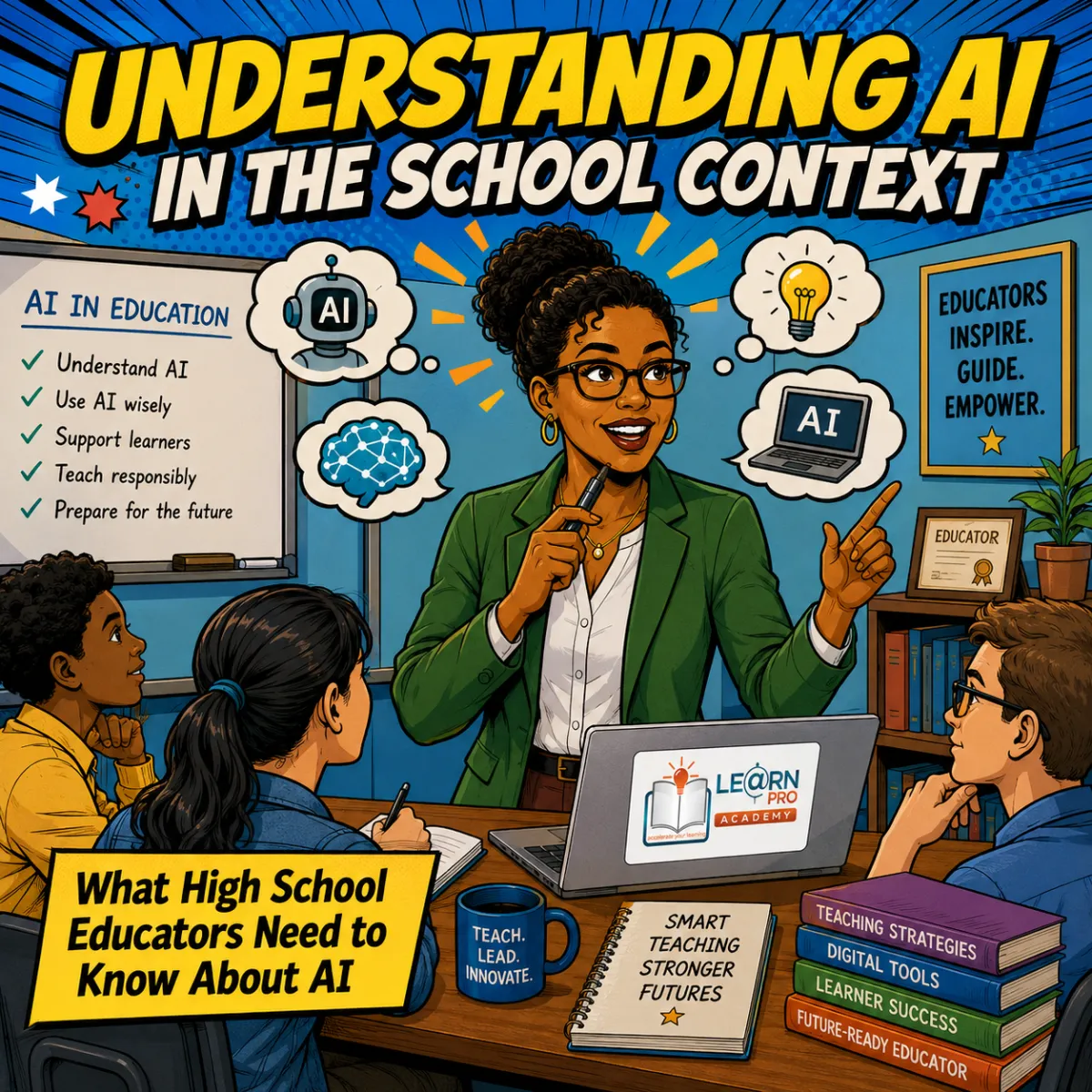
What High School Educators Need to Know About AI
This is article #1 of 5 in the Understanding AI in the School Context Series
Introduction
Artificial Intelligence (AI) is becoming one of the biggest changes to education since the internet entered classrooms. Learners are already using AI tools to explain concepts, summarise notes, generate ideas, practise questions, and even complete assignments. While many teachers have heard about AI, it can still feel confusing, overwhelming, or even intimidating.
Some educators wonder whether AI will replace teachers. Others worry about increased cheating or feel unsure about whether they should even allow AI in their classrooms. Many simply don't know where to begin.
The good news is that educators do not need to become computer programmers or technology experts to benefit from AI. Like calculators, search engines, and interactive whiteboards before it, AI is simply another tool. Understanding how it works—and how it should and should not be used—will help teachers make informed decisions that support learning rather than fear change.
This article introduces AI in simple, practical language. It explains what AI is, how it works, where educators are likely to encounter it, and why understanding AI is becoming an important part of modern teaching in South African high schools.
What Is Artificial Intelligence?
Artificial Intelligence refers to computer systems that perform tasks normally requiring human intelligence.
Instead of simply following one fixed instruction, AI can analyse information, recognise patterns, generate responses, solve problems, and even learn from enormous amounts of data.
Although AI may seem new, many people already use it every day without realising it.
Examples include:
Google Search suggestions
Email spam filters
Voice assistants
Online translation tools
Navigation apps
Recommendation systems on YouTube and Netflix
Grammar checking software
Modern educational platforms
Generative AI, which has become widely available in recent years, takes this a step further by creating new content such as:
Written text
Lesson ideas
Quiz questions
Images
Presentations
Computer code
Summaries
Explanations
This is the type of AI that has attracted significant attention in education.
AI Is Not Magic
One of the biggest misconceptions about AI is that it "knows everything."
It does not.
AI predicts likely answers based on patterns it has learned from enormous collections of information.
Think of AI as an extremely fast assistant that has read millions of documents but does not actually understand information in the same way a human does.
Because of this:
AI can produce excellent answers.
AI can also produce incorrect answers.
AI sometimes invents facts.
AI sometimes misunderstands questions.
AI may present inaccurate information confidently.
Educators should therefore treat AI as a helpful assistant—not as an unquestionable expert.
How AI Learns
Unlike traditional software that follows fixed instructions, AI learns patterns from data.
For example, if an AI system analyses millions of examples of English writing, it begins recognising:
Grammar
Vocabulary
Sentence structure
Writing styles
Common questions
Typical responses
It does not memorise every sentence.
Instead, it identifies relationships between words and ideas, allowing it to generate new responses when users ask questions.
This explains why AI can often answer questions that have never been asked before.
What Is Generative AI?
Generative AI is the type of AI that creates new content.
Instead of simply finding existing information, it generates original responses based on the user's instructions, often called prompts.
Teachers might ask AI to:
Explain photosynthesis for Grade 10 learners.
Create a revision quiz.
Rewrite difficult text in simpler English.
Generate discussion questions.
Produce marking rubrics.
Suggest classroom activities.
Draft parent communication.
Learners may ask AI to:
Explain difficult concepts.
Create flashcards.
Practise essay writing.
Generate revision questions.
Summarise textbook chapters.
Generative AI has enormous educational potential—but only when used responsibly.
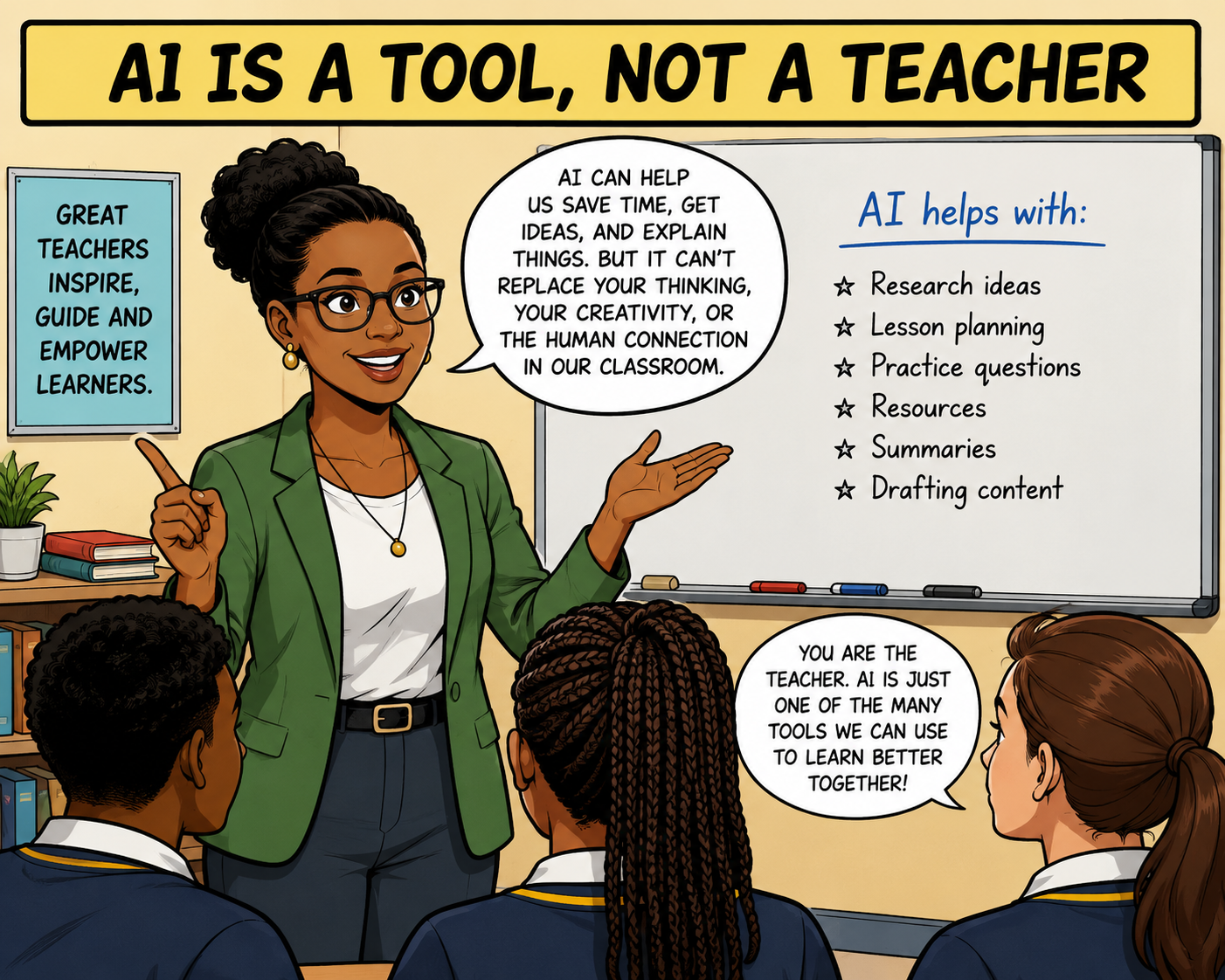
AI Is A Tool, Not A Teacher
Perhaps the most important idea educators should remember is this:
AI supports teaching. It does not replace teaching.
Teaching involves far more than providing information.
Educators:
Build relationships.
Motivate learners.
Recognise emotional needs.
Manage classrooms.
Encourage curiosity.
Adapt lessons instantly.
Inspire confidence.
Model values and behaviour.
Provide human judgement.
AI cannot genuinely care about learners.
It cannot build trust.
It cannot understand classroom dynamics.
It cannot replace the professional expertise that teachers develop over many years.
Instead, AI should be viewed as a teaching assistant that helps educators work more efficiently.
Why AI Matters For High School Educators
Many learners are already using AI—even if teachers are not.
Some use it responsibly.
Others misuse it.
If educators ignore AI completely, they may struggle to recognise:
AI-generated assignments
AI-assisted research
New forms of plagiarism
Better assessment methods
Opportunities for personalised learning
Understanding AI helps teachers guide learners rather than simply reacting to new technology.
Knowledge creates confidence.
Confidence leads to better decisions.
AI Is Already In Your Classroom
Whether educators realise it or not, AI has already entered many classrooms.
Learners may already be using AI to:
Prepare for tests
Complete homework
Research projects
Improve English writing
Translate content
Generate study notes
Create presentations
Practise mathematics
Some schools also use AI within:
Learning management systems
Online assessment tools
Attendance systems
Educational software
Adaptive learning platforms
AI is no longer something educators need to prepare for in the future.
It is already here.
Understanding Prompts
AI only performs well when users give clear instructions.
These instructions are called prompts.
For example:
Instead of asking:
"Explain chemistry."
A better prompt would be:
"Explain chemical bonding to Grade 11 learners using simple English and everyday examples."
The better the prompt, the better the response.
Prompt writing is becoming an important skill for both educators and learners.
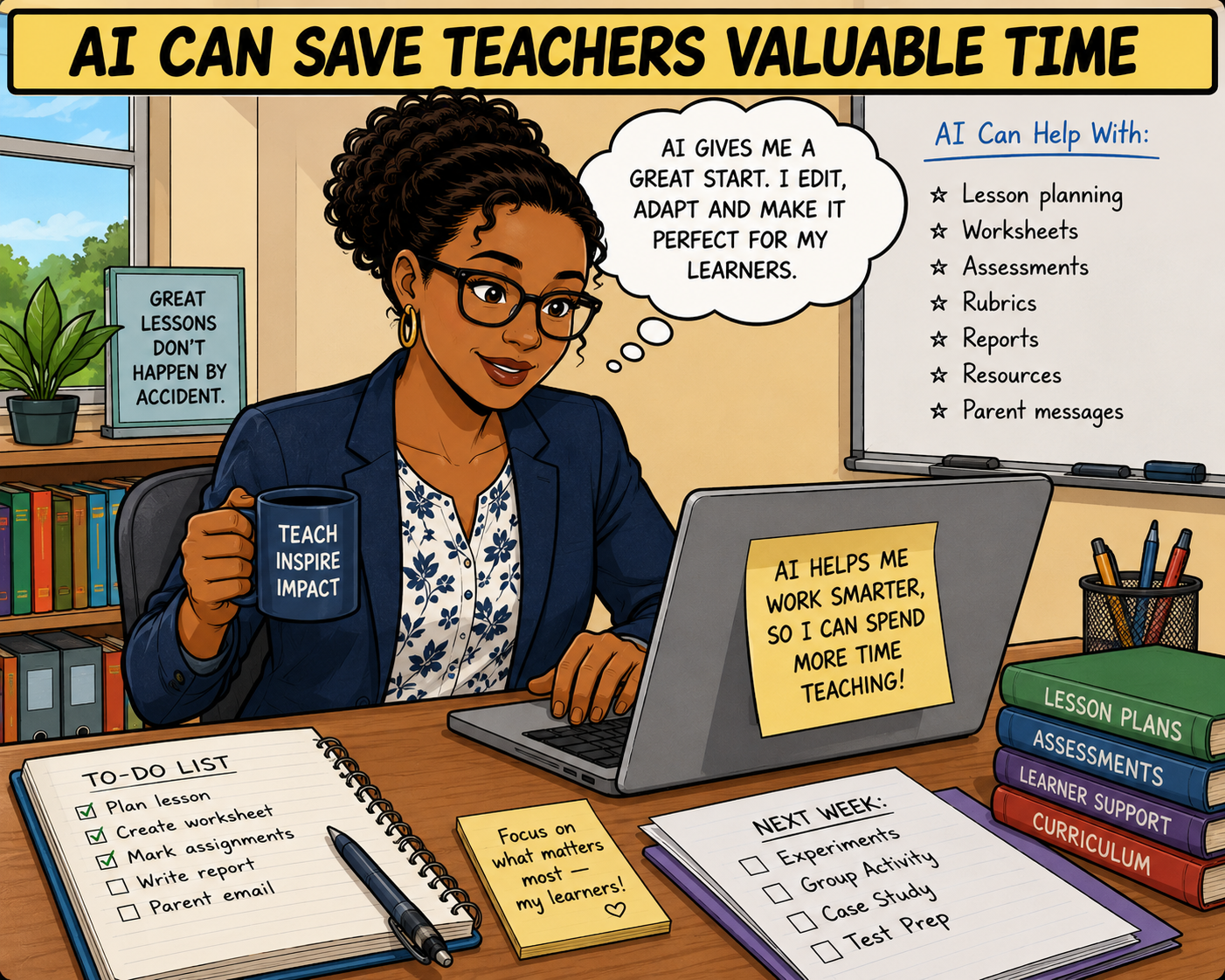
AI Can Save Teachers Valuable Time
One reason many educators are exploring AI is that teaching involves a huge amount of administrative work.
Teachers spend many hours:
Planning lessons
Writing assessments
Preparing worksheets
Creating revision activities
Drafting reports
Writing emails
Developing rubrics
Producing classroom resources
AI can help generate first drafts for many of these tasks.
Instead of starting from a blank page, teachers can begin with an AI-generated draft and then adapt it to suit their learners.
This allows educators to spend more time on teaching and learner support.
Personalised Learning Becomes More Achievable
Every classroom contains learners with different:
Abilities
Learning speeds
Language backgrounds
Interests
Confidence levels
Traditionally, creating different learning materials for every learner has required significant time.
AI can help educators create:
Simplified explanations
Extension activities
Practice questions
Vocabulary lists
Reading exercises
Revision materials
This makes differentiated instruction more practical than before.
However, teachers still decide which materials are appropriate.
AI Can Support Inclusive Education
South African classrooms often include learners with diverse educational needs.
AI may help educators support learners who:
Learn English as an additional language.
Need simplified reading materials.
Benefit from extra revision.
Require alternative explanations.
Miss school due to illness.
Need additional practice.
Although AI cannot replace specialised educational support, it can help teachers provide additional learning opportunities more efficiently.
AI Does Not Always Give Correct Answers
One of the most important lessons educators should teach learners is healthy scepticism.
AI sometimes:
Creates fictional references.
Misquotes information.
Makes mathematical mistakes.
Provides outdated information.
Misinterprets questions.
Mixes accurate and inaccurate facts.
For this reason:
Always verify important information before using it in teaching or assessment.
Critical thinking becomes even more important in the age of AI.
Ethical Use Of AI
As AI becomes more common, educators must model responsible use.
Good practice includes:
Checking AI-generated content.
Being transparent when appropriate.
Protecting learner privacy.
Respecting copyright.
Avoiding overdependence.
Encouraging independent thinking.
AI should strengthen learning—not replace it.
AI And Assessment
Assessment is one area where AI is creating significant change.
Traditional homework becomes more difficult to evaluate when learners can generate answers using AI.
This does not mean assessment becomes impossible.
Instead, educators may increasingly use:
Oral assessments
Classroom writing
Project discussions
Reflection activities
Draft submissions
Practical demonstrations
Authentic problem-solving
Assessment may become more focused on thinking processes than simply producing written answers.
AI Will Continue To Improve
Today's AI tools are only the beginning.
Future systems will likely become:
Faster
More accurate
More interactive
Better at personalising learning
More integrated into educational platforms
This means educators should develop adaptable mindsets rather than trying to master one specific AI tool.
The technology will continue changing.
The ability to learn continuously will become one of the most valuable professional skills.
The South African Context
South African schools operate under unique circumstances.
Many educators face challenges such as:
Large class sizes
Heavy administrative workloads
Limited preparation time
Unequal access to technology
Different language backgrounds
Uneven internet connectivity
Budget constraints
Because of these realities, AI should not be viewed as a complete solution.
Instead, it should be seen as one practical tool that can help reduce workload and improve access to quality educational resources where appropriate.
Some schools may adopt AI quickly.
Others may progress more gradually.
Both approaches are understandable.
The important step is developing awareness and making informed decisions rather than ignoring the technology altogether.
Practical Ways To Begin Learning About AI
Educators do not need to change everything overnight.
A sensible approach is to experiment gradually.
Consider these starting points:
Ask AI To Explain A Difficult Topic
Compare the explanation with your own teaching approach.
Generate Practice Questions
Review the questions and edit them to suit your learners.
Create Lesson Starters
Use AI to generate discussion questions or engaging introductions.
Rewrite Complex Text
Simplify reading material for learners with different language abilities.
Brainstorm Classroom Activities
Use AI to generate ideas that can be adapted to your own classroom.
Reflect On The Results
Ask yourself:
Was the output accurate?
Was it age appropriate?
Would I use it without editing?
How could it be improved?
These small experiments build confidence over time.
Developing The Right Mindset
Successful educators have always adapted to change.
They adapted to:
Computers.
The internet.
Smartphones.
Online learning.
Digital classrooms.
AI is simply the next stage.
Rather than asking:
"Will AI replace teachers?"
A better question is:
"How can I use AI responsibly to become an even better teacher?"
That shift in mindset changes the conversation completely.
Key Takeaways
As AI becomes part of everyday education, educators do not need to fear the technology—but they do need to understand it. AI is not a replacement for professional teaching, human relationships, or sound educational judgement. Instead, it is a practical tool that can support lesson preparation, differentiated instruction, assessment design, and administrative efficiency when used thoughtfully.
For South African high school educators, the goal is not to become AI experts overnight. It is to develop enough confidence to evaluate AI critically, use it responsibly, and guide learners in doing the same. Teachers who understand both the strengths and limitations of AI will be better equipped to create engaging learning experiences while maintaining academic integrity and high educational standards.
The future of education will continue to involve human educators at its centre. AI may change some of the tools we use, but it will never replace the compassion, wisdom, encouragement, and professional judgement that great teachers bring into the classroom every day. By embracing continuous learning and approaching AI with curiosity rather than fear, educators can help prepare themselves—and their learners—for a future where technology and human expertise work together.
Additional Articles in the Understanding AI in the School Context Series
What High School Educators Need to Know About AI
How AI Is Changing Teaching, Learning, and Assessment
Common Myths and Fears About AI in Education
Why AI Literacy Is Becoming Part of Good Teaching
AI in South African Education: Opportunity, Pressure, and Practical Reality
Disclaimer
AI Tools were used to assist with research. Remember to always cross-check everything that you read.