

Supporting Struggling Learners: Supporting Learners with Poor Study Skills
This is article #3 of 5 in the Supporting Struggling Learners Series
Introduction
Many learners struggle not because they cannot understand content, but because they lack effective study skills. Poor study habits can lead to low grades, frustration, and a loss of confidence. For educators, teaching content alone is not enough—students also need guidance on how to learn, organise, and remember information. This article helps teachers identify learners with weak study skills and provides practical strategies to improve their learning habits.
1. Understanding Study Skills
Study skills are strategies and techniques that help learners acquire knowledge, retain information, and apply what they have learned. They include:
Time management – planning when and how to study effectively.
Note-taking – recording important points clearly for review.
Revision strategies – summarising, questioning, and practising content.
Exam preparation – organising study sessions, using past papers.
Reading and comprehension – understanding texts efficiently.
Learners who struggle often need support in one or more of these areas.
2. Signs of Poor Study Skills
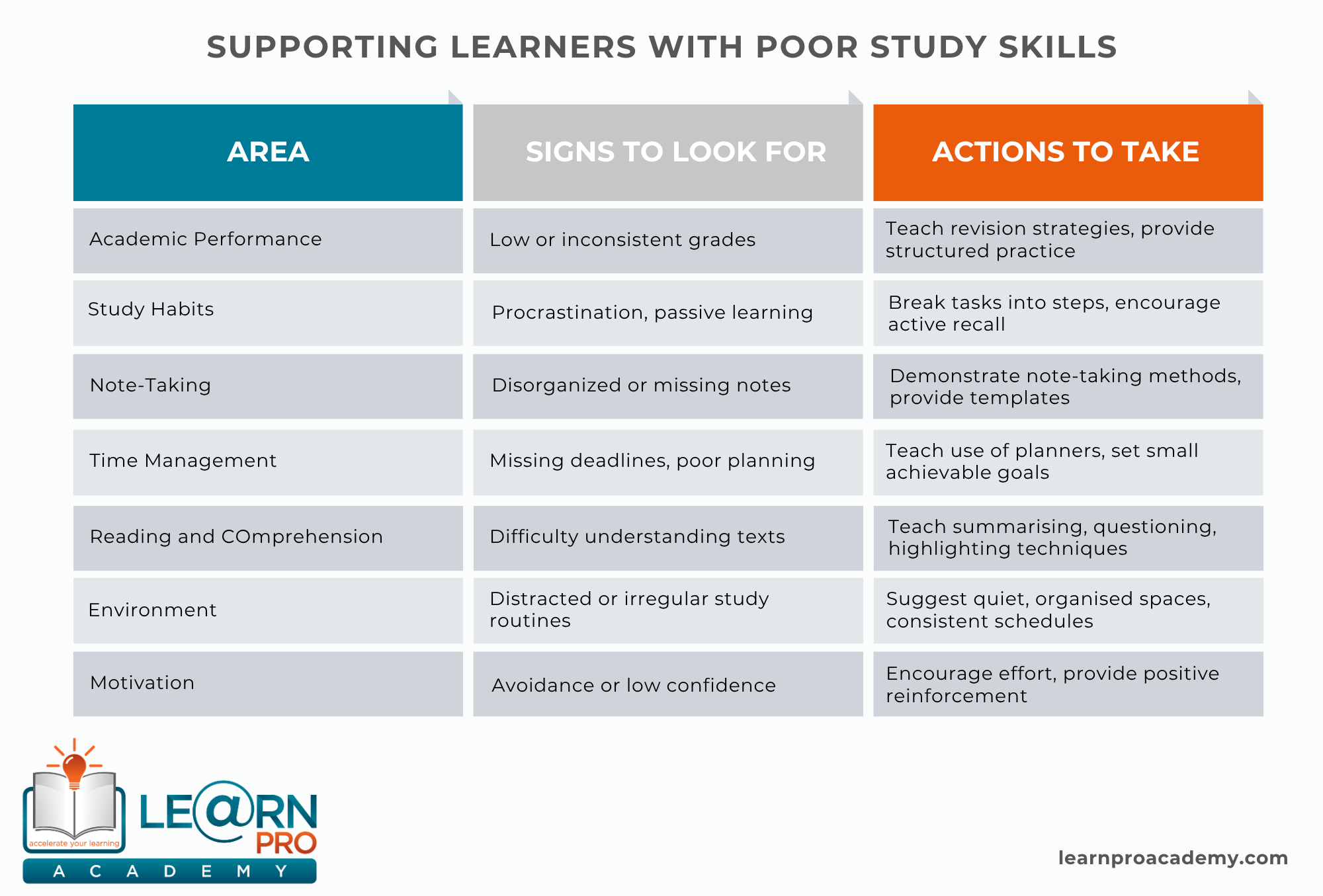
Educators can spot learners who need help by observing the following:
a) Academic Performance
Inconsistent or low grades despite effort.
Difficulty recalling learned information in tests.
Incomplete or disorganised assignments.
b) Study Habits
Leaving homework and revision to the last minute.
Using passive reading instead of active learning.
Relying on memorisation without understanding.
c) Behavioural Clues
Frustration when studying independently.
Avoidance of study tasks or procrastination.
Lack of confidence in answering questions or completing work.
3. Identifying the Root Causes
Poor study skills can result from several factors:
Lack of guidance – learners may never have been taught effective methods.
Time management issues – balancing schoolwork, extracurriculars, and personal life can be challenging.
Learning style mismatch – some learners need visual or hands-on methods rather than only verbal explanations.
Confidence issues – struggling learners may avoid trying because they fear failure.
Understanding these causes helps educators provide targeted support.
4. Teaching Effective Study Skills
Here are key strategies for helping learners improve:
a) Time Management
Encourage learners to use planners or calendars.
Break study time into focused sessions (e.g., 25–30 minutes).
Set specific goals for each session.
b) Note-Taking Techniques
Teach learners to summarise main points in their own words.
Use diagrams, charts, or mind maps for visual learners.
Review notes regularly rather than just before exams.
c) Revision Strategies
Encourage active recall (testing themselves) instead of passive reading.
Use spaced repetition – revisiting topics over time.
Practise with past papers and sample questions.
d) Reading and Comprehension
Highlight key ideas and make margin notes.
Teach learners to summarise each paragraph or section.
Ask questions while reading to improve understanding.
e) Study Environment
Suggest a quiet, well-lit, and organised space for learning.
Minimise distractions such as phones or social media.
Encourage consistent routines to build study habits.
5. Supporting Learners in Class
Teachers can reinforce study skills during lessons:
Model note-taking and summarising during class.
Assign small tasks that encourage independent study.
Check-in with learners about their revision progress.
Provide feedback on study techniques as well as content knowledge.
Encourage peer study groups to share methods and learn collaboratively.
6. Collaborating with Parents and Guardians
Support at home is essential for building strong study habits:
Share study strategies with parents.
Encourage parents to monitor study schedules and routines.
Provide resources, such as guides or checklists, to help learners at home.
Communicate progress regularly to ensure consistency between school and home.
7. Checklist: Supporting Learners with Poor Study Skills
Conclusion
Learners with poor study skills can succeed with the right guidance. By teaching effective strategies, providing ongoing support, and collaborating with parents, educators can help students improve their learning habits, gain confidence, and achieve better academic outcomes. Strong study skills are not just for school—they are life skills that last a lifetime.
Related Articles in the Study Skills & Academic Success Series
Identifying Learners Who Need Extra Support
Helping Learners Who Lack Motivation
Learners with Poor Study Skills
Teaching Learners How to Study Independently
Behaviour Without Constant Discipline
Disclaimer
AI Tools were used to assist with research. Remember to always cross-check everything that you read.