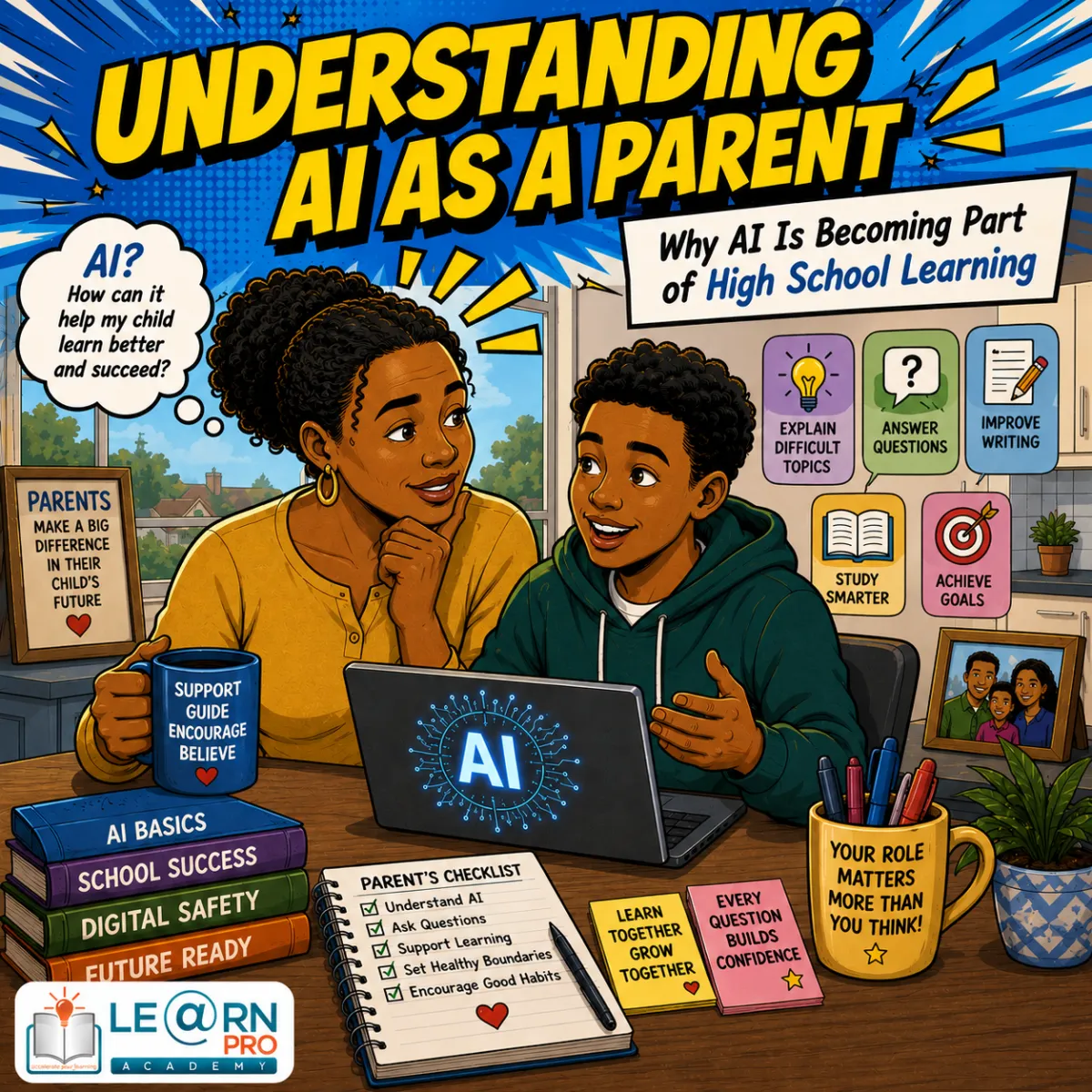
Why AI Is Becoming Part of High School Learning
This is article #2 of 5 in the Understanding AI as a Parent Series
Introduction
Artificial intelligence (AI) is becoming a normal part of everyday life. It helps people find information online, provides recommendations on streaming services, assists businesses, and supports professionals in many different industries. It is therefore no surprise that AI is also finding its way into education.
Many parents are surprised when they discover that their high school child is using AI to explain Mathematics problems, summarise History notes, improve English writing, or prepare for exams. Some parents immediately worry that learners are taking shortcuts or relying too heavily on technology. Others simply wonder why AI is appearing in education at all.
The reality is that AI is becoming part of learning because education is changing alongside the world. Just as calculators, computers, and the internet eventually became accepted classroom tools, AI is becoming another resource that can support learning when used responsibly.
This does not mean that teachers are becoming less important or that learners no longer need to study. Instead, AI has the potential to make learning more personalised, accessible, and efficient while still requiring learners to think, practise, and develop their own understanding.
This article explains why AI is becoming part of high school learning, how learners are using it, what benefits it can offer, what risks parents should understand, and how families can support responsible AI use at home.
Education Has Always Changed With Technology
Schools today look very different from schools 30 or 40 years ago.
There was a time when learners completed every assignment by hand, researched information only in libraries, and communicated with teachers almost entirely in person. Today, learners often use laptops, tablets, smartphones, online learning platforms, educational videos, and digital textbooks.
Each new technology initially caused concern.
Parents once worried about:
Calculators replacing mental maths
Computers replacing books
The internet replacing libraries
Smartphones distracting learners
Online learning reducing classroom interaction
Many of these concerns were reasonable, yet over time schools learned how to use these tools effectively.
AI represents the next stage in this ongoing development.
Rather than replacing education, it is becoming another tool that supports teaching and learning.
Why AI Is Growing So Quickly
One reason AI has become popular is that it can provide immediate assistance.
Instead of waiting until the next school day to ask a teacher, learners can receive explanations almost instantly.
For example, a learner who struggles with a Physical Sciences concept at 8 p.m. can ask AI for:
A simpler explanation
Another example
A step-by-step breakdown
Practice questions
A summary of key ideas
This instant support makes AI attractive to many learners.
However, instant answers should always lead to deeper understanding—not replace it.
AI Helps Personalise Learning
Every learner is different.
Some learners understand new ideas quickly.
Others need:
More examples
Simpler language
Slower explanations
Extra practice
Visual descriptions
Repetition
In a classroom, one teacher may be responsible for 30 to 40 learners, each with different needs. Although teachers work hard to support everyone, time is limited.
AI allows learners to ask follow-up questions until they understand.
For example, a learner might ask:
"Can you explain this using easier words?"
"Can you give another example?"
"Can you explain it like I'm in Grade 10?"
"Can you compare this to something in everyday life?"
This flexibility makes learning feel more personal.
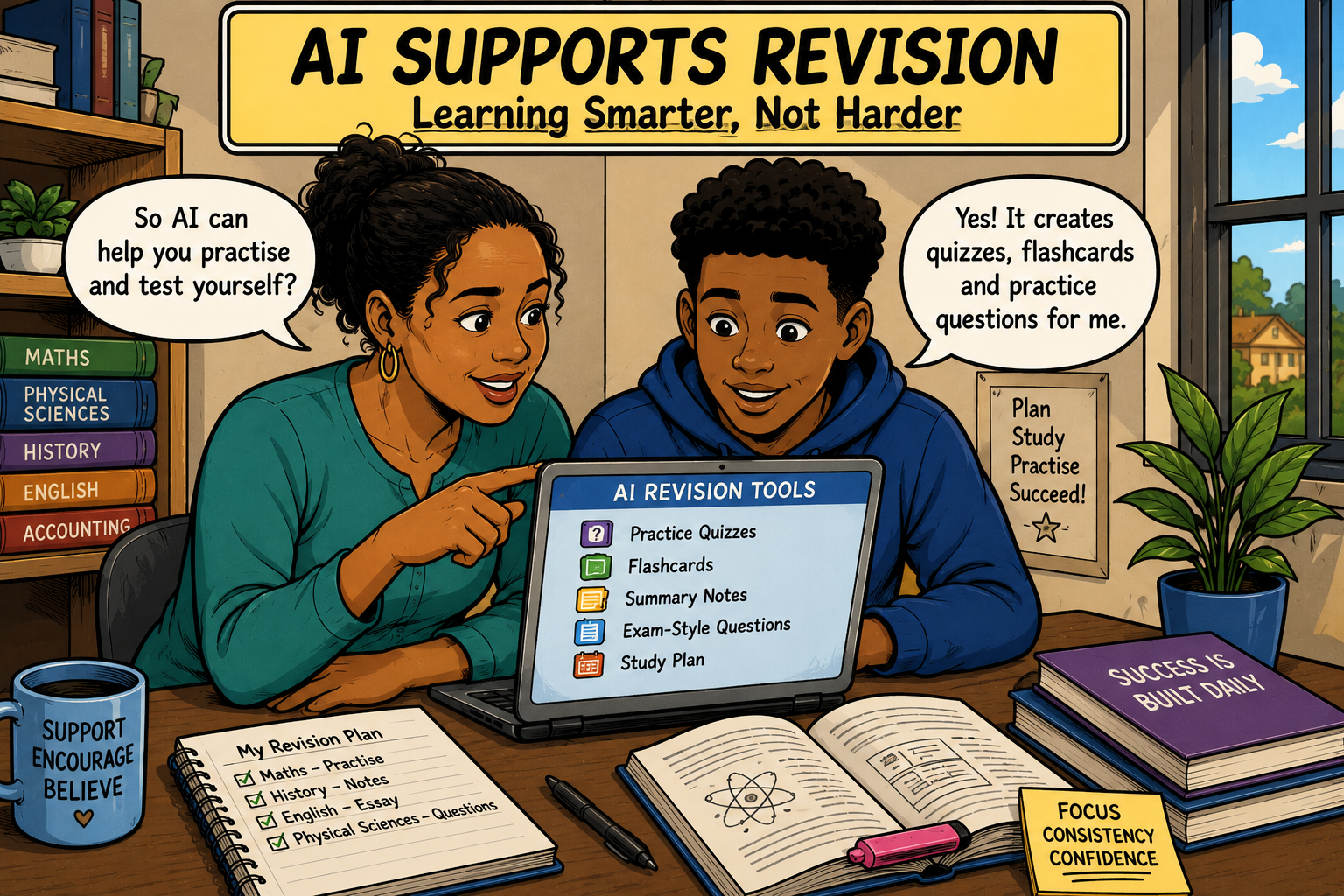
AI Supports Revision
Revision is one of the most common ways learners use AI.
Instead of reading the same notes repeatedly, learners can ask AI to create:
Practice quizzes
Flashcards
Summary notes
Multiple-choice questions
Short-answer questions
Revision checklists
These activities encourage active learning rather than passive reading.
Parents can encourage learners to use AI for revision while still studying from textbooks and class notes.
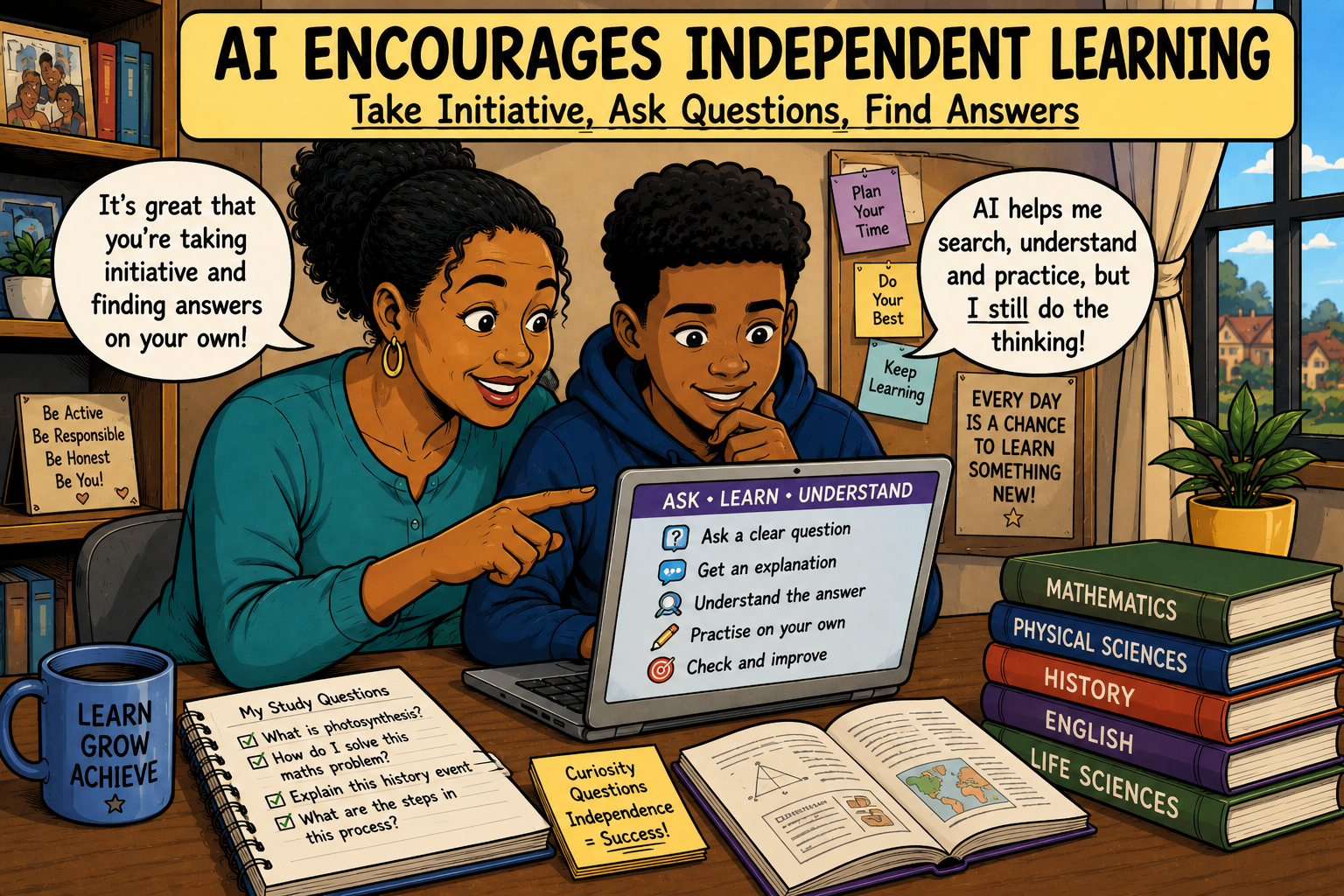
AI Encourages Independent Learning
One important goal of high school education is helping learners become independent.
Eventually, young people must learn how to:
Solve problems
Find information
Ask good questions
Organise their work
Manage their time
AI can support these skills when learners use it responsibly.
Instead of waiting for someone else to explain everything, learners can investigate topics themselves before asking teachers for additional help.
This encourages initiative and curiosity.
AI Can Make Difficult Subjects Less Intimidating
Some learners lose confidence because they struggle with particular subjects.
They may feel embarrassed to ask questions repeatedly in class.
AI provides a private environment where learners can ask:
"Can you explain this again?"
"I still don't understand."
"Can you make it easier?"
"Can you give another example?"
Many learners gain confidence through this process before discussing the topic with their teacher.
Parents should reassure children that asking questions is a strength, not a weakness.
Teachers Are Still Central To Learning
Some parents worry that AI will replace teachers.
This is highly unlikely.
Teachers do much more than provide information.
Educators:
motivate learners
manage classrooms
identify learning difficulties
encourage critical thinking
assess progress
provide emotional support
build confidence
develop social skills
guide ethical behaviour
AI cannot replace these human relationships.
Instead, many educators are learning how to use AI to improve lesson preparation, generate teaching ideas, and provide additional learner support.
Teachers remain the leaders of the learning process.
Schools Are Preparing Learners For The Future
Today's learners will enter workplaces where AI is becoming increasingly common.
Already, AI is being used in:
healthcare
engineering
accounting
banking
agriculture
marketing
journalism
law
manufacturing
customer service
Schools therefore have an important responsibility.
They are not only teaching today's curriculum.
They are also preparing learners for tomorrow's careers.
Understanding how to use AI responsibly is becoming an important digital skill.
AI Is Not A Shortcut To Success
One misunderstanding is that AI makes studying unnecessary.
This is simply not true.
AI cannot:
attend class
write examinations
understand lessons for the learner
remember information automatically
develop perseverance
replace practice
Learning still requires effort.
Think of AI as similar to a GPS.
A GPS can suggest the best route.
It cannot drive the car for you.
In the same way, AI can guide learning, but learners still have to do the work themselves.
How Learners Commonly Use AI
Parents often wonder exactly what learners are doing with AI.
Here are some common examples.
Explaining Difficult Concepts
Learners often ask AI to explain topics in Mathematics, Accounting, Physical Sciences, Geography, or Business Studies using simpler language.
Sometimes they ask for several explanations until they understand.
Improving Writing
AI can help learners:
improve grammar
strengthen sentence structure
clarify ideas
organise paragraphs
expand vocabulary
The learner should still write the assignment themselves.
Planning Assignments
Rather than writing an entire project, AI can help learners:
generate ideas
organise research
develop outlines
create timelines
plan presentations
Planning is often where many learners struggle.
Creating Study Plans
Many learners feel overwhelmed before examinations.
AI can help divide revision into manageable sections by creating realistic study timetables.
Parents can help ensure these plans remain balanced and practical.
Practising Exam Questions
AI can generate additional questions that allow learners to practise beyond their textbooks.
More practice usually builds greater confidence.
AI Also Has Limitations
Parents should understand that AI is not always correct.
Sometimes it:
misunderstands questions
provides inaccurate facts
gives incomplete explanations
uses examples that do not match the curriculum
This is why learners should compare AI responses with:
school textbooks
teacher guidance
class notes
trusted educational resources
Critical thinking remains essential.
Why Schools Are Developing AI Policies
As AI becomes more common, many schools are creating guidelines.
These policies help learners understand:
when AI may be used
when AI should not be used
how to acknowledge AI assistance
what counts as cheating
how to maintain academic honesty
Parents should familiarise themselves with their school's expectations.
If unsure, ask teachers directly.
Clear communication prevents misunderstandings.
AI In South African Education
South African schools differ greatly.
Some schools have:
computer laboratories
reliable internet
digital classrooms
learning management systems
Others work with:
limited internet access
shared devices
mobile phones
printed learning materials
This means AI adoption will vary.
Some learners may use AI regularly.
Others may only have occasional access.
Parents should not feel pressured if their family's circumstances differ.
The goal is not to have the newest technology.
The goal is to develop good learning habits using whatever resources are available.
What Parents Should Focus On
Parents often ask whether they should allow AI.
The better question is:
How should AI be used?
Healthy AI use focuses on learning rather than shortcuts.
Parents can encourage children to:
ask thoughtful questions
understand every answer
verify important information
complete their own assignments
use AI for practice rather than copying
discuss confusing topics with teachers
These habits create responsible learners.
Questions Parents Can Ask
Simple conversations often provide valuable insight into how children are using AI.
Instead of asking:
"Did AI do your homework?"
Try asking:
What did AI help you understand today?
Can you explain the topic to me in your own words?
Did you check whether the answer was correct?
What did your teacher say about using AI?
How did AI help you prepare for your test?
These questions encourage reflection rather than defensiveness.
Building Healthy Digital Habits
AI should be part of a balanced lifestyle.
Parents can encourage:
regular exercise
enough sleep
reading books
family conversations
outdoor activities
hobbies
face-to-face friendships
Technology works best when it supports a healthy, balanced life.
Working Together With Teachers
Parents and teachers share the same goal: helping learners succeed.
If parents remain curious rather than fearful, they can work together with schools to guide responsible AI use.
Teachers appreciate parents who:
encourage honesty
value effort
reinforce school expectations
support independent learning
Strong partnerships between home and school benefit every learner.
Looking Ahead
AI will continue to develop.
New tools will appear every year.
Rather than trying to learn every new application, parents should help children develop lifelong skills that remain valuable regardless of technology.
These include:
curiosity
responsibility
honesty
resilience
critical thinking
communication
problem-solving
adaptability
These qualities will remain important throughout adulthood.
Conclusion
Artificial intelligence is becoming part of high school learning because education is evolving alongside the wider world. Learners are using AI to explain difficult topics, revise for examinations, improve their writing, organise their studies, and build greater confidence in challenging subjects. When used responsibly, AI can provide valuable support that complements—not replaces—the work of teachers and the effort learners must invest in their education.
For parents, the goal is not to become AI experts. Instead, it is to understand why these tools are becoming common, recognise both their benefits and their limitations, and guide children towards responsible use. Open conversations, healthy boundaries, and encouragement to think independently remain far more important than mastering every new technology.
In South Africa, where schools and families have different levels of access to digital resources, there is no single way to use AI. What matters most is helping learners use the opportunities available to them wisely, honestly, and purposefully. By working together with teachers and maintaining a focus on genuine learning rather than shortcuts, parents can help their children develop the knowledge, skills, and character they will need to thrive in an increasingly AI-enabled world.
Additional Articles in the Understanding AI as a Parent Series
What Parents of High School Learners Need to Know About AI
Why AI Is Becoming Part of High School Learning
Common Fears Parents Have About AI — and What Is Actually True
AI in South African Education: What Parents Should Understand
Why Parents Do Not Need to Be “Tech Experts” to Support AI Learning
Disclaimer
AI Tools were used to assist with research. Remember to always cross-check everything that you read.