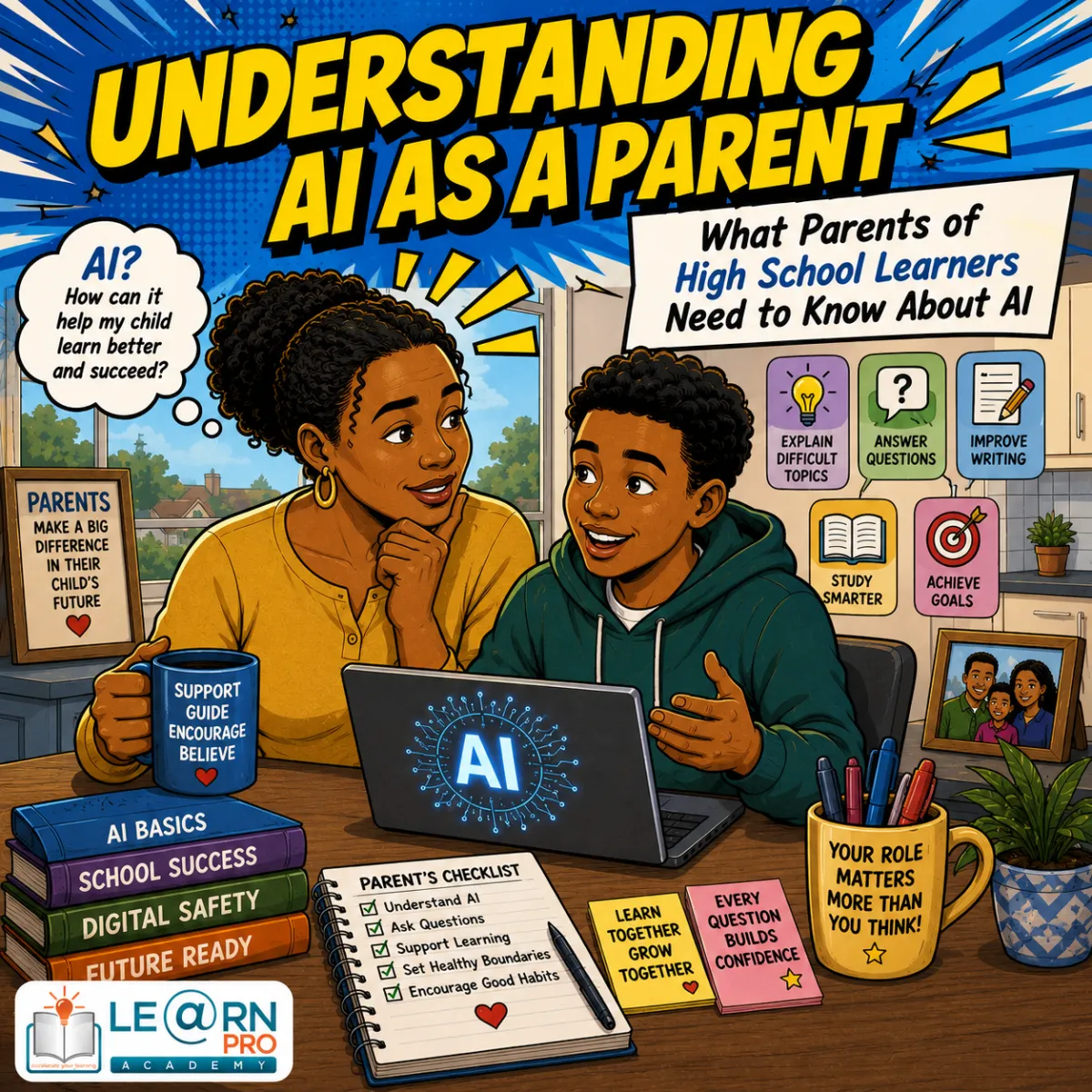
What Parents of High School Learners Need to Know About AI
This is article #1 of 5 in the Understanding AI as a Parent Series
Introduction
Artificial intelligence (AI) has become one of the most talked-about technologies in the world. It appears in news reports, social media, workplaces, and increasingly in schools. Many high school learners are already using AI to help them understand difficult subjects, prepare for tests, improve their writing, and organise their studies. As a result, many parents are hearing about AI from their children long before they have had a chance to learn about it themselves.
For some parents, this can feel overwhelming. AI may sound highly technical or even a little frightening. Some worry that it will encourage cheating, replace teachers, or make children too dependent on technology. Others simply wonder what AI actually is and whether they should allow their child to use it.
The good news is that parents do not need to become technology experts to understand AI. A basic understanding is enough to help your child use it wisely and responsibly. Just as parents learned about the internet, smartphones, and social media over time, AI is another technology that families can learn about together.
This article explains AI in simple language, shows how it is being used in education, discusses both the opportunities and the risks, and explains why parents play an important role in helping their children develop healthy AI habits.
What Is Artificial Intelligence?
Artificial intelligence refers to computer systems that are designed to perform tasks that normally require human thinking. Instead of simply following one fixed set of instructions, AI can analyse information, recognise patterns, answer questions, generate text, solve problems, and even create images.
Although this sounds very advanced, many people already use AI every day without realising it.
Examples include:
Voice assistants on smartphones.
Navigation apps that suggest faster routes.
Streaming services recommending movies.
Online shopping suggestions.
Email spam filters.
Translation tools.
AI chatbots such as ChatGPT.
Your child may already be using AI without calling it "AI."
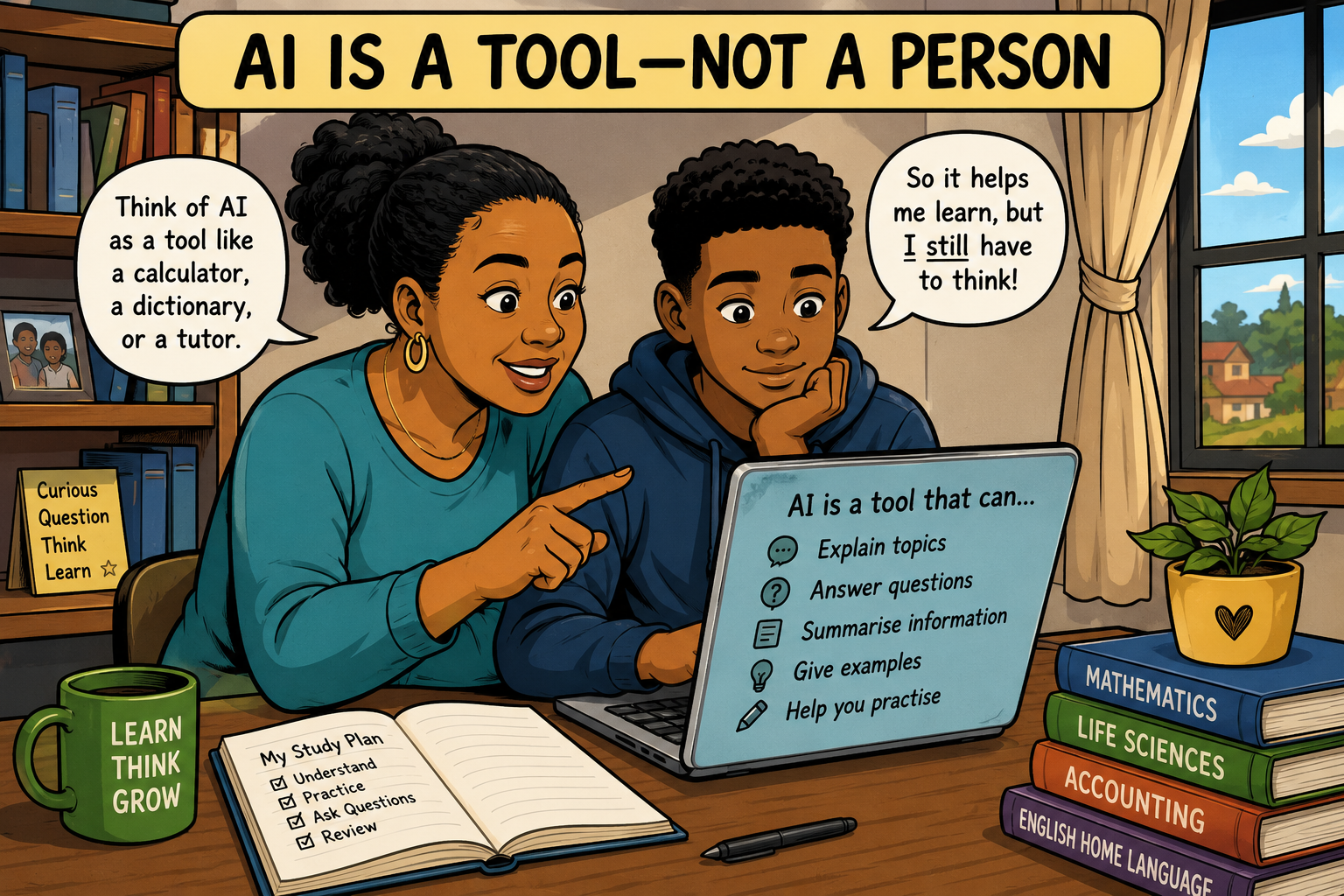
AI Is A Tool—Not A Person
One of the biggest misunderstandings about AI is that it "thinks" like a human being.
It does not.
AI has no emotions, opinions, personal experiences, or common sense. It does not understand information the way people do. Instead, it predicts useful responses based on enormous amounts of information it has been trained on.
Think of AI as something similar to:
A calculator for mathematics
A dictionary for language
An encyclopedia for information
A tutor who explains concepts
The important difference is that AI can often combine these abilities into one conversation.
However, unlike a human teacher, AI can sometimes make mistakes or give incorrect information with confidence. This is why learners must always think critically instead of accepting every answer as correct.
Why Are Schools Talking About AI?
Schools are talking about AI because it is becoming part of modern life.
Today's learners will enter universities and workplaces where AI is already being used. Many employers now expect workers to understand how to use AI responsibly alongside traditional skills.
Education is therefore beginning to adapt.
Instead of pretending AI does not exist, many schools are asking questions such as:
How should learners use AI responsibly?
When is AI helpful?
When does AI become cheating?
How can AI improve learning?
How should assessments change?
Different schools are moving at different speeds, but AI is becoming an important discussion across education.
How Learners Are Already Using AI
Many parents are surprised to discover how often learners already use AI.
Common examples include:
Explaining Difficult Topics
A learner struggling with algebra, biology, accounting, or history may ask AI to explain the topic using simpler language.
Sometimes learners ask AI to explain the same topic several different ways until it finally makes sense.
Creating Study Notes
AI can help organise long chapters into shorter summaries.
This saves time during revision, although learners should still read and understand the original material.
Practising Exam Questions
Some learners ask AI to create quizzes, practice tests, flashcards, or multiple-choice questions.
This provides additional revision opportunities beyond school textbooks.
Improving Writing
Learners may ask AI to:
improve grammar
check spelling
explain sentence structure
suggest better vocabulary
improve clarity
Used correctly, this can strengthen writing skills instead of replacing them.
Planning School Projects
AI can help learners:
brainstorm ideas
organise research
develop outlines
create timelines
generate study plans
Good planning often reduces stress before assignments are due.
AI Does Not Replace Learning
One concern many parents have is whether AI will eventually replace learning.
The answer is no.
Learning still requires learners to:
understand concepts
solve problems
think independently
practise regularly
remember information
communicate clearly
AI cannot develop these skills for someone else.
Imagine buying expensive gym equipment.
Owning the equipment does not make someone fit.
They still have to exercise.
AI works in much the same way.
It provides support, but the learner still has to do the thinking.
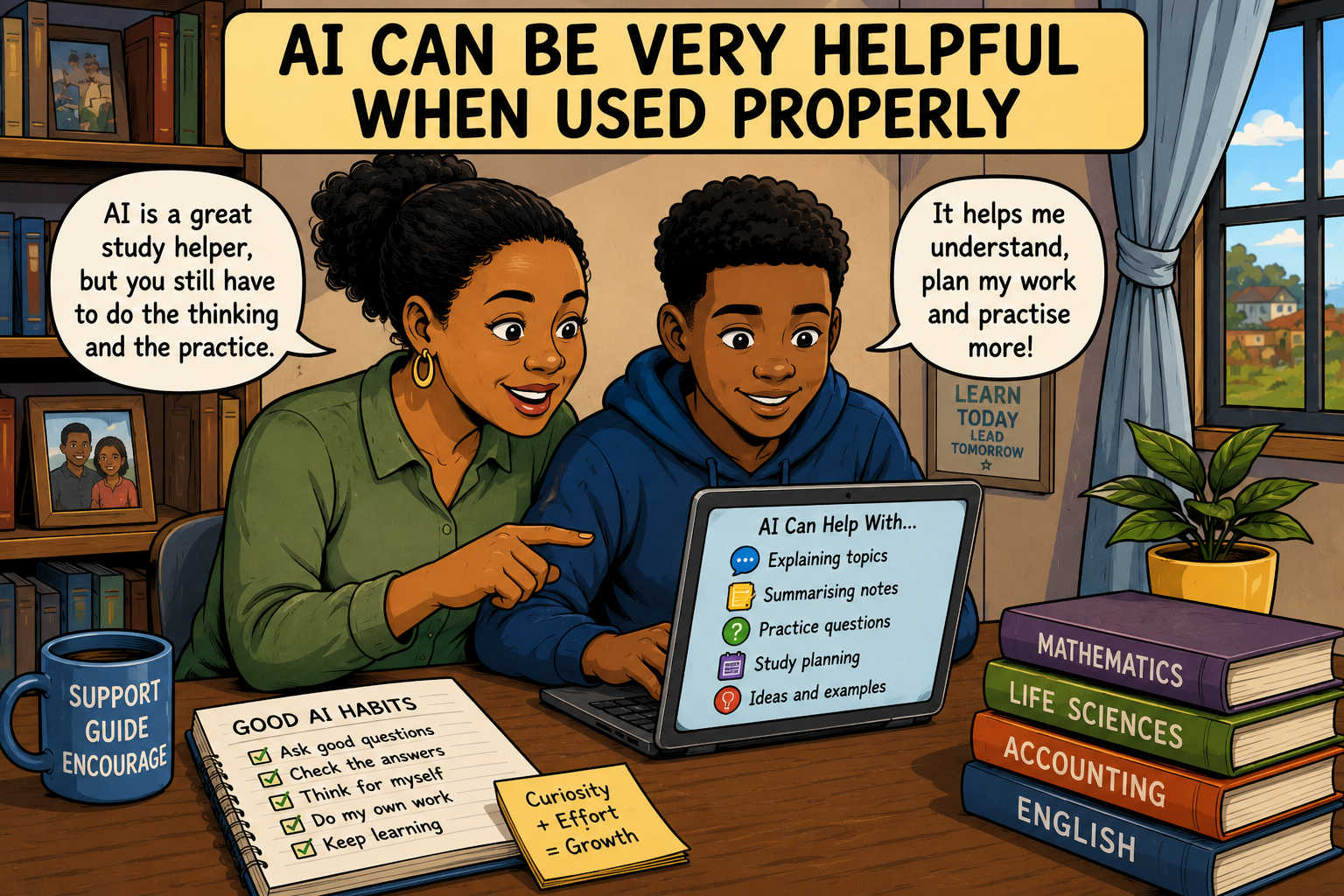
AI Can Be Very Helpful When Used Properly
When used responsibly, AI offers many benefits.
These include:
Personalised Learning
Every learner studies differently.
Some understand through examples.
Others prefer diagrams.
Some need slower explanations.
AI allows learners to ask follow-up questions until they understand.
Learning At Any Time
Teachers cannot always be available after school.
Parents may also feel unable to explain certain subjects.
AI provides additional support during evenings, weekends, and holidays.
It should never replace teachers but can provide extra help between lessons.
Building Confidence
Many learners hesitate to ask questions in class because they fear embarrassment.
AI gives them a private space to ask questions repeatedly without feeling judged.
This often helps learners become more confident before asking teachers for further guidance.
Supporting Independent Learning
One important life skill is learning how to learn.
AI can encourage learners to:
organise information
plan revision
identify weak areas
explore topics independently
These skills remain valuable throughout life.
AI Also Has Risks
Like every technology, AI has limitations.
Parents should understand these so they can guide their children wisely.
Incorrect Answers
AI sometimes provides incorrect information.
It may sound convincing while being completely wrong.
Learners should always verify important information using:
textbooks
teachers
trusted educational websites
class notes
Overdependence
If learners ask AI to do all their thinking, they stop developing their own abilities.
Learning requires effort.
Struggle is often part of understanding.
Parents should encourage children to use AI for guidance—not as a shortcut.
Cheating
AI should never complete assignments that learners are expected to do independently.
Submitting AI-generated work as their own is dishonest and may break school rules.
Responsible AI use supports learning rather than replacing it.
Too Much Screen Time
Many learners already spend large amounts of time on phones and computers.
Parents should distinguish between:
productive study time
entertainment
endless scrolling
Healthy digital habits remain important even when AI is used for learning.
AI Is Becoming A Workplace Skill
Many careers are beginning to include AI.
Examples include:
business
healthcare
engineering
law
accounting
journalism
marketing
software development
customer service
design
Future employers will likely expect workers to know how to use AI responsibly.
Learning these skills now may help today's learners become better prepared for tomorrow's jobs.
What AI Cannot Replace
Despite rapid advances, AI cannot replace many human qualities.
These include:
kindness
honesty
empathy
creativity based on lived experience
ethical judgement
teamwork
leadership
resilience
perseverance
relationships
These remain some of the most valuable skills parents help develop at home.
Technology changes quickly.
Human character remains essential.
What Parents Can Do
Parents often believe they need detailed technical knowledge before they can help.
This is not true.
Some of the most valuable support comes through everyday conversations.
Ask Questions
Instead of asking, "Did you use AI?" ask questions like:
How did AI help you understand this topic?
What did you learn from it?
Did you check whether the answer was correct?
Could you explain it to me in your own words?
These questions encourage real learning.
Encourage Thinking
If your child receives an AI answer, encourage them to ask:
Does this make sense?
Can I explain it myself?
Does it match my textbook?
Would my teacher agree?
Critical thinking remains essential.
Focus On Learning Rather Than Technology
Parents do not need to understand every AI tool.
Instead, focus on learning habits.
Encourage your child to:
stay curious
ask questions
complete their own work
practise regularly
think independently
These habits matter far more than mastering any specific app.
Keep Communication Open
Technology changes quickly.
Children often discover new tools before adults do.
Instead of reacting with fear, remain interested.
Ask your child to show you how they use AI.
Many young people enjoy teaching their parents something new.
This creates trust instead of conflict.
AI In South African Homes
South African families have different levels of access to technology.
Some learners have:
laptops
fibre internet
multiple digital devices
Others rely on:
shared smartphones
prepaid mobile data
school computer labs
public internet access
This means AI will not look the same in every household.
Parents should avoid comparing their situation with others.
Instead, focus on helping children make the best use of the resources they already have.
Responsible learning matters more than expensive technology.
Working Together With Schools
Parents and schools share the same goal:
Helping learners succeed.
As AI becomes more common, schools may introduce new policies about:
acceptable AI use
homework
assignments
exams
academic honesty
Parents can support these efforts by discussing school expectations at home.
If you are unsure about your school's AI policy, ask teachers for guidance.
Open communication between home and school helps learners receive consistent messages.
Looking Ahead
AI is still developing rapidly.
The tools available today may look very different in a few years.
Rather than trying to learn every new application, parents should focus on timeless principles:
honesty
responsibility
curiosity
critical thinking
balance
lifelong learning
These values will continue to guide children regardless of how technology changes.
Conclusion
Artificial intelligence is becoming part of education, work, and everyday life. While it may seem unfamiliar at first, parents do not need advanced technical knowledge to support their children. Understanding the basics of AI, recognising both its benefits and its limitations, and encouraging responsible use can make a significant difference to a learner's success.
AI is not a replacement for teachers, parents, or hard work. It is simply another tool that can support learning when used wisely. Just as calculators, computers, and the internet became normal parts of education over time, AI is becoming another resource that learners need to understand and use responsibly.
The most important influence in a child's education is still not a computer—it is the guidance, encouragement, values, and support they receive at home. By staying curious, asking thoughtful questions, and keeping communication open, parents can help their children develop not only digital skills but also the judgment and integrity they will need throughout their lives.
As AI continues to evolve, informed and supportive parents will be well placed to help their children embrace its opportunities while avoiding its risks. The goal is not to raise technology experts, but confident, responsible young people who know how to use powerful tools wisely in school and beyond.
Additional Articles in the Understanding AI as a Parent Series
What Parents of High School Learners Need to Know About AI
Why AI Is Becoming Part of High School Learning
Common Fears Parents Have About AI — and What Is Actually True
AI in South African Education: What Parents Should Understand
Why Parents Do Not Need to Be “Tech Experts” to Support AI Learning
Disclaimer
AI Tools were used to assist with research. Remember to always cross-check everything that you read.