
How to Create a Classroom AI Policy That Is Fair and Practical
This is article #4 of 5 in the AI, Academic Honesty, and Responsible Classroom Use Series
Introduction
Artificial intelligence (AI) is rapidly becoming part of education. Learners are using AI tools to explain difficult concepts, improve their writing, generate ideas, revise for tests, and organise their schoolwork. While these tools offer many educational benefits, they also raise important questions about honesty, assessment, and academic integrity.
Many educators feel uncertain about how to respond. Some consider banning AI completely, while others allow learners to use it without providing clear guidance. Unfortunately, neither approach works particularly well.
A complete ban is difficult to enforce and does not prepare learners for a future where AI will be common in universities and workplaces. On the other hand, having no clear rules creates confusion, inconsistency, and opportunities for misuse.
The solution is to develop a classroom AI policy that is fair, practical, and easy for learners to understand. A good policy does not simply list prohibited behaviours. It explains why responsible AI use matters, sets clear expectations, encourages honesty, and supports genuine learning.
This article explores how educators can create realistic classroom AI policies that protect academic integrity while preparing learners to use technology responsibly.
Why Every Classroom Needs Clear Expectations
Learners cannot follow expectations that have never been explained.
Many educators assume learners automatically know the difference between appropriate AI use and cheating.
In reality, many learners are unsure.
Questions they often ask include:
Can I use AI to brainstorm ideas?
Can AI check my grammar?
Can I ask AI to explain difficult concepts?
Can I use AI when researching a project?
Should I tell my teacher if I used AI?
If different teachers provide different answers, learners become confused.
A classroom AI policy removes uncertainty by explaining expectations before problems arise.
A Classroom Policy Should Support Learning
The purpose of an AI policy should not simply be catching learners doing something wrong.
Instead, it should answer one important question: How can AI help learners learn without replacing their own thinking?
When learners understand that the purpose of the policy is to support learning rather than punish mistakes, they are more likely to cooperate.
The focus should remain on education rather than enforcement.
Avoid Blanket Bans
Some schools respond to AI by saying: "AI is not allowed under any circumstances." While this may appear simple, it creates several challenges.
Firstly, AI is becoming increasingly difficult to avoid. Many search engines, office software, and educational platforms now include AI features.
Secondly, learners will probably use AI in university and future employment. Schools should prepare them for responsible use rather than pretending AI does not exist.
Finally, blanket bans may encourage secrecy instead of honesty. Learners may simply hide their AI use.
A more balanced approach is to explain when AI is appropriate and when it is not.
Start With Simple Principles
An effective classroom AI policy does not need dozens of complicated rules.
Instead, begin with a few simple principles.
For example:
AI should support learning, not replace it.
Learners remain responsible for all submitted work.
Honest disclosure is encouraged.
Independent thinking is expected.
Assessment instructions must always be followed.
These principles provide a strong foundation for more detailed guidance.
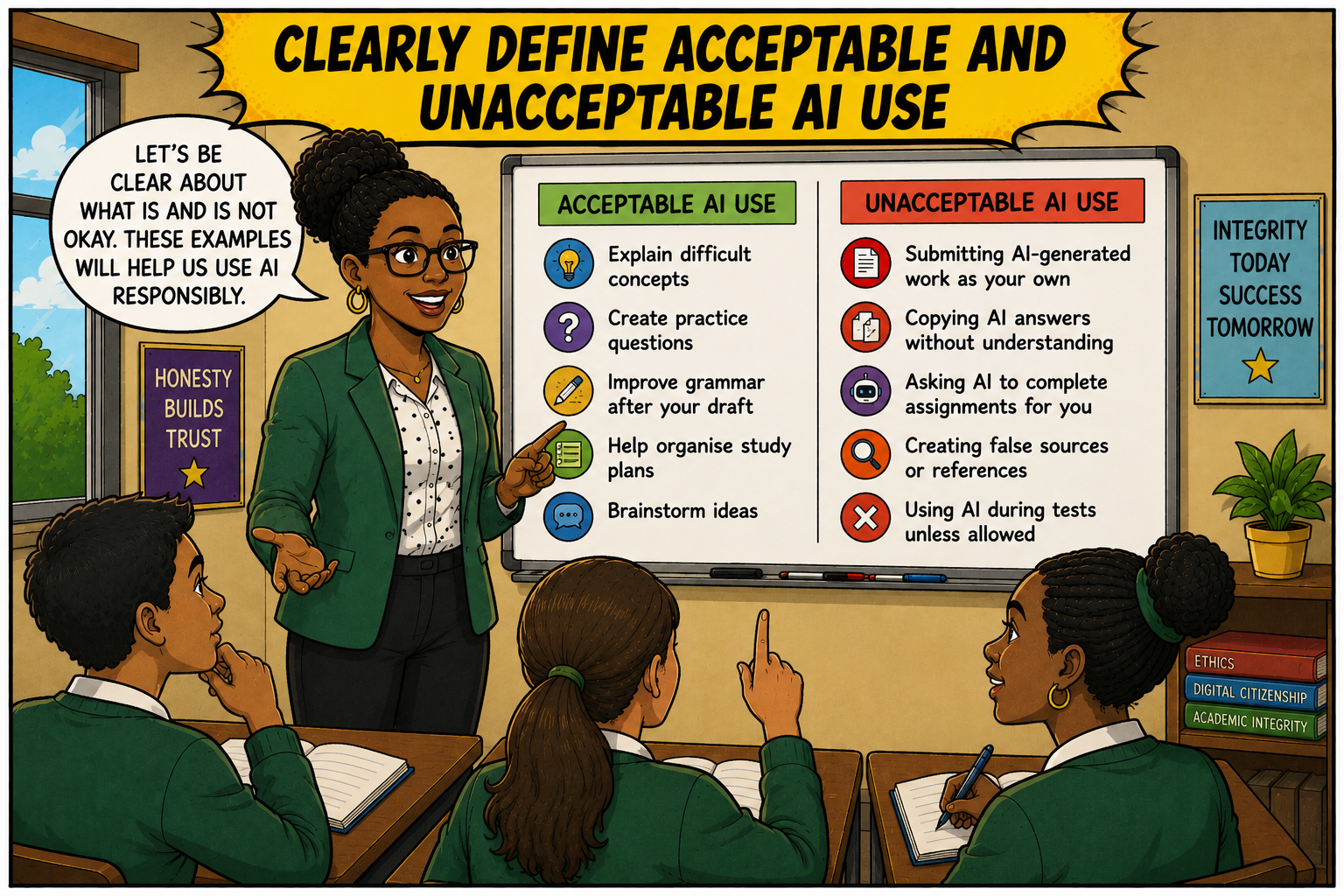
Clearly Define Acceptable And Unacceptable AI Use
Acceptable:
Learners need examples.
A policy should explain which uses of AI are generally acceptable.
Examples include:
Explaining difficult concepts.
Creating revision questions.
Summarising notes after reading.
Brainstorming ideas.
Improving grammar after writing a first draft.
Helping organise study plans.
Translating unfamiliar words while learning.
These examples show learners that AI is not automatically forbidden.
Unacceptable
The policy should also explain what learners may not do.
Examples include:
Submitting AI-generated work as their own.
Using AI during assessments where it is prohibited.
Copying AI responses without understanding them.
Asking AI to complete assignments independently.
Creating fake references or sources using AI.
Allowing AI to replace required research or problem-solving.
Providing examples removes uncertainty.
Make Expectations Specific For Different Types Of Work
Not every assessment should follow exactly the same rules. Different tasks require different expectations.
For example:
Homework: AI may be used to explain concepts and create practice questions.
Essays: AI may assist with brainstorming and grammar but may not write the final submission.
Projects: AI may help generate ideas, but learners must complete their own research and analysis.
Practical Tasks: Learners should complete demonstrations independently unless instructed otherwise.
Tests And Examinations: AI should not be used unless permission has been specifically granted.
Being task-specific reduces confusion.
Explain Why The Rules Exist
Rules without explanations often feel unfair. Help learners understand why expectations matter.
For example:
"We want to assess your own understanding."
"We want you to develop independent thinking."
"We want you to be prepared for future study and employment."
"We want AI to help your learning — not replace it."
Understanding the reasons behind the rules encourages cooperation.
Encourage Honest Disclosure
One of the most valuable parts of an AI policy is encouraging transparency. Learners should not feel that every use of AI is automatically wrong.
Instead, encourage statements such as:
"AI helped me understand this topic."
"AI suggested possible essay ideas."
"AI helped me improve grammar."
Simple disclosure builds trust.
It also helps educators distinguish between appropriate assistance and inappropriate dependence.
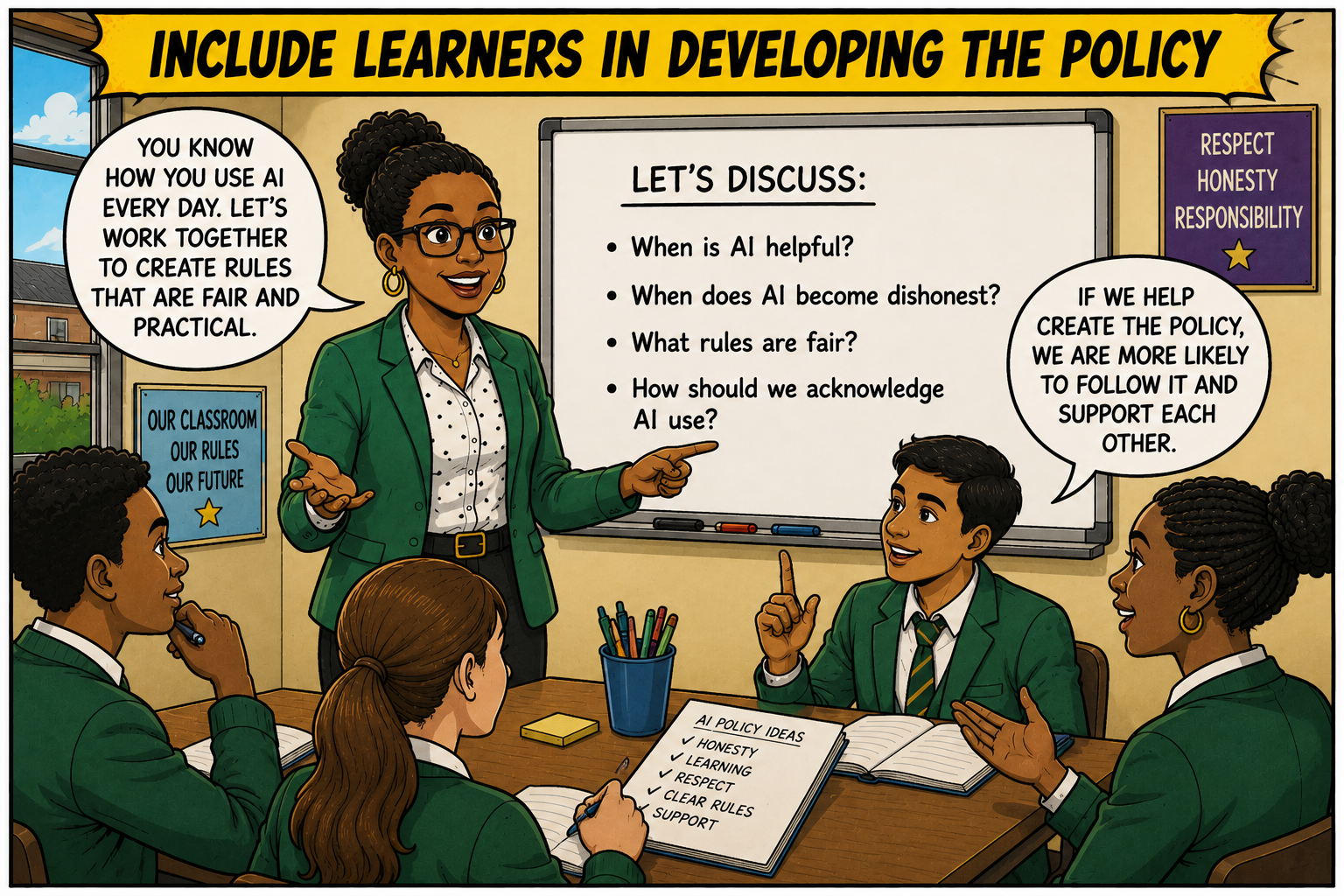
Include Learners In Developing The Policy
Policies are often more effective when learners help create them.
Consider discussing questions such as:
When is AI helpful?
When does AI become dishonest?
What expectations seem fair?
How should learners acknowledge AI use?
These conversations encourage ownership.
Learners are more likely to respect rules they helped shape.
Keep The Language Simple
An effective classroom policy should be easy to understand. Avoid legal language or lengthy technical explanations.
Instead, write clear statements such as:
Think before using AI.
Always do your own thinking.
Ask if you are unsure.
Be honest about AI assistance.
Follow assessment instructions.
Simple language improves understanding for all learners.
Create Consistent Consequences
Consequences should be fair, educational, and proportionate. Not every situation deserves the same response.
For example:
First-Time Mistake: Provide guidance, discuss expectations, and allow learning from the mistake where appropriate.
Repeated Misuse: Apply school assessment procedures and discuss academic integrity.
Serious Academic Dishonesty: Follow the school's disciplinary processes while ensuring fairness and consistency.
The goal should remain education rather than punishment whenever possible.
Encourage Questions
Learners should feel comfortable asking: "Can I use AI for this assignment?" A classroom where questions are welcomed experiences fewer misunderstandings.
Remind learners: If you are unsure, ask before submitting your work.
This simple message prevents many problems.
Review The Policy Regularly
AI technology changes quickly. A policy written today may require updating next year.
Review classroom expectations regularly.
Ask yourself:
Are these rules still practical?
Have new AI tools appeared?
Are learners still clear about expectations?
Are these rules supporting learning?
A flexible policy remains useful over time.
Work Towards School-Wide Consistency
Individual classroom policies are helpful. However, learners benefit even more when schools develop consistent expectations.
School leaders may consider creating common guidance that applies across subjects while allowing individual teachers flexibility where needed.
Consistency reduces confusion.
It also helps parents understand school expectations.
Communicate With Parents
Parents are also learning about AI. Some worry AI encourages cheating. Others believe AI should be used freely.
Sharing classroom expectations helps parents support responsible AI use at home.
Explain:
What AI may be used for.
What learners must complete independently.
Why honesty matters.
How parents can encourage responsible technology use.
Partnerships between schools and families strengthen learner success.
A South African Perspective
South African schools operate in very different environments. Some learners have personal smartphones and reliable internet. Others share devices or have limited online access.
A fair AI policy should recognise these differences. It should never assume every learner has equal access to technology.
Policies should focus on principles that apply equally:
Honesty.
Responsibility.
Independent thinking.
Respect for learning.
Academic integrity.
These values remain relevant regardless of available technology.
Example Classroom AI Policy
Educators may adapt a simple policy such as:
Our Classroom AI Expectations
AI may be used to support learning, not replace it.
Always complete your own thinking and final work.
Follow the instructions provided for every assessment.
If AI helped you, be honest about how you used it.
Verify important information before submitting your work.
Ask your teacher if you are unsure whether AI is appropriate.
Respect academic integrity at all times.
Simple expectations are often remembered more easily than lengthy documents.
Practical Classroom Strategies
Educators can reinforce the policy by:
Discussing AI expectations at the beginning of each term.
Including AI guidance on assignment instructions.
Using classroom examples of acceptable and unacceptable AI use.
Asking learners to explain how they completed major assignments.
Encouraging reflective discussions about technology.
Rewarding honesty and responsible decision-making.
Revisiting expectations before major assessments.
Regular reinforcement helps learners develop lasting habits.
Preparing Learners For Life Beyond School
Responsible AI use is becoming an essential life skill. Universities increasingly expect students to understand ethical AI use. Many workplaces already use AI to improve productivity.
Future employees will need to know:
When AI is appropriate.
How to verify AI-generated information.
How to use AI ethically.
How to maintain professional integrity.
Schools have an important role in developing these habits.
A good classroom AI policy prepares learners not only for school but for lifelong responsible technology use.
Conclusion
Creating a classroom AI policy is not about banning technology or creating unnecessary rules. It is about helping learners understand how to use AI responsibly while protecting the value of genuine learning, independent thinking, and academic integrity.
A fair and practical policy provides clear expectations, explains acceptable and unacceptable AI use, encourages honesty, and supports open communication. When learners understand both the rules and the reasons behind them, they are far more likely to make responsible choices.
As AI becomes an increasingly normal part of education and the workplace, educators have an opportunity to guide learners with confidence rather than fear. A well-designed classroom AI policy helps create a learning environment where technology supports education without replacing the curiosity, effort, and critical thinking that remain at the heart of meaningful learning.
Additional Articles in the AI, Academic Honesty, and Responsible Classroom Use Series
What Counts as Cheating When Learners Use AI?
How to Talk to Learners About Responsible AI Use
Designing Assessments That Reduce AI Cheating
How to Create a Classroom AI Policy That Is Fair and Practical
Teaching Integrity in an Age of Easy Answers
Disclaimer
AI Tools were used to assist with research. Remember to always cross-check everything that you read.