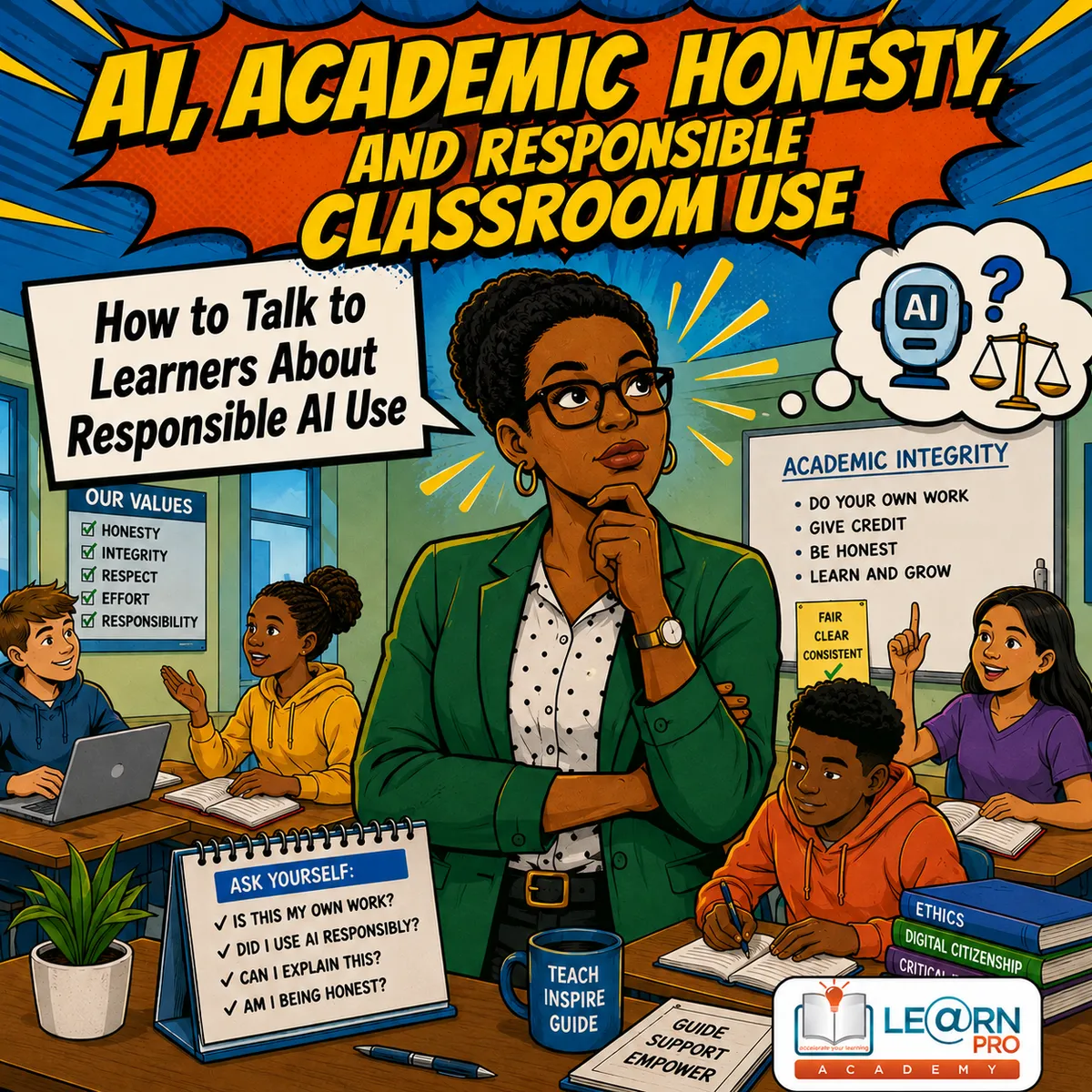
How to Talk to Learners About Responsible AI Use
This is article #2 of 5 in the AI, Academic Honesty, and Responsible Classroom Use Series
Introduction
Artificial intelligence (AI) is changing the way learners study, complete assignments, and access information. Many high school learners already use AI tools to explain difficult concepts, generate ideas, improve writing, or prepare for assessments. As these tools become more accessible, educators face an important challenge: How do we teach learners to use AI responsibly?
The answer is not to avoid the conversation.
If schools only describe AI as something dangerous or dishonest, learners may become reluctant to admit when they have used it. They may hide their AI use instead of asking questions about what is appropriate. This creates an environment where misunderstandings, dishonesty, and confusion can grow.
Instead, educators should aim to create classrooms where AI can be discussed openly and honestly. Learners need guidance, not just rules. They need to understand why academic integrity matters, how AI can support learning without replacing it, and how responsible technology use will benefit them long after they leave school.
This article explores practical ways educators can talk to learners about responsible AI use in a respectful, realistic, and educational way that builds trust while protecting genuine learning.
Why Open Conversations Matter
Technology has always changed education:
Calculators changed mathematics.
The internet changed research.
Smartphones changed access to information.
AI is simply the next step.
Many learners already know that AI exists. Some use it regularly, while others are curious but unsure how it works. If educators avoid discussing AI, learners will still use it—but without guidance.
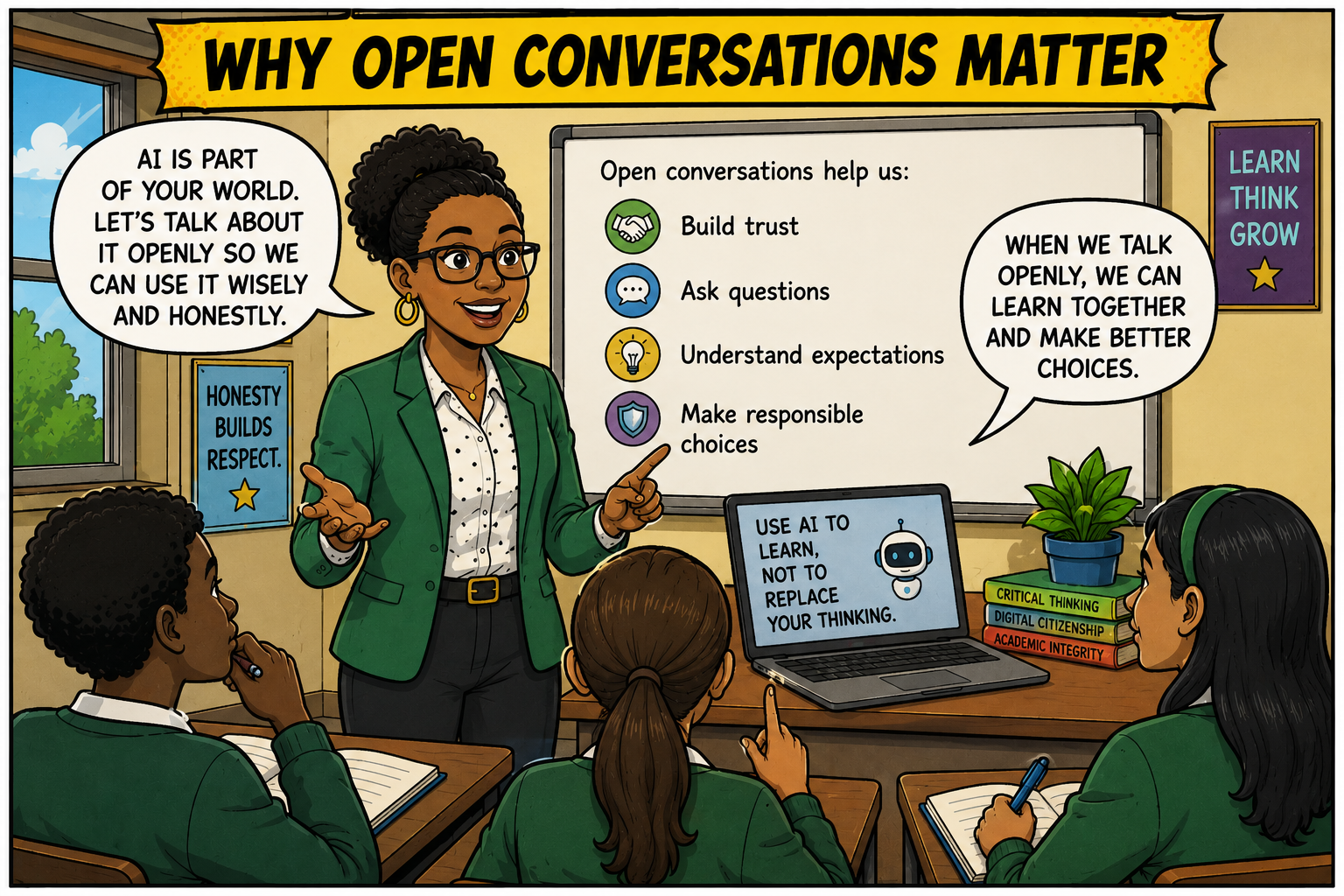
Open conversations allow educators to:
Correct misunderstandings.
Explain expectations clearly.
Build trust.
Encourage honest questions.
Promote responsible decision-making.
Reduce unnecessary fear.
Learners are more likely to act responsibly when they understand the reasons behind classroom expectations.
Avoid Treating AI As The Enemy
It is easy to focus only on the risks of AI.
News reports often highlight cheating, misinformation, or job losses. While these concerns deserve attention, presenting AI only as a threat can create unintended consequences.
If learners believe teachers only want to catch them using AI, they may:
Hide their AI use.
Feel afraid to ask questions.
Avoid honest discussions.
Miss opportunities to learn responsible habits.
Instead, educators can explain that AI is a powerful tool with both benefits and limitations.
A balanced message sounds like this: "AI can be a useful learning tool when used responsibly, but it should never replace your own thinking or effort."
This approach encourages learners to view AI as something that requires good judgement rather than something that must always be avoided.
Start With Curiosity Instead Of Accusation
Many conversations about AI begin with suspicion. Questions such as: "Did you use AI?" can immediately make learners defensive.
Instead, educators can begin with curiosity.
For example:
"Tell me how you completed this assignment."
"What resources helped you?"
"Did you use any digital tools during your research?"
"How did AI help you understand this topic?"
These questions invite honest discussion rather than confrontation.
They also help educators understand how learners are actually using AI.
Explain Why Academic Integrity Matters
Some learners think academic honesty only exists to help teachers enforce rules. In reality, integrity benefits learners themselves.
Explain that school assessments are opportunities to develop important skills.
If AI completes all the work:
Writing skills do not improve.
Problem-solving becomes weaker.
Critical thinking declines.
Confidence decreases.
Learners struggle in future assessments.
Integrity is not simply about avoiding punishment.
It is about ensuring that learning actually takes place.
Help Learners Understand The Purpose Of AI
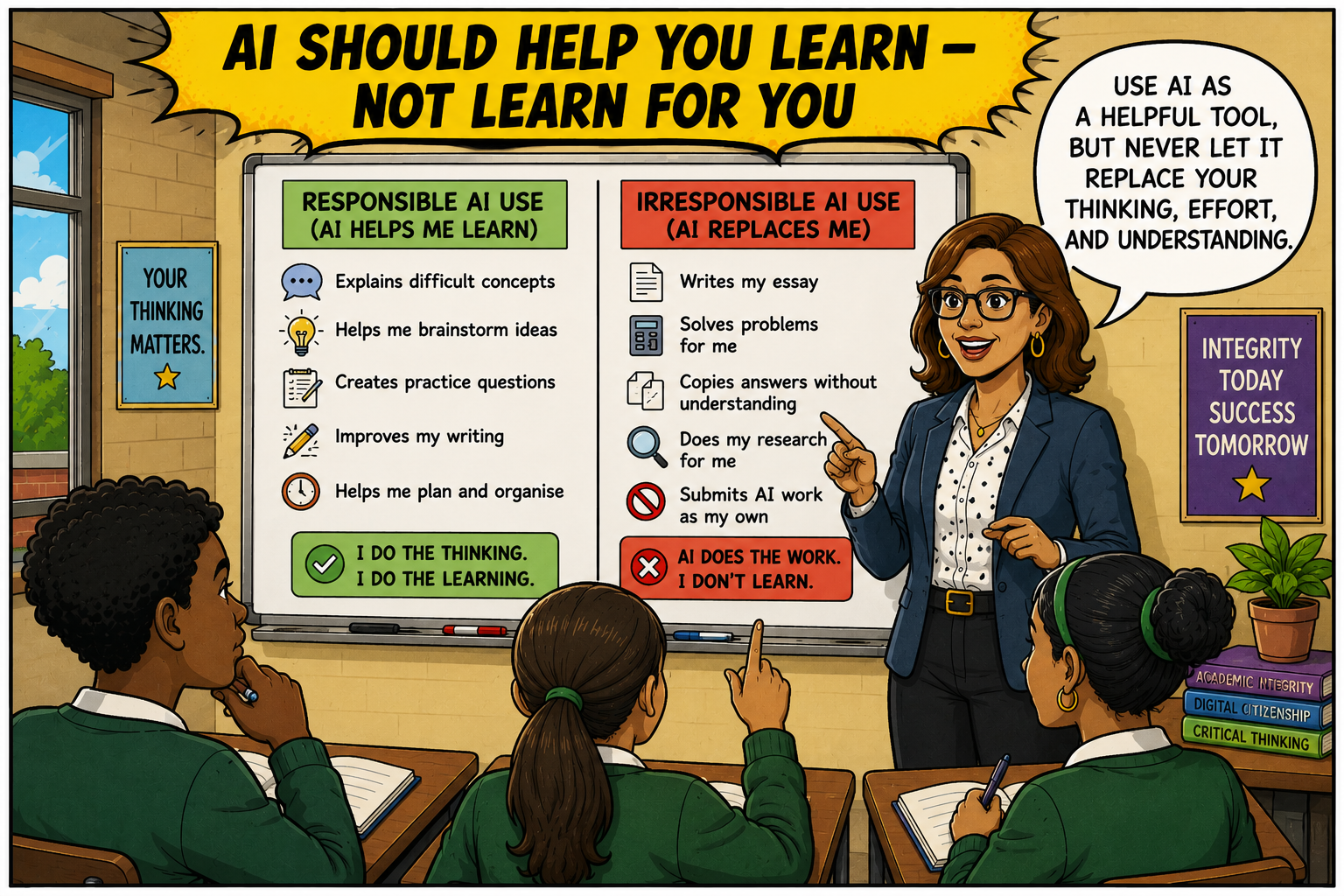
One of the most effective messages educators can share is: AI should help you learn — not learn for you.
This simple statement helps learners understand the role AI should play.
Examples of responsible use include:
Explaining difficult concepts.
Creating revision questions.
Suggesting essay ideas.
Improving grammar.
Summarising notes after reading.
Helping organise study schedules.
Examples of irresponsible use include:
Copying AI answers without understanding them.
Submitting AI-generated assignments as original work.
Using AI during assessments where it is not permitted.
Allowing AI to complete tasks the learner should perform independently.
Learners often understand these differences once they are explained clearly.
Discuss Real Classroom Examples
Abstract rules can be difficult to understand. Real examples make expectations clearer. Consider discussing situations such as:
Scenario 1
A learner asks AI to explain Newton's Laws before completing science homework independently. Is this acceptable?
Most learners will recognise that AI supported learning.
Scenario 2
A learner asks AI to write an entire history essay and submits it unchanged. Is this acceptable?
Most learners immediately recognise that this replaces their own work.
Discussing examples encourages learners to think about the reasons behind the rules.
Encourage Learners To Ask Questions
Many learners genuinely do not know what is allowed.
Create opportunities for questions such as:
Can I use AI for brainstorming?
Can AI help me improve grammar?
Can I use AI to explain mathematics?
Should I tell my teacher when I used AI?
Welcoming these questions reduces uncertainty.
When learners understand the boundaries, they are more likely to make responsible choices.
Explain That AI Can Make Mistakes
Learners often assume AI is always correct.
Educators should explain that AI can:
Provide incorrect facts.
Invent references.
Misunderstand questions.
Produce outdated information.
Present opinions as facts.
Encourage learners to verify information using reliable sources such as textbooks, academic resources, and trusted educational websites.
This develops critical thinking instead of blind trust.
Teach Learners To Think Before They Prompt
Responsible AI use begins before the learner even types a question.
Encourage learners to pause and ask themselves:
What am I trying to learn?
Could I solve part of this myself first?
Am I asking AI to explain or to replace my work?
Will I understand the answer?
Can I check whether the information is accurate?
These simple questions encourage thoughtful use instead of automatic dependence.
Promote Transparency Instead Of Secrecy
Learners should feel comfortable saying: "I used AI to help me understand this topic."
or: "I used AI to improve my grammar after writing my own draft."
Transparency builds trust.
When learners hide AI use, educators lose opportunities to teach responsible behaviour.
Some educators choose to include a simple AI declaration in assignments, allowing learners to briefly describe how AI was used.
This shifts the conversation from hiding technology to using it honestly.
Build Digital Responsibility Alongside Academic Integrity
Responsible AI use is part of a much bigger picture.
Learners should also understand:
Digital citizenship.
Online safety.
Privacy protection.
Respect for intellectual property.
Responsible sharing of information.
Critical evaluation of online content.
AI education should become part of broader digital literacy rather than existing as a separate topic.
Encourage Independent Thinking
One of the greatest risks of AI is not simply cheating. It is becoming dependent on technology for every answer.
Educators should regularly remind learners:
Your ideas matter.
Your reasoning matters.
Your creativity matters.
Your voice matters.
Even if AI produces polished writing, it cannot replace the learner's personal understanding and experiences.
Helping learners value their own thinking strengthens confidence and resilience.
Create A Safe Classroom Environment
Learners are more likely to admit mistakes when they feel respected.
Avoid creating an atmosphere where every AI discussion feels like an investigation.
Instead:
Listen before judging.
Ask questions calmly.
Explain expectations patiently.
Focus on learning rather than blame.
Treat mistakes as learning opportunities whenever appropriate.
This approach strengthens relationships between educators and learners.
Involve Learners In Developing Expectations
Rather than simply announcing classroom rules, involve learners in discussions.
Ask questions such as:
When do you think AI is helpful?
When do you think AI becomes dishonest?
What would fair classroom rules look like?
How should learners acknowledge AI assistance?
These discussions encourage ownership.
Learners are often more willing to follow expectations they helped develop.
Keep Expectations Consistent
Confusion often occurs when different teachers apply different rules. Where possible, schools should work towards consistent guidance across subjects.
Consistency helps learners understand that responsible AI use is a school-wide expectation rather than an individual teacher's preference.
Even if every subject requires slightly different rules, the underlying principles should remain similar:
Learn first.
Think independently.
Use AI honestly.
Follow assessment instructions.
Respect academic integrity.
Talking To Parents About AI
Parents are also learning about AI. Some worry that AI will encourage cheating. Others see only the benefits. Educators can help by communicating clearly with parents.
Explain:
How AI may be used appropriately.
What classroom expectations are.
Why integrity still matters.
How parents can encourage responsible AI use at home.
When schools and families share similar messages, learners receive consistent guidance.
A South African Perspective
South African classrooms are diverse. Some learners have daily access to smartphones, laptops, and high-speed internet. Others have limited connectivity or shared devices.
Educators should recognise these differences when discussing AI. Responsible AI education should never assume equal access to technology.
Instead, conversations should focus on principles that apply regardless of the tool being used:
Honesty.
Effort.
Respect.
Critical thinking.
Responsible decision-making.
These values remain relevant across all educational settings.
Practical Conversation Starters
Educators do not need formal lessons every time AI is mentioned. Short classroom discussions can be highly effective.
Examples include:
"How could AI help you learn this topic?"
"When might AI actually prevent learning?"
"How would you know if an AI answer is wrong?"
"What would responsible AI use look like in this assignment?"
"How can we use AI without becoming dependent on it?"
These conversations encourage reflection and discussion.
Practical Classroom Strategies
Educators can build responsible AI habits by:
Discussing AI expectations at the start of each term.
Including AI guidance in assignment instructions.
Demonstrating appropriate AI prompts during lessons.
Showing learners how to verify AI-generated information.
Encouraging learners to explain their thinking verbally.
Asking learners to keep drafts for major assignments.
Praising honest disclosure of AI assistance.
Regularly reinforcing that learning is the priority.
These routines gradually build a culture of responsibility.
Preparing Learners For Their Future
AI will become part of many workplaces across South Africa and around the world.
Future professionals may use AI to:
Draft reports.
Analyse information.
Generate ideas.
Improve communication.
Automate routine tasks.
However, employers will still expect people to think independently, solve problems, communicate effectively, and make ethical decisions.
Schools should prepare learners for both realities.
Learners need technical skills, but they also need judgement.
Responsible AI education helps develop both.
Conclusion
Talking to learners about responsible AI use is not about creating fear or enforcing endless rules. It is about helping young people understand how technology can support learning without replacing their own thinking, effort, and integrity.
When educators approach AI with openness, curiosity, and clear expectations, learners are more likely to ask questions, admit mistakes, and develop responsible habits. Conversations built on trust are far more effective than those based only on suspicion or punishment.
As AI continues to become part of education, work, and everyday life, schools have an important opportunity to teach learners not only how to use these tools, but also when, why, and how to use them ethically. By encouraging honesty, critical thinking, and independent learning, educators help prepare learners to become capable, responsible citizens who can use AI wisely throughout their lives.
Additional Articles in the AI, Academic Honesty, and Responsible Classroom Use Series
What Counts as Cheating When Learners Use AI?
How to Talk to Learners About Responsible AI Use
Designing Assessments That Reduce AI Cheating
How to Create a Classroom AI Policy That Is Fair and Practical
Teaching Integrity in an Age of Easy Answers
Disclaimer
AI Tools were used to assist with research. Remember to always cross-check everything that you read.